Evolution Meeting in Lisbon Raises Concern

Evolution Meeting in Lisbon Raises Concern

Dr. Guillermo Paz-y-Miño-C — © 2013

Department of Biology, University of Massachusetts Dartmouth

[click on title to be redirected to The Standard Times]

“…Lisbon taught us a lesson: its beauty and history, museums and palaces, cathedrals and monuments all honored the value of discovery, the irrefutable foundation of true civilizations.”

     There is a connection between Portugal’s cultural and historical commitment to explore the unknown and what just happened at the XIV European Society for Evolutionary Biology (ESEB) meeting held in Lisbon August 19 to 24, 2013. But a preamble here is merited before I address the conference’s substantial outcomes.

     Portugal’s and Spain’s leadership during The Age of Discovery (1500s-1600s) is undeniable. The Treaty of Tordesillas, signed in 1494, aimed at sharing between both kingdoms the geopolitical control of the world, as much as it could be explored, conquered and, inevitably by post-Crusade-invasion practices, Christianized. And so it was.

Monument to The Discoveries with Henry The Navigator leading it, Lisbon, Photo © 2013 Guillermo Paz-y-Miño-C.

     Exploration and discovery did nurture Europe’s curiosity for sighting the “planet’s final frontiers” in the 16th and 17th centuries, starting with the uncertainty of Earth’s shape and its implications for circumnavigation. But trade and profit were the vested motivators for the monarchies to “globalize” their understanding of the world which, 500 years ago, was not even conceived as a globe.

     In a classical Type One error effort —to use modern science terminology— Christopher Columbus, a Genoese explorer sponsored by Spain, failed at arriving to Asia via the Pacific, and instead bumped into unfamiliar terra firma in 1492. Columbus was conceptually wrong and died, in 1506, unaware of the mistake, but his maritime adventure brought, nonetheless, unprecedented wealth to Europe.

     The Portuguese Vasco da Gama tested with success, from 1497-1499, an alternative proposal: that India could be reached if sailing around Africa, relying, of course, on the Earth’s roundness, plus novel technology, instrumentation, and vessel design.

     In retrospect, Columbus and da Gama quests seeded today’s world interconnectedness. But it was science inspiring mere pursuit of knowledge —equivalent to research programs— which led to the prosperity later harvested. Both Columbus and da Gama thought the former arrived in the “West Indies.” Yet, it took additional expeditions (1499-1504), by cartographer Amerigo Vespucci, from Florence, to conjecture the existence of an entirely new continent in the Pacific, a major “paradigm shift” not unusual in science considering it relies on seeking the truth via skepticism.

Tomb of Vasco da Gama in the Jeronimos Monastery, Lisbon, Photo © 2013 Guillermo Paz-y-Miño-C.

     And science, materialized for its intrinsic significance, curiosity-driven and respected for advancing knowledge and debunking myth —rather than for amassing fortune when its applications expedite income for entrepreneurs— was the spirit of 1,500 international delegates gathered at ESEB 2013.  

     Lisbon was ideal for a conference about ancestry and change, legacy and improvement, the essence of evolutionary biology. At 34 symposia and 74 plenary talks, 360 speakers and authors of 900 posters discussed genetic and non-genetic (cultural) inheritance of traits, animal behavior, mechanisms of species recognition to avoid hybridization, natural and sexual selection, host-parasite interactions, human evolution, aging and senescence, emergence of drug resistance, conservation of wildlife, online resources and quantitative simulations to teach evolution, and climate-change impacts on ecological and evolutionary processes.    

     A sense of “fundamental research is what matters, not the sheer application of science for revenue” resounded during the conference. The concern that funding for basic science is scarce worldwide, the disinterest among benefactors in sponsoring “why questions” in studies, and rather favoring the “how much return will that generate for the industry, the patenting system, the biolabs, the administrative overheads,” and the uncertainty about the future of exploring ultimate queries —the reason for science’s existence— were at the heart of small talking during the conference. 

Splendid exhibit “Forms and Formulas” at Lisbon’s National Museum of Natural History and Science, Photo © 2013 Guillermo Paz-y-Miño-C. 

     But ESEB 2013 was not alone in this respect. During this summer, US researchers had specifically addressed the importance of sponsoring significant investigations. The Animal Behavior Society (ABS), for example, organized at its 50th anniversary meetings in Boulder, Colorado, July 28 to August 1st, the discussion “Time to Step Up! Defending Basic Science,” under the premise that behavioral research has been “ridiculed” and caricatured by elected officials as “wasteful government spending.” Ironically, behaviorists are the “role models” who continue to inspire worldwide interest in science, and ABS provided a list of them: Edward O. Wilson, Richard Dawkins, Judy A. Stamps, John Maynard Smith, and William D. Hamilton, among 15 others.

     Likewise, the American Society for Microbiology featured in Denver, Colorado, May 18 to 21, the President’s Forum “Curiosity-Driven Basic Research: Laying the Foundation for Discoveries and Application of the Future,” where “the critical importance of basic investigations and the need to articulate why discovery is so essential” was the consensus. And it cannot be otherwise at times when trivialization of reality, fed by entertainment, belief in the supernatural, disrespect for education, and self confidence nourished by how much is in the pocket, rather than in the schooled mind, can lead the populous to applaud emptiness.

     But Lisbon taught us a lesson: its beauty and history, museums and palaces, cathedrals and monuments all honored the value of discovery, the irrefutable foundation of true civilizations. — © 2013 by Guillermo Paz-y-Miño-C. all rights reserved.

Related Articles:
Unforgettable Galapagos, a Summit, and Why Evolution Matters

Galapagos Evolution Conference Adds to Understanding Part II

Can We Forecast the Fall of Today’s Empires?

To Deny Evolution is To Deny History

Galapagos Evolution Conference Adds to Understanding Part II

Galapagos Conference Adds to Understanding – Part II

Dr. Guillermo Paz-y-Miño-C — © 2013

Department of Biology, University of Massachusetts Dartmouth

[click on title to be redirected to The Standard Times]

“…University San Francisco of Quito and its Galapagos Institute for the Arts and Sciences excelled at managing the III World Evolution Summit with unique vision and hospitality and at highlighting the scientific relevance of the Galapagos, its role in Charles Darwin’s conceptualization of “his theory” of evolution by natural selection, and the importance of this volcanic archipelago as World Heritage… USFQ and GAIAS are exemplars of a liberal arts model in the Americas, one that merges institutional identity with cultural heritage…”

    I just represented UMassD at the World Evolution Summit, San Cristobal Island, Galapagos, Ecuador. The 200-attendee meeting took place June 1-5, 2013; it included 12 keynote addresses, 20 oral presentations by international scholars, and about 30 posters by, mostly, graduate and undergraduate students. It was the third Summit organized by University San Francisco of Quito (USFQ) and its Galapagos Institute for the Arts and Sciences (GAIAS). The Summit reverberates every four years.

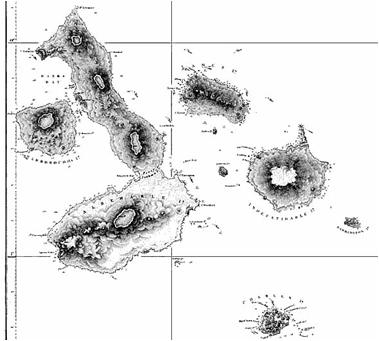
     Both USFQ and GAIAS excelled at managing the event with unique vision and hospitality and at highlighting the scientific relevance of the Galapagos, its role in Charles Darwin’s conceptualization of “his theory” of evolution by natural selection, and the importance of this volcanic archipelago as World Heritage. Darwin visited the Galapagos in 1835 during an amazing journey (1831-1836) on board of the HMS Beagle, an expedition vessel commanded by Captain Robert FitzRoy.

Above, map of the Galapagos Islands by Captain Robert FitzRoy (1836)
Above, HMS Beagle at Tierra del Fuego, painted by Conrad Martens, ship’s artist (1831-1836)

     Under the umbrella “Why Does Evolution Matter?” the Summit included five sessions: evolution and society, pre-cellular evolution and the RNA world (RNA is a precursor molecule to DNA, the carrier of genetic coding), behavior and environment, genome, and microbes and diseases. Plus an unforgettable farewell party, Galapagean style, with live music, performances, and spirits. USFQ and GAIAS are skillful at including the Galapagos community in all events, which brings pride to all parties. USFQ and GAIAS are exemplars of a liberal arts model in the Americas, one that merges institutional identity with cultural heritage.

     The Summit was publicized by the media worldwide with instant twitting, video uploading online, TV and radio reporters chasing the speakers, and press releases. The Galapagos might be distantly located 600 miles west of the coast of Ecuador, but the Summit was constantly “close by” in the news. Indeed, there is no place on Earth like the Galapagos Islands and no better destination to discuss the reality of evolution.

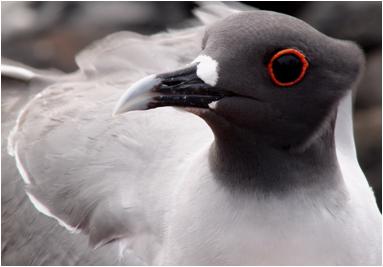
Above, magnificent Swallow-tailed Gull. “…Indeed, there is no place on Earth like the Galapagos Islands and no better destination to discuss the reality of evolution…” Photo © 2009 Guillermo Paz-y-Miño-C.

     I was invited by USFQ and GAIAS to present at the Summit my research program at UMassD. In my keynote address, I discussed “Evolution, Science, Pseudo Science and the Public’s Perception of Reality.” The topic is provocative and it did trigger sharp questions from the audience, dozens of twits, journalists impatient to get exclusive interviews, and an avalanche of sympathizers with my concerns about the low public’s acceptance of evolution worldwide. I contrasted with data the anecdotic perception, even among some of the co-keynote speakers, that opposition to evolution is a phenomenon restricted to the United States, and I framed the problem conceptually, subject to scientific inquiry and testing.

     During the past five years, my collaborator Dr. Avelina Espinosa (professor at Roger Williams University) and I have documented scientifically the patterns of acceptance of evolution in New England and the attitudes toward science by highly educated audiences [download PDF of scientific article on Acceptance of Evolution in New England]. With so many reputable universities, New England is a great “field site” for our studies. We have proposed that the controversy over evolution versus creationism (including all its modern forms: theistic evolution, creation science, young-earth creationism, Intelligent Design, BioLogos) is intrinsic to the incompatibility between scientific rationalism/empiricism and the belief in supernatural causation.

   Dr. Espinosa and I have published extensively on the topic and tested quantitatively the “incompatibility hypothesis” which helps us understand the core reason for the controversy science versus belief. This was the essence of my keynote address at the World Evolution Summit and my colleagues’ response, plus that of the audience, were amazingly encouraging. The media went beyond: “it is time, and important, to say it the way it is” stated Rodolfo Asar, host of the TV program “On Myths and Truths: Frauds in Science” when dialoguing with Dr. Espinosa and me. Rodolfo and his co-host, Maria Eulalia Silva, play a crucial role in educating the public, their program is featured primetime by Teleamazonas.

     What is the incompatibility hypothesis, how do you test it?, asked Rodolfo. I explained that acceptance of evolution and scientific rationalism is characterized by three main factors: the level of an individual’s understanding of science, her/his familiarity with the process of evolution, and her/his personal belief convictions [download PDF of scientific article about the Incompatibility Hypothesis]. In all our studies with the New England professors, educators of prospective teachers, and college students, the single negatively associated variable with acceptance of evolution is the degree of religiosity. And to test it, we have compared such trend with the views of non-believers, who do not possess the academic credentials of the New England scholars, but their levels of understanding the foundations of science and evolution are comparable to the highly educated professors. “Evolution is true regardless of our awareness of it,” I concluded.

     I must confess that the World Evolution Summit in the Galapagos shall remain as one of my most memorable experiences. — © 2013 by Guillermo Paz-y-Miño-C. all rights reserved.

Related Articles:

Unforgettable Galapagos, a Summit, and Why Evolution Matters

Darwin Day Awaits Designation by US Congress

Why the Notion that “The Theory of Evolution is Not an Explanation for the Origin of Life” is Wrong

Unforgettable Galapagos, a Summit, and Why Evolution Matters

Unforgettable Galapagos, a Summit, and Why Evolution Matters

By Guillermo Paz-y-Miño-C.

Department of Biology, University of Massachusetts Dartmouth

Evolution Literacy © 2013

     There is no place on Earth like the Galapagos Islands and no better destination to discuss the reality of evolution. Charles Darwin visited this volcanic archipelago in 1835; the rest is 180 years of science’s history after a major paradigm shift from creationism –including all its modern forms: theistic evolution, creation science, young-earth creationism, Intelligent Design, BioLogos— to evolution.

     Evolution is true regardless of our awareness of it. The evolutionary processes preceded the emergence of our ape consciousness –which is only about 150,000 years old. Evolution itself is indifferent to our level of understanding of it, although we must admit that proper education leads to accepting evolution and admiring one of the most magnificent phenomena ever discovered, that of organisms’ transformations by means of natural selection as described by Darwin in The Origin of Species (1859).

     “Why Does Evolution Matter” was the theme of the III World Evolution Summit which just adjourned in San Cristobal Island, Galapagos, after a fascinating scientific gathering (June 1-5, 2013) organized by University San Francisco of Quito (USFQ) and its Galapagos Institute for the Arts and Sciences (GAIAS), Ecuador. Twelve international keynote speakers rationalized over evolution at the microscopic and organismic levels, the applications of evolutionary principles for the conservation of endangered species and their environments and, of course, for the relevance of evolution to human health. 

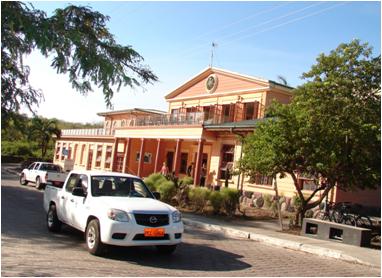
Above: Galapagos Center for the Arts and Sciences (GAIAS) of University San Francisco of Quito (USFQ), San Cristobal Island, Ecuador. Photo © 2013 Guillermo Paz-y-Miño-C.
Above: Galapagos Science Center of University San Francisco of Quito (USFQ), San Cristobal Island, in partnership with the University of North Carolina, Chapel Hill, USA. Photo © 2013 Guillermo Paz-y-Miño-C.

     USFQ and GAIAS shinned big: they led us to ‘dream’ about evolution… Yes, one can dream about reality, feel the joy of understanding the facts about life’s origins, from the tinniest molecules like RNA (an evolutionary precursor of DNA) to intriguing viruses who rely on RNA or DNA to infest each other or replicate inside cells and thus fuel unfolding biological complexity… and to the emergence of bacteria and archaea (prokaryotes, cells without a nucleus) and of nucleated unicellular organisms (eukaryotes), like amoeba, which reside freely in ponds or in the guts of reptiles and other creatures… and to the magnificent Galapagos hawks, penguins inhabiting the cold waters of this equatorial archipelago –away from their ancestral home in the South Pole— and sea lions resting on the shores occasionally awakening to hikers’ traffic. Indeed, uniquely amazing, beautiful, unforgettable.

Above: Galapagos Hawk. Photo © 2013 Guillermo Paz-y-Miño-C.
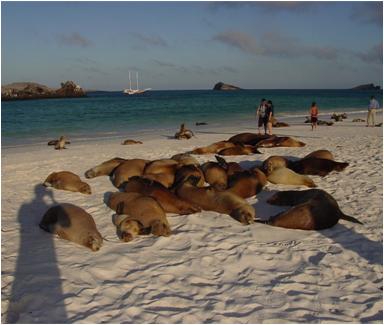
Above: Galapagos Sea Lions. Photo © 2013 Guillermo Paz-y-Miño-C.

     The keynote researchers shared their scholarly stories with two hundred attendees to the Summit. I have never seen so many high school Ecuadorian kids and college undergraduates twitting science, reporting in situ the outcomes of each talk, interviewing the speakers, making science part of their youthful experiences, unafraid of asking the simplest, yet most important question: Why is evolution the foundation of all? Well, I replied, evolution offers the only naturalistic explanation about biological phenomena; it relies on empiricism and rationalism, on facts and scientific observations of rigor. Evolution is a reality that can be tested and replicated and, if us, humans, understand and embrace it, it offers the foundation of all scientific thinking. Evolution is not only about natural history, it is about appreciating our place in the universe and securing our descendants’ future existence in healthy, evolving ecosystems.

     The Summit was also about launching the Lynn Margulis Center for Evolutionary Biology, affiliated with USFQ, in celebration of a genuine seeker of nature’s deep mysteries. Margulis (1938-2011) provoked fascinating controversies over the origin and evolution of cells, their nuclei and organelles, via symbiotic relationships among ancient life forms that apparently merged during the Earth’s early past. Lynn co-proposed the hypothesis of GAIA (no relation to GAIAS) which suggested that the complex associations of all organisms in the planet engender a homeostatic balance, a harmonic coexistence responsible for life’s perpetuity over eons. Lynn lived by this principle of fruitful association and influenced the academic careers of hundreds of naturalists; she was best friend to many, perhaps to most.

     Chemistry Nobel Laureate (2009) Ada Yonath, Israel, delivered a brilliant talk on the evolution of ribosomes, organelles responsible for the assemblage of amino acids and, therefore, of proteins, the essence of Earthy life. Her charisma on stage paralleled the profound evolutionary relevance of the research. An exuberant journey inside the intimate confinements of molecules brought us, the audience, to imagine infinitude at the micro scale, where atoms harmonize with each other, where chemical properties and magnetic interactions resemble the delicate balance invoked by GAIA at the macro scale. I felt inner ‘enlightment’ when reassured by Ada that evolution is within us, in every particle of matter that makes who we are.

     In my own talk, I addressed Evolution, Science, Pseudo Science and the Public’s Perception of Reality; in essence, my concerns about the current patterns of low acceptance of evolution worldwide and the conflict between the belief in supernatural causation and the reality of scientific rationalism/empiricism. I concluded that coexistence between faith and science is illusory due to their inherent incompatibility and that the controversy over acceptance of evolution will continue, indefinitely, via alternating mild and intense antagonism [download PDF of scientific article about the Incompatibility Hypothesis]. And while writing this piece, my research co-author and collaborator, Avelina Espinosa, alerted me about the upcoming debate The Origin and Evolution of Life: Is Galapagos a Detour? between Michael Denton, from the Center for Science and Culture (branch of the Discovery Institute –sponsor of the late doctrine of Intelligent Design) and Michael Shermer, editor of Skeptic Magazine. The duel is part of the Las Vegas gathering freedomfesta “festival –July, 2013— where free minds meet to celebrate great books, great ideas, and great thinkers...” I hope Shermer delivers the greatness of Galapagos to honor the reality of evolution and puts to rest Denton’s efforts to smuggle the fictitious into science. — © 2013 by Guillermo Paz-y-Miño-C. all rights reserved.

Above: Galapagos Tortoise. Photo © 2013 Guillermo Paz-y-Miño-C.

Related Articles:

Darwin Day Awaits Designation by US Congress

“Theory of Evolution” versus “Concept of Evolution”

Why the Notion that “The Theory of Evolution is Not an Explanation for the Origin of Life” is Wrong

To Deny Evolution is To Deny History

Darwin Day Awaits Designation by US Congress

Darwin Day Awaits Designation by US Congress

Dr. Guillermo Paz-y-Miño-C — © 2013

Department of Biology, University of Massachusetts Dartmouth

“…Darwin Day… signifies the celebration of the achievements of reason, science, and the advancement of human knowledge. The igniting moments in human history when light was brought into our own origins, when understanding that ordinary apes, like Homo, were capable of the extraordinary, of discovering the truth and debunking obscurantism; yet we still struggle to make science the sole guiding star in our survival decisions, the reliable source of concern and joy, the toolkit to plan our departure from Earth –before our Sun in agonizing heat engulfs its nearest orbiting planets– and seek home somewhere else in the cosmos.”

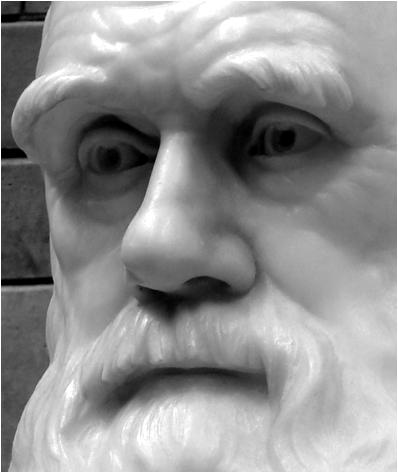
Above, close up photo of Charles Darwin statue © G. Paz-y-Miño-C. 2010, British Museum of Natural History, London

On January 22, 2013, representative Rush Holt (D) of New Jersey, and seven of his colleagues, introduced bill H.Res.41 to Congress expressing support for designation of February 12 as Darwin Day.

The Congressional Record of the US House of Representatives (p. H437), dated February 12, 2013, reports: 2 p.m. Prayer; approval of the Journal of the last day’s proceedings; Pledge of Allegiance… Darwin Day, among other items.

In one minute, Mr. Holt summarized for the House the purpose of the bill, which was later referred to the House Committee on Science, Space and Technology (more on this Committee below).

Why Darwin Day? The bill “whereases” explain:

Charles Darwin theory of evolution by the mechanism of natural selection, together with the monumental amount of scientific evidence he compiled to support it, provides humanity with a logical an intellectually compelling explanation for the diversity of life on earth.”

“The validity of Darwin’s theory of evolution by natural selection is further strongly supported by the modern understanding of the science of genetics.”

“It has been the human curiosity and ingenuity exemplified by Darwin that has promoted new scientific discoveries that have helped humanity solve many problems and improve living conditions.”

“The advancement of science must be protected from those unconcerned with the adverse impacts of global warming and climate change.”

“The teaching of creationism in some public schools compromises the scientific and academic integrity of the United States education systems.”

“Charles Darwin is a worthy symbol of scientific advancement on which to focus and around which to build a global celebration of science and humanity intended to promote a common bond among all of Earth’s peoples.”

“February 12, 2013, is the anniversary of the birth of Charles Darwin in 1809 and would be an appropriate date to designate as Darwin Day: Now, therefore, be it Resolved, that the House of Representatives (1) supports the designation of Darwin Day, and (2) recognizes Charles Darwin as a worthy symbol on which to celebrate the achievements of reason, science, and the advancement of human knowledge.”

Bill H.Res.41, itself, embodies the never-ending battle against irrationalism, the latter vividly present in the views of those who see evil in truth and menace in the realities discovered by science. Take, for example, last year’s remarks by congressman Paul Broun (R), from Georgia, a physician and member of the House of Representatives Committee on Science, Space and Technology (the very Committee to which the “Darwin Day bill” was referred), who declared: “God’s word is true. I’ve come to understand that. All that stuff I was taught about evolution and embryology and the big bang theory, all that is lies straight from the pit of Hell.”

And Mr. Broun went on, as documented in video watched worldwide: “It’s lies to try to keep me and all the folks who were taught that from understanding that they need a savior.” “You see, there are a lot of scientific data that I’ve found out as a scientist that actually show that this is really a young Earth.” “I don’t believe that the earth’s but about 9,000 years old.” “I believe it was created in six day as we know them.” “That’s what the Bible says.”

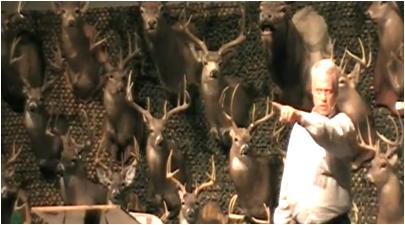
But what shocked me most about Mr. Broun’s remarks at the 2012 Sportsman’s Banquet at Liberty Baptist Church in Hartwell, Georgia, was not the interactive mood of the audience excitedly identifying with and encouraging the speech to ascend to pulpit climax, but how startled looked the dozens of antlered-and-dead deer-trophies casted on the background which, unlike “deer in the headlights” helpless to the imminent collision with the unseen, seemed almost responsive and eager to stampede.

“…All that stuff I was taught about evolution and embryology and the big bang theory, all that is lies straight from the pit of Hell…” Representative Paul Broun (R) Georgia, physician and member of the House of Representatives Committee on Science, Space and Technology.

Ironically, the quadrupeds themselves symbolize evolution by natural and sexual selection, magnificent concepts explained to the Victorian public by Darwin on The Origin of Species (1859) and the Descent of Man (1871).

Darwin reasoned about antler evolution: “With stags of many kinds the branching of the horns offers a curious case of difficulty; for certainly a single straight point would inflict a much more serious wound than several diverging points.” “The suspicion has therefore crossed my mind that they may serve partly as ornaments. That the branched antlers of stags, as well as the elegant lyrated horns of certain antelopes, with their graceful double curvature, are ornamental in our eyes, no one will dispute. If, then, the horns, like the splendid accoutrements of the knights of old, add to the noble appearance of stags and antelopes, they may have been partly modified for this purpose, though mainly for actual service in battle.”

Image above from Darwin, C. R. 1871. The descent of man, and selection in relation to sex. London: John Murray. Volume 1. 1st edition.

Indeed, Darwin Day –now awaiting action by the House Committee on Science, Space and Technology— signifies the celebration of the achievements of reason, science, and the advancement of human knowledge. The igniting moments in human history when light was brought into our own origins, when understanding that ordinary apes, like Homo, were capable of the extraordinary, of discovering the truth and debunking obscurantism; yet we still struggle to make science the sole guiding star in our survival decisions, the reliable source of concern and joy, the toolkit to plan our departure from Earth –before our Sun in agonizing heat engulfs its nearest orbiting planets– and seek home somewhere else in the cosmos. — © 2013 by Guillermo Paz-y-Miño-C. all rights reserved

Related Articles:

Rejection of science threatens to be epidemic

Massachusetts Gets an A- in Science Standards

All History is Black History – Editorial The Standard Times – March 2, 2011

“Theory of Evolution” versus “Concept of Evolution”

Interesting Site: ”Darwin’s Notebook”

“…A team of hip-hop and contemporary dancers injected life into the still artifacts at a museum… in a show called “Darwin’s Notebook” held at the University of Cambridge Museum of Zoology ” (Source Science Magazine: click on image below for details).

DarwinAsModernDarwin

Darwin’s Image Credit: Ben Swift/Nonsinthetik, from Hip-Hoppin’ Through Darwin’s Theories

Americans Want Candidates to Debate Science

Dr. Guillermo Paz-y-Miño-C — © 2012

Department of Biology, University of Massachusetts Dartmouth

“…Statistics –reliable tools in the scientific method— strongly suggest that Americans want a presidential and congressional debate on science, innovation, health, and the environment, and that such dialog should exclude the personal opinions and beliefs of the candidates. Imagine, at last, a conversation over reality, facts, evidence, and rationality. If science becomes the backbone –better the brain— of candidates, and the voters are literate enough to assess it, a single debate shall suffice to unmask it all…”

85 percent of Americans want a presidential science debate, although more registered democrats (89 percent) than republicans (83 percent) would like a match between President Barack Obama and former Massachusetts Governor Mitt Romney over science-based challenges in healthcare, climate change, energy, education, innovation and the economy. In fact, 84 percent of likely voters rank science, innovation and healthcare as the third most important topic in a debate, after the economy and taxes, and foreign policy and national security.

“…Does the public prefer presidents and congressional representatives to rationally condition their outlooks to what science says?”

These views stretch beyond the presidential elections, with 81 percent of probable voters also expecting congressional science debates. But what surprised me most about these figures, released by Science Debate Dot Org, was that 81 percent of the 1000 surveyed adults thought that public policies should be based on science, not the personal opinions or beliefs of elected officials. Really? Does the public prefer presidents and congressional representatives to rationally condition their outlooks to what science says? I love it, because the data implies that we can safely approach politicians and the public with facts, and expect broad appreciation for the truth, the backbone of science. Right?

Above: 81% of Americans want public policies to be based on science, not the personal opinions or beliefs of elected officials. Source Science Debate Dot Org 2012.

Evolution, climate change, the importance of stem cell research, the benefits of vaccines to public health, the cleanness of clean energy, the dangers of pollution, are all scientific realities –not to mention the impending collision of an asteroid with Earth. But what politicians or the citizens believe about “reality” contradicts the enthusiastic 81 percent support for an honest conversation about facts.

“…what politicians or the citizens believe about “reality” contradicts the enthusiastic 81 percent support for an honest conversation about facts…”

According to Gallup Poll, 40 percent of Americans accept evolution. Among them, 60 percent of democrats or independents versus 30 percent of republicans think evolution is true. Yet, there is no doubt among scientists that cosmic transformations and Darwinian evolution are factual. Gallup also reports that 58 percent of the general public think that climate change is occurring, versus 75 percent of democrats, 53 percent of independents, and 43 percent of republicans. But thousands of world researchers, advisors to the Intergovernmental Panel on Climate Change, have compiled chronological evidence of concerning fluctuations in climate.

Evolution aside, which formulation as a scientific reality dates back to, at least, 150 years, and to Charles Darwin’s seminal contributions (On the Origin of Species, 1859, and The Descent of Man, 1871), and whose on-and-off opponents always lose in the court of science and, frequently, in the court of law, the recent human-made corollaries of climate change are also factual despite the opinions of candidates, ideologies or congregations. But here is relevant trivia reported by Yale University and George Manson University Project/Center for Climate Change Communication: Americans trust President Obama (47 percent) more than former Governor Romney (21 percent) as “a source of information about global warming.”

“…what is expected from politicians by the public differs from what is observed in the electorate voting behavior…”

Remember that four in every five responders to the Science Debate Dot Org poll preferred science-inspired public policies rather than belief-based decisions. However what is expected from politicians by the public differs from what is observed in the electorate voting behavior. Who is telling the truth about evolution or climate change, President Obama or former Governor Romney? The answer is scientists! And that should be the point of reference for those seeking genuineness: learn what science says about reality, expect politicians to understand and match that view, and cast votes accordingly.

“… science… should be the point of reference for those seeking genuineness: learn what science says about reality, expect politicians to understand and match that view, and cast votes accordingly…”

Harris Interactive has surveyed that, despite medical researchers’ need of experimentation with stem cells to develop treatment or to prevent diabetes, Alzheimer or Parkinson disease, only 72 percent of the American public thinks such research should be allowed, in contrast to 82 percent of democrats, 73 percent of independents, and 58 percent of republicans. But misinformation about health can be even more scandalous, for example, one in every five adults believes that vaccines cause autism.

Above: Views about evolution, climate change, stem cell research, and alternative sources of energy by the American public, registered democrats, independents and republicans. Sources: Evolution: Gallup Poll 2007, Climate Change:  Gallup Poll 2012; Stem Cell Research: Harris Interactive 2010; Alternative Sources of Energy: Pew Research Center 2012.

The Pew Research Center has reported 52 percent of public support to developing alternative sources of energy –to oil, coal and gas; 65 percent of democrats, 55 percent of independents, and 36 percent of republicans agree with this view; not surprisingly 81 percent of progressives versus 52 percent of conservatives think that more federal funding should sponsor alternative energy research. And three quarters of the electorate trusts more the Environmental Protection Agency –to research, monitor, set standards and reinforce policies concerning pollution— than the US Congress.

“…Imagine, at last, a conversation over reality, facts, evidence, and rationality. …”

Statistics –reliable tools in the scientific method— strongly suggest that Americans want a presidential and congressional debate on science, innovation, health, and the environment, and that such dialog should exclude the personal opinions and beliefs of the candidates. Imagine, at last, a conversation over reality, facts, evidence, and rationality. If science becomes the backbone –better the brain— of candidates, and the voters are literate enough to assess it, a single debate shall suffice to unmask it all. — © 2012 by Guillermo Paz-y-Miño-C. all rights reserved

Related Articles:

United States ‘exceptionalism’ built on backs of the 99 percent

Can Atheists Be Our Leaders? – Editorial The Standard Times – Nov 6, 2010