Dehumanizing Academia by Dismantling the Humanities

Dr. Guillermo Paz-y-Miño-C — © 2014

New England Science Public – An Initiative for the Public Understanding of Science – on Twitter @EvoLiteracy@gpazymino

Dehumanizing Academia

[click on subtitle to be redirected to The Standard Times]

“…our history and future survival as prosperous civilizations will depend on the integration of what we discover about ourselves via science, about our bodies, brains and cultures, and on what we internalize from such discoveries via the humanities, the sentinels of knowledge in society…”

Edward O Wilson BBC2 Evolution Literacy Paz-y-Mino-C

Harvard Professor Edward O. Wilson during the interview posted online by BBC2’s Newsnight

In his latest book (2014), “The Meaning of Human Existence,” Harvard Professor Edward O. Wilson, 85, makes an unwise remark: he calls Oxford Professor Richard Dawkins, 73, an “eloquent science journalist.” If Wilson’s intention had been to plea for higher standards in contemporary media reporting, then Dawkins’ exquisite communication skills, proficiency in science, sharp intellect, and always controversial presence (in the right journalistic sense), would have made him a robust role model for investigative journalism. But Wilson aimed at demeaning Dawkins by invoking the character of a profession, one that has given coverage to Wilson’s career during half a century.

The Guardian (U.K.) titled the Wilson vs. Dawkins exchange a “biological warfare.” Perhaps by now the reader realizes how journalistically treasured are these scuffles. But The Guardian’s story itself fed on a previous BBC2’s Newsnight interview, where Wilson reiterated his judgment about Dawkins. Via Twitter, Dawkins responded by reaching out to his one million followers: “anybody who thinks I’m a journalist, who reports what other scientists think –as Wilson described Dawkins’ work— is invited to readThe Extended Phenotype.” The latter, published in 1982, is a follow up to the famous “The Selfish Gene” of 1976; both outstanding scientific contributions to theoretical biology.

Richard Dawkins Evolution Literacy Paz-y-Mino-CBefore going any further, it is indeed imprudent to use the term “science journalist” as a dishonor, to discredit a colleague, and to inattentively belittle a vital occupation.

The Wilson-Dawkins crossfire was triggered by Dawkins’ review of Wilson’s earlier book “The Social Conquest of Earth” of 2012. In it, Wilson drifted away from a well established concept in biology, called Kin Selection, which helps understand why organisms that cooperate with close relatives, more than with strangers, can improve survival and reproduction, thus leaving descendants who carry the traits that make them social and altruistic. The evolution of high sociality, cooperation, altruism and intelligence in the human animal are often explained under kin selection theory (natural selection ultimately favoring kin).

Kin selection is an experimentally documented phenomenon, supported by most evolutionary biologists, to the point that when Wilson and collaborators wrote an article for Nature, in 2010 (which became part of a contentious chapter in “The Social Conquest of Earth”), challenging the kin selection principle and suggesting that high cooperation and altruism can still evolve regardless of kinship, 137 world scientists authored and signed a debunk-letter-to-the-Wilson’s position, which Nature published the following year. [Note that in a paper published in PLoS Biology, March 23, 2015, authors Liao, Rong and Queller completely dismiss the Wilson’s team proposal of 2010; in fact, Liao et al. state that “all… apparently novel conclusions –in the Nature’s 2010 article– are essentially false”].

E O Wilson Books Evolution Literacy Paz-y-Mino-CIn the 2010 paper, Wilson and associates acknowledged that kin selection could still work, but that an alternative scenario based on a combination of individual and group selection, not necessarily closely related members, results in a mathematically sounder model than the “elderly” –ossified– kin selection. The same assertion appeared in Wilson’s “The Social Conquest of Earth,” about which Dawkins –after borrowing words attributed to American poet and satirist Dorothy Parker— declared: “this is not a book to be tossed lightly aside. It should be thrown with great force.” And sincere regret (Dawkins’ emphasis).

“…Creationists, of course, grew excited about the scientists’ disagreement. Not so fast. Evolution is true regardless of the dispute over kin selection…”

Creationists, of course, grew excited about the scientists’ disagreement. Not so fast. Evolution is true regardless of the dispute over kin selection [note that researchers are constantly reexamining hypotheses and paradigms, for example, see discussion about Standard Evolutionary Theory SET versus Extended Evolutionary Synthesis EES in Nature]. And both Wilson and Dawkins, as evolutionary biologists, are secular, openly and vigorously opposed to creationism, including Theistic Evolution, Creation Science, Intelligent Design, and Evolutionary Creation; all represent belief-based views of reality, which impose a Creator or Designer in the background of causality. Wilson and Dawkins have categorically stated that there is no scientific evidence in support of any style of creationism.

“…[the] American universities… seem committed to turning off the humanities, dismantling the social sciences, and replacing them with for-profit, translational research to generate goods for patents and commercialization…”

Unfortunately, the message Wilson sought to convey in “The Meaning of Human Existence” was eclipsed by the exchange with Dawkins; Ed threw unnecessary punches, while Richard diverted them back with customary power; a fight with no winner. And Wilson’s book is crucially important to raise awareness about the current dehumanization of academia at American universities, which seem committed to turning off the humanities (philosophy, history, archeology, anthropology, arts, law, literature and linguistics), dismantling the social sciences, and replacing them with for-profit, translational research to generate goods for patents and commercialization; a path leading to the extinction of curiosity-driven science and risk-taking ideas, which have modernized fundamental scientific work: wisdom driven.

In closing, Wilson makes an excellent connection between human evolution and the humanities. He reasons that our history and future survival as prosperous civilizations will depend on the integration of what we discover about ourselves via science, about our bodies, brains and cultures, and on what we internalize from such discoveries via the humanities, the sentinels of knowledge in society (including journalism, my emphasis). And he envisions the relevant humanities under no faith: “the best way to live in this real world is to free ourselves of demons and tribal gods.” — © 2014 by Guillermo Paz-y-Miño-C. all rights reserved.
Related Articles

Fragmentary Truths and the Intellectual Imbalance in Academia

The Incompatibility Hypothesis: Evolution vs Supernatural Causation

Bill Nye defeats Ken Ham at Creation Museum

Evolution Stands Faith Up: Reflections on Evolution’s Wars

On Francis Collins’ and Karl Giberson “The Language of Science and Faith”

Hiking among Trilobites, Ancient Whales and Dinosaurs

Dr. Guillermo Paz-y-Miño-C — © 2014

New England Science Public – An Initiative for the Public Understanding of Science – on Twitter @EvoLiteracy@gpazymino

Museums Display Truth of Evolution

[click on subtitle to be redirected to The Standard Times]

“Q?RIUS is about ‘Early Youth Engagement through Science;’ the visitor [to the museum exhibit] acts as curator, protector of Nature’s treasures. Thus Q?RIUS empowers our youth’s innate curiosity to seek and value the truth. And there is no more powerful scientific truth than evolution.” 

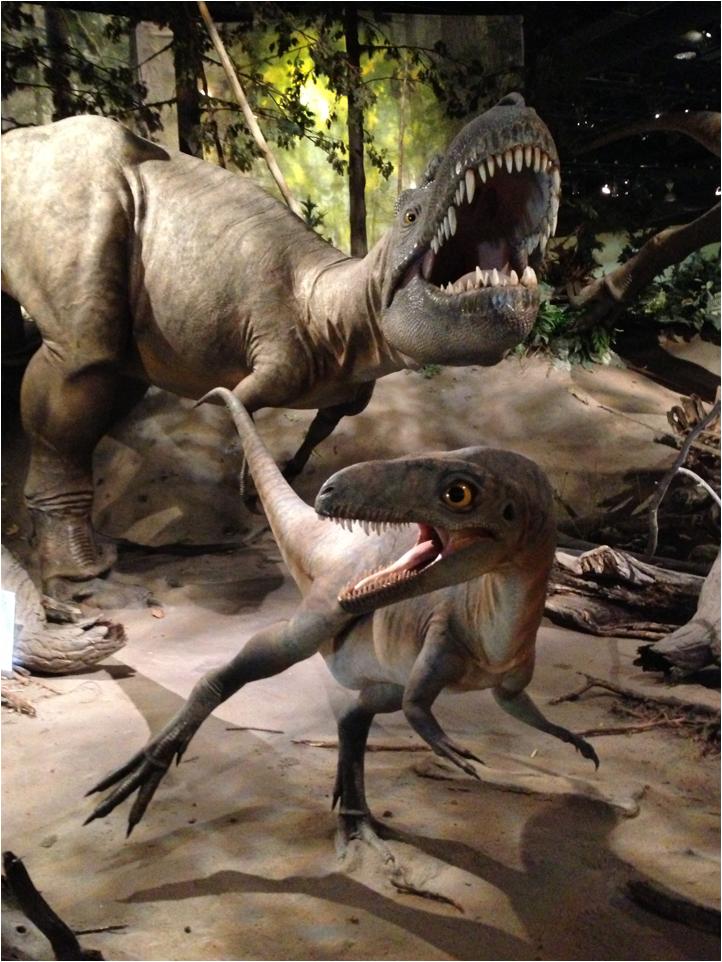
Albertosaurus Evolution Literacy G Paz-y-Mino-C photo

Albertosaurus —earlier relatives of Tyrannosaurus rex. Discovered by Joseph B. Tyrrell, in 1884, the “Alberta Lizards” were endemic to today’s Alberta region, in Canada, and ruled the top-predator occupation 70 million years ago; Royal Tyrrell Museum; GPC photo © 2014

I have previously stated that to be reassured that evolution is true one simply needs to visit the New Bedford Whaling Museum. Its displays of skeletons of a North Atlantic right whale with a calf, a humpback, a juvenile blue, and a sperm whale can impress anyone curious to compare human bones to those of cetaceans. And such comparison suffices to infer that common ancestry connects mammalian sea gallopers — whales and dolphins — to us, the upright bipedal apes who live in cities and launch vessels to explore the stars.

My addiction to the splendid North American science museums — antidotes to the impostors “Genesis Park” or “Creation Museum” — will remain pleasurably incurable. But a latest visit to the Smithsonian National Museum of Natural History, in Washington, D.C., was certainly unique. It started while hiking among 540-million-year-old trilobite fossils, at the Burgess Shale deposit in the Canadian Rockies. What used to be the bottom of the sea is, nowadays, layers of flaked rock at 6,900 feet elevation, evidence that Earth’s crust moves and shapes the imposing mountains.

In 1909, Charles D. Walcott, paleontologist and secretary of the Smithsonian Institution, discovered the first fossils of the Burgess Shale. He later brought to the National Museum of Natural History 65,000 specimens, mostly collected at Fossil Ridge, which runs from the Wapta Mountain to Mount Field, in British Columbia.

When alive during the Cambrian, the now fossilized Burgess Shale organisms anchored themselves to the sea floor, some were sessile, or dwellers on the muddy substrate, a few swam freely. Sponges, plenty of algae and arthropods like trilobites, or chordates like Pikaia (a tiny elongated and laterally flattened fish-shaped swimmer, related to modern vertebrates) enriched the biodiversity of the oceans. The most appealing to me are the trilobites and the predator Anomalocaris.

Trilobites Evolution Literacy G Paz-y-Mino-C photo

540-million year old trilobite fossils at the Burgess Shale deposit in the Canadian Rockies; what used to be the bottom of the sea is, nowadays, layers of flaked rock at 6,900 feet elevation, evidence that Earth’s crust moves and shapes the imposing mountains; GPC photo © 2014

To envision the complexity of the Cambrian ecology, one must immerse the imagination into the ways of the archaic ocean or, perhaps, enlarge all creatures 12 times their original size and gather people to watch them. The latter is precisely what the Royal Tyrrell Museum of Alberta — the second stop in my journey — has done. A well conceived exhibit helps visitors understand the relevance of the Burgess Shale fossils.

The adventure began in the dark. Spotlights shepherd our eyes to the colorful sponges Vauxia, Takakkawia and Pirania, which cohabited with green algae in an apparently serene environment. The cute trilobites, with their large-cockroach pretense and curled sensory antennae resembling groomed whiskers, emerged while the audience pointed at them with excitement as the lights brightened, thus bringing our sight onto additional life forms, like mollusks, sea cucumbers or velvet worms. This tranquility was interrupted by the sudden illumination of a 3-foot Anomalocaris (actual dimension of the “abnormal shrimp”). This segmented animal, distantly related to today’s arthropods, swam by undulating lateral flaps along its body. With huge eyes on stalks and two arched gripping appendages with spikes, one on each side of the mouth, Anomalocaris predated upon soft-shelled organisms and, arguably, on the armored trilobites.

Anomalocaris Evolution Literacy G Paz-y-Mino-C photo

Anomalocaris about to feed on Canadaspis; below are two sponges Takakkawia. Burges Shale diorama at the Royal Tyrrell Museum; GPC photo © 2014

The Burgess Shale exhibit was, however, just a warm up for what the Royal Tyrrell Museum had to offer: after the Cambrian interpretation dome, a world class display of more than 40 mounted dinosaurs and large mammals followed; a saturation of fauna, from the Triassic, 230 million years ago, to the Pleistocene, 2 million years ago. The museum’s most prominent specimens were the Late Cretaceous Albertosaurus — earlier relatives of Tyrannosaurus rex — discovered by Joseph B. Tyrrell in 1884. These “Alberta Lizards” were endemic to the region and ruled the top-predator occupation 70 million years ago.

Genome Smithsonian Evolution Literacy G Paz-y-Mino-C photo

‘Genome, Unlocking Life’s Code,’ an interactive touch-screen experience about how research in genetics benefits citizens and humanity; Smithsonian National Museum of Natural History; GPC photo © 2014

In its entirety, the Royal Tyrrell Museum of Alberta is a celebration of the 3.5-billion-year history of life on Earth, an elegant showcase of the evidence for evolution. But the Smithsonian National Museum of Natural History — the last stop in my journey — has brought technology and modernity into two contrasting new exhibits: “Genome, Unlocking Life’s Code,” an interactive touch-screen experience about how research in genetics benefits citizens and humanity, and “Q?RIUS,” a hands-on access to real specimens in the Smithsonian collection. Both exhibits are exemplars of effective informal education.

I looked for Q?RIUS eagerly while walking through ancient whale skeletons, hanging from the ceiling, and a diorama of Cetacean evolution: Basilosaurus (35-40 million years ago), Maiacetus (40-49 million years ago), Dorudon (36-38 million years ago), and Llanocetus (34-38 million years ago), which looks comparable to the baleen whales displayed at our New Bedford Whaling Museum.

Q?RIUS is about “Early Youth Engagement through Science;” the visitor acts as curator, protector of Nature’s treasures. Thus Q?RIUS empowers our youth’s innate curiosity to seek and value the truth. And there is no more powerful scientific truth than evolution. — © 2014 by Guillermo Paz-y-Miño-C. all rights reserved.

QRIUS Smithsonian Evolution Literacy G Paz-y-Mino-C photo

Q?RIUS is about ‘Early Youth Engagement through Science;’ the visitor acts as curator, protector of Nature’s treasures; Smithsonian National Museum of Natural History; GPC photo © 2014

Smithsonian Evolution Literacy G Paz-y-Mino-C photo

The splendid Smithsonian National Museum of Natural History in Washington DC; GPC photo © 2014

Fragmentary Truths and the Intellectual Imbalance in Academia

Fragmentary Truths and the Intellectual Imbalance in Academia

Dr. Guillermo Paz-y-Miño-C — © 2014

Department of Biology, University of Massachusetts Dartmouth

[click on title to be redirected to The Standard Times]

“…If we ought to quote E.O. Wilson in the context of what is good for science and science education, then we must look at his unyielding journey in support to fundamental research and long-standing concerns about the future of academia. Although open to dialog with spiritualists, Wilson has never endorsed creationism under the principle of Consilience, nor sponsored profit at the expense of quality schooling…” 

Some months ago, an administrator ventured to school me by asserting: “E.O. Wilson is known for his books in popular science, but his area of research is ants.” I will return to this fragmentary truth after documenting what can be done, following Harvard Professor Edward Osborne Wilson’s example, to make outreach to students —our public— via proper science education.


Above, Professor Edward O. Wilson, painting by Jennie Summerall

When I arrived at UMass Dartmouth in 2007, the evolution wars were at their peak. Although Intelligent Design had been defeated in the 2005 Dover, Pa., trial for violating the rules of science by “invoking and permitting supernatural causation” in matters of evolution and for “failing to gain acceptance in the scientific community,” the 21st century anti-science crusade had just began. Current legislation constraining the teaching of evolution reigns in 12 states.

According to Intelligent Design, evolution could not explain holistically the origin of the natural world or the emergence of intricate molecular pathways essential to life, nor the immense phylogenetic differentiation of biological diversity and, instead, proposed an “intelligent agent,” a designer, as the ultimate architect of nature.

During the process of ripping Intelligent Design apart, earlier variants of creationism resuscitated —mostly in media-driven discussions, which I never considered harmless since they reflected the quiescent mind of the public— and newly emerged as, allegedly, better alternatives to Intelligent Design. I discuss them in my 2013 book “Evolution Stands Faith Up: Reflections on Evolution’s Wars:”

Among the former were Theistic Evolution and Creation Science, creationism in principle and practice (God the maker of the universe, always present in the fore- or background of causality); among the latter was BioLogos (2000s), which aimed at merging Christianity with science by proposing a “model for divinely guided evolution” that required “no intrusions from the outside for its account of God’s creative process, except for the origin of the natural laws guiding the process.”

Supporters of BioLogos suggested that “once life arose, evolution and natural selection permitted the development of biological diversity and complexity,” including humans. After evolution got underway, “no special supernatural intervention was required” (quotes from “The Language of Science and Faith” 2011, co-authored by Karl Giberson and Francis Collins —the latter Director of the National Institutes of Health). In essence, the Creator was done, but remained in touch for eternity! This is, of course, inconsistent with everything we know about reality.

As an evolutionary biologist and university professor, I considered a duty to properly educate my students and prepare them to examine, by themselves, the anti-science cultural pollutants that aim at “zombieing” their minds, “corpseing” their innate spirit of inquiry, and perpetuating societal confusion around empirical discoveries.

New England has the highest acceptance of evolution in the U.S., only 59 percent. Back in 2008, when I first polled the UMass Dartmouth campus, our biology graduates used to join the workforce with an acceptance level evolution of 65 percent; the freshman —right out of high school— were at 52 percent. A year later, in May 2009, after I restructured the core biology courses with an evolutionary perspective, acceptance of evolution jumped to 82 percent among the youngest undergrads. Today, 95 percent of graduating bio-majors accept evolution at UMass Dartmouth, the highest score ever reported for college students in the U.S., and comparable to 97 percent of the New England faculty.

Evolution literacy matters: It correlates with understanding climate change, support for stem-cell research, vaccines, alternative sources of energy, respect for education and human rights.

And this brings me back to my allusion to Professor E.O. Wilson. Indeed, he had (still does) a celebrated career in the study of Hymenoptera (ants, wasps and bees). But there is high complexity in Wilson’s contribution to theoretical science, far beyond “ants” (which vastness has been revealed by his passionate disciples).

Forgive my professorial account: Concepts such as Island Biogeography (1967), the still controversial Sociobiology (1975), Biophilia (1984), Biodiversity (1988), Consilience (1998), “The Creation” in the context of what nature can do to assemble life (2006), are among Wilson’s seminal proposals. But he also co-founded “evolutionary biology” in 1960, in an attempt to address “the intellectual imbalance of biology at Harvard,” and his fears of seeing ecology and evolution “being outgunned, outfunded, and outnumbered” by alternative fields of investigation, as he narrates in “Letters to A Young Scientist” (2013).

If we ought to quote Wilson in the context of what is good for science and science education, then we must look at his unyielding journey in support to fundamental research and long-standing concerns about the future of academia. Although open to dialog with spiritualists, E.O. Wilson has never endorsed creationism under the principle of Consilience, nor sponsored profit at the expense of quality schooling.

Evolution Meeting in Lisbon Raises Concern

Evolution Meeting in Lisbon Raises Concern

Dr. Guillermo Paz-y-Miño-C — © 2013

Department of Biology, University of Massachusetts Dartmouth

[click on title to be redirected to The Standard Times]

“…Lisbon taught us a lesson: its beauty and history, museums and palaces, cathedrals and monuments all honored the value of discovery, the irrefutable foundation of true civilizations.”

     There is a connection between Portugal’s cultural and historical commitment to explore the unknown and what just happened at the XIV European Society for Evolutionary Biology (ESEB) meeting held in Lisbon August 19 to 24, 2013. But a preamble here is merited before I address the conference’s substantial outcomes.

     Portugal’s and Spain’s leadership during The Age of Discovery (1500s-1600s) is undeniable. The Treaty of Tordesillas, signed in 1494, aimed at sharing between both kingdoms the geopolitical control of the world, as much as it could be explored, conquered and, inevitably by post-Crusade-invasion practices, Christianized. And so it was.

Monument to The Discoveries with Henry The Navigator leading it, Lisbon, Photo © 2013 Guillermo Paz-y-Miño-C.

     Exploration and discovery did nurture Europe’s curiosity for sighting the “planet’s final frontiers” in the 16th and 17th centuries, starting with the uncertainty of Earth’s shape and its implications for circumnavigation. But trade and profit were the vested motivators for the monarchies to “globalize” their understanding of the world which, 500 years ago, was not even conceived as a globe.

     In a classical Type One error effort —to use modern science terminology— Christopher Columbus, a Genoese explorer sponsored by Spain, failed at arriving to Asia via the Pacific, and instead bumped into unfamiliar terra firma in 1492. Columbus was conceptually wrong and died, in 1506, unaware of the mistake, but his maritime adventure brought, nonetheless, unprecedented wealth to Europe.

     The Portuguese Vasco da Gama tested with success, from 1497-1499, an alternative proposal: that India could be reached if sailing around Africa, relying, of course, on the Earth’s roundness, plus novel technology, instrumentation, and vessel design.

     In retrospect, Columbus and da Gama quests seeded today’s world interconnectedness. But it was science inspiring mere pursuit of knowledge —equivalent to research programs— which led to the prosperity later harvested. Both Columbus and da Gama thought the former arrived in the “West Indies.” Yet, it took additional expeditions (1499-1504), by cartographer Amerigo Vespucci, from Florence, to conjecture the existence of an entirely new continent in the Pacific, a major “paradigm shift” not unusual in science considering it relies on seeking the truth via skepticism.

Tomb of Vasco da Gama in the Jeronimos Monastery, Lisbon, Photo © 2013 Guillermo Paz-y-Miño-C.

     And science, materialized for its intrinsic significance, curiosity-driven and respected for advancing knowledge and debunking myth —rather than for amassing fortune when its applications expedite income for entrepreneurs— was the spirit of 1,500 international delegates gathered at ESEB 2013.  

     Lisbon was ideal for a conference about ancestry and change, legacy and improvement, the essence of evolutionary biology. At 34 symposia and 74 plenary talks, 360 speakers and authors of 900 posters discussed genetic and non-genetic (cultural) inheritance of traits, animal behavior, mechanisms of species recognition to avoid hybridization, natural and sexual selection, host-parasite interactions, human evolution, aging and senescence, emergence of drug resistance, conservation of wildlife, online resources and quantitative simulations to teach evolution, and climate-change impacts on ecological and evolutionary processes.    

     A sense of “fundamental research is what matters, not the sheer application of science for revenue” resounded during the conference. The concern that funding for basic science is scarce worldwide, the disinterest among benefactors in sponsoring “why questions” in studies, and rather favoring the “how much return will that generate for the industry, the patenting system, the biolabs, the administrative overheads,” and the uncertainty about the future of exploring ultimate queries —the reason for science’s existence— were at the heart of small talking during the conference. 

Splendid exhibit “Forms and Formulas” at Lisbon’s National Museum of Natural History and Science, Photo © 2013 Guillermo Paz-y-Miño-C. 

     But ESEB 2013 was not alone in this respect. During this summer, US researchers had specifically addressed the importance of sponsoring significant investigations. The Animal Behavior Society (ABS), for example, organized at its 50th anniversary meetings in Boulder, Colorado, July 28 to August 1st, the discussion “Time to Step Up! Defending Basic Science,” under the premise that behavioral research has been “ridiculed” and caricatured by elected officials as “wasteful government spending.” Ironically, behaviorists are the “role models” who continue to inspire worldwide interest in science, and ABS provided a list of them: Edward O. Wilson, Richard Dawkins, Judy A. Stamps, John Maynard Smith, and William D. Hamilton, among 15 others.

     Likewise, the American Society for Microbiology featured in Denver, Colorado, May 18 to 21, the President’s Forum “Curiosity-Driven Basic Research: Laying the Foundation for Discoveries and Application of the Future,” where “the critical importance of basic investigations and the need to articulate why discovery is so essential” was the consensus. And it cannot be otherwise at times when trivialization of reality, fed by entertainment, belief in the supernatural, disrespect for education, and self confidence nourished by how much is in the pocket, rather than in the schooled mind, can lead the populous to applaud emptiness.

     But Lisbon taught us a lesson: its beauty and history, museums and palaces, cathedrals and monuments all honored the value of discovery, the irrefutable foundation of true civilizations. — © 2013 by Guillermo Paz-y-Miño-C. all rights reserved.

Related Articles:

Unforgettable Galapagos, a Summit, and Why Evolution Matters

Galapagos Evolution Conference Adds to Understanding Part II

Can We Forecast the Fall of Today’s Empires?

To Deny Evolution is To Deny History

Galapagos Evolution Conference Adds to Understanding Part II

Galapagos Conference Adds to Understanding – Part II

Dr. Guillermo Paz-y-Miño-C — © 2013

Department of Biology, University of Massachusetts Dartmouth

[click on title to be redirected to The Standard Times]

“…University San Francisco of Quito and its Galapagos Institute for the Arts and Sciences excelled at managing the III World Evolution Summit with unique vision and hospitality and at highlighting the scientific relevance of the Galapagos, its role in Charles Darwin’s conceptualization of “his theory” of evolution by natural selection, and the importance of this volcanic archipelago as World Heritage… USFQ and GAIAS are exemplars of a liberal arts model in the Americas, one that merges institutional identity with cultural heritage…”

    I just represented UMassD at the World Evolution Summit, San Cristobal Island, Galapagos, Ecuador. The 200-attendee meeting took place June 1-5, 2013; it included 12 keynote addresses, 20 oral presentations by international scholars, and about 30 posters by, mostly, graduate and undergraduate students. It was the third Summit organized by University San Francisco of Quito (USFQ) and its Galapagos Institute for the Arts and Sciences (GAIAS). The Summit reverberates every four years.

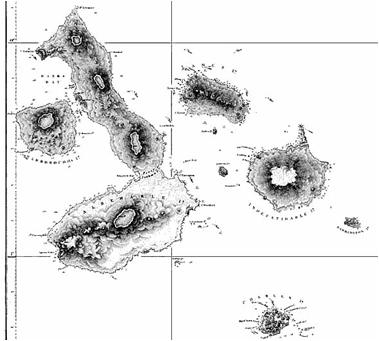
     Both USFQ and GAIAS excelled at managing the event with unique vision and hospitality and at highlighting the scientific relevance of the Galapagos, its role in Charles Darwin’s conceptualization of “his theory” of evolution by natural selection, and the importance of this volcanic archipelago as World Heritage. Darwin visited the Galapagos in 1835 during an amazing journey (1831-1836) on board of the HMS Beagle, an expedition vessel commanded by Captain Robert FitzRoy.

Above, map of the Galapagos Islands by Captain Robert FitzRoy (1836)
Above, HMS Beagle at Tierra del Fuego, painted by Conrad Martens, ship’s artist (1831-1836)

     Under the umbrella “Why Does Evolution Matter?” the Summit included five sessions: evolution and society, pre-cellular evolution and the RNA world (RNA is a precursor molecule to DNA, the carrier of genetic coding), behavior and environment, genome, and microbes and diseases. Plus an unforgettable farewell party, Galapagean style, with live music, performances, and spirits. USFQ and GAIAS are skillful at including the Galapagos community in all events, which brings pride to all parties. USFQ and GAIAS are exemplars of a liberal arts model in the Americas, one that merges institutional identity with cultural heritage.

     The Summit was publicized by the media worldwide with instant twitting, video uploading online, TV and radio reporters chasing the speakers, and press releases. The Galapagos might be distantly located 600 miles west of the coast of Ecuador, but the Summit was constantly “close by” in the news. Indeed, there is no place on Earth like the Galapagos Islands and no better destination to discuss the reality of evolution.

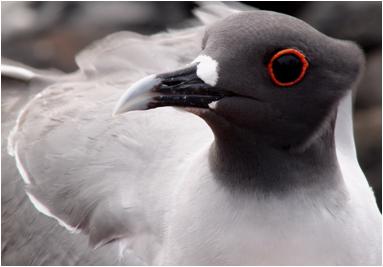
Above, magnificent Swallow-tailed Gull. “…Indeed, there is no place on Earth like the Galapagos Islands and no better destination to discuss the reality of evolution…” Photo © 2009 Guillermo Paz-y-Miño-C.

     I was invited by USFQ and GAIAS to present at the Summit my research program at UMassD. In my keynote address, I discussed “Evolution, Science, Pseudo Science and the Public’s Perception of Reality.” The topic is provocative and it did trigger sharp questions from the audience, dozens of twits, journalists impatient to get exclusive interviews, and an avalanche of sympathizers with my concerns about the low public’s acceptance of evolution worldwide. I contrasted with data the anecdotic perception, even among some of the co-keynote speakers, that opposition to evolution is a phenomenon restricted to the United States, and I framed the problem conceptually, subject to scientific inquiry and testing.

     During the past five years, my collaborator Dr. Avelina Espinosa (professor at Roger Williams University) and I have documented scientifically the patterns of acceptance of evolution in New England and the attitudes toward science by highly educated audiences [download PDF of scientific article on Acceptance of Evolution in New England]. With so many reputable universities, New England is a great “field site” for our studies. We have proposed that the controversy over evolution versus creationism (including all its modern forms: theistic evolution, creation science, young-earth creationism, Intelligent Design, BioLogos) is intrinsic to the incompatibility between scientific rationalism/empiricism and the belief in supernatural causation.

   Dr. Espinosa and I have published extensively on the topic and tested quantitatively the “incompatibility hypothesis” which helps us understand the core reason for the controversy science versus belief. This was the essence of my keynote address at the World Evolution Summit and my colleagues’ response, plus that of the audience, were amazingly encouraging. The media went beyond: “it is time, and important, to say it the way it is” stated Rodolfo Asar, host of the TV program “On Myths and Truths: Frauds in Science” when dialoguing with Dr. Espinosa and me. Rodolfo and his co-host, Maria Eulalia Silva, play a crucial role in educating the public, their program is featured primetime by Teleamazonas.

     What is the incompatibility hypothesis, how do you test it?, asked Rodolfo. I explained that acceptance of evolution and scientific rationalism is characterized by three main factors: the level of an individual’s understanding of science, her/his familiarity with the process of evolution, and her/his personal belief convictions [download PDF of scientific article about the Incompatibility Hypothesis]. In all our studies with the New England professors, educators of prospective teachers, and college students, the single negatively associated variable with acceptance of evolution is the degree of religiosity. And to test it, we have compared such trend with the views of non-believers, who do not possess the academic credentials of the New England scholars, but their levels of understanding the foundations of science and evolution are comparable to the highly educated professors. “Evolution is true regardless of our awareness of it,” I concluded.

     I must confess that the World Evolution Summit in the Galapagos shall remain as one of my most memorable experiences. — © 2013 by Guillermo Paz-y-Miño-C. all rights reserved.

Related Articles:

Unforgettable Galapagos, a Summit, and Why Evolution Matters

Darwin Day Awaits Designation by US Congress

Why the Notion that “The Theory of Evolution is Not an Explanation for the Origin of Life” is Wrong

New England Science Public Reaches The Community

New England Science Public Reaches The Community

Dr. Guillermo Paz-y-Miño-C — © 2012

Department of Biology, University of Massachusetts Dartmouth


“…New England Science Public will sponsor simultaneous events across institutions to celebrate iconic scientific achievements, their relevance and value in modern society. Via the NE-Science Public Reports, the initiative will publicize meta-data documents nationwide on trends in attitudes toward science and its controversies…”

     The last elections taught us something substantial about scientific rationalism and politics: Science was absent from the presidential debates despite that 84 percent of Americans ranked science, innovation and health care as the third most important topic in a debate, after the economy and taxes, and foreign policy and national security.

     ScienceDebate.org also revealed that 81 percent of likely voters would prefer public policies to be based on science, not the personal opinions or beliefs of elected officials. The fourth favored topic for a debate was the environment.

“…it is a challenge nowadays to disinfect science from the menace of “cultural common sense,” which is ubiquitously prized but often wrong…”

     Disappointment aside, the needed discussions about science controversies and the elections were brought onto our university campuses by the faculty and students, and there are two examples relevant to my later story here —an emerging inter-institutional New England initiative— on how to translate science to the public without the filters of ideology or political pollutants, although it is a challenge nowadays to disinfect science from the menace of “cultural common sense,” which is ubiquitously prized but often wrong.

“…acceptance of climate change as a reality, favorable views toward alternative sources of energy, and pro acceptance of evolution and stem cell research were ideologically divided …”

     The first event was a panel discussion, on Oct. 24, at the University of Massachusetts Dartmouth (UMassD): “What’s Your Fracking Problem,” a title that helped fill the brand-new Claire T. Carney Library Grand Reading Room. Hydraulic extraction of natural gas, climate change, energy policy and evolution were examined by professors in the civil and environmental engineering, public policy, and biology departments. The scholars revealed distressing statistics about the United States: acceptance of climate change as a reality, favorable views toward alternative sources of energy, and pro acceptance of evolution and stem cell research were ideologically divided with only 56 percent of the general public, 71 percent of Democrats, 60 percent of independents and 42 percent of Republicans supporting them.

“…Hundreds of students networked… using their cell phones for something meaningful, profound: the debate on science and the elections became theirs…”

     Roger Williams University, in Bristol, Rhode Island, organized an earlier and comparable event on Oct. 16: “Scientific Controversies and the 2012 Presidential Elections” at the impressive Global Heritage Hall and its adjacent Communications Department. The student movement “Hawk The Vote” managed the show uniquely and with immediate tweeting of an online-televised faculty panel facing vivid audience opinions over sustainability, nuclear waste, the science of reproduction in the context of women’s rights and health care. Hundreds of students networked in the RWU campus using their cell phones for something meaningful, profound: the debate on science and the elections became theirs.

“…UMassD and RWU have a powerful faculty and student potential in common, a desire to transcend, to make a difference, and collaborate by bringing science debates directly to their own public with no stoppers of thought or restraints on logic…”

     These two universities have a powerful faculty and student potential in common, a desire to transcend, to make a difference, and collaborate by bringing science debates directly to their own public with no stoppers of thought or restraints on logic. And it is here that my story over the New England Science Public initiative makes sense.

     Since 2007, UMassD and RWU professors have led an intercampus outreach collaboration through Biology New England South aiming at gathering sister institutions in the area to discuss science, network research collaboration, offer a forum for formal presentation of studies and make an impact on the regional communities. More than 1,300 students have participated at the annual BioNES meetings —which take place at RWU— during the past six years (representing UMassD, RWU, Brown University, Tufts University, University of Rhode Island, Providence College, Rhode Island College, University of Connecticut and Salve Regina University), 50 professors have presented papers (four world specialists in science communication as keynote speakers), 40 graduate and undergraduate students have competed for the BioNES prestigious awards, 15 awards have been granted to the best student oral presentations, and 220 posters have been exhibited.

     The BioNES initiative has seeded future challenges for New England Science Public, which will assimilate BioNES and work across campuses to outreach the communities and disseminate correct interpretation of science. NE-Science Public will sponsor simultaneous events across institutions to celebrate iconic scientific achievements, their relevance and value in modern society. Via the New England Science Public: Series Evolution, the initiative will publicize meta-data documents nationwide on trends in attitudes toward science and its controversies.

“…New England Science Public shall take [the] challenge to debate the difficult issues and thus reach out to the public and foster the proper understanding of reality.”

     This past Nov. 29, UMassD and RWU commemorated the transition of BioNES to New England Science Public at the Global Heritage Hall (RWU) with invited guests from 12 regional organizations —universities, colleges, industry and the media. A message extracted from Harry R. Lewis’ —former dean of Harvard College— 2006 book “Excellence Without a Soul: How a Great University Forgot Education,” affected the 80 delegates in the audience: “A good university challenges its students to ask questions that are both disturbing and deeply important.” And New England Science Public shall take that challenge to debate the difficult issues and thus reach out to the public and foster the proper understanding of reality. — © 2012 by Guillermo Paz-y-Miño-C. all rights reserved

Related Articles:

Americans Want Candidates to Debate Science

United States ‘exceptionalism’ built on backs of the 99 percent

Can Atheists Be Our Leaders? – Editorial The Standard Times – Nov 6, 2010

Mauna Kea Telescopes To Sink in The Pacific

Mauna Kea Telescopes to Sink in the Pacific at TST

[click on subtitle to be redirected to The Standard Times]

By Guillermo Paz-y-Miño-C — © 2012

“…before the Dim End, all land telescopes will wear off and turn obsolete and… orbiting-the-planet observatories will likely replace them. Eventually, the shining domes resting on Mauna Kea will crumble while drifting away Northwest on their carrier, the late “Big Island.” These magnificent pieces of engineering will sink in the Pacific… when the summit of Mauna Kea succumbs to erosion, hence following the drowning fate of the Hawaiian Islands.”

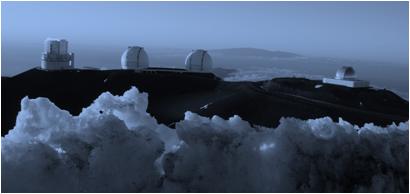
Telescopes Mauna Kea Hawaii Photo G Paz-y-Mino-C Evolution Literacy 2012

Telescopes on Mauna Kea, Hawaii, Photo GPC — © 2012 

Contemplating the night sky from the top of the largest volcano on Earth is spectacular. Indeed, on the Hawaiian Mauna Kea’s slopes, 13 astronomical observatories reach the universe through their light and radio-wave telescopes.

From base to summit, Mauna Kea (33,500 feet) raises taller than the Mahalangur-Himal Mount Chomolungma (29,000 feet) or, as renamed in the 1860s, “Everest.” The Royal Geographical Society, responsible for the authoritarian christening, eagerly sought to immortalize fellow member George Everest, a Welsh prominent topographer, who in youth was Surveyor General of India (1830s-40s). Thus the centuries-old Tibetan tradition of honoring the marvelous Chomolungma with a beautiful native name (of course surreal “Mother Goddess”) was lost.

But Mauna Kea, or “The White Mountain” (at times covered with snow), conserved its Hawaiian designation, traceable to the 11th century, and probably to the years 300-500, when Polynesians settled in the islands. The Mauna Wakea synonym, or “Mountain of the Deity Wakea,” is probably a more recent adoption since mythical traditions regarding the landscape customarily develop after the descriptive word-stock.

Despite the appalling American and European business-men conspiracy to overthrow the Kingdom of Hawaii (1893), followed by a short-lived pseudo-sovereign republic (1894-98), an annexation as territory to the United States (1898), a granted statehood (1959), and a final Apology Resolution by the US Congress (1993) –which was co-signed by President Bill Clinton— for the “deprivation of the rights of Native Hawaiians to self-determination,” the ancestral cultures reverberate in contemporary Hawaii.

Above: The Apology Resolution of 1993 -for the “deprivation of the rights of Native Hawaiians to self-determination”- was co-signed by the US Congress and President Bill Clinton

Mauna Kea’s volcanic foundations emerge from the mantle, deep below the Pacific tectonic plate. A hotspot fuels with magma the islands in the Hawaiian Ridge, and these “huge masses of interconnected rock” move slowly –at the speed our nails grow— toward the Northwest. The Big Island (0 to 600,000 years old), the newest formation and where Mauna Kea is located, rests on the hotspot, while the remaining smaller islands of the Maui cluster (1-2 million years old), Oahu (2-4 million years old) where Honolulu is situated, and the Kauai cluster (more than 5 million years old) continue to erode and sink away from the hotspot. The current archipelago is destined to disappear under the ocean and, if the hotspot remains active, to be replaced by new islands. Hawaii is an exemplar of the reality of an evolutionary tectonic process.

“…The current archipelago is destined to disappear under the ocean and, if the hotspot remains active, to be replaced by new islands. Hawaii is an exemplar of the reality of an evolutionary tectonic process…” Image: aerial view of The Big Island – Photo GPC — © 2012

Regardless of the sporadic snowy peaks, the atmosphere over Mauna Kea is cloudless most of the year, free of high-elevation particle pollution and very dark with no artificial-nightlight influence, key factors for telescopic observations. And $2-billion in infrastructure and equipment have been brought to the summit by a dozen countries which work in partnership with the University of Hawaii, active manager of the “Astronomy Precinct” within the Mauna Kea Science Reserve.

The Mauna Kea telescopes look grandiose in close proximity. Their white and silver domes stand out at twilight while waking up for their night runs: in 1968-70, the University of Hawaii built the first two large observatories (UH 0.9-m educational telescope and UH 2.2-m telescope); followed by the NASA Infrared Telescope Facility (1979), Canada-France-Hawaii Telescope (1979), UK Infrared Telescope (1979), James Clerk Maxwell Telescope (1987), CALTECH Submillimeter Observatory (1988), Very Long Baseline Array (1992), Keck I and II (1993-6), Subaru (1997), the Gemini North (1999), and the Submillimeter Array (2002). These instruments explore outer space under optical, infrared, submillimiter and radio spectra.

Above: Canada-France-Hawaii Telescope, Mauna Kea, Hawaii, Photo GPC — © 2012 

Above: Keck I and II observatories, Mauna Kea, Hawaii, Photo GPC — © 2012 

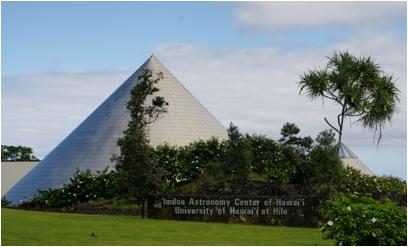
I found much mysticism, however, intertwined with cosmological facts, at Imiloa, an impressive, beautifully colored educational facility, which is advertised as “part science center, part indigenous peoples museum” by the University of Hawaii at Hilo. Imiloa merges scientific knowledge and sacred traditions about “origins” as if they were empirically compatible, but they are not. We do know, for example, that neither the Hawaiian Islands nor humans were created, but that the former emerged from magma piercing its way out through the Earth’s crust, while the latter evolved 180,000 years ago from African ancestors whose descendants, the Polynesians, arrived in Hawaii. And thanks to the Mauna Kean telescopes –plus two millennia of astronomy— we are certain that the universe evolved autonomously, independent from the invention of mythology, and that it will end when the last stars deplete their own fuel.

Above:  Imiloa Astronomy Center sponsored by the University of Hawaii at Hilo, Photo GPC — © 2012 

But before the Dim End, all land telescopes will wear off and turn obsolete and, if our species persists over a few more cosmic seconds in the time scale, orbiting-the-planet observatories will likely replace them. Eventually, the shining domes resting on Mauna Kea will crumble while drifting away Northwest on their carrier, the late “Big Island.” These magnificent pieces of engineering will sink in the Pacific, as archeological relics, when the summit of Mauna Kea succumbs to erosion, hence following the drowning fate of the Hawaiian Islands.  – © 2012 by Guillermo Paz-y-Miño-C. all rights reserved.

Above: the CALTECH Submillimeter Observatory, Mauna Kea, Hawaii, Photo GPC — © 2012 

On the Wrongly Called The God Particle

[click HERE to be redirected to The Standard Times]

Dr. Guillermo Paz-y-Miño-C — © 2012

New England Science Public

[A book-review format of this article is available at Amazon.com]

“…without mass, no atoms would exist, no galaxies or stars, no solar systems or planets with life, and no brains capable of thinking about it…”

Computer-generated image of a proton-proton collision recorded with the CMS detector at CERN (2012). The data is consistent with the decay of a Higgs-like-boson into photons (dashed yellow lines and green towers). Alternatively, the data could also be explained by background processes consistent with the Standard Model (image credit CMSCERN © 2012).

Nobel laureate Leon Lederman affirms that the title of his 1993 book “The God Particle: If the Universe is the Answer, What is the Question?” offended two groups: those who believe in God and those who do not. But this is another astute –and a posteriori— marketing pronouncement. If true, Lederman and coauthor Dick Teresi, a science writer, would have disappointed 95 percent of all Americans (the 80 percent of believers and the 15 percent of seculars), the book’s initial and major target audience.

     As particle physicist, Lederman’s intention with such an unfortunate and misleading heading –here I don’t only blame the publishers for scrambling science with the supernatural to secure sales— was to precisely reach the populous obsessed with science fiction, more than with science facts, and discuss the potential existence of the Higgs boson (a subatomic particle), which experimental demonstration, as predicted for decades, could bring major understanding to the essence of matter.

This past 4th of July, the European Organization for Nuclear Research, CERN, celebrated with its own “fireworks,” or highly energetic particle collisions, the discovery of a Higgs-like boson generated at the Large Hadron Collider (LHC), a magnificent underground instrument built to study the fundamental structuring blocks of all things.

I visited CERN, last year, located nearby Geneva, at the Swiss-Franco border. Its 17-mile circular accelerator speeds up, in opposite directions, subatomic “hadrons,” either hydrogen nuclei or lead ions, which gain energy after consecutive laps. At the instant of collision, scientists recreate the conditions immediately after the Big Bang, resembling the first events in the existence of our 14 billion-year-old universe. CERN is shockingly impressive; its amazing technology and scale of engineering caused me profound joy.

Square Galileo Galilei and THE GLOBE (Visitors Interpretation Center) at the European Organization for Nuclear Research, CERN, nearby Geneva — Swiss-Franco border (photos G. Paz-y-Miño-C — © 2011).

Hadron collisions produce short-lasting minuscule particles difficult to detect, and the Higgs boson has been indeed elusive. Its existence was postulated in 1964, in separate articles published in Physical Review Letters by Robert Brout and Francois Englert, Peter Higgs (alone), Gerald Guralnik, Richard Hagen and Tom Kibble. But CERN seems to have found it or, as cautiously announced, “measured the products of its decay,” thus inferring its existence.

  ATLAS control room at the European Organization for Nuclear Research, CERN (photo G. Paz-y-Miño-C — © 2011).

To help us imagine this day of discovery, or presumption that the Higgs boson is real, in his 1990s book Lederman traces back the history of particle physics to 2,600 years ago; sparkled by the Greek philosopher Thales of Miletus, who wondered about the simplest forms of matter, continuing with Democritus of Abdera (c 400 BP), who not only coined the term atom (“uncuttable”) but declared that “…nothing exists except for atoms and empty space; everything else is opinion,” and ending with the 1993 cancellation, by the US Congress, of the Superconducting Super Collider project to be built in Waxahachie, Texas, and which would have surpassed the LHC at CERN with a 54-mile-diameter particle accelerator.

Greek Philosopher Democritus of Abdera (460-370 BP) “…nothing exists except for atoms and empty space; everything else is opinion…”

What are Higgs bosons? Remember that atoms consist of positively charged protons and electrically neutral neutrons, both occurring at a nucleus. Electrons cloud around the nucleus and are negatively charged. The entire atom package is kept together by electromagnetic forces. If a nucleus of hydrogen –the simplest known element which is essentially a proton— is accelerated and rammed against another proton an explosion occurs, which liberates subatomic particles. Physicists rely on a body of scientific knowledge, called the Standard Model, to theorize and explore experimentally –currently at CERN— the properties of such subatomic particles.

About 60 of these particles have been hypothesized and/or documented to exist, and scientists classify them as bosons, hadrons and fermions (for technical terminology visit CERN’s Glossary). The Higgs is a boson and a crucial one to understand the properties of other elementary particles, for example, why some have mass and others, like the photons (components of light) don’t. Without mass, no atoms would exist, no galaxies or stars, no solar systems or planets with life, and no brains capable of thinking about it. (Note, however, that Higgs-like particles are expected to account for only a fraction of the total mass of the universe). CERN asserts that the characterization of Higgs will provide “the final missing ingredient in the Standard Model” and guide us in the comprehension of the forces acting at the microscopic core of nature.

Elementary subatomic particles (top: bosons, hadrons, fermions) and their interactions (bottom); source Public Domain.

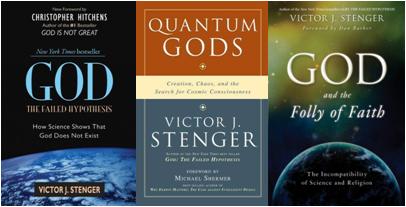
As for Lederman’s book (I belong to the 15 percent of seculars who detest its heading and insertions of subliminal mysticism into the facts), the prose offers an enjoyable ride, rich in historicity, sarcastic humor –rare for a physicist— and fantasizing dialogs with Democritus, Lederman’s imaginary physics peer. And to poise Lederman’s enlightenment about particle physics and its ramifications to modern cosmology with the views of one of his contemporary elementary-particles colleagues, I recommend reading Victor Stenger’s “God: The Failed Hypothesis” (2008), “Quantum Gods” (2009), and the latest “God And the Folly of Faith” (2012). – © 2012 by Guillermo Paz-y-Miño-C. all rights reserved.

Above, some of the books authored by Dr. Victor Stenger: “God: The Failed Hypothesis” (2008), “Quantum Gods” (2009), and “God And the Folly of Faith” (2012).

Massachusetts Gets an A- in Science Standards

Massachusetts Gets an A- in Science Standards

[click on title to be redirected to The Standard Times]

Dr. Guillermo Paz-y-Miño-C — © 2012

Department of Biology, University of Massachusetts Dartmouth

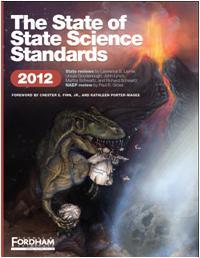
Massachusetts just got an A- on The State of State Science Standards, a 2012 report released by the Thomas B. Fordham Institute. Although “The Bay State” ranked fourth in the nation, after California (A), District of Columbia (A) and Indiana (A-), the other New England states did poorly: Connecticut ranked 14th, Vermont 24th, Maine 30th, New Hampshire 31st and Rhode Island 33rd.

“A majority of states’ standards remain mediocre to awful,” the report says. “The average grade across all states is — once again — a thoroughly undistinguished C. In fact, it’s a low C,” highlights the Foreword to a 217-page state-by-state scrutiny of the science education expectations in physics, earth and space, and life sciences.

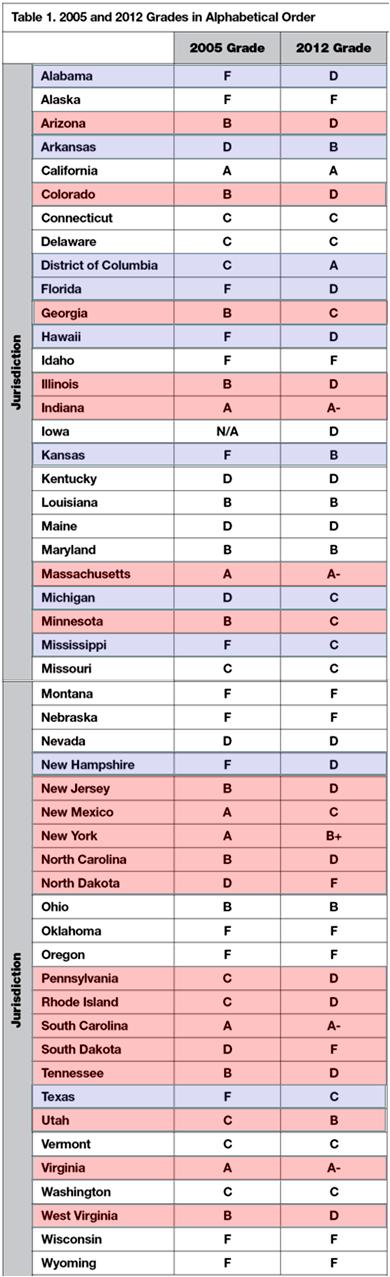
When contrasting the overall performance between 2005 and 2012, a reality emerges: only 11 states improved their grades, usually from F to higher — but still embarrassing — scores, except for the District of Columbia which went from a C to an exemplary A; 19 states worsen from a B or A to lower grades; and 20 states remained unchanged, half of them around F or D (see complete Table at the end of article).

In New England, Massachusetts was “degraded” from A to A-, Connecticut and Vermont remained in C, and Maine in D, Rhode Island decreased from C to D, and New Hampshire improved from F to D (image below).

The letter grades corresponded to numeric scores over 10 points; seven for content and rigor of state science standards and three for clarity and specificity. However, the assessment by the Fordham Institute was not about actual performance of students or teachers in physics, earth and space, or life sciences, but exclusively about the science expectations that schools are supposed to meet. Note that the U.S. world placement in math (25th), science (17th) and reading (14th) has been documented in previous studies.

A few questions emerge out of the Fordham results: If schools and teachers stick to a “C average” state of science standards, what quality of education are we really offering? If state science standards guide science education, how do we escape from this loop of poor standards and the expectation to follow them? Shouldn’t science teaching standards actually match the rigors of universal scientific progress? Should self-regulation in school curricula break apart from proper science education in the name of self-regulation?

The Fordham report stresses, nor surprisingly, four major problems inherent to these state science standards:

First, the undermining of evolution, a battle not only traceable to the Scopes Trial of 1925, in Tennessee, when the Butler Act (see original document) declared “unlawful to teach any theory, in public schools, that denies the Story of the Divine Creation of man as taught in the Bible,” but currently to the 2012 New Hampshire bill proposals to “require evolution to be taught as a theory, including the theorists’ political and ideological view points and their position on the concept of atheism” or “require science teachers to instruct pupils that proper scientific inquire results from not committing to any one theory or hypothesis, no matter how firmly it appears to be established.” Both bills are hymns to ignorance.

[Updates on the Anti Evolution Bills in New Hampshire]

Second, vagueness in the statements of expectations about what students should actually learn or be able to do after learning; 29 states scored 1 or 0 in the clarity and specificity score of the assessment, out of three points.

Third, poor integration of scientific inquiry, a pernicious malady nationwide; rather than helping students to acquire scientific content through discovery, there is “too much attention to engineering and technology, as well as to “science process skills,” which leads to a technical mind-set where true scientific thinking is lacking.

And fourth, poor foundations in mathematical skills; in essence, the most significant tool for modern scientific explorations, that is mathematics, is avoided as the centerpiece of proper science education: a fear of equations and rejection of complexity, or, as one of my excellent students ironically puts it, “there are too many numbers in math.”

An illustration by Sarah Samaroo (image left) is the only humorous, purposely macabre, aspect of the Fordham report. She depicts on the cover a Tyrannosaurus rex grossly salivating and crushing, before gulping, massive paper balls — as if they were carcasses of cellulose — of the “Science Standards.” In the background, a mega eruption and in the foreground an asteroid colliding with Earth warns us of the imminent extinction of magnificent science standards that we could have fully possessed or preserved if proper scientific inquiry had been in our minds. – © 2012 by Guillermo Paz-y-Miño-C. all rights reserved

“A majority of states’ standards remain mediocre to awful,” the report says. “The average grade across all states is — once again — a thoroughly undistinguished C. In fact, it’s a low C,” highlights the foreword to a 217-page state-by-state scrutiny of the science education expectations in physics, earth and space, and life sciences…

Below Complete State-by-state Grade Table Extracted and Adapted From the Fordham Report (grades 2005 vs. 2012):

LIGHT BLUE = grade improvement

WHITE = grade unchanged (or N/A)

PINK = grade worsen

Rejection of science threatens to be epidemic

Rejection of science threatens to be epidemic

[click on title to be redirected to The Standard Times]

Dr. Guillermo Paz-y-Miño-C — © 2012

Department of Biology, University of Massachusetts Dartmouth

“…There is a civic duty all citizens can exert to rectify the politics obscuring education: Cast our votes for candidates who sponsor proper schooling and support significant, not only profitable research. Escort out of office those who see fiction and facts compatible, or worship ignorance-based opinions as rightful views of equitable value to the empirical truth…”

Houston, we have a problem. And it has nothing to do with the explosion of an oxygen tank at 200,000 miles away from Earth that is threatening the lives of three astronauts cramped in a 1970s model of a spaceship, nor with an imminent meteor shower or solar radiation blast.

It is the rejection of science by elected officials and their constituents who, although privileged to grow up in a nation leading the most important quest of all, that of superb education and cutting-edge discoveries at prestigious universities, now dismiss the value of knowledge and of scientific realities essential to our existence.

And it is not only evolution that is rejected (my favorite topic, as a biologist and university faculty committed to education) but specifically space explorations, climate change research, stem cell studies, cloning and vaccinations.

The opposition resides, at times, on costs, a legitimate reason when prioritizing funding for billion-dollar projects like NASA’s Apollo (1960s-1970s), Shuttle (1980s-2000s) or International Space Station programs (1990s-2000s), but the resistance to the other fields is dubious under the economic justification (climate change) or relies on puritan thinking rather than on pro-health sincerity (stem cells, cloning and some vaccines).

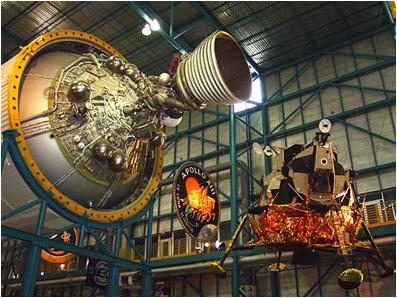
 Figure above: Apollo rocket and lunar module at Cape Canaveral — photo G. Paz-y-Miño-C — © 2001.

Figure above: Suttle Model, International Space Station Training Facilities at NASA Houston — photo G. Paz-y-Miño-C — © 2011.

It is impossible to honor knowledge when a nation’s admiration for it vanishes, when its students rank 25th in math and 17th in science worldwide, or when the youth of 14 other countries reads more than our own, or when the term “professorial” becomes an insult or a reprehensible trait in a public figure, as if the sophistication gained by formal education were a malady that must be eradicated to ensure “equality” and fair share of omnipresent unawareness of all issues.


Figure above: World Reading Math Science Ranks Evolution Literacy — OECD PISA Database © 2009.

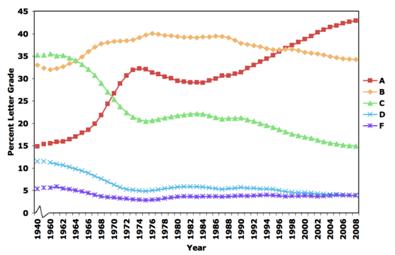
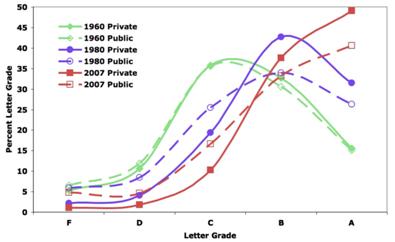
In the quest for attaining this absurd egalitarian recognition to low and high standards, the American colleges and universities have fallen into a pervasive grade-inflation. According to the Teachers College Record, a solid C was the most popular grade in the 1940s (35 percent), followed by B (below 35 percent), then by A (15 percent), and finally by D and F (above 10 and 5 percent, respectively). In the 1970s, the Vietnam War draft triggered a proliferation of A’s, which surpassed 30 percent. Today the A grade is fashionable (over 40 percent) and the “uncool” C is granted to only 15 percent of all college students — a situation accentuated at private institutions.

Figure above: Where A Is Ordinary: The Evolution of American College and University Grading 1940-2009 — Distribution of grades at American colleges and universities as a function of time— Rojstaczer & Healy — Teachers College Record © 2010.

Figure above: National average grading curves as a function of time, 1960, 1980, and 2007 for public and private schools — Rojstaczer & Healy– Teachers College Record © 2010. 

But trivializing education can be suicidal in a competitive job market where only earning a bachelor’s degree would keep a U.S. worker out of poverty. Indeed, education pays by reducing unemployment and rising income, and The Bureau of Labor Statistics has examined these trends: 15 percent of those without a high school diploma remained unemployed during 2010 and, if employed, they earned only $450 per week. Those who graduated from college reduced their unemployment to 5 percent and, if employed, earned more than $1,000 weekly. Only holders of master’s degrees and above — professional and doctorate degrees — secured a job more than 95 percent of the time and earned beyond $1,300 per week.

Figure above: Education Pays: Unemployment and Median Weekly Earnings as Function of Education — Bureau of Labor Statistics — © 2011.

Although the crisis in the current educational system is multi factorial and complex, there is a civic duty all citizens can exert to rectify the politics obscuring education: Cast our votes for candidates who sponsor proper schooling and support significant, not only profitable research. Escort out of office those who see fiction and facts compatible, or worship ignorance-based opinions as rightful views of equitable value to the empirical truth.

What can we achieve if public officials and their electors treasure education? An overwhelming support to science and reason; in fact, if citizens advance from holding a high school diploma to graduating from college, societal concurrence with major research topics will increase: space explorations from 50 to 70 percent; climate change from 45 to 58 percent; acceptance of evolution from 21 to 74 percent; embryonic stem-cell research from 51 to 71 percent; therapeutic cloning from 64 to 73 percent; and childhood immunization from 79 to 91 percent (data from Space Policy Journal, Gallup, Pew Research Center, Georgia Department of Human Resources and Coalition for the Advancement of Medical Research).

And going back to Houston, and specifically to NASA, our “competent sentinel” when cosmic menace approaches Earth, its terrestrial problem is now to secure $19 billion during 2012 — about 0.6 percent of the $3 trillion federal budget — and continue with the programs: science (planetary, astrophysics), aeronautics, space technology, exploration, space operations and education, the latter alone worth $138 million (click on NASA’s Positive Impact on Society). Indeed, world-quality research and education can be expensive; is someone willing to try ignorance? — © 2012 by Guillermo Paz-y-Miño-C. all rights reserved

Figure above: Space suit, International Space Station Training Facilities at NASA Houston — photo G. Paz-y-Miño-C — © 2011.


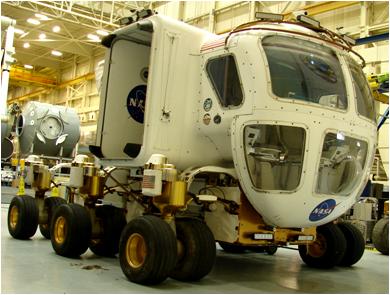
Figure above: Model vehicle for Mars exploration, International Space Station Training Facilities at NASA Houston — photo G. Paz-y-Miño-C — © 2011.