EvoLiteracy News 04 03 2015

Atlanta Educators Convicted in School Cheating Scandal. Judge ordered them jailed immediately. From The New York Times.

Atlanta Educators Might Go to Jail photos Kent D Johnson

Donald Bullock, a former Atlanta testing coordinator, and Sharon Davis Williams, a former research team director, after judge Jerry W. Baxter ordered the educators jailed immediately. Photo by Kent D. Johnson.

As an educator –although, mostly college– this story is both distressing and sad for me since I support high standards in education, at the same time that consider public schools to be underfunded and in constant need of financial and public support. The historical sequels of neglect and segregation -in the region- might also explain the complexity of this case, but the evidence presented to the court seems unequivocal — GPC.

Alan Blinder, who writes for The New York Times, examines the “largest cheating scandal in the nation’s history, [in which] a jury convicted 11 educators —a mixture of Atlanta public school teachers, testing coordinators and administrators— for their roles in a standardized test cheating that tarnished a major school district’s reputation and raised broader questions about the role of high-stakes testing in American schools.” The defendants (11 of 12) were convicted of racketeering, a felony that carries up to 20 years in prison.

Judge Jerry W. Baxter ordered most of the educators jailed immediately, and they were led from the courtroom in handcuffs. “Defense lawyers, some of whom were clearly angered by Judge Baxter’s decision to jail the educators, immediately began planning appeals and said they were stunned by the verdicts,” reports journalist Alan Blinder in his NYT article. “I don’t like to send anybody to jail,” Judge Baxter said. “It’s not one of the things I get a kick out of. But they have made their bed, and they’re going to have to lie in it, and it starts today”… Read complete story in The New York Times. For a local perspective and updates since 2008, see report in The Atlanta Journal Constitution, for an international take see The Guardian.

“Little-Foot” older than “Lucy.” New technology dates skeleton 3.67 million years old. What does it mean for hominid evolution?

Little Foot Skull 2.67 Million Years Old

The skull extracted from the cave breccia. Photo by Jason Heaton. Click on image for higher resolution.

“Little Foot is a rare, nearly complete skeleton of Australopithecus first discovered 21 years ago in a cave at Sterkfontein, in central South Africa. The new date places Little Foot as an older relative of Lucy, a famous Australopithecus skeleton dated at 3.2 million years old that was found in Ethiopia. It is thought that Australopithecus is an evolutionary ancestor to humans that lived between 2 million and 4 million years ago.” Read Purdue University press release in EurekAlert! Or see the original article in the journal Nature.

The Little Foot skeleton represents Australopithecus prometheus, a species very different from its contemporary, Australopithecus afarensis (“Lucy”), and with more similarities to the Paranthropus lineage. The dating relied on a radioisotopic technique, which uses radioisotopes within several rock samples surrounding a fossil to date when the rocks and the fossil were first buried underground.

“…Australopithecus africanus and Paranthropus did not all have to have derived from Australopithecus afarensis [Lucy]… This new date [Little Foot’s 3.67 my] is a reminder that there could well have been many species of Australopithecus extending over a much wider area of Africa…”

The authors of the study, Granger et al. (total of 6 coauthors), who just published their results in Nature, summarize the work as follows: “The cave infills at Sterkfontein contain one of the richest assemblages of Australopithecus fossils in the world, including the nearly complete skeleton StW 573 (Little Foot) in its lower section, as well as early stone tolls in higher sections. However, the chronology of the site remains controversial due to the complex history of cave infilling. Much of the existing chronology based on U-PB and paleomagnetic stratigraphy has recently been called into question by the recognition that dated flowstones fill cavities formed within previously cemented breccias and therefore do not form a stratigraphic sequence. Earlier dating with cosmogenic nuclides suffered a high degree of uncertainty and has been questioned on grounds of sediment reworking. Here we use isochron burial dating with cosmogenic Al-26 and Be-10 to show that the breccia containing StW 573 did not undergo significant reworking, and that is was deposited 3.67 ± 0.16 My ago, far earlier than the 2.2 My flowstones found within it. The skeleton is thus coeval with early Australopithecus afarensis in eastern Africa. We also date the earlies stone tools at Sterkfontein to 2.18 ± 0.21 My ago, placing them in the Oldowan at a time similar to that found elsewhere in South Africa at Swartkans and Wonderwerk.” For complete study go to Nature.

EvoLiteracy News 03 19 2015

US Senator Ted Cruz Distorts NASA’s Mission Budget. This report, appeared first in FactCheck.org and refers to Republican Senator Ted Cruz, who chairs the Senate Subcommittee on Space, Science, and Competitiveness (03 18 2015).

Earth Art from Space Close Up imageFactCheck.Org summarizes both Sen. Cruz remarks vs. NASA’s mission and vision:  Sen. Cruz, March 12, 2015: As we begin the process of putting together a roadmap for the future of NASA, there is one vital question that this committee should examine: Should NASA focus primarily inwards, or outwards beyond lower Earth orbit. Since the end of the last administration we have seen a disproportionate increase in the amount of federal funds that have been allocated to the earth science program at the expense of and in comparison to exploration and space operations, planetary science, heliophysics and astrophysics, which I believe are all rooted in exploration and should be central to the core mission of NASA. … I am concerned that NASA in the current environment has lost its full focus on that core mission. NASA, 1964: The fundamental objective of the Geophysics and Astronomy Program is to increase our knowledge and understanding of the space environment of the Earth, the Sun and its relationships to the Earth, the geodetic properties of the Earth, and the fundamental physical nature of the Universe. Knowledge of these areas is basic, not only to our understanding of the problems of survival and navigation in space, but also to the improvement of our ability to make technological advances in other fields. The understanding of the Earth’s atmosphere is important for advancement of weather forecasting, for solution of spacecraft reentry problems and for study of the atmospheres of other planets. For complete report go to FactCheck.org Cruz Distorts NASA’s Mission, Budget.

The Subcommittee on Space, Science and Competitiveness “has responsibility for science, technology, engineering, and math research and development and policy; standards and measurement; and civil space policy. The Subcommittee conducts oversight on the National Science Foundation, the National Aeronautics and Space Administration, the National Institute of Standards and Technology, the Office of Science and Technology Policy, and the National Technical Information Service. Advancements in science and technology are vital to the nation’s continued economic security, innovation, and competitiveness.”

Extraordinary diversity of visual opsin genes in dragonflies. This article was just published and featured on the cover of the Proceedings of the National Academy of Sciences (03 17 2015).

Dragonfly PNAS 03 17 2015The authors highlight the significance of their study as follows: “Human color vision is tri-chromatic, with three opsins expressed in cone photoreceptors that are sensitive in the red, green, and blue region of the spectrum. As theories predict, such tri- or tetra-chromacy with three or four opsin genes is common among mammals, birds, and other animals, including insects. However, we discovered that dragonflies possess as many as 15–33 opsin genes that have evolved through dynamic gene multiplications and losses within the lineage of dragonflies. These opsin genes are differentially expressed between adult and larva, as well as between dorsal and ventral regions of adult compound eyes, which plausibly underpin the versatile behavioral and ecological adaptations of actively flying adults to aerial lifestyle and sedentary larvae to aquatic lifestyle.” See source PNAS Vol. 112 (11).

UK mapped out by genetic ancestry. Finest-scale DNA survey of any country reveals historical migrations (03 18 2015).

UK Genetic Diversity Nature March 18 2015

A map of the United Kingdom shows how individuals cluster based on their genetics, with a striking relationship to the geography of the country. Source Stephen Leslie, Nature Magazine.

“The analysis — which shows a snapshot of clusters of genetic variation in the late 1800s, when people were less likely to migrate far from their region of birth — reflects historical waves of migration by different populations into the island…  [A] statistical model lumped participants into 17 groups based only on their DNA, and these groupings matched geography. People across central and southern England fell into the largest group, but many groupings were more isolated, such as the split between Devonians and Cornish in Britain’s southwest. People who trace their ancestry to the Orkney Islands, off the northeast coast of Scotland, fell into three distinct categories.” Source Nature  http://dx.doi.org/10.1038/nature14230.

Darwin’s puzzle… again evolution was, is true. Ancient proteins resolve the evolutionary history of some South American ungulates. Camel or elephant? Actually, this extinct South American mammal called Macrauchenia is most closely related to horses! (03 18 2015).

Toxodon Illustration

Toxodon – Illustration by Peter Schouten “Biggest, Fiercest, Strangest” W. Norton Publishers

The study was published in the journal Nature: “…Toxodon and Macrauchenia form a monophyletic group whose sister taxon is not Afrotheria or any of its constituent clades as recently claimed, but instead crown Perissodactyla (horses, tapirs, and rhinoceroses). These results are consistent with the origin of at least some South American native ungulates from ‘condylarths’, a paraphyletic assembly of archaic placentals. With ongoing improvements in instrumentation and analytical procedures, proteomics may produce a revolution in systematics such as that achieved by genomics, but with the possibility of reaching much further back in time.” See source Nature doi:10.1038/nature14249.

Macrauchenia Illustration

Macrauchenia – Illustration by Peter Schouten “Biggest, Fiercest, Strangest” W. Norton Publishers

Evolution illiteracy at America’s colleges and universities

Evolution illiteracy at America’s colleges and universities

Dr. Guillermo Paz-y-Miño-C — © 2014

New England Science Public – An Initiative for the Public Understanding of Science – on Twitter @EvoLiteracy@gpazymino

Belief in supernatural causation disrupts, distorts, delays or stops the acceptance of scientific evidence. These 3Ds + S are upshots of the inner struggles between an individual’s unsubstantiated convictions faith and its collisions with the empirical reality. And there is no better landscape to document the incompatibility between belief and facts than investigating if and how people accept evolution.”

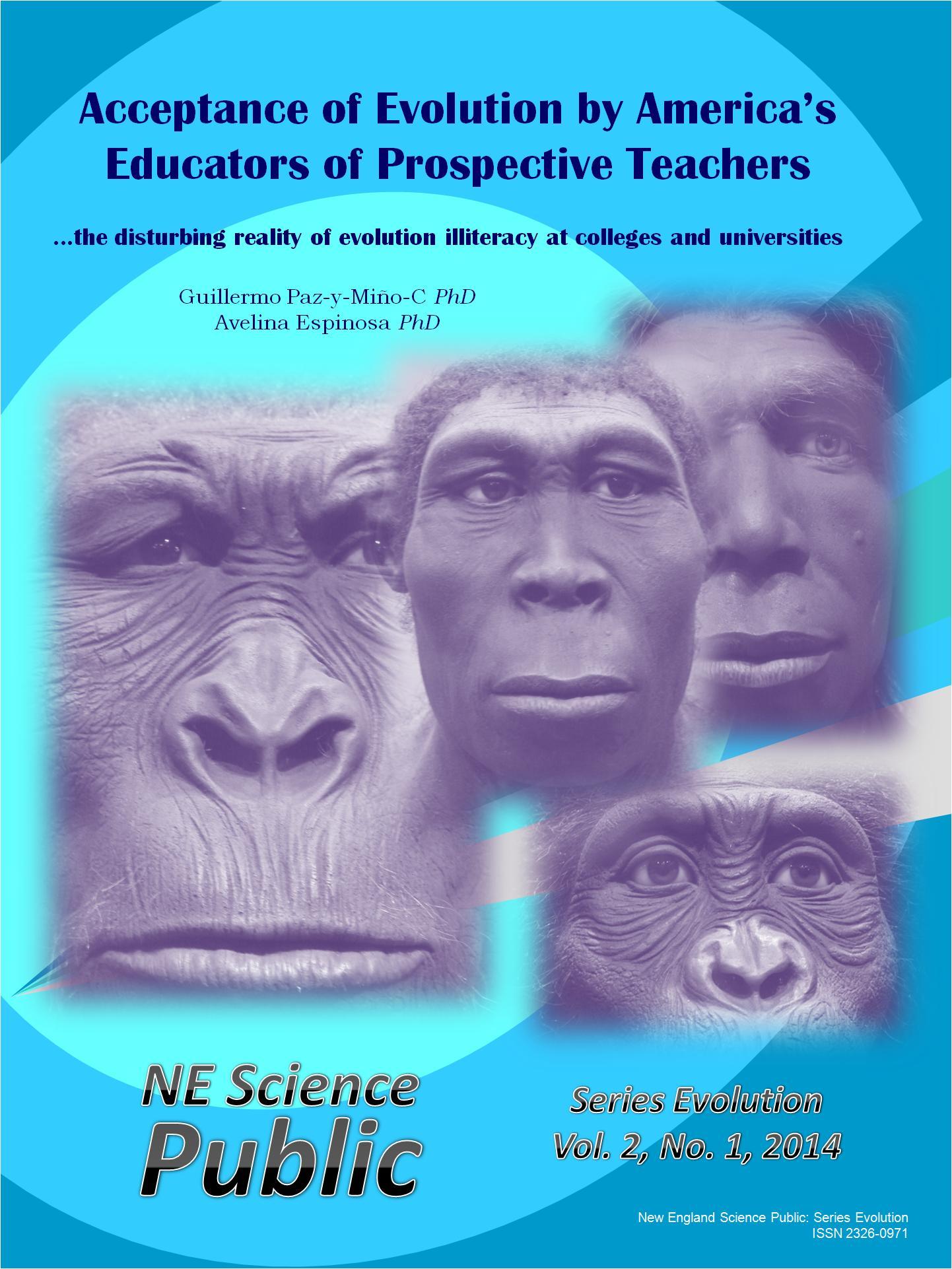
Paz-y-Mino-C_NESP cover Evolution Study 2014     In collaboration with Dr. Avelina Espinosa, a biologist at Roger Williams University, US, we have postulated that the controversy over evolution-and-science versus creationism is inherent to the incompatibility between scientific rationalism/empiricism and the belief in supernatural causation. The ‘incompatibility hypothesis’ (IH) helps us explain the everlasting antagonism in the relationship between science/evolution and religion.

     Our latest study is titled ‘Acceptance of Evolution by America’s Educators of Prospective Teachers,’ to which the New England Science Public Series Evolution –where the work was just published— has added the subheading ‘The Disturbing Reality of Evolution Illiteracy at Colleges and Universities.’ In it, we rely on IH to test the cultural-pollution effects of religiosity on acceptance of evolution by America’s finest education scholars; that is, university professors specialized in training future teachers.

     Previous reports about public acceptance of evolution in the US (around 40%, a rate distant from the top countries’ 80%, like Ireland, Denmark, Sweden, France or Japan) have examined the role of religiosity in the rejection of evolution; but only few studies have characterized the influence of religion on evolution’s endorsement by elite educators. It has been assumed that higher-education faculty remain distant from belief-based explanations of natural phenomena; a supposition that Dr. Espinosa and I suspected to be false.  

     We studied attitudes toward evolution among 495 educators of prospective teachers affiliated with 281 colleges and universities distributed in 4 regions and 50 states in the US. These professionals (87% PhD or doctorate holders) where polled in five areas: (1) their views about evolution, creationism and Intelligent Design, (2) their understanding of how science and the evolutionary process work, (3) their position about the hypothetical ‘harmony or compatibility’ between science/evolution and supernatural causation, (4) their awareness of the age of the Earth, its moon, our solar system and the universe, and the application of the concept of evolution to the cosmos, and (5) their personal convictions concerning the evolution and/or creation of humans in the context of the responders’ religiosity.

     Acceptance of evolution among these educators was influenced by their level of understanding the foundations of science/evolution and their beliefs in supernatural causation. In comparison to two other populations, whose acceptance of evolution had already been documented in our previous research (i.e. New England research faculty, non-educators, and college students), the educators had an intermediate level of understanding science/evolution, low acceptance of evolution, and high religiosity, as follows:

Acceptance Evolution Educators Evolution Literacy

‘Acceptance of evolution openly’ and ‘thinking that evolution is definitely true’ among educators of prospective teachers in the United States (center). For comparison, New England college students (left) and research faculty (right) are depicted; both have the highest national levels of acceptance of evolution among students and university professors, respectively.

• 59% of the educators accepted evolution openly, 51% thought that evolution is definitely true, and 59% admitted to be religious.

• 94% of the New England researchers accepted evolution openly, 82% thought that evolution is definitely true, and 29% admitted to be religious.

• 63% of the New England Students accepted evolution openly, 58% thought that evolution is definitely true, and 37% admitted to be religious (Figure above).

• Educators in each of the four regions of the US (North East, Midwest, South, and West) had science- and evolution-literacy scores below the researchers’ but above the students.’

• The educators’ rejection of evolution increased, conspicuously, with increasing level of religiosity.

Humans are Apes Evolution Literacy

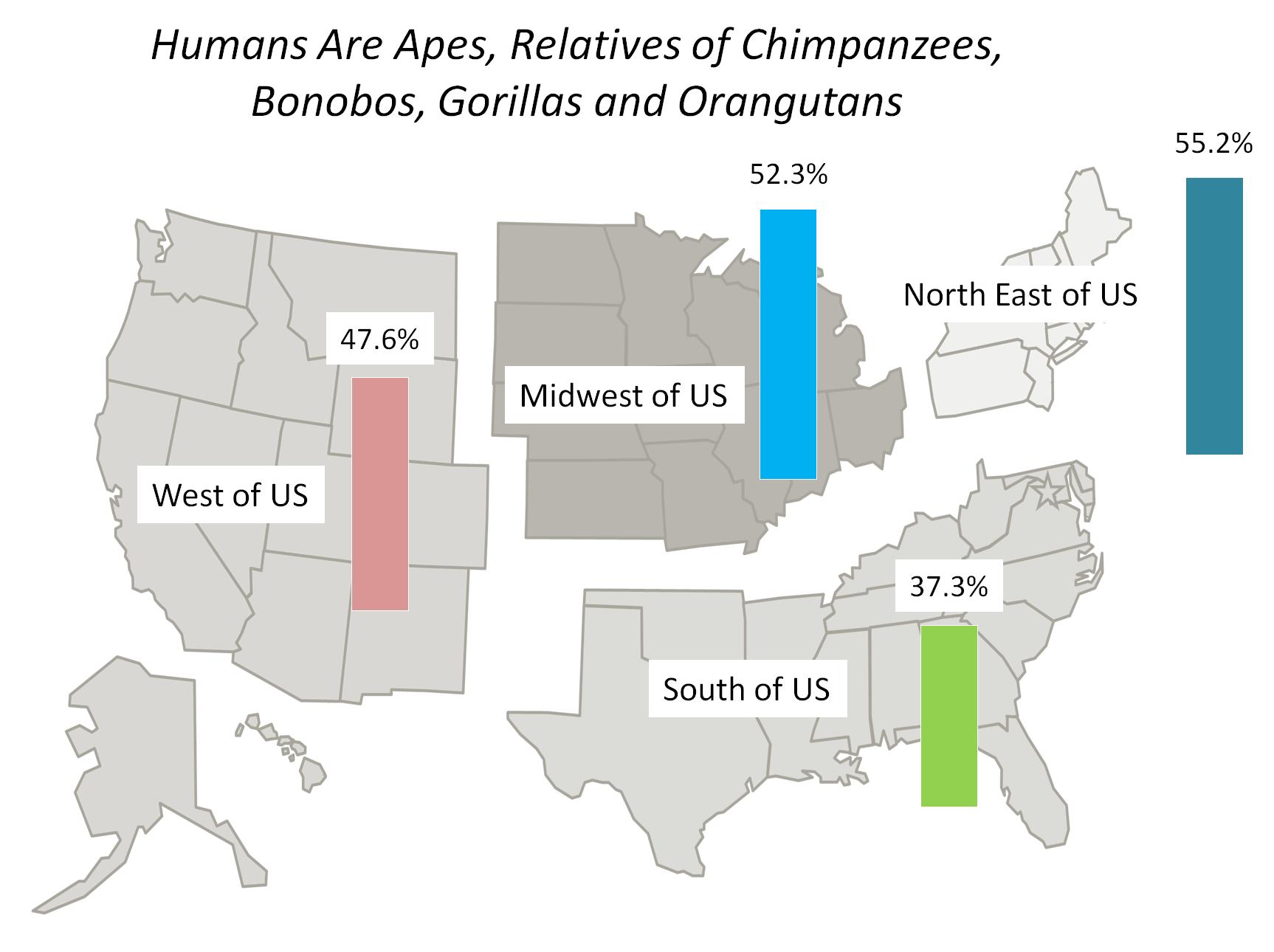
One of the significant results of the study: only 37.3% to 55.2% of educators of prospective teachers knew (or accepted) that humans are apes, relatives of chimpanzees, bonobos, gorillas and orangutans.

     Our research has led us to conclude that harmonious coexistence between science/evolution and religion is illusory. If co-persisting in the future, the relationship between science and religion will fluctuate between moderate and intense antagonism. — © 2014 by Guillermo Paz-y-Miño-C. all rights reserved.

Note: The complete 92-page study is available open access at New England Science Public; it includes 23 figures, statistics, 34 maps, 12 tables, and a companion slide show ‘Image Resources’ for science journalists, researchers and educators.  

NESP Series Evolution Vol. 2 No. 1 was released on September 15, 2014, in celebration of Captain Robert FitzRoy’s arrival in the Galapagos on September 15, 1835; at that time, the young naturalist Charles Darwin was FitzRoy’s distinguished guest on board of the HMS Beagle.

Reference: Paz-y-Miño-C, G. & Espinosa A. 2014. Acceptance of Evolution by America’s Educators of Prospective Teachers. New England Science Public: Series Evolution 2(1): 1-92. [PDF] and supplementary ‘Image Resources’.

 Related Articles and Media Reports:

Richard Dawkins Foundation Newsletter: Evolution Illiteracy among America’s Finest Educators

Why people do not accept evolution?

The Incompatibility Hypothesis (IH): evolution versus supernatural causation

The Boston Globe Metro: Basic knowledge of Darwin’s theory lost in some classes

Boston.com: Happy Birthday, Charles Darwin!

South Coast Today: Evolution misunderstood by students, faculty

TEN TIPS ABOUT: How university professors can contribute to strengthen evolution literacy

By Guillermo Paz-y-Miño C. & Avelina Espinosa — © 2011

Excerpts from “New England Faculty and College Students Differ in Their Views  About Evolution, Creationism, Intelligent Design, and Religiosity” published in Evolution Education and Outreach

(1) By being proactive rather than reactive in confronting the “anti-evolution wars.” It is imperative that the university professors reach out to the public and lead the debate over science education and evolution literacy.

(2) By persuading the education departments at their institutions to fortify science training of future educators: higher education and outreach programs in science, particularly biology, for school teachers are fundamental to integrate evolution into our society’s culture.

TheScientificMethod

(3) By changing the emphasis with which college science is taught and improving the science curriculum: it is easier and faster to change the perspectives with which a course is taught than to modify the university/college curriculum; however, both might be indispensable to improving positive attitudes toward science and evolution.

(4) By creating a new type of professorship position: “professor for the public understanding of science,” whose exclusive role shall be to explain to the public the significance of the research conducted by each discipline, and also by assigning the most reputable professors and best communicators of science to the large-lecture courses, usually attended by nonscience majors.

(5) By constantly surveying variations in attitudes toward science and evolution among faculty, students and staff, and coordinating immediate responses to emerging antievolutionism: contrary to the assumption that skepticism toward creationist views predominates in academia, U.S. university professors, even at prestigious research institutions, increasingly embrace religiosity, a factor negatively correlated with acceptance of evolution; it is conceivable to forecast a decline in acceptance of evolution by university professors.

SchoolAdmissions

(6) By sponsoring in- and off-campus lecture series, workshops and debates, open to the local high school teachers and the public, where university professors of all disciplines examine the anti-evolution phenomena, learn about the limitations established by schools boards on the science school curriculum and orient the audience on how to communicate modern science to all. Workshop discussion modules on “why evolution matters” can be particularly effective when organized for school board members, school district administrators, science teachers and university professors.

(7) By actively pursuing participation in “town Evo Edu Outreach halls for scientists and public” to discuss issues related to scientific research and the controversy of evolution versus creationism versus ID.

DownWithEducationCartoon

(8) By organizing multidisciplinary teams of professors (anthropology, biology, education, ethics, history, law, philosophy, political science, social psychology, and religious studies) committed to advice community groups on theoretical and practical aspects of civil action to counter anti-evolution campaigns, anti-intellectualism tendencies, and pro creationism and ID agendas.

(9) By never underestimating the influence of the anti-evolution movements that grow strong among misinformed citizens, vary in impact geographically, and benefit from the frequent disconnect between scientists and society. Indeed, the regional differential acceptance of evolution in the U.S. (i.e., Northeast 59%, Northwest 57%, Midwest 45%, South 38%; The Pew Research Center for the People & the Press 2005) suggests that pro-evolution campaigns shall require strategies compatible with local idiosyncrasies.

EqualWeighEvolutionCreation

 (10) By including in the “broad impact” section of research grant applications specific multidisciplinary outreach modules to educate the public in the areas of scientific literacy, “on-the-job-training” workshops for local/ regional high school teachers, online-mini courses, online assessment of local/regional attitudes toward science/evolution, laboratory internships and field work. The National Science Foundation, U.S. Department of Education, and private donors encourage and even require grant applicants to reach out to the public in meaningful areas of current interest and societal debate. — © 2011 by Guillermo Paz-y-Miño-C. & Avelina Espinosa all rights reserved

TeachBothSidesCartoon

For original scientific article (New England Faculty and College Students Differ in Their Views  About Evolution, Creationism, Intelligent Design, and Religiosity), published in Evolution Education & Outreach, click on [PDF]

“Theory of Evolution” versus “Concept of Evolution”

By Guillermo Paz-y-Miño C. & Avelina Espinosa — © 2011

Excerpt from “On the Theory of Evolution versus the Concept of Evolution” published in Evolution Education and Outreach

“…It is important to make a distinction between the theory of evolution and the concept of evolution, but without compromising logic…

As scientific theory (Greek theoria), evolution provides naturalistic explanations of empirical observations, it organizes them in a comprehensive system with central and auxiliary hypotheses.

From the epistemological perspective (Greek episteme, epistemology = theoryof knowledge), the theory of evolution encompasses the nature and scope of knowledge about the phenomenon of evolution (=what really happens), including the chronological discoveries by naturalists and scientists during the development of our cumulative understanding of how evolution works.

Scholars call the latter “theory of evolution,” whose epistemological beginning is attributed to the mid and late 1800s, and to Charles Darwin (1809-1882) and Alfred R. Wallace (1823-1913) as main contributors to the conceptualization of evolution at the mechanistic level (=natural selection).

Charles Darwin and Alfred Wallace

Charles Darwin and Alfred Wallace co-discovered the mechanism of natural selection

But the phenomenon of evolution is ongoing, precedes Darwin and Wallace in billions of years, and it shall continue, with comparable magnitude, in time and space.

The concept of evolution, therefore, is about the occurrence of evolution (i.e., the aggregation of matter, the emergence of organic compounds from simpler molecules, the formation of self-replicating macro-molecules, the encasing of chemical reactions within the boundaries of lipid-layered membranes, the formation of cells and their reproduction and differentiation, and the diversification of uni- and multi-cellular life) and it helps us understand and represent cognitively—via mental symbolism and abstraction— the reality of evolution.

Our understanding of evolution improves with new discoveries, but the reality of evolution continues to exist regardless of our awareness and level of understanding of it…” — © 2011 by Guillermo Paz-y-Miño-C. & Avelina Espinosa all rights reserved

For original scientific article (On the Theory of Evolution versus the Concept of Evolution), published in Evolution Education & Outreach, click on [PDF]

Related article: Why the Notion that “The Theory of Evolution is Not an Explanation for the Origin of Life” is Wrong.

Recommended Book: Why Evolution is True by Jerry A. Coyne click on book for link

BookWhyEvolutionIsTrue