Why Accepting Evolution Matters
…New England professors accept evolution, but they are religious…
[click on title to be redirected to The Standard Times]
Dr. Guillermo Paz-y-Miño C. — © 2011
Department of Biology, University of Massachusetts Dartmouth
People do not “believe” in evolution; we either accept it, or doubt about it, or reject it. But the reality of the evolutionary process continues regardless of our cognitive awareness or position about it. Evolution is true.
Together with my collaborator, Dr. Avelina Espinosa, professor at Roger Williams University in Rhode Island, we have uncovered the patterns of acceptance of evolution among university professors in New England, and the results are both fascinating and startling.
A cultural assumption has been that scholars are supportive of science and remain distant from belief-based perspectives regarding the natural world. Is this factual?
We surveyed 244 faculty — 90 percent Ph.D. holders in 40 disciplines at 35 colleges and universities widely distributed geographically in Connecticut, Maine, Massachusetts, New Hampshire, Rhode Island and Vermont. Our study was recently published online in Evolution, Education and Outreach, and the hard-copy report will appear in the March 2011 issue of the journal.
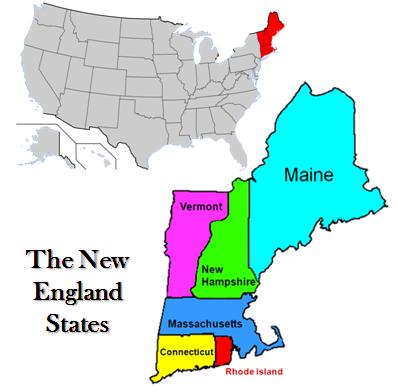
Why New England? The first shocking fact that triggered our interest in studying the Northeast of the United States was that, back in 2005, the Pew Research Center for the People and the Press had documented that only 59 percent of New Englanders accept evolution, the highest score nationwide, and that the overall regional acceptance of evolution in the United States was even more distressing: 57 percent in the Northwest, 45 percent in the Midwest, and 38 percent in the South.
More alarmingly, in 2006, the United States ranked 33rd among 34 other countries where acceptance of evolution was assessed, in contrast to Iceland, Denmark, Sweden, France, Japan and the United Kingdom, top in the list, where 75 to 85 percent of adults accept evolution (Science, 2006).
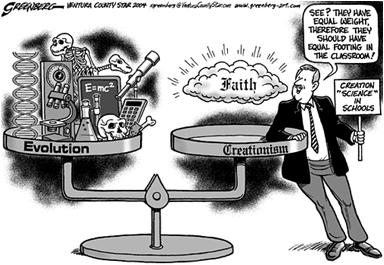
Our study revealed that 91 percent of the New England professors were very or somehow concerned about the controversy of evolution versus creationism versus “intelligent design” and its implications for science education. In fact, 96 percent of them supported the exclusive teaching of evolution in science classes and a 4 percent minority favored equal time to evolution and creationism (the latter declared unconstitutional by the Supreme Court in 1987). And 92 percent of the faculty perceived intelligent design as not scientific and as proposed to counter evolution, or as doctrine consistent with creationism.

Percentage of New England faculty (Fac) versus college students from public secular (Pub), private secular (Priv), and religious (Rel) institutions who consider one of the following statements to be consistent with intelligent design (ID): (A) ID is not scientific but has been proposed to counter evolution based on false claims; (B) ID is religious doctrine consistent with creationism; (C) no opinion; (D) ID is a scientific alternative to evolution and of equal scientific validity among scientists; (E) ID is a scientific theory about the origin and evolution of life on Earth.
Although 92 percent of the professors thought that evolution relies on common ancestry — or that organisms can be traced back in time to ancestors that reproduced successfully and left descendants — one in every four faculty did not know that humans are apes, or relatives of primates. Worse, 30 percent of the faculty were Lamarckian, or believed in the inheritance of acquired traits during an organism’s lifetime, like longer necks, larger brains, or resistance to parasites, which are passed on to the progeny, a hypothesis rejected a century ago.

Percentage of New England faculty (Fac) versus college students from public secular (Pub), private secular (Priv), and religious (Rel) institutions who consider the following definitions of evolution to be either true (black bars) or false (color bars): (A) gradual process by which the universe changes, it includes the origin of life, its diversification and the synergistic phenomena resulting from the interaction between life and the environment; (B) directional process by which unicellular organisms, like bacteria, turn into multicellular organisms, like sponges, which later turn into fish, amphibians, reptiles, birds, mammals, and ultimately humans, the pinnacle of evolution; (C) gradual process by which monkeys such as chimpanzees, turn into humans; (D) random process by which life originates, changes, and ends accidentally in complex organisms such as humans; and (E) gradual process by which organisms acquire traits during their lifetimes, such as longer necks, larger brains, resistance to parasites, and then pass on these traits to their descendants.
We asked the professors if faith in God is necessary for morality, if religion is important in their lives, and if they pray. Only 5 percent agreed with the need of a God to secure proper social behavior, but 30 percent considered religion to be very important in their daily existence, and 17 percent confessed to pray daily.
The one-third of the faculty who thought that religion is important in their lives was comparable to the 33 percent of American scientists who admit to believe in God (Pew Research Center, 2009), but differed from the 12 percent of “professional evolutionary scientists” — members of the North American, European, United Kingdom, and other countries’ National Academies of Sciences (American Scientist, 2007) — and particularly the 7 percent of members of the United States National Academy of Sciences who believe in a personal God (Nature, 1998).
Indeed, most international scientists and the elite of the United States researchers are not religious.
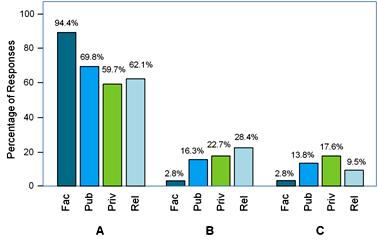
Percentage of New England faculty (Fac) versus college students from public secular (Pub), private secular (Priv), and religious (Rel) institutions who believe one of the following statements describes them best: (A) I accept evolution and express it openly regardless of others’ opinions; (B) no opinion; and (C) I accept evolution but do not discuss it openly to avoid conflicts with friends and family.
Why does acceptance of evolution matter? Because public acceptance of evolution in the United States (about 40 percent) correlates with support to: (1) proper science education in public schools; (2) science and technology as essential components of development and prosperity; and (3) rationalism and freedom of thought, all indisputable ingredients for a thriving society.
And it also matters because only the highly educated university professors of New England — hopefully of the nation — have levels of acceptance of evolution (97 percent according to our study) comparable to or higher than the ordinary public in other industrialized countries of Northern and Western Europe.
Because attitudes toward evolution correlated positively with understanding of science and negatively with religiosity and political ideology, aspects examined in our study, we concluded that science education combined with vigorous public debate should suffice to increase acceptance of naturalistic rationalism and decrease the negative impact of creationism and intelligent design on collective evolution literacy. — © 2011 by Guillermo Paz-y-Miño-C. all rights reserved
For original scientific article (New England Faculty and College Students Differ in Their Views About Evolution, Creationism, Intelligent Design, and Religiosity), published in Evolution Education & Outreach, click on [PDF]
* * *
Recommended Book: Evolution, Creationism, And The Battle To Control America’s Classrooms, by Michael Berkman & Eric Plutzer click on book for link

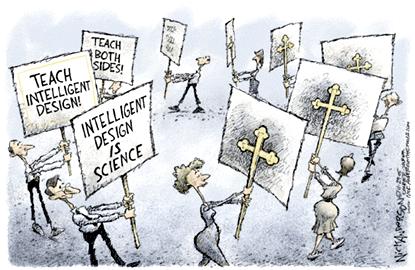
Cartoon: Intelligent Design as Science…
Cartoon: Biology 101… The Lord Censored Textbooks

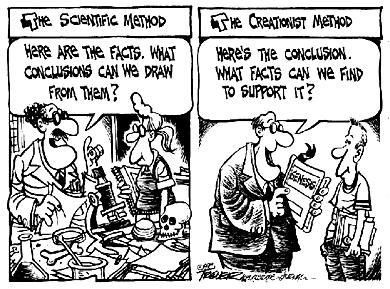




 Evolution Literacy
You must be logged in to post a comment.