Imminent Collapse of Basic Science Under For-profit Model

By Guillermo Paz-y-Miño-C PhD — © 2015

New England Science Public – An Initiative for the Public Understanding of Science – on Twitter @EvoLiteracy@gpazyminoResearchGateAcademia.edu

Imminent Collapse of Basic Science Under For-profit Model

[click on subtitle to be redirected to The Standard Times]

“…A collapse of America’s world-leading research is imminent if higher education adopts a purely for-profit financial model… And I caution the reader to distrust when the word ‘evolution’ is deployed to advertise laissez-faire investments in academia.”

Each time my students insist that natural selection, “Darwin‘s Theory” of 1859, is the “survival of the fittest,” I correct them, but futilely –in some cases— since this misconception has permeated into popular culture as an infectious catchphrase, an adverse “meme,” which continues to be reinforced by inadequate education.
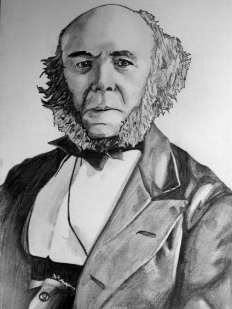
Herbet Spencer

Herbert Spencer (1820-1903), British intellectual, author of Principles of Biology (1864); in his book, Spencer used the phrase “survival of the fittest” in reference to Charles Darwin’s concept of natural selection (1859). Image by Deansta.

It was polymath Herbert Spencer, not Charles Darwin, who, in 1864, introduced the expression “survival of the fittest” in Principles of Biology, one of Spencer’s many books in multiple fields, including philosophy, economics, sociology and politics.

Although Darwin did use Spencer’s term in the fifth edition of the Origin of Species (1869), for “accuracy” and “convenience,” since survival of the “most fit” paralleled nature, where the highly adapted organisms to the environment endured and left descendants, he never advocated for the abuse of the concept of natural selection in human affairs. Darwin knew better and alerted how the struggle for life could lead to the extinction of entire populations and species.

The cut-throat economists of the late 19th century in the United Kingdom, United States and Western Europe, however, did see in Darwin’s work the “biological, natural foundations” to justify “laissez-faire capitalism,” or the freedom to do as they will in the market; to become most financially robust, via “competition,” and, thus, overpower the “unfit,” whose survival became their own fiscal responsibility. This twisted view of social existence, popular among Victorian financiers of the 1870s, still sanctions the contemporary accretion of wealth by the top 0.1%, which, in the United States, is almost the same as the entire bottom 90%.

The reality above concerns me as a citizen of our interdependent world since laissez-faire economic policies have generated the most inequality in the United States since the 1940s. But what further worries me, as an evolutionary biologist, is the current and contagious misuse of Darwinian terminology to characterize trends of institutional development at colleges and universities. And I caution the reader to distrust when the word “evolution” is deployed to advertise laissez-faire investments in academia.

A collapse of America’s world-leading research is imminent if higher education adopts a purely for-profit financial model (watch documentary Ivory Tower). I will restrict my analysis of this complex phenomenon to highlighting some crucial points.

According to the National Science Foundation Enterprise Information Systems, more than 70% of the research awards (by amount received) are granted annually to the top 100 academic institutions in the United States. The top 50 institutions take more than half of the awards; the top 10 take about 15%; and all other institutions take roughly 25%. This trend has remained steady from 2005 to 2013. In essence, the non-ranked institutions have low probability of capturing meaningful, competitive extramural support –one quarter of it is “catchable” via competition among all such institutions in the country.

NSF Awards to Academic Institutions 2013

Percentage of Awards to Academic Institutions (by amount received). On average, more than 70% of NSF awards go to the top 100 academic institutions in the United States. Source: NSF Enterprise Information Systems – October 1, 2013

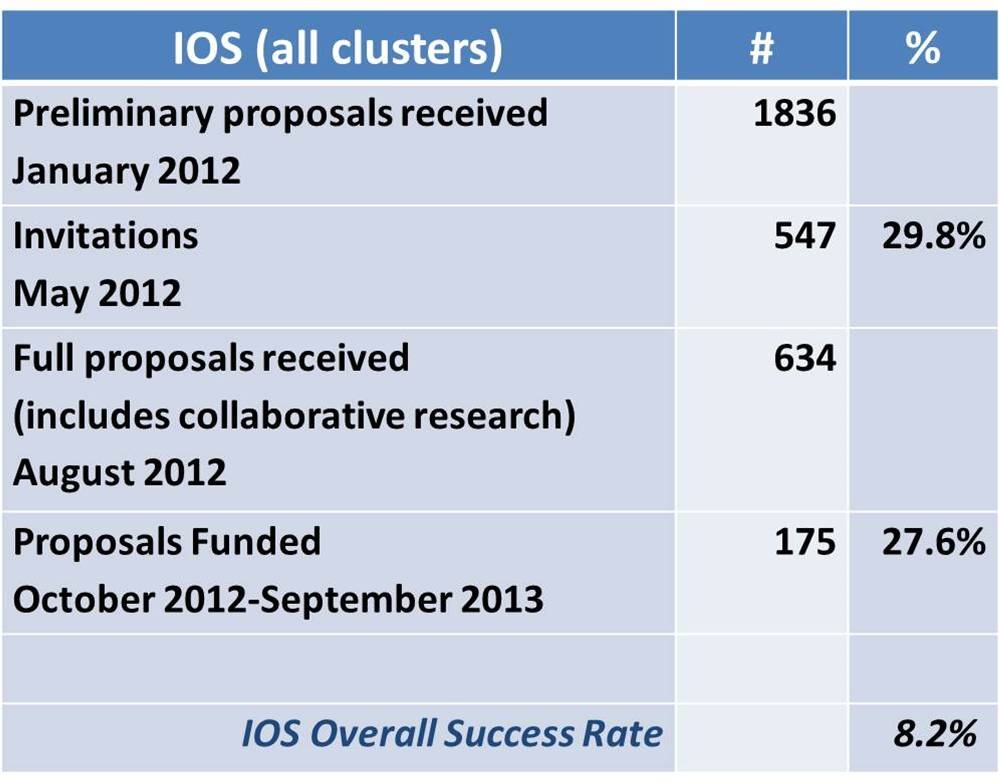
Within the Division of Integrative Organismal Systems (IOS) at NSF, which oversees funding in the bio-sciences, there was a 43% increase in the yearly amount of grants submitted from 2001 (less than 1,500 proposals) to 2010 (just above 2,000 proposals). Yet IOS-NSF decreased funding by 14% during the same decade. In fact, by 2014, the IOS-NSF overall success rate of awarded proposals was 8.2%.

IOS Proposal Submissions and Awards 2001 to 2010

Integrative Organismal Systems Proposal Submissions and Awards: 43% increase in proposal submissions and 14% decrease in funding (2001 to 2010). Source: IOS-NSF
IOS-NSF funding trends

Analysis of Integrative Organismal Systems (IOS) Preliminary Proposal Submission System at NSF. Rationale of data: 29.8% = 547 / 1,836; 27.6% = 175 / 634; and 8.2% corresponds to 150 projects ultimately awarded by NSF (= 150 / 1,836). Source: IOS-NSF

The situation for under-represented minority investigators, who conduct research in fields within the IOS-NSF sponsoring scope, continues to be disturbing: while success rate in funding increased from 4% to 7%, from 2008 to 2011, respectively, it decreased to below 6% in 2012 and 2013.

NSF funding Under Represented Investigators

Awards to Under-Represented Investigators. Less than 6% of the awards go to minority researchers. Source: IOS-NSF

But the major problem goes beyond the historically scarce funds for research. Instead, it relies on shifting from basic science –which generates new knowledge, is profound, bold, risk-taking and impactful long-term— to valuing mostly applied, profitable, safe translational work (= development spending) that benefits society in the short-term and can be “sold” to the taxpayer under the slogan that higher education and its research are “evolving” in such worthy direction.

Why should such a model of promised prosperity work at academic institutions when it already failed at the national market-oriented economy, and at a rate of 0.1% (top) versus 90% (bottom)? Why would it create sustainable research at non-ranked universities if it is destined to benefit the top 100, and at a rate of 70% (top) versus 25% (bottom)? It does not make scientific sense to imitate such a path under the vision of “survival of the richest.” But it can, of course, create the illusion that, as long as we believe in it, or try it, most of us will join the elite.

And, as per “evolution,” let us evoke it when we actually understand the concept of gradual change with modification and ancestry, driven by the laws of nature, and explained to our students and the public by competent scholars, not by the whim of the wealthy. — © 2015 by Guillermo Paz-y-Miño-C. all rights reserved.

Suggested Articles in Peer-reviewed Journals, plus an undergraduate honors thesis (!):

Unlikely Funding – BioScience 2014

Reforming Science: Structural Reforms -IAI Journal 2012

Funding Troubles for Evolution and Ecology – Current Biology 2011

Lost in Translation: Basic Science in the Era of Translational Research – IAI Journal 2010

And my favorite, an Honors Thesis by undergraduate Sam Shapiro Federal R&D: Analyzing the Shift from Basic and Applied Research toward Development – Department of Economics, Stanford University 2013

Recommended Documentary & Books:

Books About Ivory Tower

Related Articles:

Dehumanizing Academia by Dismantling the Humanities

Fragmentary Truths and the Intellectual Imbalance in Academia

Evolution Illiteracy at America’s Colleges and Universities

Massachusetts Gets an A- in Science Standards

The Incompatibility Hypothesis: Evolution vs. Supernatural Causation

Reviews of Evolution Stands Faith Up: Reflections on Evolution’s Wars

Science Challenges Golden Age of Violin Making

Dr. Guillermo Paz-y-Miño-C — © 2015

New England Science Public – An Initiative for the Public Understanding of Science – on Twitter @EvoLiteracy@gpazymino – ResearchGate Academia.edu

Golden Age of Violin Making Challenged by Modern Science

[click on subtitle to be redirected to The Standard Times]

“…As for the value of a Stradivari or a Guarneri del Gesu, they are priceless relics of our collective history, treasures from our always evolving civilizations. I wish they continue to be preserved for eternity, to be fervently admired for what they mean and meant; but not for what they no longer are.”

Stradivarius 60 minutes Evolution Literacy

Anastasiya Petryshak playing a Stradivarius at the Violin Museum of Cremona, Italy (CBS 60-Minutes, click on image)

Unsubstantiated beliefs interfere with the acceptance of evidence. Belief is a powerful cultural pollutant: it disrupts, distorts, delays and stops the assessment of reality, what I call in my academic work “the 3Ds + S cognitive effects of illusory thinking.” Indeed, I explore, at a scientific level, why people struggle when confronting inner beliefs with facts, and for that I examine acceptance of evolution by highly educated audiences —university professors, educators of prospective teachers, and college students at elite institutions, who, despite their fine education, embrace distinctive degrees of superstition.

But illusory thinking is not restricted to deniers of evolution or human-induced climate change, another truth rejected by the general public (although less frequently by the literate) upon the conviction that “as long as we faithfully repudiate imminent environmental menace, it shall never happen.”

Self-deceptive ideas, collectively or individually reinforced, affect our ordinary living; and science keeps documenting astonishing examples:

Let’s celebrate the New Year with music and with the most revered classical instrument, the violin. World class virtuosos believe that instruments crafted during the Golden Age of violin-making (1550s to 1750s), by Antonio Stradivari or Giuseppe Guarneri “del Gesu,” outshine the quality of other violins, chiefly the contemporary ones.

Various attributes have been hypothesized to account for the tonal superiority of Old Italian violins: local weather effects on wood growth, density of early– and late–growth layers in the wood, chemical treatment of the timber, varnishing, plate-tuning techniques, and the spectral balance of the radiated sound (efficient energy propagation in each of the instrument’s sound–producing–frequencies). However, no tests had been conducted to discern between the professed value (monetary, historical, or just musical) ascribed to the antique violins in respect to the plain acoustics of their modern counterparts.

Violin Making Evolution Literacy

Violin Making — Where And How To Start If You Want To Make Violins?

The first properly controlled study on player preferences among old and new violins was published in 2012, in the Proceedings of the National Academy of Sciences (PNAS). In it, 21 experienced violinists played and compared instruments crafted by Stradivari (one violin) and Guarneri del Gesu (two violins) with three new, exquisite exemplars. Under double-blind conditions, in which neither the violinists nor the experimenters knew the identity of the instruments, the players preferred the new violins over the old. In fact, the least appreciated was the Stradivari. And most players seemed unable to tell whether their favorite instrument was new or old.

“…the perceived monetary and historical value of the Old Italian violins were so ‘cognitively influential’ that they likely primed the violinists to believe that such instruments had better tonal quality…”

The combined estimated price of the antique violins was $10-million, about one hundred times that of the new instruments. And this was precisely what Claudia Fritz and her collaborators at the National Center of Scientific Research, University of Paris, who coauthored the study, intended to bring to our attention: both the perceived monetary and historical value of the Old Italian violins were so “cognitively influential” (my emphasis) that they likely primed the violinists to believe that such instruments had better tonal quality.

Of course Fritz and collaborators’ study ignited emotional responses among musicians. The very violinists who judged the virtues of the instruments hardly accepted the results of the trials. The research challenged conventional wisdom and a five-century old tradition. “There is nothing like an Old Italian violin sound,” goes the saying.

Violinis Itzhak Perlman 60 minutes Evolution Literacy

Violinist Itzhak Perlman “If you want to play a pianissimo, that is almost inaudible and yet it carries through a hall that seats 3,000 people, there’s your Strad… I can actually see the sound in my head …it has silk. God, it’s so difficult to describe …there is a sparkle to the sound.” (CBS 60-Minutes, click on image)

To overcome the passionate criticism –scientists adore rebuttals— Fritz and her team published a second paper in PNAS, in the spring of 2014. Their follow-up study contrasted soloist evaluations of six Old Italian (five Stradivari) and six new violins, thus increasing the sample size and sharpening the methods. Ten renowned virtuosos evaluated the instruments under, again, double-blind experimental conditions.

Six out of the 10 performers chose the new violins as “most preferred” over the Old Italians. The soloists also rated higher the preferred new violins than the older instruments in playability, articulation and projection; and at least equal to an old violin in timbre. Fritz and coauthors bravely reiterated: “some studies open new fields for investigation; [ours] attempts to close a perennially fruitless one —the search for the ‘secrets of Stradivari.’ Great efforts have been made to explain why instruments by Stradivari, and other Italian makers, sound better than high-quality new violins, but without providing scientific evidence that this is, in fact, the case.”

Belief disrupts, distorts, delays or stops the acceptance of scientific evidence. And only science can ultimately guide us to accurately explore reality, to demystify the polluters of our perception. As for the value of a Stradivari or a Guarneri del Gesu, they are priceless relics of our collective history, treasures from our always evolving civilizations. I wish they continue to be preserved for eternity, to be fervently admired for what they mean and meant; but not for what they no longer are. — © 2015 by Guillermo Paz-y-Miño-C. all rights reserved.

Related Articles

Dehumanizing Academia by Dismantling the Humanities

Fragmentary Truths and the Intellectual Imbalance in Academia

The Incompatibility Hypothesis: Evolution vs Supernatural Causation

Bill Nye defeats Ken Ham at Creation Museum

Evolution Stands Faith Up: Reflections on Evolution’s Wars

On Francis Collins’ and Karl Giberson “The Language of Science and Faith”


Dehumanizing Academia by Dismantling the Humanities

Dr. Guillermo Paz-y-Miño-C — © 2014

New England Science Public – An Initiative for the Public Understanding of Science – on Twitter @EvoLiteracy@gpazymino

Dehumanizing Academia

[click on subtitle to be redirected to The Standard Times]

“…our history and future survival as prosperous civilizations will depend on the integration of what we discover about ourselves via science, about our bodies, brains and cultures, and on what we internalize from such discoveries via the humanities, the sentinels of knowledge in society…”

Edward O Wilson BBC2 Evolution Literacy Paz-y-Mino-C

Harvard Professor Edward O. Wilson during the interview posted online by BBC2’s Newsnight

In his latest book (2014), “The Meaning of Human Existence,” Harvard Professor Edward O. Wilson, 85, makes an unwise remark: he calls Oxford Professor Richard Dawkins, 73, an “eloquent science journalist.” If Wilson’s intention had been to plea for higher standards in contemporary media reporting, then Dawkins’ exquisite communication skills, proficiency in science, sharp intellect, and always controversial presence (in the right journalistic sense), would have made him a robust role model for investigative journalism. But Wilson aimed at demeaning Dawkins by invoking the character of a profession, one that has given coverage to Wilson’s career during half a century.

The Guardian (U.K.) titled the Wilson vs. Dawkins exchange a “biological warfare.” Perhaps by now the reader realizes how journalistically treasured are these scuffles. But The Guardian’s story itself fed on a previous BBC2’s Newsnight interview, where Wilson reiterated his judgment about Dawkins. Via Twitter, Dawkins responded by reaching out to his one million followers: “anybody who thinks I’m a journalist, who reports what other scientists think –as Wilson described Dawkins’ work— is invited to readThe Extended Phenotype.” The latter, published in 1982, is a follow up to the famous “The Selfish Gene” of 1976; both outstanding scientific contributions to theoretical biology.

Richard Dawkins Evolution Literacy Paz-y-Mino-CBefore going any further, it is indeed imprudent to use the term “science journalist” as a dishonor, to discredit a colleague, and to inattentively belittle a vital occupation.

The Wilson-Dawkins crossfire was triggered by Dawkins’ review of Wilson’s earlier book “The Social Conquest of Earth” of 2012. In it, Wilson drifted away from a well established concept in biology, called Kin Selection, which helps understand why organisms that cooperate with close relatives, more than with strangers, can improve survival and reproduction, thus leaving descendants who carry the traits that make them social and altruistic. The evolution of high sociality, cooperation, altruism and intelligence in the human animal are often explained under kin selection theory (natural selection ultimately favoring kin).

Kin selection is an experimentally documented phenomenon, supported by most evolutionary biologists, to the point that when Wilson and collaborators wrote an article for Nature, in 2010 (which became part of a contentious chapter in “The Social Conquest of Earth”), challenging the kin selection principle and suggesting that high cooperation and altruism can still evolve regardless of kinship, 137 world scientists authored and signed a debunk-letter-to-the-Wilson’s position, which Nature published the following year. [Note that in a paper published in PLoS Biology, March 23, 2015, authors Liao, Rong and Queller completely dismiss the Wilson’s team proposal of 2010; in fact, Liao et al. state that “all… apparently novel conclusions –in the Nature’s 2010 article– are essentially false”].

E O Wilson Books Evolution Literacy Paz-y-Mino-CIn the 2010 paper, Wilson and associates acknowledged that kin selection could still work, but that an alternative scenario based on a combination of individual and group selection, not necessarily closely related members, results in a mathematically sounder model than the “elderly” –ossified– kin selection. The same assertion appeared in Wilson’s “The Social Conquest of Earth,” about which Dawkins –after borrowing words attributed to American poet and satirist Dorothy Parker— declared: “this is not a book to be tossed lightly aside. It should be thrown with great force.” And sincere regret (Dawkins’ emphasis).

“…Creationists, of course, grew excited about the scientists’ disagreement. Not so fast. Evolution is true regardless of the dispute over kin selection…”

Creationists, of course, grew excited about the scientists’ disagreement. Not so fast. Evolution is true regardless of the dispute over kin selection [note that researchers are constantly reexamining hypotheses and paradigms, for example, see discussion about Standard Evolutionary Theory SET versus Extended Evolutionary Synthesis EES in Nature]. And both Wilson and Dawkins, as evolutionary biologists, are secular, openly and vigorously opposed to creationism, including Theistic Evolution, Creation Science, Intelligent Design, and Evolutionary Creation; all represent belief-based views of reality, which impose a Creator or Designer in the background of causality. Wilson and Dawkins have categorically stated that there is no scientific evidence in support of any style of creationism.

“…[the] American universities… seem committed to turning off the humanities, dismantling the social sciences, and replacing them with for-profit, translational research to generate goods for patents and commercialization…”

Unfortunately, the message Wilson sought to convey in “The Meaning of Human Existence” was eclipsed by the exchange with Dawkins; Ed threw unnecessary punches, while Richard diverted them back with customary power; a fight with no winner. And Wilson’s book is crucially important to raise awareness about the current dehumanization of academia at American universities, which seem committed to turning off the humanities (philosophy, history, archeology, anthropology, arts, law, literature and linguistics), dismantling the social sciences, and replacing them with for-profit, translational research to generate goods for patents and commercialization; a path leading to the extinction of curiosity-driven science and risk-taking ideas, which have modernized fundamental scientific work: wisdom driven.

In closing, Wilson makes an excellent connection between human evolution and the humanities. He reasons that our history and future survival as prosperous civilizations will depend on the integration of what we discover about ourselves via science, about our bodies, brains and cultures, and on what we internalize from such discoveries via the humanities, the sentinels of knowledge in society (including journalism, my emphasis). And he envisions the relevant humanities under no faith: “the best way to live in this real world is to free ourselves of demons and tribal gods.” — © 2014 by Guillermo Paz-y-Miño-C. all rights reserved.

Related Articles

Fragmentary Truths and the Intellectual Imbalance in Academia

The Incompatibility Hypothesis: Evolution vs Supernatural Causation

Bill Nye defeats Ken Ham at Creation Museum

Evolution Stands Faith Up: Reflections on Evolution’s Wars

On Francis Collins’ and Karl Giberson “The Language of Science and Faith”

Editing Darwin to Reach the Almost Unreachable Reader

Editing Darwin to Reach the Almost Unreachable Reader

Dr. Guillermo Paz-y-Miño-C — © 2014

New England Science Public – An Initiative for the Public Understanding of Science – on Twitter @EvoLiteracy@gpazymino

…If we possessed a perfect pedigree of mankind, a genealogical arrangement of the [ethnicities]… would afford the best classification of the various languages… [If] all extinct languages, and all intermediate and slowly changing dialects, had to be included, such an arrangement would… be the only possible one.

In 1859, Charles Darwin wrote, so Darwinianly, the passage above in “On the Origin of Species by Means of Natural Selection, or the Preservation of Favoured Races in the Struggle for Life.” He envisioned the roots and evolution of languages via common ancestry, a process of gradual modification, from simple to diversified variants over time. In modern terms: an evolutionary phenomenon, not only factual for organisms that communicate complexly with one another, but also a feature detectable in non-human animal cultures (when sophisticated cognition allows culture), vocalizations and signals inherited through learning rather than by means of exclusive genetic programming.

The_Readable_Darwin_Evolution_Literacy_Paz-y-Mino-CPerhaps Darwin envisioned –as I wish to think— that his own Victorian writing style of the 1800s would change, drift comparably to a dialect, and in the future require a “translator” to bring up to date the Darwinian message. And this is what my valued colleague, Jan A. Pechenik, Professor of Biology at Tufts University, has done. In his 2014 “The Readable Darwin: The Origin of Species, as Edited for Modern Readers,” Jan takes the challenge to adapt the century-and-a-half-old book for a contemporary audience. And he does it in a unique manner: rather than abridging the text as, for example, in Richard Dawkins’ 2008 elegant audio-book narration of the first edition of The Origin; or expanding it, as in David Quammen’s 2008 illustrated volume, which includes hundreds of historic images, Pechenik sharpens the text, edits it to make it legible in current American English by, I suspect, primarily our youth.

Pechenik knows that in the Era of Vast Intellectual Emptiness, ours, when communication is not only restricted to the 140 characters of a tweet, but to the out-of- grammar, rebelliousness to syntax, or no spelling-rules revered by the blogging industry, persuading the public to treasure Darwin is almost impossible. Pechenik relies, however, on his college-instructor intuition, his patience and responsibility as educator, to be confident that some minds can be rescued, and that “…[this] wonderful reminder of the incredible diversity of life on [our] planet Darwin’s book  and honest argument [for evolution] based on evidence and logical thinking…” cannot continue to be rarely appreciated under the excuse that allegorical writing, the Victorian style, is unattractive to those whose neurons operate only when plugged into electrical appliances.

You care for nothing but shooting, dogs, and rat-catching, and you will be a disgrace to yourself and all your family” reads the opening quote to Pechenik’s preface in “The Readable Darwin.”

…A rebuke attributed to Darwin’s father when struggling to reason with the juvenile Charles, whose uncertainty to pursue an honorable occupation –either medicine or the clergy, as he attempted first in Edinburgh, 1825-1827, and later in Cambridge, 1827-1831, respectively— became a family concern. Thus Pechenik knows how to relate to the standard career-undecided college student, how to invite him/her to accept Darwin and fall in love with Charles’ story, his voyage on board of the Beagle (1831-1836), and his forever important contribution to universal knowledge and human history.

In “The Readable Darwin,” Pechenik edits The Origin under the recommendations of his own “Short Guide to Writing About Biology” (eight edition, 2012). He eliminates the copious prepositions (much common among Victorians), polishes the “Wimpy Verb Syndrome” (i.e. the use of multiple verbs to refer to a single action), warns us that examples are about to be generously listed, rather than appearing unannounced in long paragraphs; incorporates definitions of terms (not often given by Darwin), and reorders the sentences to convey the message straightforwardly. And Pechenik succeeds at editing Darwin without disrupting the beauty of the prose or distorting the message. To accomplish this, Pechenik recurs to his reflective understanding of Darwin, to his solid background in evolutionary biology and textbook-writing skills.

Each of the eight chapters edited in “The Readable Darwin” starts with an explanatory mini introduction to: Variation Under Domestication (Chapter 1), Variation in Nature (Chapter 2), The Struggle for Existence (Chapter 3), Natural Selection, or the Survival of the Fittest (Chapter 4), Laws of Variation (Chapter 5), Difficulties with the Theory (Chapter 6), Miscellaneous Objections to the Theory of Natural Selection (Chapter 7), and Instinct (Chapter 8). About one hundred color images illustrate the chapters (note that Darwin’s Origin had only one visual, a roughly sketched evolutionary tree), footnotes, online resources, links to videos, and a list of classic and modern references.

Illustration_Origin_of_Species_Evolution_Literacy_Paz-y-Mino-C

The only illustration in Darwin’s On The Origin of Species (1859) was a roughly sketched evolutionary tree

I find of particular value the section Key Issues to Talk and Write About at the end of the chapters, where the reader, or an instructor using the book for proper college education, is confronted with testing queries and themes to essay about. This exposes the rigorous mind of Pechenik, the Professor, who now, after assisting the bookworm to enjoy the digested text, wants to know if some actual retention of content took place, if critical thinking can be exercised once each chapter has been handled to the reader-learner in a gracious format. But Pechenik goes beyond that: in Appendix A: Other Books by Charles Darwin, he overwhelms us with descriptions of fifteen additional books and four monographs authored by Darwin between 1839 and 1881, thus broadcasting that Darwin’s giving to science was monumental.

The Readable Darwin” is suitable for all audiences, particularly college instructors, undergraduate and graduate students, and I eagerly await for the second book in which Pechenik will present us with the remaining seven edited chapters of the 1872 sixth edition of The Origin. I emphatically recommend Pechenik’s work to those in administrative positions in academia, and to creationists who reject the reality of evolution; both audiences need rigorous schooling in matters of evolution — © 2014 by Guillermo Paz-y-Miño-C. all rights reserved.

Related Articles:

On the Wrongly Called “The God Particle”

Evolution Stands Faith Up: Reflections on Evolution’s Wars

On Francis Collins’ and Karl Giberson “The Language of Science and Faith”

Evolution illiteracy at America’s colleges and universities

Evolution illiteracy at America’s colleges and universities

Dr. Guillermo Paz-y-Miño-C — © 2014

New England Science Public – An Initiative for the Public Understanding of Science – on Twitter @EvoLiteracy@gpazymino

Belief in supernatural causation disrupts, distorts, delays or stops the acceptance of scientific evidence. These 3Ds + S are upshots of the inner struggles between an individual’s unsubstantiated convictions faith and its collisions with the empirical reality. And there is no better landscape to document the incompatibility between belief and facts than investigating if and how people accept evolution.”

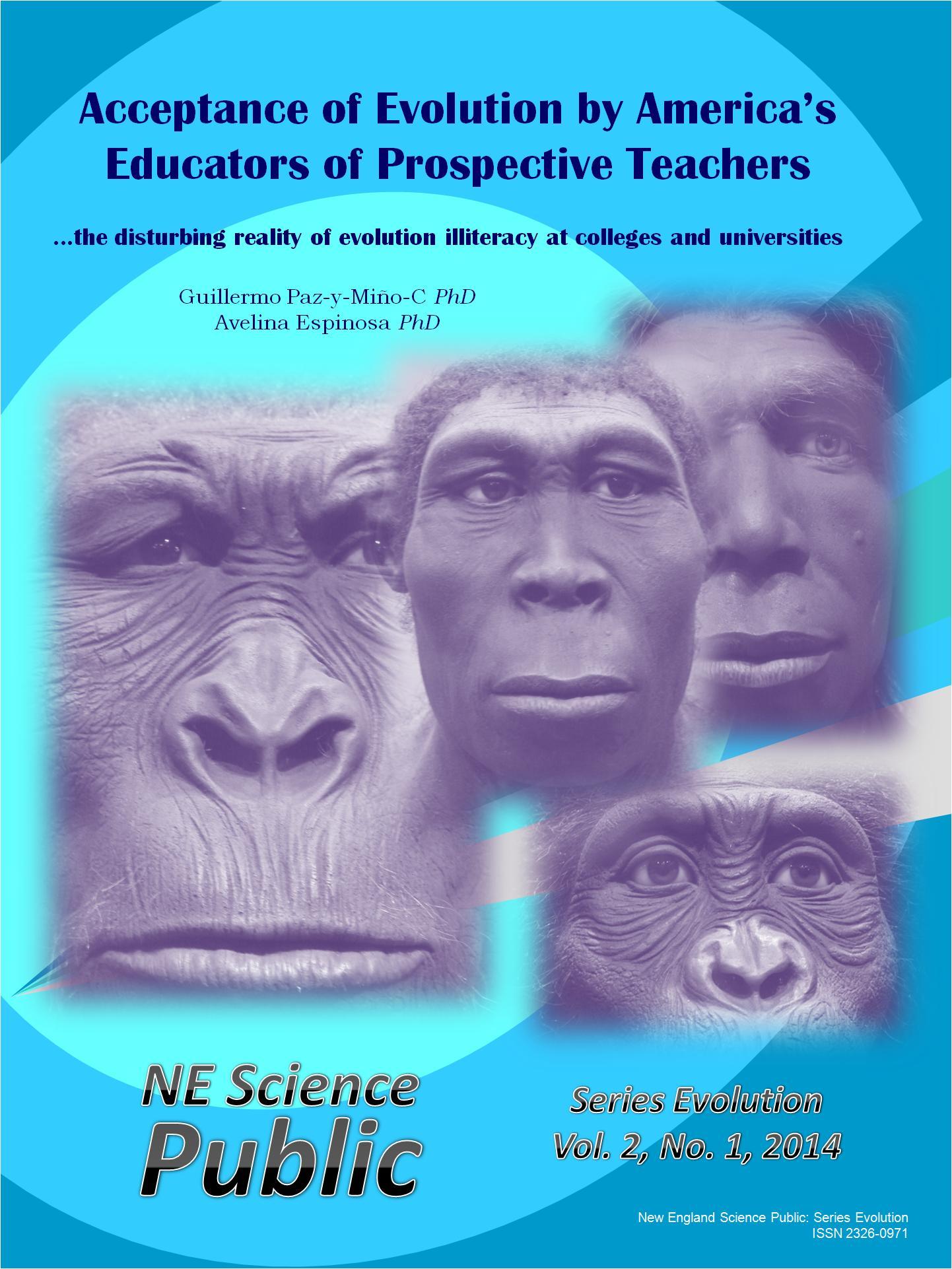
Paz-y-Mino-C_NESP cover Evolution Study 2014     In collaboration with Dr. Avelina Espinosa, a biologist at Roger Williams University, US, we have postulated that the controversy over evolution-and-science versus creationism is inherent to the incompatibility between scientific rationalism/empiricism and the belief in supernatural causation. The ‘incompatibility hypothesis’ (IH) helps us explain the everlasting antagonism in the relationship between science/evolution and religion.

     Our latest study is titled ‘Acceptance of Evolution by America’s Educators of Prospective Teachers,’ to which the New England Science Public Series Evolution –where the work was just published— has added the subheading ‘The Disturbing Reality of Evolution Illiteracy at Colleges and Universities.’ In it, we rely on IH to test the cultural-pollution effects of religiosity on acceptance of evolution by America’s finest education scholars; that is, university professors specialized in training future teachers.

     Previous reports about public acceptance of evolution in the US (around 40%, a rate distant from the top countries’ 80%, like Ireland, Denmark, Sweden, France or Japan) have examined the role of religiosity in the rejection of evolution; but only few studies have characterized the influence of religion on evolution’s endorsement by elite educators. It has been assumed that higher-education faculty remain distant from belief-based explanations of natural phenomena; a supposition that Dr. Espinosa and I suspected to be false.  

     We studied attitudes toward evolution among 495 educators of prospective teachers affiliated with 281 colleges and universities distributed in 4 regions and 50 states in the US. These professionals (87% PhD or doctorate holders) where polled in five areas: (1) their views about evolution, creationism and Intelligent Design, (2) their understanding of how science and the evolutionary process work, (3) their position about the hypothetical ‘harmony or compatibility’ between science/evolution and supernatural causation, (4) their awareness of the age of the Earth, its moon, our solar system and the universe, and the application of the concept of evolution to the cosmos, and (5) their personal convictions concerning the evolution and/or creation of humans in the context of the responders’ religiosity.

     Acceptance of evolution among these educators was influenced by their level of understanding the foundations of science/evolution and their beliefs in supernatural causation. In comparison to two other populations, whose acceptance of evolution had already been documented in our previous research (i.e. New England research faculty, non-educators, and college students), the educators had an intermediate level of understanding science/evolution, low acceptance of evolution, and high religiosity, as follows:

Acceptance Evolution Educators Evolution Literacy

‘Acceptance of evolution openly’ and ‘thinking that evolution is definitely true’ among educators of prospective teachers in the United States (center). For comparison, New England college students (left) and research faculty (right) are depicted; both have the highest national levels of acceptance of evolution among students and university professors, respectively.

• 59% of the educators accepted evolution openly, 51% thought that evolution is definitely true, and 59% admitted to be religious.

• 94% of the New England researchers accepted evolution openly, 82% thought that evolution is definitely true, and 29% admitted to be religious.

• 63% of the New England Students accepted evolution openly, 58% thought that evolution is definitely true, and 37% admitted to be religious (Figure above).

• Educators in each of the four regions of the US (North East, Midwest, South, and West) had science- and evolution-literacy scores below the researchers’ but above the students.’

• The educators’ rejection of evolution increased, conspicuously, with increasing level of religiosity.

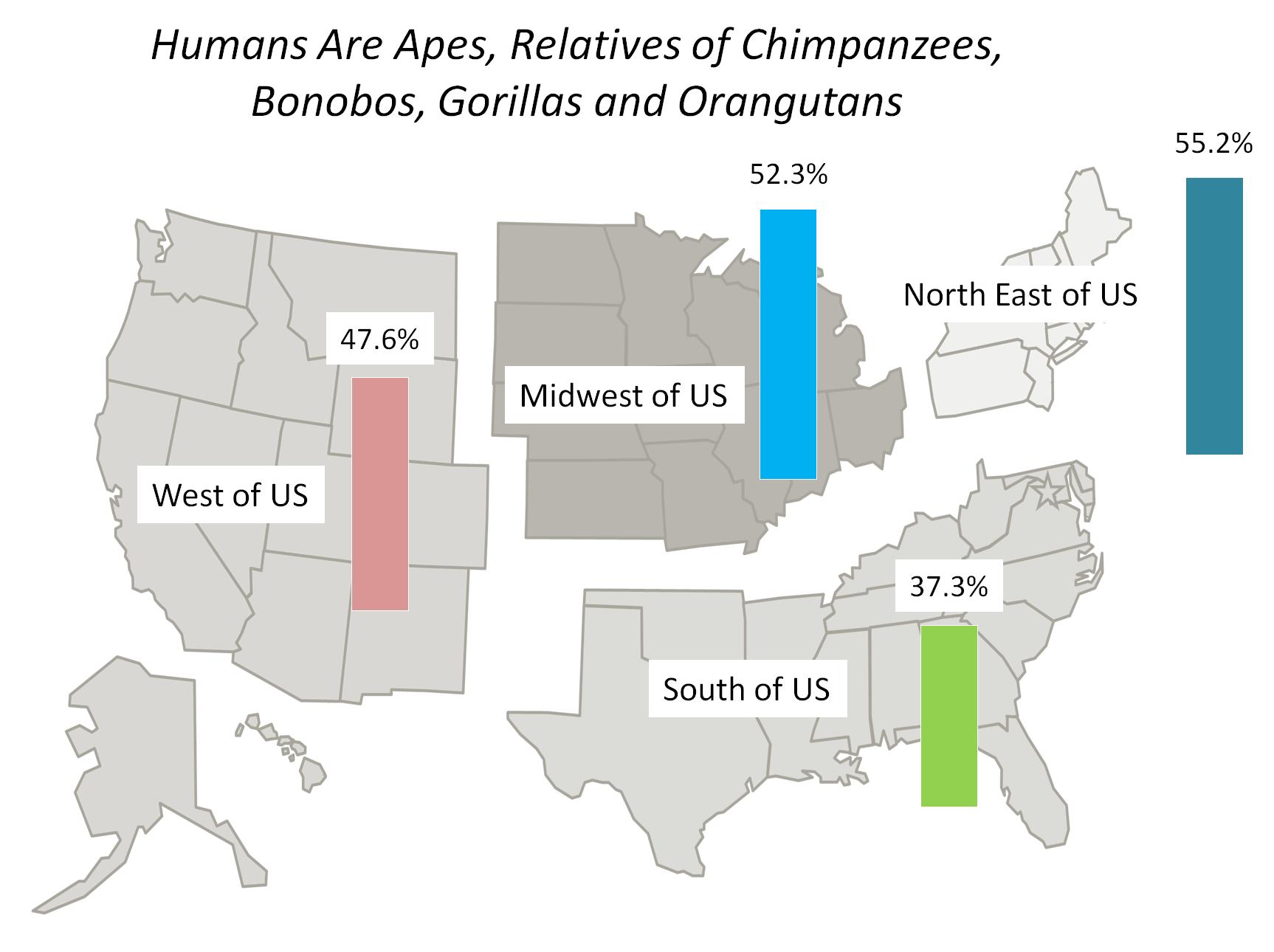
Humans are Apes Evolution Literacy

One of the significant results of the study: only 37.3% to 55.2% of educators of prospective teachers knew (or accepted) that humans are apes, relatives of chimpanzees, bonobos, gorillas and orangutans.

     Our research has led us to conclude that harmonious coexistence between science/evolution and religion is illusory. If co-persisting in the future, the relationship between science and religion will fluctuate between moderate and intense antagonism. — © 2014 by Guillermo Paz-y-Miño-C. all rights reserved.

Note: The complete 92-page study is available open access at New England Science Public; it includes 23 figures, statistics, 34 maps, 12 tables, and a companion slide show ‘Image Resources’ for science journalists, researchers and educators.  

NESP Series Evolution Vol. 2 No. 1 was released on September 15, 2014, in celebration of Captain Robert FitzRoy’s arrival in the Galapagos on September 15, 1835; at that time, the young naturalist Charles Darwin was FitzRoy’s distinguished guest on board of the HMS Beagle.

Reference: Paz-y-Miño-C, G. & Espinosa A. 2014. Acceptance of Evolution by America’s Educators of Prospective Teachers. New England Science Public: Series Evolution 2(1): 1-92. [PDF] and supplementary ‘Image Resources’.

 Related Articles and Media Reports:

Richard Dawkins Foundation Newsletter: Evolution Illiteracy among America’s Finest Educators

Why people do not accept evolution?

The Incompatibility Hypothesis (IH): evolution versus supernatural causation

The Boston Globe Metro: Basic knowledge of Darwin’s theory lost in some classes

Boston.com: Happy Birthday, Charles Darwin!

South Coast Today: Evolution misunderstood by students, faculty

Hiking among Trilobites, Ancient Whales and Dinosaurs

Dr. Guillermo Paz-y-Miño-C — © 2014

New England Science Public – An Initiative for the Public Understanding of Science – on Twitter @EvoLiteracy@gpazymino

Museums Display Truth of Evolution

[click on subtitle to be redirected to The Standard Times]

“Q?RIUS is about ‘Early Youth Engagement through Science;’ the visitor [to the museum exhibit] acts as curator, protector of Nature’s treasures. Thus Q?RIUS empowers our youth’s innate curiosity to seek and value the truth. And there is no more powerful scientific truth than evolution.” 

Albertosaurus Evolution Literacy G Paz-y-Mino-C photo

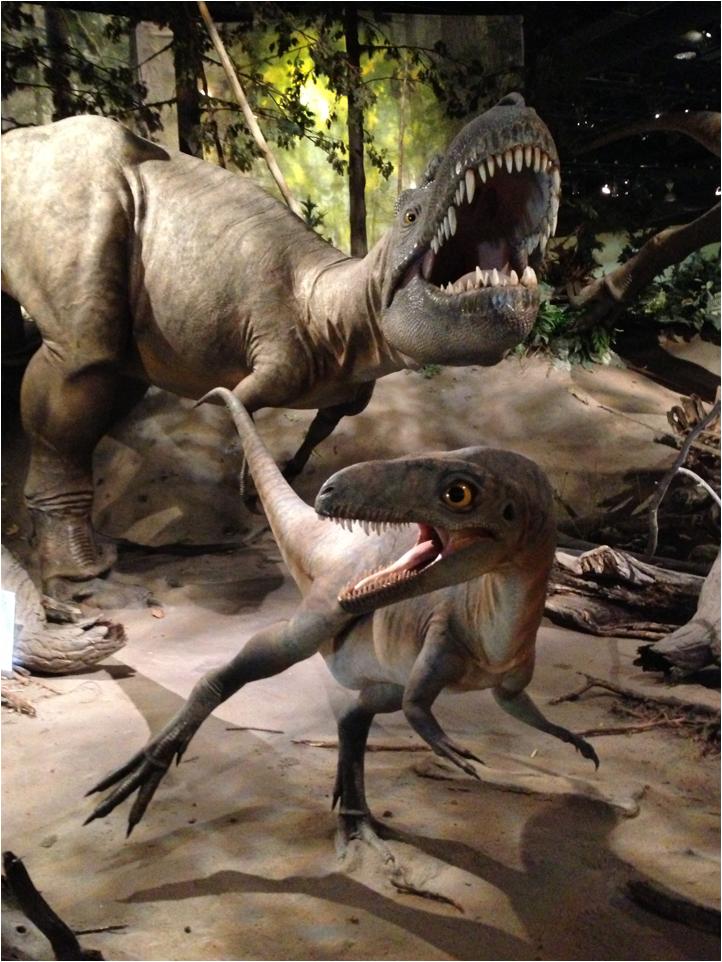
Albertosaurus —earlier relatives of Tyrannosaurus rex. Discovered by Joseph B. Tyrrell, in 1884, the “Alberta Lizards” were endemic to today’s Alberta region, in Canada, and ruled the top-predator occupation 70 million years ago; Royal Tyrrell Museum; GPC photo © 2014

I have previously stated that to be reassured that evolution is true one simply needs to visit the New Bedford Whaling Museum. Its displays of skeletons of a North Atlantic right whale with a calf, a humpback, a juvenile blue, and a sperm whale can impress anyone curious to compare human bones to those of cetaceans. And such comparison suffices to infer that common ancestry connects mammalian sea gallopers — whales and dolphins — to us, the upright bipedal apes who live in cities and launch vessels to explore the stars.

My addiction to the splendid North American science museums — antidotes to the impostors “Genesis Park” or “Creation Museum” — will remain pleasurably incurable. But a latest visit to the Smithsonian National Museum of Natural History, in Washington, D.C., was certainly unique. It started while hiking among 540-million-year-old trilobite fossils, at the Burgess Shale deposit in the Canadian Rockies. What used to be the bottom of the sea is, nowadays, layers of flaked rock at 6,900 feet elevation, evidence that Earth’s crust moves and shapes the imposing mountains.

In 1909, Charles D. Walcott, paleontologist and secretary of the Smithsonian Institution, discovered the first fossils of the Burgess Shale. He later brought to the National Museum of Natural History 65,000 specimens, mostly collected at Fossil Ridge, which runs from the Wapta Mountain to Mount Field, in British Columbia.

When alive during the Cambrian, the now fossilized Burgess Shale organisms anchored themselves to the sea floor, some were sessile, or dwellers on the muddy substrate, a few swam freely. Sponges, plenty of algae and arthropods like trilobites, or chordates like Pikaia (a tiny elongated and laterally flattened fish-shaped swimmer, related to modern vertebrates) enriched the biodiversity of the oceans. The most appealing to me are the trilobites and the predator Anomalocaris.

Trilobites Evolution Literacy G Paz-y-Mino-C photo

540-million year old trilobite fossils at the Burgess Shale deposit in the Canadian Rockies; what used to be the bottom of the sea is, nowadays, layers of flaked rock at 6,900 feet elevation, evidence that Earth’s crust moves and shapes the imposing mountains; GPC photo © 2014

To envision the complexity of the Cambrian ecology, one must immerse the imagination into the ways of the archaic ocean or, perhaps, enlarge all creatures 12 times their original size and gather people to watch them. The latter is precisely what the Royal Tyrrell Museum of Alberta — the second stop in my journey — has done. A well conceived exhibit helps visitors understand the relevance of the Burgess Shale fossils.

The adventure began in the dark. Spotlights shepherd our eyes to the colorful sponges Vauxia, Takakkawia and Pirania, which cohabited with green algae in an apparently serene environment. The cute trilobites, with their large-cockroach pretense and curled sensory antennae resembling groomed whiskers, emerged while the audience pointed at them with excitement as the lights brightened, thus bringing our sight onto additional life forms, like mollusks, sea cucumbers or velvet worms. This tranquility was interrupted by the sudden illumination of a 3-foot Anomalocaris (actual dimension of the “abnormal shrimp”). This segmented animal, distantly related to today’s arthropods, swam by undulating lateral flaps along its body. With huge eyes on stalks and two arched gripping appendages with spikes, one on each side of the mouth, Anomalocaris predated upon soft-shelled organisms and, arguably, on the armored trilobites.

Anomalocaris Evolution Literacy G Paz-y-Mino-C photo

Anomalocaris about to feed on Canadaspis; below are two sponges Takakkawia. Burges Shale diorama at the Royal Tyrrell Museum; GPC photo © 2014

The Burgess Shale exhibit was, however, just a warm up for what the Royal Tyrrell Museum had to offer: after the Cambrian interpretation dome, a world class display of more than 40 mounted dinosaurs and large mammals followed; a saturation of fauna, from the Triassic, 230 million years ago, to the Pleistocene, 2 million years ago. The museum’s most prominent specimens were the Late Cretaceous Albertosaurus — earlier relatives of Tyrannosaurus rex — discovered by Joseph B. Tyrrell in 1884. These “Alberta Lizards” were endemic to the region and ruled the top-predator occupation 70 million years ago.

Genome Smithsonian Evolution Literacy G Paz-y-Mino-C photo

‘Genome, Unlocking Life’s Code,’ an interactive touch-screen experience about how research in genetics benefits citizens and humanity; Smithsonian National Museum of Natural History; GPC photo © 2014

In its entirety, the Royal Tyrrell Museum of Alberta is a celebration of the 3.5-billion-year history of life on Earth, an elegant showcase of the evidence for evolution. But the Smithsonian National Museum of Natural History — the last stop in my journey — has brought technology and modernity into two contrasting new exhibits: “Genome, Unlocking Life’s Code,” an interactive touch-screen experience about how research in genetics benefits citizens and humanity, and “Q?RIUS,” a hands-on access to real specimens in the Smithsonian collection. Both exhibits are exemplars of effective informal education.

I looked for Q?RIUS eagerly while walking through ancient whale skeletons, hanging from the ceiling, and a diorama of Cetacean evolution: Basilosaurus (35-40 million years ago), Maiacetus (40-49 million years ago), Dorudon (36-38 million years ago), and Llanocetus (34-38 million years ago), which looks comparable to the baleen whales displayed at our New Bedford Whaling Museum.

Q?RIUS is about “Early Youth Engagement through Science;” the visitor acts as curator, protector of Nature’s treasures. Thus Q?RIUS empowers our youth’s innate curiosity to seek and value the truth. And there is no more powerful scientific truth than evolution. — © 2014 by Guillermo Paz-y-Miño-C. all rights reserved.

QRIUS Smithsonian Evolution Literacy G Paz-y-Mino-C photo

Q?RIUS is about ‘Early Youth Engagement through Science;’ the visitor acts as curator, protector of Nature’s treasures; Smithsonian National Museum of Natural History; GPC photo © 2014

Smithsonian Evolution Literacy G Paz-y-Mino-C photo

The splendid Smithsonian National Museum of Natural History in Washington DC; GPC photo © 2014

Fragmentary Truths and the Intellectual Imbalance in Academia

Fragmentary Truths and the Intellectual Imbalance in Academia

Dr. Guillermo Paz-y-Miño-C — © 2014

Department of Biology, University of Massachusetts Dartmouth

[click on title to be redirected to The Standard Times]

“…If we ought to quote E.O. Wilson in the context of what is good for science and science education, then we must look at his unyielding journey in support to fundamental research and long-standing concerns about the future of academia. Although open to dialog with spiritualists, Wilson has never endorsed creationism under the principle of Consilience, nor sponsored profit at the expense of quality schooling…” 

Some months ago, an administrator ventured to school me by asserting: “E.O. Wilson is known for his books in popular science, but his area of research is ants.” I will return to this fragmentary truth after documenting what can be done, following Harvard Professor Edward Osborne Wilson’s example, to make outreach to students —our public— via proper science education.


Above, Professor Edward O. Wilson, painting by Jennie Summerall

When I arrived at UMass Dartmouth in 2007, the evolution wars were at their peak. Although Intelligent Design had been defeated in the 2005 Dover, Pa., trial for violating the rules of science by “invoking and permitting supernatural causation” in matters of evolution and for “failing to gain acceptance in the scientific community,” the 21st century anti-science crusade had just began. Current legislation constraining the teaching of evolution reigns in 12 states.

According to Intelligent Design, evolution could not explain holistically the origin of the natural world or the emergence of intricate molecular pathways essential to life, nor the immense phylogenetic differentiation of biological diversity and, instead, proposed an “intelligent agent,” a designer, as the ultimate architect of nature.

During the process of ripping Intelligent Design apart, earlier variants of creationism resuscitated —mostly in media-driven discussions, which I never considered harmless since they reflected the quiescent mind of the public— and newly emerged as, allegedly, better alternatives to Intelligent Design. I discuss them in my 2013 book “Evolution Stands Faith Up: Reflections on Evolution’s Wars:”

Among the former were Theistic Evolution and Creation Science, creationism in principle and practice (God the maker of the universe, always present in the fore- or background of causality); among the latter was BioLogos (2000s), which aimed at merging Christianity with science by proposing a “model for divinely guided evolution” that required “no intrusions from the outside for its account of God’s creative process, except for the origin of the natural laws guiding the process.”

Supporters of BioLogos suggested that “once life arose, evolution and natural selection permitted the development of biological diversity and complexity,” including humans. After evolution got underway, “no special supernatural intervention was required” (quotes from “The Language of Science and Faith” 2011, co-authored by Karl Giberson and Francis Collins —the latter Director of the National Institutes of Health). In essence, the Creator was done, but remained in touch for eternity! This is, of course, inconsistent with everything we know about reality.

As an evolutionary biologist and university professor, I considered a duty to properly educate my students and prepare them to examine, by themselves, the anti-science cultural pollutants that aim at “zombieing” their minds, “corpseing” their innate spirit of inquiry, and perpetuating societal confusion around empirical discoveries.

New England has the highest acceptance of evolution in the U.S., only 59 percent. Back in 2008, when I first polled the UMass Dartmouth campus, our biology graduates used to join the workforce with an acceptance level evolution of 65 percent; the freshman —right out of high school— were at 52 percent. A year later, in May 2009, after I restructured the core biology courses with an evolutionary perspective, acceptance of evolution jumped to 82 percent among the youngest undergrads. Today, 95 percent of graduating bio-majors accept evolution at UMass Dartmouth, the highest score ever reported for college students in the U.S., and comparable to 97 percent of the New England faculty.

Evolution literacy matters: It correlates with understanding climate change, support for stem-cell research, vaccines, alternative sources of energy, respect for education and human rights.

And this brings me back to my allusion to Professor E.O. Wilson. Indeed, he had (still does) a celebrated career in the study of Hymenoptera (ants, wasps and bees). But there is high complexity in Wilson’s contribution to theoretical science, far beyond “ants” (which vastness has been revealed by his passionate disciples).

Forgive my professorial account: Concepts such as Island Biogeography (1967), the still controversial Sociobiology (1975), Biophilia (1984), Biodiversity (1988), Consilience (1998), “The Creation” in the context of what nature can do to assemble life (2006), are among Wilson’s seminal proposals. But he also co-founded “evolutionary biology” in 1960, in an attempt to address “the intellectual imbalance of biology at Harvard,” and his fears of seeing ecology and evolution “being outgunned, outfunded, and outnumbered” by alternative fields of investigation, as he narrates in “Letters to A Young Scientist” (2013).

If we ought to quote Wilson in the context of what is good for science and science education, then we must look at his unyielding journey in support to fundamental research and long-standing concerns about the future of academia. Although open to dialog with spiritualists, E.O. Wilson has never endorsed creationism under the principle of Consilience, nor sponsored profit at the expense of quality schooling.

The Incompatibility Hypothesis: Evolution vs Supernatural Causation

The Incompatibility Hypothesis (IH): Evolution vs. Supernatural Causation, by Paz-y-Miño-C & Espinosa

“Like the oil vs. water experiment, evolution and supernatural causation don’t mix. Evolution raises to the surface…”

Incompatibility Hypothesis Paz-y-Mino-C EspinosaSupernatural causation (i.e. the belief in a Supreme Being, creator and sustainer of the universe, omnipresent, omnipotent, omniscient) is a cultural pollutant, incompatible with empirical reality. “Belief” disrupts, distorts, delays and/or stops (3Ds+S) the correct comprehension and acceptance of evidence. We have postulated that the controversy over evolution-and-science versus creationism is inherent to the incompatibility between scientific rationalism/empiricism and the belief in supernatural causation (Paz-y-Miño-C & Espinosa 2012, 2013a,b,c, 2014a,b, 2015, 2016). This hypothesis (= incompatibility) helps us understand and explain the everlasting and fluctuating antagonism –in cycles, from moderate to intense opposition during human history– in the relationship between science/evolution and religion (Paz-y-Miño-C and Espinosa 2013a). In our most recent book chapter (Paz-y-Miño-C and Espinosa 2014a; article 2015 and book 2016), we examine conceptually the incompatibility hypothesis (IH), its predictions and alternatives, and approaches to test it quantitatively. Image top-left: Like the oil vs. water experiment, evolution and supernatural causation don’t mix. Evolution raises to the surface.

Suggested Readings where The Incompatibility Hypothesis is discussed:

Book: Paz-y-Miño-C, G & Espinosa, A. 2016. Measuring the Evolution Controversy: A Numerical Analysis of Acceptance of Evolution at America’s Colleges and Universities. Cambridge Scholars Publishing, Newcastle, United Kingdom. ISBN (10): 1-4438-9042-1, ISBN (13): 978-1-4438-9042-7.

Scientific Article: Paz-y-Miño-C, G. & Espinosa A. 2015. Evolution Controversy: A Phenomenon Prompted by the Incompatibility between Science and Religious Beliefs. International Journal of Science in Society 7(2). ISSN 1836-6236 [PDF].

Book-Chapter: Paz-y-Miño-C., G. & Espinosa A. 2014a. The Incompatibility Hypothesis: Evolution vs. Supernatural Causation. Pp. 3-16. [PDF] In G. Trueba (Ed.) Why Does Evolution Matter? The Importance of Understanding Evolution. Cambridge Scholars Publishing, Newcastle, United Kingdom. ISBN (10): 1-4438-6518-4, ISBN (13): 978-1-4438-6518-0.

Scientific Article: Paz-y-Miño-C, G. & Espinosa A. 2014b. Acceptance of Evolution by America’s Educators of Prospective Teachers: the disturbing reality of evolution illiteracy at colleges and universities. New England Science Public: Series Evolution Vol. 2, No. 1. [PDF] The complete 92-page study includes 23 figures, statistics, 34 maps, 12 tables, and a companion slide show ‘Image Resources’ for science journalists, researchers and educators. The supplementary materials include 15s figures and 25s tables. This article has been featured in the Richard Dawkins Foundation Newsletter and website. RDF has also posted a note in its Facebook page.

Book-Chapter: Paz-y-Miño-C., G. & Espinosa A. 2013a. The Everlasting Conflict Evolution-and-Science versus Religiosity. pp. 73-97 [PDF]. In G. Simpson & S. Payne (eds) Religion and Ethics NOVA Publishers, New York. Download OPEN ACCESS at NOVA.

Scientific Article: Paz-y-Miño-C., G. & Espinosa A. 2013b. Galapagos III world evolution summit: why evolution matters. Evolution: Education and Outreach, 6:28. [PDF]. Open Access.

Scientific Article: Paz-y-Miño-C, G. & Espinosa A. 2013c. Attitudes toward evolution at New England colleges and universities, United States. New England Science Public: Series Evolution 1: 1-32. [PDF]. Read commentaries in Happy Birthday Charles Darwin – The Boston Globe and Basic Knowledge of Darwin’s Theory Lost in Some Classes – The Boston Globe Metro. The Standard Times of New Bedford published the note Evolution Misunderstood By Students, Faculty.

Scientific Article: Paz-y-Miño-C, G. & Espinosa, A. 2012a. Introduction: Why People Do Not Accept Evolution: Using Protistan Diversity to Promote Evolution Literacy. Journal of Eukaryotic Microbiology 59:101-104. [PDF].

Public Talks, Interviews, and Discussions where The Incompatibility Hypothesis is addressed:

Departmental Seminar UMass Amherst (November 13, 2015), Organismic and Evolutionary Biology Graduate Program: Measuring the Evolution Controversy: The Present and Future of Evolution’s Acceptance.

Interview by the Richard Dawkins Foundation for Reason and Science (April 1, 2014) where both the book Evolution Stands Faith Up: Reflections on Evolution’s Wars, and the Incompatibility Hypothesis is discussed.

Disproof Atheism Society, Boston University (February 2014).

Atheists Alliance of America 2013, National Convention in Boston (watch and/or DOWNLOAD VIDEO from the AAA website).

Atheists Alliance of America 2013 (watch video in YouTube posted on September 2, 2013).


Other Scientific Publications Related to Acceptance of Evolution in the US and the World:

Paz-y-Miño-C, G. & Espinosa A. 2012b. Educators of prospective teachers hesitate to embrace evolution due to deficient understanding of science/evolution and high religiosity. Evolution: Education and Outreach 5:139-162. [PDF]. Follow a discussion on this study in The Chronicle of Higher Education.

Paz-y-Miño-C, G., Espinosa A. & Bai, C. 2011a. The Jackprot Simulation couples mutation rate with natural selection to illustrate how protein evolution is not random. Evolution: Education and Outreach 4:502-514 [PDF] Visit The Jackprot Simulation website to access computer program and tutorials.

Paz-y-Miño-C, G. & Espinosa A. 2011b. On the theory of evolution versus the concept of evolution: three observations. Evolution: Education and Outreach 4:308–312 [PDF].

Paz-y-Miño-C, G. & Espinosa A. 2011c. New England faculty and college students differ in their views about evolution, creationism, intelligent design, and religiosity. Evolution: Education and Outreach 4:323–342 [PDF].

Paz-y-Miño-C, G. & Espinosa, A. 2010. Integrating horizontal gene transfer and common descent to depict evolution and contrast it with “common design.” J. Eukaryotic Microbiology 57: 11-18 [PDF].

Paz-y-Miño-C, G. & Espinosa, A. 2009a. Acceptance of evolution increases with student academic level: a comparison between a secular and a religious college. Evolution: Education & Outreach 2:655–675 [PDF].

Paz-y-Miño-C, G. & A. Espinosa. 2009b. Assessment of biology majors’ versus non-majors’ views on evolution, creationism and intelligent design. Evolution Education and Outreach 2: 75-83 [PDF].

Related Readings:

Book: Paz-y-Miño-C., G. 2013. Evolution Stands Faith Up: Reflections on Evolution’s Wars. NOVA Publishers, New York.

Popular media article: Paz-y-Miño-C, G. & Espinosa A. 2012c. Atheists’ knowledge about science and evolution. Secular World 8(1): 33-36 [PDF].

Secular VIP of the Week: Guillermo Paz-y-Mino-C

Secular VIP of the Week:

Interview posted by the Richard Dawkins Foundation for Reason and Science on April 01, 2014 08:36PM GMT

Guillermo Paz-y-Mino-C is an Assistant Professor of Evolutionary Biology at UMass Dartmouth, the author of Evolution Stands Faith Up: Reflections on Evolution’s Wars (Science, Evolution and Creationism), and a leading public speaker in the secular community. His work on the incompatibility hypothesis ‘science versus supernatural causation’ has been featured in The Boston Globe, The Standard Times, New England Science Public Series Evolution, and Secular World Magazine.

Professor Paz-y-Mino-C has published more than one hundred editorials about science and the environment and organized international discussions for scholars about the future of science education. Johnny Monsarrat interviewed him for the Richard Dawkins Foundation.

Read the entire interview at Secular VIP of the Week: Guillermo Paz-y-Mino-C.

Bill Nye defeats Ken Ham at Creation Museum

Bill Nye defeats Ken Ham at Creation Museum

Dr. Guillermo Paz-y-Miño-C — © 2014

Department of Biology, University of Massachusetts Dartmouth

[click on title to be redirected to The Standard Times]

“…It [takes] only a reasonable citizen, literate in science and evolution, with the courage to walk into the darkness of the Creation Museum, to illuminate the pervasive remnants of obscurantism...”


It can be of great consequence to defeat creationism at selected battles, although not all fights should be fought and not all impostors enjoy “equal time” debating science under the illusion that a dialog between nonsense and facts will educate the public.

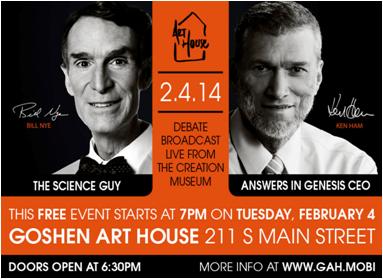
But extraordinary circumstances do emerge: the draftsman of the Creation Museum, spiritualist Ken Ham, challenged Bill Nye, The Science Guy, to a duel. And Ham’s mistake was twofold, imagining that Bill Nye will not accept and, worse, organizing the clash at the preacher’s den, on February 4, 2014.

Nye won the debate months in advance, perhaps years. His most recent and highly publicized advocacy for science literacy, awareness about climate change and support to education follow two decades of media exposure: from “The Science Guy” in the early 1990s, where elementary science was featured, to “The Eyes of Nye” in the mid 2000s, which questioned pseudoscience and educated viewers about addiction, antibiotics, nuclear waste, and cloning, to “100 Greatest Discoveries” and “The Greatest Inventions” for the Discovery Channel (both about technology and innovation), to “Stuff Happens” for Planet Green (pro-environment) and the latest “Solving For X” which highlights the value of algebra in children’s schooling.

Bill Nye Evolution Literacy Debate

With enough credentials to describe himself as a “reasonable man” and “a patriot” concerned about the United States imminent drift toward “producing a generation of students who do not believe in science,” Nye began his opening debate-statement by thanking the organizers for the invitation to “this facility,” the Creation Museum in Petersburg, Kentucky. Indeed, proper science museums are accredited by reputable organizations (i.e. American Alliance of Museums; see 2013 List of Accredited Museums), but the enterprise envisioned by Ken Ham, president/CEO and founder of Answers in Genesis and the Creation Museum, aims at smuggling pseudoscience via the façade of an educational institution —two million visitors since 2007.

The ultimate point in the debate was an old one, the ever-lasting conflict between science, represented by evolution, and supernatural causation epitomized by Biblical Creationism. In essence, an easy wrestling scuffle for science in today’s world —but not in the US, as pointed out by Nye, a unique nation in its opposition to evolution. Ham referred to the Old and New Testaments as “the book” —with which Bill Nye ought to be aware— containing “the evidence” for Origins, and for all beginnings, the universe, life, consciousness, morality; the list was long. Frightening!

Nye took the path of explaining to Kentuckians how a cultural sense of scientific curiosity, innovation based on discovery, and love for exploring the realities of nature are the foundations of economic development and prosperity; the “things that matter” in a competitive world. “Mr. Ham, do you have a creation model that could help us predict something?” Of course, no answer, except for the recurrent reference to Genesis as the justification for empty arguments; however, the frustration resides not in the incoherent view of the cosmos by an individual who capriciously rejects facts, but on the impact that educational malpractice can have on students being encouraged to believe that the Earth is 6,000 years old, and that “because no one was there to witness evolution,” as portrayed by Ham, scripture suffices to explain the eons.

Riding Dinosaurs in Eden

“…because no one was there to witness evolution, as portrayed by Ham, scripture suffices to explain the eons…”

Despite opposition to the debate by science celebrities and secular leaders, who ridiculed Bill Nye for lacking the “biology credentials” to confront an unpredictable, chaotic opponent in his turf, or for being “just an engineer with a Bachelors degree from Cornell (1977)” and holder of —almost meaningless for the critics— three honorary doctorates (Johns Hopkins University 2008, Goucher College 2000, Rensselaer Polytechnic 1999), or for not even resembling a “Navy-SEAL-Team-6-like-guy” toughened to take down a major target (yes, that contemptible was the blogging before the debate), The Science Guy overcame all significant resistance, and his persona and intellect prevailed. It took only a reasonable citizen, literate in science and evolution, with the courage to walk into the darkness of the Creation Museum, to illuminate the pervasive remnants of obscurantism.

Judge for yourselves, the debate is available online (click here). Here are some statistics: 800 ticket-buyers in the audience, 70 media organizations, 10,000 churches, schools and colleges hosting a free-live stream (likely for Ham’s supporters), 750,000 viewers in YouTube within twenty four hours after the video was posted, and one of the top topics on Twitter. What was the major blow, if any? Well, 92% of 36,000 responders to a Christian Today poll declared Nye the winner.

The big picture, however, is not the outcome of a debate, but that only 40% of Americans accept the reality of evolution. And not trusting science, in matters of science, can be suicidal in a world where our evolutionary background is the foundation of all our endeavors. — © 2014 by Guillermo Paz-y-Miño-C. all rights reserved.

Related Links:

BOOK: Evolution Stands Faith Up: Reflections on Evolution’s Wars

STUDY: Attitudes Toward Evolution at New England Colleges and Universities, United States

BOOK CHAPTER: The Ever-lasting Conflict Evolution-and-Science versus Religiosity

Scientific Article: Why People Do Not Accept Evolution?

Back to Evolution Literacy website