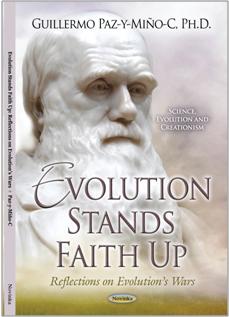
Reviews of Book Evolution Stands Faith Up – Reflections on Evolution’s Wars

Book_Evolution_Stands_Faith_Up_G_Paz-y-Mino-C

Paz-y-Miño-C  marvels at the intricacy and diversity of life, and how it came about through natural selection over hundreds and hundreds of millions of years, and is clearly frustrated by the unwillingness of so many to see the beauty and majesty in this view of the world and all that it explains

This is a delightful collection of essays about, as the author puts it, “evolution and its wars against superstition.” Professor Paz-y-Miño-C does not try to teach evolutionary thinking in this book, or explain Darwin’s ideas in any way. But he is a firm believer in evolutionary processes, and you can easily feel his frustration at the victory of inherent belief over evidence-based thinking in our society. He would like to see decisions made on the basis of facts, not unsupported opinion. Indeed, he abhors and fears irrational thinking, especially “the views of those who see evil in truth and menace in the realities discovered by science.” He marvels at the intricacy and diversity of life, and how it came about through natural selection over hundreds and hundreds of millions of years, and is clearly frustrated by the unwillingness of so many to see the beauty and majesty in this view of the world and all that it explains. He is clearly an educator at heart, and a proponent of “curiosity-driven research, critical thinking inside and outside the classroom, and the passion for exploring the truth just because we wanted to seek it.” It makes me want to take one of his courses. He dreams of a world in which science becomes the backbone of political candidates, and voters are literate enough to thoughtfully assess what they are saying, and is rightly concerned by the decline in U.S. educational standards and expectations, particularly with regard to the teaching of science and mathematics, and especially our failure to teach scientific thinking skills to our students.

The book is an easy read, at under 100 pages. From essay to essay, each of which is only a few pages long, the author breezes past an amazing variety of topics, from the decline in American educational standards and student performance, to what we know about human origins, to the decline in society’s respect for science and its role in guiding political decisions, to the wish that science would guide debates among political candidates on environmental and other issues of key importance, to pressing conservation issues in the Galapagos, to the reluctance of the American voter to elect an atheist to public office, to the relationship between prayer healing and the scientific basis for the benefits of our natural Relaxation Response, to the incompatibility between the idea of Noah’s ark and the well-documented consequences of inbreeding. His thoughts about our educational system particularly hit home with me. Children at all levels should be learning how to ask good questions, how to design rigorous experiments, and how to evaluate and present information, learning what science actually is and how it is done rather than only memorizing facts and learning lab and computer techniques. As Professor Paz-y-Miño-C clearly understands, there is a strong creative element in doing science that few students, unfortunately, get to see.

As he continues to make his plea for public recognition of the value of basic research, his writing is often lovely and poetic, as in his passage about the Mother Church of Christian Science in Boston, which “still breathes…through a majestic golden pipe organ, which gives the impression of resounding even in silence.” The author clearly reads widely; interspersed throughout the book we see quotes from, and allusions to, Darwin, de Tocqueville, various Nobel laureates, C.S. Lewis, George Santayana, Melville, Goldilocks, Mary Baker Eddy, Giordano Bruno, Galileo, Noah’s ark, Christopher Columbus, Vasco da Gama, the Incas, the Ecuadorian painter Oswaldo Guayasamin, Jared Diamond, Lucy the Australopithecus, Stalin, the 1925 Scopes Trial in Tennessee, and Democritus of Abdera, who coined the term “atom” more than 2,000 years ago. And he takes us to so many places, including Mauna Kea in Hawaii, the Boston Museum of Science, Noah’s Ark, The New Bedford Whaling Museum, and conferences in Lisbon, Switzerland, and Denver Colorado.

The final essay in the volume is about National Darwin Day (Feb 12), something I had not heard about before but that was apparently proposed in 2013 by representative Rush Holt from NJ to honor Darwin’s birth, and as a way of “celebrating the achievements of reason, science, and the advancement of human knowledge.” Some of the responses to Mr. Holt’s bill —reported verbatim in Evolution Stands Faith Up— are remarkable, and not in an encouraging way. Many people do indeed celebrate Darwin Day around the world (http://darwinday.org/), but it unfortunately has yet to become a national holiday in the U.S. As the authors says, “It is impossible to honor knowledge when a nation’s admiration for it vanishes…” – Jan A. Pechenik, PhD, Professor of Biology, Tufts University, United States.

Another Strong Defender of Evolution Rises: with [Evolution Stands Faith Up], Dr. Paz-y-Miño-C establishes himself as a clear, lucid, and refreshingly candid fighter of creationism and defender of evolution

Many biologists and scientists in general would probably agree that the struggle against creationism as an alternative to science is a war that must be waged. However, we all know it is a difficult fight. Hence, most of us are content sitting on the sidelines, doing our own work, watching others engage this important and often thankless debate. After all, how does one produce a coherent, logical, and intelligent argument against an opponent whose very aim is to create confusion, to deny reality, and to promote ignorance? Few among us have the audacity. Dawkins might be the best-known opponent of creationism, but there are many strong and clear voices in the choir. With this book, Dr. Paz-y-Miño-C establishes himself as a clear, lucid, and refreshingly candid fighter of creationism and defender of evolution.

The book is a series of essays, previously published in various venues. In each essay, Paz-y-Miño-C adds his own personal experiences as they relate to an important topic. Sometimes, Paz-y-Miño-C deals with a current issue; often he starts with his own personal experiences, and occasionally highlights his own research about creationists’ misconceptions. In every case, he produces a short, and very readable essay that debunks creationist beliefs in a style that is not necessarily confrontational (the tome’s title notwithstanding), but rather directs us to consider problems in the creationists’ agenda using their own logic against themselves, and urges us to draw our own conclusions.

The essays are written clearly and are very readable. Many chapters begin with a quotation, but I was disappointed that in many cases the source of the quotation is not given [Note: the reviewer refers to excerpts from each essay, which are quoted at the beginning of each chapter and belong to the author, except when indicated otherwise]. Every essay ends with a clear message.

The book would definitely be an asset to anyone interested in the debate, and might easily be incorporated into a course in evolution, science and society, and/or philosophy of science. – G.A.L., PhD, Evolutionary Biologist, Canada.

When Paz-y-Miño-C cuts to the core of an argument, he does it with the flare of a true artist

I am delighted that some of Paz-y-Miño-C’s finest essays and editorials have been collected in a single volume. He is a prolific essayist and I have enjoyed reading his work over the last two decades. In the tradition of Richard Dawkins he does not pull any punches, but when he cuts to the core of an argument, he does it with the flare of a true artist. Too many of our colleagues work so hard to appear open minded that their brains seem to have fallen out. When they teach our students that they can pick and choose when to be logical, critical thinkers, they are modeling the type of reasoning that leads to the politics of convenience and its bridesmaids: racism, sexism, and the whole host of xenophobias. When the emperor has no clothes, I want to be standing in the back row with Guillermo, pointing a finger and having a good laugh. – Stan Braude, PhD, Professor of Practice in Biology, Washington University in St. Louis, United States.

For Scientists and Readers Seeking Analysis of the Evolution Wars and Science Illiteracy

“Science is just a refined device for resolving ordinary curiosity and a powerful liberator of superstition. It stands alone in its secular turf”.With this thought-provoking statement in the preface, Guillermo Paz-y-Miño-C hints at what will fascinate the reader in his recent book Evolution Stands Faith Up: Reflections on Evolution Wars. The author immerses us in a broad range of topics with a common theme: why science is critical for our well being and how “belief,” as a “disruptor,” delays and stops the correct comprehension and acceptance of evidence.

All chapters provide useful information and enjoyment. Several descriptions take us to stunning sites while bringing evolution to life (e.g. Unforgettable Galapagos, a Summit, and Why Evolution Matters; Conservation Behavior in the Galapagos; Denying Rome, the Exquisite Colosseum and Evolution; Mauna Kea Telescopes to Sink in the Pacific; All History is Black History); others, alert us about the dangers of pseudoscience or belief in the supernatural (e.g Faith Healing vs. Medical Science; Wrong at Forecasting Armageddon; Rejection of Science Threatens to Be Epidemic; Evolution Stands Faith Up: On Francis Collins’ & Karl Giberson’s “The Language of Science and Faith”).

As reader and researcher, I was captivated when being transported, by the author’s narratives, to natural history museums, animal collections and cities (e.g. Boston’s Charles Hayden Planetarium; A Stationary Ark on the Isle of Jersey; On Whales and a Whaling Museum; Lisbon’s Lesson: Honor the Value of Discovery). I found it concerning to learn that, although Americans Want Candidates to Debate Science, our science standards cause our high school students to be uncompetitive in the world (e.g. Massachusetts Gets an A- in Science Standards), and that high religiosity is common among the New England Faculty and Educators of Prospective Teachers (e.g. New England Professors Accept Evolution, but They are Religious).

I must confess my favorite chapter is On the Wrongly Called The God Particle. I admired how the author takes us in an easy-to-follow journey through the discovery of the Higgs Boson in 2012. Without overwhelming the reader with technical details, the message is clear “The Higgs is a sub atomic particle, a boson, and a crucial one to understand the properties of other elementary particles, for example, why some have mass and others, like the photons (components of light) don’t. Without mass, no atoms would exist, no galaxies or stars, no solar systems or planets with life, and no brains capable of thinking about it.”

I would use this book in a college course on science writing, or possibly in science journalism. And recommend it to scientists and readers seeking a great combination of content, style and sharpness in the analysis of the “evolution wars” and “science illiteracy.” – Avelina Espinosa, PhD, Professor of Biology, Roger Williams University, United States.

Paz-y-Miño-C has a marvelously eloquent style of writing, full of inspiring metaphors and lateral observations

This is an inspiring, readable collection of 21 essays of reflective value to everyone. You can dip into any of these well-crafted and thoughtful essays at leisure without concern for order. The layout of each essay is appealing, beginning with a quote extracted from the essay, which summarizes the key insight, and finishing with a list of suggested readings and resources. The essays, mainly written within the past 4 years, are taken largely from the author’s contributions to local newspapers and his online blog, Evolution Literacy.

The author is an evolutionary biologist and an atheist who originally immigrated to the U.S. as a graduate student from Ecuador. His preface to the book provides a rationale for these essays arising from his training as a scientist and the need to address the breadth of irrational thinking around us. Notably, he points to the vain attempt by many to try and accommodate scientific rationalism with supernatural beliefs. They are simply incompatible. To emphasize this point, his first essay, from which the title of this set of essays is taken, is based on his critical book review in Amazon.com of “The Language of Science and Faith” by Francis Collins (former head of the Human Genome Project) and Karl Giberson. Francis Collins, a widely respected genetic researcher but devout Christian, demonstrates a cognitive dissonance between one’s scientific skills and the emotional need for an ineffable, “spiritual” connection to something greater outside of oneself. This latter sense of connection with the natural world devolves into an inborn tendency to take mental shortcuts and default to “unseen” supernatural causes, a common impediment to critical thinking.

The essays address a broad range of topics, including faith healing, astronomy, physics, nature, archaeology, the curiosity-driven urge to discover, and the serious threat from the arrogant ignorant who equate opinion with knowledge, especially those in positions of power to further corrode education. As the author counsels, “Escort out of office those who see fiction and facts compatible, or worship ignorance-based opinions as rightful views of equitable value to the empirical truth.”

The author has a marvelously eloquent style of writing, full of inspiring metaphors and lateral observations that reinforce connections to the foundations of scientific inquiry and to biological evolution in particular. These thoughtful essays are accessible to the general public and an inspiration to all of us who should write an occasional essay for our local newspaper or an online blog to help clear the fog in our own communities and arm our neighbors against theistic anti-science, medical quackery and other irrational nonsense. – Greg M. Stott, PhD, Geoscientist with the Ontario Geological Survey, Canada.

For information go to Evolution Stands Faith Up: Reflections on Evolution’s Wars by NOVA Publishers, New York Soft Cover

Find it at Barnes & Noble, Amazon.comAmazon UK


BOOK Evolution Stands Faith Up Reflections on Evolution’s Wars

NOVA Publishers NY announces “Evolution Stands Faith Up: Reflections on Evolution’s Wars”

Author: Guillermo Paz-y-Miño-C.

Book Description

Book_Evolution_Stands_Faith_Up_G_Paz-y-Mino-C“…Shot-gun marriages between evolution and faith have never worked, despite the tradition of pointing the barrel at evolution’s head. The truth is that evolution likes it single. Free, with no stoppers of thought or restrains on logic. And when lured unknowingly into the altar by those who see facts and fiction compatible, evolution has consistently stood belief up and walked away, sometimes run, toward its secular turf… [The] dream of arranging evolution’s wedding with belief will remain dormant for as long as evolution is awake.” Provocative, intriguing, a contemporary and concise analysis of the clashes between science and faith: In this book, Guillermo Paz-y-Miño-C examines the societal sequels in public education, the future of America’s science and academia of believing in a deity. For this evolutionary biologist, educator and public speaker, “science is [the only] refined device for resolving ordinary curiosity and a powerful liberator of superstition.” He thinks of science as “the subsistence kit to defeat re-emerging fundamentalism” in the world. With a journalistic style in short, yet documented essays, Paz-y-Miño-C encourages the reader to question “faith healing,” the “silly” forecast of Armageddon on two occasions in 2012 (after postponing the first engagement), or the “wrongly called” The God Particle, which scrambles fiction with facts. He considers “belief” to be a “disruptor,” which delays and stops the correct comprehension and acceptance of evidence. He alerts us about the threats of rejecting science, our African and ape evolutionary ancestry, and the epidemic growth of anti-intellectualism among decision makers, whose interest in replacing “curiosity-driven science” with profitable laboratory-bench work to secure sales of “science products” will drive the “culture of discovery in America” to vanish. But this author also contrasts his inner “frustration in attempting to reverse, at least around [his] immediate circle of influence, such trend…” with essays in which his contagious passion for science emerges. In his prose, Paz-y-Miño-C ignites our imagination to “take off from the roof of the Boston Museum of Science and its Charles Hayden Planetarium, while flying in a helicopter that, after metamorphosing into a spaceship, leaves Earth to immerse us into galactic infinitude.” Or to hike among sea lions, while they rest on the Galapagos shores, and feel as Darwin did the magnificence of nature. Or to contemplate the night sky from the top of the largest volcano in the World, Mauna Kea, in Hawaii, and accept the fact that, one day in the distant future, all its telescopes —or their remains— will drift away on their carrier, the late “Big Island,” and sink in the Pacific when the summit of Mauna Kea succumbs to erosion, hence following the drowning fate of the Hawaiian Islands. This open-ended book assures: “Once embraced by all, this truly universal language —scientific rationalism/empiricism and evolution— shall lead us to a more cohesive understanding of nature and of our amazingly diverse human condition. Humanity’s ultimate challenge will be to collectively embrace reality, with no stoppers of thought or restrains on logic.”

Table of Contents:

Preface

Essay 1. Evolution Stands Faith Up: On Francis Collins’ & Karl Giberson’s “The Language of Science and Faith”

Essay 2. Faith Healing vs. Medical Science

Essay 3. Wrong at Forecasting Armageddon

Essay 4. Unforgettable Galapagos, a Summit, and Why Evolution Matters

Essay 5. Conservation Behavior in the Galapagos

Essay 6. Mauna Kea Telescopes to Sink in the Pacific – Hawaii

Essay 7. Boston’s Charles Hayden Planetarium

Essay 8. On the Wrongly Called “the God Particle”

Essay 9. A Stationary Ark on the Isle of Jersey

Essay 10. On Whales and a Whaling Museum

Essay 11. Denying Rome, the Exquisite Colosseum and Evolution

Essay 12. Lisbon’s Lesson: Honor the Value of Discovery

Essay 13. Can We Forecast the Fall of Today’s Empires?

Essay 14. All History is Black History

Essay 15. American Exceptionalism Built on Backs of the 99%

Essay 16. Rejection of Science Threatens to Be Epidemic

Essay 17. New England Professors Accept Evolution, but They are Religious

Essay 18. Massachusetts Gets an A- in Science Standards

Essay 19. Americans Want Candidates to Debate Science

Essay 20. Darwin Day Awaits Designation by the US Congress

Essay 21. Can Atheists Be Our Leaders?

Epilogue

Index

Series:

Science, Evolution and Creationism

Pub. Date: 2013 – 4th Quarter

Pages: 6×9 – (NBC-C)

ISBN: 978-1-62948-447-1

For information go to Evolution Stands Faith Up: Reflections on Evolution’s Wars by NOVA Publishers, New York Soft Cover

Find it at Barnes & Noble, Amazon.comAmazon UK

Review of Evolution Stands Faith Up: Reflections on Evolution’s Wars


by Dr. Greg M. Stott, Canada


This is an inspiring, readable collection of 21 essays of reflective value to everyone. You can dip into any of these well-crafted and thoughtful essays at leisure without concern for order. The layout of each essay is appealing, beginning with a quote extracted from the essay, which summarizes the key insight, and finishing with a list of suggested readings and resources. The essays, mainly written within the past 4 years, are taken largely from the author’s contributions to local newspapers and his online blog, Evolution Literacy.

The author is an evolutionary biologist and an atheist who originally immigrated to the U.S. as a graduate student from Ecuador. His preface to the book provides a rationale for these essays arising from his training as a scientist and the need to address the breadth of irrational thinking around us. Notably, he points to the vain attempt by many to try and accommodate scientific rationalism with supernatural beliefs. They are simply incompatible. To emphasize this point, his first essay, from which the title of this set of essays is taken, is based on his critical book review in Amazon.com of “The Language of Science and Faith” by Francis Collins (former head of the Human Genome Project) and Karl Giberson. Francis Collins, a widely respected genetic researcher but devout Christian, demonstrates a cognitive dissonance between one’s scientific skills and the emotional need for an ineffable, “spiritual” connection to something greater outside of oneself. This latter sense of connection with the natural world devolves into an inborn tendency to take mental shortcuts and default to “unseen” supernatural causes, a common impediment to critical thinking.

The essays address a broad range of topics, including faith healing, astronomy, physics, nature, archaeology, the curiosity-driven urge to discover, and the serious threat from the arrogant ignorant who equate opinion with knowledge, especially those in positions of power to further corrode education. As the author counsels, “Escort out of office those who see fiction and facts compatible, or worship ignorance-based opinions as rightful views of equitable value to the empirical truth.”

The author has a marvellously eloquent style of writing, full of inspiring metaphors and lateral observations that reinforce connections to the foundations of scientific inquiry and to biological evolution in particular. These thoughtful essays are accessible to the general public and an inspiration to all of us who should write an occasional essay for our local newspaper or an online blog to help clear the fog in our own communities and arm our neighbors against theistic anti-science, medical quackery and other irrational nonsense.

On the Wrongly Called The God Particle

[click HERE to be redirected to The Standard Times]

Dr. Guillermo Paz-y-Miño-C — © 2012

New England Science Public

[A book-review format of this article is available at Amazon.com]

“…without mass, no atoms would exist, no galaxies or stars, no solar systems or planets with life, and no brains capable of thinking about it…”

Computer-generated image of a proton-proton collision recorded with the CMS detector at CERN (2012). The data is consistent with the decay of a Higgs-like-boson into photons (dashed yellow lines and green towers). Alternatively, the data could also be explained by background processes consistent with the Standard Model (image credit CMSCERN © 2012).

Nobel laureate Leon Lederman affirms that the title of his 1993 book “The God Particle: If the Universe is the Answer, What is the Question?” offended two groups: those who believe in God and those who do not. But this is another astute –and a posteriori— marketing pronouncement. If true, Lederman and coauthor Dick Teresi, a science writer, would have disappointed 95 percent of all Americans (the 80 percent of believers and the 15 percent of seculars), the book’s initial and major target audience.

     As particle physicist, Lederman’s intention with such an unfortunate and misleading heading –here I don’t only blame the publishers for scrambling science with the supernatural to secure sales— was to precisely reach the populous obsessed with science fiction, more than with science facts, and discuss the potential existence of the Higgs boson (a subatomic particle), which experimental demonstration, as predicted for decades, could bring major understanding to the essence of matter.

This past 4th of July, the European Organization for Nuclear Research, CERN, celebrated with its own “fireworks,” or highly energetic particle collisions, the discovery of a Higgs-like boson generated at the Large Hadron Collider (LHC), a magnificent underground instrument built to study the fundamental structuring blocks of all things.

I visited CERN, last year, located nearby Geneva, at the Swiss-Franco border. Its 17-mile circular accelerator speeds up, in opposite directions, subatomic “hadrons,” either hydrogen nuclei or lead ions, which gain energy after consecutive laps. At the instant of collision, scientists recreate the conditions immediately after the Big Bang, resembling the first events in the existence of our 14 billion-year-old universe. CERN is shockingly impressive; its amazing technology and scale of engineering caused me profound joy.

Square Galileo Galilei and THE GLOBE (Visitors Interpretation Center) at the European Organization for Nuclear Research, CERN, nearby Geneva — Swiss-Franco border (photos G. Paz-y-Miño-C — © 2011).

Hadron collisions produce short-lasting minuscule particles difficult to detect, and the Higgs boson has been indeed elusive. Its existence was postulated in 1964, in separate articles published in Physical Review Letters by Robert Brout and Francois Englert, Peter Higgs (alone), Gerald Guralnik, Richard Hagen and Tom Kibble. But CERN seems to have found it or, as cautiously announced, “measured the products of its decay,” thus inferring its existence.

  ATLAS control room at the European Organization for Nuclear Research, CERN (photo G. Paz-y-Miño-C — © 2011).

To help us imagine this day of discovery, or presumption that the Higgs boson is real, in his 1990s book Lederman traces back the history of particle physics to 2,600 years ago; sparkled by the Greek philosopher Thales of Miletus, who wondered about the simplest forms of matter, continuing with Democritus of Abdera (c 400 BP), who not only coined the term atom (“uncuttable”) but declared that “…nothing exists except for atoms and empty space; everything else is opinion,” and ending with the 1993 cancellation, by the US Congress, of the Superconducting Super Collider project to be built in Waxahachie, Texas, and which would have surpassed the LHC at CERN with a 54-mile-diameter particle accelerator.

Greek Philosopher Democritus of Abdera (460-370 BP) “…nothing exists except for atoms and empty space; everything else is opinion…”

What are Higgs bosons? Remember that atoms consist of positively charged protons and electrically neutral neutrons, both occurring at a nucleus. Electrons cloud around the nucleus and are negatively charged. The entire atom package is kept together by electromagnetic forces. If a nucleus of hydrogen –the simplest known element which is essentially a proton— is accelerated and rammed against another proton an explosion occurs, which liberates subatomic particles. Physicists rely on a body of scientific knowledge, called the Standard Model, to theorize and explore experimentally –currently at CERN— the properties of such subatomic particles.

About 60 of these particles have been hypothesized and/or documented to exist, and scientists classify them as bosons, hadrons and fermions (for technical terminology visit CERN’s Glossary). The Higgs is a boson and a crucial one to understand the properties of other elementary particles, for example, why some have mass and others, like the photons (components of light) don’t. Without mass, no atoms would exist, no galaxies or stars, no solar systems or planets with life, and no brains capable of thinking about it. (Note, however, that Higgs-like particles are expected to account for only a fraction of the total mass of the universe). CERN asserts that the characterization of Higgs will provide “the final missing ingredient in the Standard Model” and guide us in the comprehension of the forces acting at the microscopic core of nature.

Elementary subatomic particles (top: bosons, hadrons, fermions) and their interactions (bottom); source Public Domain.

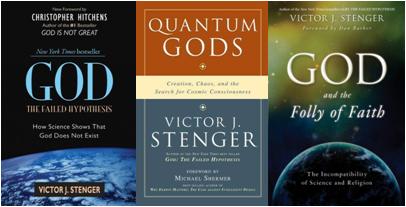
As for Lederman’s book (I belong to the 15 percent of seculars who detest its heading and insertions of subliminal mysticism into the facts), the prose offers an enjoyable ride, rich in historicity, sarcastic humor –rare for a physicist— and fantasizing dialogs with Democritus, Lederman’s imaginary physics peer. And to poise Lederman’s enlightenment about particle physics and its ramifications to modern cosmology with the views of one of his contemporary elementary-particles colleagues, I recommend reading Victor Stenger’s “God: The Failed Hypothesis” (2008), “Quantum Gods” (2009), and the latest “God And the Folly of Faith” (2012). – © 2012 by Guillermo Paz-y-Miño-C. all rights reserved.

Above, some of the books authored by Dr. Victor Stenger: “God: The Failed Hypothesis” (2008), “Quantum Gods” (2009), and “God And the Folly of Faith” (2012).

United States ‘exceptionalism’ built on backs of the 99 percent

United States ‘exceptionalism’ built on backs of the 99 percent

[click on title to be redirected to The Standard Times]

Dr. Guillermo Paz-y-Miño C. — © 2011

Department of Biology, University of Massachusetts Dartmouth 

“A sense of inner exceptional nature probably drives the existence of most individuals and seems to be a Darwinian adaptive trait. Tribal pride is not only ancestral but ubiquitous…”

Overconfidence, or “believing you are better than in reality, is advantageous because it increases ambition, morale, resolve, persistence or the credibility of bluffing, generating a self-fulfilling prophecy in which exaggerated confidence boosts up success,” write Dominic D.P. Johnson and James H. Fowler in their latest article, The Evolution of Overconfidence, published in Nature in September.

Johnson and Fowler remark that “populations become overconfident, as long as benefits from contested resources are large compared with the cost of competition. The fact that overconfident populations are evolutionarily stable in diverse environments may explain why overconfidence remains prevalent today, even if it contributes to hubris, market bubbles, financial collapses, policy failures, disasters and wars.”

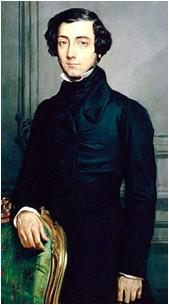
In “Democracy in America” (Volumes I, 1835, and II, 1840: visit Democracy in America Online), the French sociologist and historian Alexis de Tocqueville [image left] acknowledged and critically contemplated the originality and uniqueness of the 19th century emerging superpower, the United States. He called it “exceptional” for its generalized equality and constitutional democracy, and for its commercial habits and pragmatism.

In retrospect, his observations about American ideology, cultural cohesiveness and shared values were astute and visionary. But de Tocqueville also detected the underlying fabric of puritan thinking, the essence of our modern conservatism:

“Almost all the sects of the United States are comprised within the great unity of Christianity, and Christian morality is everywhere the same. In the United States the sovereign authority is religious, and consequently hypocrisy must be common; but there is no country in the whole world in which the Christian religion retains a greater influence over the souls of men than in America, and there can be no greater proof of its utility, and of its conformity to human nature, than that its influence is most powerfully felt over the most enlightened and free nation of the earth [Alexis de Tocqueville].”

The clause “American exceptionalism” was apparently used, depreciatively, by Joseph Stalin (1878-1953) while forecasting in the 1920s that the American wealth, technological pride and social fairness were temporary and fated to collapse, unless communism took over. Ironically, the Soviet system crumpled in the 1980s and its “restructuring” — Perestroika — led to political and economic reform by mimicking the market-based models of the West, which, paradoxically, became today’s fiasco in a landscape of deregulated money-making opportunities that did not benefit –mainly– the people.

Winston Churchill (UK), Franklin Roosevelt (USA) and Joseph Stalin (USSR), The “Big Three,” at The Yalta Conference, 1945. They met to discuss the future of Europe after World War II. [Click for VIDEOS The Yalta Conference].

The idea of exceptionalism consolidated in the United States and abroad after the 1950s, based on unparalleled industrial transformations, scientific achievements, competitive labor and education. Reality surpassed the cliche of uniqueness and actually disproved one of de Tocqueville’s assertions: that Americans’ exclusive trading interests “diverted their minds from the pursuit of science, literature and the arts” and that, therefore, exceptionalism was evident mainly in socio-economic affairs.

But living up to exclusiveness has proved difficult, and fast excessive wealth has led to ignore the history that created the “extraordinary.” It was judicious investment in rigorous education, basic science and technology that gave rise to the best universities in the world, the finest hospitals, unrivaled space explorations, magnificent natural history museums and ecologically managed national parks. Farms, factories, highway connectivity and urbanization prospered due to an agile economy that generated, in hindsight, short lasting bonanza.

“It was judicious investment in rigorous education, basic science and technology that gave rise to unrivaled space explorations” — Mission Control International Space Station — Houston, photo G. Paz-y-Miño C. © 2011

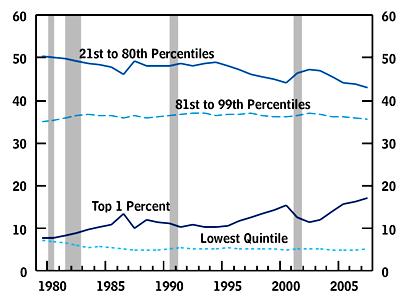
And it was an outstanding work force, driven by the highest standards of performance, that enriched today’s heartless, and sometimes brainless, “top 1 percent,” the financial conservative elite who opposes science, mocks intellectuals and ridicules college education. The overconfident mega-wealthy who question the reality of human-induced climate change, reject evolution, blame vaccines for causing mental retardation or autism, diminish the importance of biodiversity, and oppose environmental protection and clean energy.

Above: Cumulative Growh in Average After-tax Income, by Income Group (percentage change in income since 1979, adjusted for inflation); source US Congressional Budget Office, CBO Report October 2011

Above: Share of Total After-tax Income, by Income Group (percent); source US Congressional Budget Office, CBO Report October 2011

Yet, they claim the value of exceptionalism as their own and intend to renegotiate it for the upcoming elections, re-sell it to the voters — as in the profitable stock market — of course, without committing their assets, or taxes, to the continuation of the “extraordinary,” thus neglecting that “uniqueness” took a century to be erected over the human capital of workers, artists, scientists, musicians, teachers, novelists or poets, who invested themselves, and fully, to harvest collective good.

If a bailout is an “act of loaning or giving capital to a company, a country, or an individual that is in danger of collapsing, in an attempt to prevent ruin,” then the exceptionalism that we treasure must be rescued — “bailed out” — by the prosperous untouchable class that amassed fortune over the exceptional labor of their compatriots.  — © 2011 by Guillermo Paz-y-Miño-C. all rights reserved

World Extreme Poverty Map 2008

Source: for original document Click on 2008 World Development Indicators, The World Bank.

For World Statistics on Poverty visit Global Issues Poverty Facts


Above: Almost half the world — over three billion people — live on less than $2.50 a day. Source World Bank Development Indicators 2008.

Above: In 2005, the wealthiest 20% of the world accounted for 76.6% of total private consumption. The poorest fifth just 1.5%. Source World Bank Development Indicators 2008.

Recommended Book: The Price of Civilization, 2011, by Jeffrey D. Sachs

“…At the root of America’s economic crisis lies a moral crisis: the decline of civic virtue among America’s political and economic elite. A society of markets, laws, and elections is not enough if the rich and powerful fail to behave with respect, honesty, and compassion toward the rest of society and toward the world. America has developed the world’s most competitive market society but has squandered its civic virtue along the way. Without restoring an ethos of social responsibility, there can be no meaningful and sustained economic recovery…” says author Jeffrey D. Sachs.

On Francis Collins and Karl Giberson “The Language of Science and Faith”

On Francis Collins’ & Karl Giberson’s “The Language of Science and Faith”

By Guillermo Paz-y-Miño-C.  © 2011

“In matters of God’s nonexistence, the high-school-educated atheist is more lucid than the deeply religious scientist…”

“…A trilogy of spiritual books… has been written or sponsored by Francis Collins, Director of the National Institutes of Health NIH and former head of the Human Genome Project: The Language of God 2006, Belief: Readings on the Reason for Faith 2010, and the brand new –coauthored with… Karl Giberson– The Language of Science and Faith 2011…”

“…Shot-gun marriages like this, between evolution and faith, have never worked, despite the tradition of pointing the barrel at evolution’s head. The truth is that evolution likes it single. Free, with no stoppers of thought or restrains on logic. And when lured unknowingly into the altar by those who see facts and fiction compatible, evolution has consistently stood belief up and walked away, sometimes run, toward its secular turf…” — © 2011 by Guillermo Paz-y-Miño-C.

Trilogy Francis Collins Books“…the dream of arranging evolution’s wedding with belief will remain dormant for as long as evolution is awake.” Click on image to access complete article.