TEN TIPS ABOUT: How university professors can contribute to strengthen evolution literacy

By Guillermo Paz-y-Miño C. & Avelina Espinosa — © 2011

Excerpts from “New England Faculty and College Students Differ in Their Views  About Evolution, Creationism, Intelligent Design, and Religiosity” published in Evolution Education and Outreach

(1) By being proactive rather than reactive in confronting the “anti-evolution wars.” It is imperative that the university professors reach out to the public and lead the debate over science education and evolution literacy.

(2) By persuading the education departments at their institutions to fortify science training of future educators: higher education and outreach programs in science, particularly biology, for school teachers are fundamental to integrate evolution into our society’s culture.
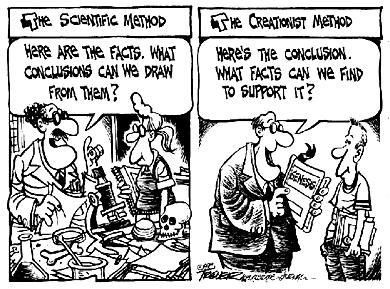
TheScientificMethod

(3) By changing the emphasis with which college science is taught and improving the science curriculum: it is easier and faster to change the perspectives with which a course is taught than to modify the university/college curriculum; however, both might be indispensable to improving positive attitudes toward science and evolution.

(4) By creating a new type of professorship position: “professor for the public understanding of science,” whose exclusive role shall be to explain to the public the significance of the research conducted by each discipline, and also by assigning the most reputable professors and best communicators of science to the large-lecture courses, usually attended by nonscience majors.

(5) By constantly surveying variations in attitudes toward science and evolution among faculty, students and staff, and coordinating immediate responses to emerging antievolutionism: contrary to the assumption that skepticism toward creationist views predominates in academia, U.S. university professors, even at prestigious research institutions, increasingly embrace religiosity, a factor negatively correlated with acceptance of evolution; it is conceivable to forecast a decline in acceptance of evolution by university professors.

SchoolAdmissions

(6) By sponsoring in- and off-campus lecture series, workshops and debates, open to the local high school teachers and the public, where university professors of all disciplines examine the anti-evolution phenomena, learn about the limitations established by schools boards on the science school curriculum and orient the audience on how to communicate modern science to all. Workshop discussion modules on “why evolution matters” can be particularly effective when organized for school board members, school district administrators, science teachers and university professors.

(7) By actively pursuing participation in “town Evo Edu Outreach halls for scientists and public” to discuss issues related to scientific research and the controversy of evolution versus creationism versus ID.

DownWithEducationCartoon

(8) By organizing multidisciplinary teams of professors (anthropology, biology, education, ethics, history, law, philosophy, political science, social psychology, and religious studies) committed to advice community groups on theoretical and practical aspects of civil action to counter anti-evolution campaigns, anti-intellectualism tendencies, and pro creationism and ID agendas.

(9) By never underestimating the influence of the anti-evolution movements that grow strong among misinformed citizens, vary in impact geographically, and benefit from the frequent disconnect between scientists and society. Indeed, the regional differential acceptance of evolution in the U.S. (i.e., Northeast 59%, Northwest 57%, Midwest 45%, South 38%; The Pew Research Center for the People & the Press 2005) suggests that pro-evolution campaigns shall require strategies compatible with local idiosyncrasies.
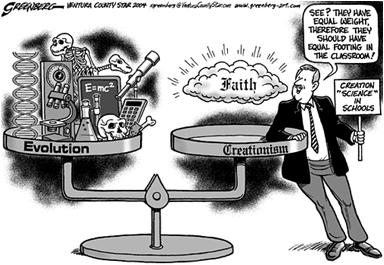
EqualWeighEvolutionCreation

 (10) By including in the “broad impact” section of research grant applications specific multidisciplinary outreach modules to educate the public in the areas of scientific literacy, “on-the-job-training” workshops for local/ regional high school teachers, online-mini courses, online assessment of local/regional attitudes toward science/evolution, laboratory internships and field work. The National Science Foundation, U.S. Department of Education, and private donors encourage and even require grant applicants to reach out to the public in meaningful areas of current interest and societal debate. — © 2011 by Guillermo Paz-y-Miño-C. & Avelina Espinosa all rights reserved

TeachBothSidesCartoon

For original scientific article (New England Faculty and College Students Differ in Their Views  About Evolution, Creationism, Intelligent Design, and Religiosity), published in Evolution Education & Outreach, click on [PDF]
Acceptance of evolution by Biology Majors at the University of Massachusetts Dartmouth is one the highest in the United States

What is an effective way of communicating evolutionary principles to students?

By Guillermo Paz-y-Miño C. — © 2011

Comprehensively: (i) discuss the reality of evolution explicitly and directly, (ii) teach human evolution and place humans within the Apes, as primates, as animals, (iii) explain why the fossil record is discontinuous and incomplete, (iv) connect forensics, or the “applications of molecular techniques” to the evolutionary implications of molecular evolution, e.g. DNA connects organisms via common descent, (v) discuss how the human mind is the product of evolution.

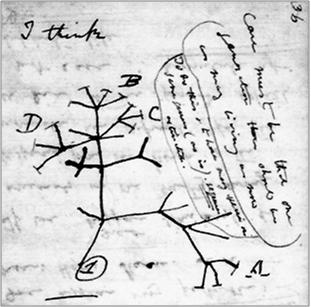
I_Think_Darwin

 Darwin’s “I Think…” handwriting from Notebook B: Transmutation of species 1837-8

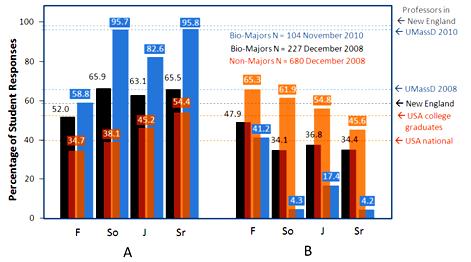
The histogram below summarizes the patterns of acceptance of evolution openly (A) or no opinion (B) among undergraduates at the University of Massachusetts Dartmouth (UMassD) as function of their academic level: Freshman (F), Sophomore (So), Junior (J) or Senior (Sr). Note that public acceptance of evolution in the United States of America (USA national) is about 40 percent (data The Gallup Poll 2009) and in New England 59 percent (data The Pew Research Center for the People and the Press 2005), the highest nationwide (shown as horizontal lines in Figure 1). 

UMass Dartmouth Statistics

Figure 1. Acceptance of evolution openly (A) or no opinion (B) by UMassD undergraduates as function of academic level F (Freshman), So (Sophomore), J (Junior), Sr (Senior). Data G. Paz-y-Miño C. © 2011

Biology Majors in 2008 (black bars in Figure 1) had levels of “open acceptance” of evolution between 52.0 percent (Freshman) to 65.5 percent (Seniors). No opinion decreased from 47.9 percent (Freshman) to 34.4 percent (Seniors).

In contrast, Non-biology Majors’ (orange bars) highest levels of acceptance of evolution reached 54.4 percent among Seniors (a value that most likely remained unchanged by the time of graduation), comparable to the level of the “arriving-to-college Biology Majors” (52.0 percent), similar to the USA college graduates (53 percent, The Gallup Poll 2009), and below the New England average (59 percent, The Pew Research Center for the People and the Press 2005). No opinion decreased as function of academic level but from 65.3 percent (Freshman) to only 45.6 percent (Seniors).

After re-conceptualizing the Freshman Biology Majors courses Biology of Organisms BIO-121/122 and Laboratories BIO-131/132 (re-conceptualization began in the 2007-2008 academic year – to present), which now have a comprehensive evolutionary approach, all cohorts of Biology Majors (blue bars) have increased significantly their acceptance of evolution, from 58.8 percent (Freshman) to 95.8 percent (Seniors)…

CharlesDarwinCartoonByDGranlund…These values are comparable to the 97 percent acceptance of evolution by the New England Professors and rank among the highest in the US…

Longitudinal analysis of two Freshman cohorts (2008-9 or 2009-10) revealed significant increase in acceptance of evolution in a single academic year (means: 56 percent in September, 70 percent in December, and 80 percent in May). — © 2011 by Guillermo Paz-y-Miño-C. all rights reserved

For related topics click on Research Articles on Acceptance of Evolution

The “Jackprot” Simulation

The Jackprot is a didactic slot machine simulation that illustrates  how mutation rate coupled with natural selection  can interact to generate highly specialized proteins.

NEWConceptualized by Guillermo Paz-y-Miño C. (University of Massachusetts Dartmouth), Avelina Espinosa (Roger Williams University) and Chunyan Y. Bai (Roger Williams University), the Jackprot uses simplified slot-machine probability principles to demonstrate how mutation rate coupled with natural selection suffice to explain the origin and evolution of highly specialized proteins. The Jackprot also helps us understand why evolution by means of natural selection cannot be a random process.

Winning the ‘jackprot,’ or highest-fitness complete-peptide sequence, requires gradual and cumulative smaller ‘wins’ (rewarded by selection) at the first, second and third nucleotide positions in each of the codons coding for a polypeptide (= ‘jackdons’ that lead to ‘jackacids’ that lead to the ‘jackprot’).

TheJackprotSimulation

A slot-machine represents the cellular chemical apparatus, product itself of Darwinian evolution, required to generate, step by step, each of the three nucleotides coding for an amino acid. The probability of getting the correct triplet, for example, the start codon methionine or ATG, in a single attempt (or winning the ‘jackacid’), is equal to 1/64, or one divided by 4 x 4 x 4 (i.e. the total number of possible nucleotides per position multiplied by itself three times)…

…But because molecular evolution occurs gradually, a naturalistic assumption of the ‘jackprot’ model, each time any of the correct nucleotides is generated by the slot-machine, natural selection rewards it and keeps it (partial nucleotide win in a codon or ‘jackdon’)…

…Therefore, the probability of arriving, nucleotide by nucleotide, at the ATG sequence is equal to 1/12, or one divided by 4 + 4 + 4 (i.e. the summation of the individual probabilities for each nucleotide position), a much faster evolutionary process. Note that the sequential and additive arrival at the phenotypically meaningful sequence of A plus T plus G, represents, in reality, the accumulation of events fixed by natural selection during protein evolution, which entails clustered changes of multiple parts, and at diverse locations, within functional protein domains.

NCBITeachers and students can access The Jackprot Simulation (click on illustration above) and run statistical analyses of protein evolution by simply cutting and pasting genomic (nucleotide) sequences obtained from the National Center for Biotechnology Information NCBI. The Jackprot generates statistics on nucleotide evolution under selection (both observed and expected values) and at random (expected values without selection). — © 2011 by Guillermo Paz-y-Miño-C. all rights reserved

For detailed guidelines on how to use The Jackprot Simulation click on Guidelines Jackprot

To access original scientific article on The Jackprot Simulation, published in Evol Edu Outreach, click on PDF

Watch Demonstrational Video in YouTube (click on icon below) Jackprot_Simulation_YouTube


*    *    *    *    *

Interesting Site: “Darwin’s Notebook”

“…A team of hip-hop and contemporary dancers injected life into the still artifacts at a museum… in a show called “Darwin’s Notebook” held at the University of Cambridge Museum of Zoology ” (Source Science Magazine: click on image below for details).

DarwinAsModernDarwin

Darwin’s Image Credit: Ben Swift/Nonsinthetik, from Hip-Hoppin’ Through Darwin’s Theories

RESEARCH ARTICLES on Acceptance of Evolution

New England Faculty and College Students Differ in Their Views About Evolution, Creationism, Intelligent Design and ReligiosityNEW just published (online access) in Evolution Education and Outreach, December 18th 2010 [PDF]

Statistics NE Faculty vs Students Evolution

Figure 1. Percentage of New England faculty (Fac) versus college students from public secular (Pub), private secular (Priv) and religious (Rel) institutions who think evolution is: A = definitely true, B = probably true.

Statistics NE Faculty vs Students Religion

Figure 2. Percentage of New England faculty (Fac) versus college students from public secular (Pub) and private secular (Priv) institutions who consider the following statements about religiosity to be either true (black part of the bar) or false (color): A = faith in God is necessary for morality, B = religion is very important in my life, C = I pray at least once a day.


“On the Theory of Evolution versus the Concept of Evolution: Three Observations”NEW just published (online access) in Evolution Education and Outreach, December 15th 2010 [PDF]

“Integrating horizontal gene transfer and common descent to depict evolution and contrast it with common design” published in the Journal of Eukaryotic Microbiology 2010 [PDF]

Read comment about the article above by staff writer from the Discovery Institute Casey Luskin (click on him) and also by Intelligent Design ideolog Michael J. Behe (click on him).

Also read Introduction: Protistan Biology, Horizontal Gene Transfer, and Common Descent Uncover Faulty Logic in Intelligent Design [PDF] to Pre-ISOP meeting workshop (International Society of Protistologists), June 11-13 2009, “Horizontal Gene Transfer and Phylogenetic Evolution Debunk Intelligent Design” by Dr. Avelina Espinosa, professor at Roger Williams University.

IntelligentGeography


“Acceptance of evolution increases with student academic level: A comparison between a secular and a religious college”published in Evolution Education and Outreach 2009 [PDF]

“Assessment of Biology Majors versus Non-majors views on evolution, creationism and intelligent design”published in Evolution Education and Outreach 2009 [PDF]