Fragmentary Truths and the Intellectual Imbalance in Academia

Fragmentary Truths and the Intellectual Imbalance in Academia

Dr. Guillermo Paz-y-Miño-C — © 2014

Department of Biology, University of Massachusetts Dartmouth

[click on title to be redirected to The Standard Times]

“…If we ought to quote E.O. Wilson in the context of what is good for science and science education, then we must look at his unyielding journey in support to fundamental research and long-standing concerns about the future of academia. Although open to dialog with spiritualists, Wilson has never endorsed creationism under the principle of Consilience, nor sponsored profit at the expense of quality schooling…” 

Some months ago, an administrator ventured to school me by asserting: “E.O. Wilson is known for his books in popular science, but his area of research is ants.” I will return to this fragmentary truth after documenting what can be done, following Harvard Professor Edward Osborne Wilson’s example, to make outreach to students —our public— via proper science education.


Above, Professor Edward O. Wilson, painting by Jennie Summerall

When I arrived at UMass Dartmouth in 2007, the evolution wars were at their peak. Although Intelligent Design had been defeated in the 2005 Dover, Pa., trial for violating the rules of science by “invoking and permitting supernatural causation” in matters of evolution and for “failing to gain acceptance in the scientific community,” the 21st century anti-science crusade had just began. Current legislation constraining the teaching of evolution reigns in 12 states.

According to Intelligent Design, evolution could not explain holistically the origin of the natural world or the emergence of intricate molecular pathways essential to life, nor the immense phylogenetic differentiation of biological diversity and, instead, proposed an “intelligent agent,” a designer, as the ultimate architect of nature.

During the process of ripping Intelligent Design apart, earlier variants of creationism resuscitated —mostly in media-driven discussions, which I never considered harmless since they reflected the quiescent mind of the public— and newly emerged as, allegedly, better alternatives to Intelligent Design. I discuss them in my 2013 book “Evolution Stands Faith Up: Reflections on Evolution’s Wars:”

Among the former were Theistic Evolution and Creation Science, creationism in principle and practice (God the maker of the universe, always present in the fore- or background of causality); among the latter was BioLogos (2000s), which aimed at merging Christianity with science by proposing a “model for divinely guided evolution” that required “no intrusions from the outside for its account of God’s creative process, except for the origin of the natural laws guiding the process.”

Supporters of BioLogos suggested that “once life arose, evolution and natural selection permitted the development of biological diversity and complexity,” including humans. After evolution got underway, “no special supernatural intervention was required” (quotes from “The Language of Science and Faith” 2011, co-authored by Karl Giberson and Francis Collins —the latter Director of the National Institutes of Health). In essence, the Creator was done, but remained in touch for eternity! This is, of course, inconsistent with everything we know about reality.

As an evolutionary biologist and university professor, I considered a duty to properly educate my students and prepare them to examine, by themselves, the anti-science cultural pollutants that aim at “zombieing” their minds, “corpseing” their innate spirit of inquiry, and perpetuating societal confusion around empirical discoveries.

New England has the highest acceptance of evolution in the U.S., only 59 percent. Back in 2008, when I first polled the UMass Dartmouth campus, our biology graduates used to join the workforce with an acceptance level evolution of 65 percent; the freshman —right out of high school— were at 52 percent. A year later, in May 2009, after I restructured the core biology courses with an evolutionary perspective, acceptance of evolution jumped to 82 percent among the youngest undergrads. Today, 95 percent of graduating bio-majors accept evolution at UMass Dartmouth, the highest score ever reported for college students in the U.S., and comparable to 97 percent of the New England faculty.

Evolution literacy matters: It correlates with understanding climate change, support for stem-cell research, vaccines, alternative sources of energy, respect for education and human rights.

And this brings me back to my allusion to Professor E.O. Wilson. Indeed, he had (still does) a celebrated career in the study of Hymenoptera (ants, wasps and bees). But there is high complexity in Wilson’s contribution to theoretical science, far beyond “ants” (which vastness has been revealed by his passionate disciples).

Forgive my professorial account: Concepts such as Island Biogeography (1967), the still controversial Sociobiology (1975), Biophilia (1984), Biodiversity (1988), Consilience (1998), “The Creation” in the context of what nature can do to assemble life (2006), are among Wilson’s seminal proposals. But he also co-founded “evolutionary biology” in 1960, in an attempt to address “the intellectual imbalance of biology at Harvard,” and his fears of seeing ecology and evolution “being outgunned, outfunded, and outnumbered” by alternative fields of investigation, as he narrates in “Letters to A Young Scientist” (2013).

If we ought to quote Wilson in the context of what is good for science and science education, then we must look at his unyielding journey in support to fundamental research and long-standing concerns about the future of academia. Although open to dialog with spiritualists, E.O. Wilson has never endorsed creationism under the principle of Consilience, nor sponsored profit at the expense of quality schooling.

The Incompatibility Hypothesis: Evolution vs Supernatural Causation

The Incompatibility Hypothesis (IH): Evolution vs. Supernatural Causation, by Paz-y-Miño-C & Espinosa

“Like the oil vs. water experiment, evolution and supernatural causation don’t mix. Evolution raises to the surface…”

Incompatibility Hypothesis Paz-y-Mino-C EspinosaSupernatural causation (i.e. the belief in a Supreme Being, creator and sustainer of the universe, omnipresent, omnipotent, omniscient) is a cultural pollutant, incompatible with empirical reality. “Belief” disrupts, distorts, delays and/or stops (3Ds+S) the correct comprehension and acceptance of evidence. We have postulated that the controversy over evolution-and-science versus creationism is inherent to the incompatibility between scientific rationalism/empiricism and the belief in supernatural causation (Paz-y-Miño-C & Espinosa 2012, 2013a,b,c, 2014a,b, 2015, 2016). This hypothesis (= incompatibility) helps us understand and explain the everlasting and fluctuating antagonism –in cycles, from moderate to intense opposition during human history– in the relationship between science/evolution and religion (Paz-y-Miño-C and Espinosa 2013a). In our most recent book chapter (Paz-y-Miño-C and Espinosa 2014a; article 2015 and book 2016), we examine conceptually the incompatibility hypothesis (IH), its predictions and alternatives, and approaches to test it quantitatively. Image top-left: Like the oil vs. water experiment, evolution and supernatural causation don’t mix. Evolution raises to the surface.

Suggested Readings where The Incompatibility Hypothesis is discussed:

Book: Paz-y-Miño-C, G & Espinosa, A. 2016. Measuring the Evolution Controversy: A Numerical Analysis of Acceptance of Evolution at America’s Colleges and Universities. Cambridge Scholars Publishing, Newcastle, United Kingdom. ISBN (10): 1-4438-9042-1, ISBN (13): 978-1-4438-9042-7.

Scientific Article: Paz-y-Miño-C, G. & Espinosa A. 2015. Evolution Controversy: A Phenomenon Prompted by the Incompatibility between Science and Religious Beliefs. International Journal of Science in Society 7(2). ISSN 1836-6236 [PDF].

Book-Chapter: Paz-y-Miño-C., G. & Espinosa A. 2014a. The Incompatibility Hypothesis: Evolution vs. Supernatural Causation. Pp. 3-16. [PDF] In G. Trueba (Ed.) Why Does Evolution Matter? The Importance of Understanding Evolution. Cambridge Scholars Publishing, Newcastle, United Kingdom. ISBN (10): 1-4438-6518-4, ISBN (13): 978-1-4438-6518-0.

Scientific Article: Paz-y-Miño-C, G. & Espinosa A. 2014b. Acceptance of Evolution by America’s Educators of Prospective Teachers: the disturbing reality of evolution illiteracy at colleges and universities. New England Science Public: Series Evolution Vol. 2, No. 1. [PDF] The complete 92-page study includes 23 figures, statistics, 34 maps, 12 tables, and a companion slide show ‘Image Resources’ for science journalists, researchers and educators. The supplementary materials include 15s figures and 25s tables. This article has been featured in the Richard Dawkins Foundation Newsletter and website. RDF has also posted a note in its Facebook page.

Book-Chapter: Paz-y-Miño-C., G. & Espinosa A. 2013a. The Everlasting Conflict Evolution-and-Science versus Religiosity. pp. 73-97 [PDF]. In G. Simpson & S. Payne (eds) Religion and Ethics NOVA Publishers, New York. Download OPEN ACCESS at NOVA.

Scientific Article: Paz-y-Miño-C., G. & Espinosa A. 2013b. Galapagos III world evolution summit: why evolution matters. Evolution: Education and Outreach, 6:28. [PDF]. Open Access.

Scientific Article: Paz-y-Miño-C, G. & Espinosa A. 2013c. Attitudes toward evolution at New England colleges and universities, United States. New England Science Public: Series Evolution 1: 1-32. [PDF]. Read commentaries in Happy Birthday Charles Darwin – The Boston Globe and Basic Knowledge of Darwin’s Theory Lost in Some Classes – The Boston Globe Metro. The Standard Times of New Bedford published the note Evolution Misunderstood By Students, Faculty.

Scientific Article: Paz-y-Miño-C, G. & Espinosa, A. 2012a. Introduction: Why People Do Not Accept Evolution: Using Protistan Diversity to Promote Evolution Literacy. Journal of Eukaryotic Microbiology 59:101-104. [PDF].

Public Talks, Interviews, and Discussions where The Incompatibility Hypothesis is addressed:

Departmental Seminar UMass Amherst (November 13, 2015), Organismic and Evolutionary Biology Graduate Program: Measuring the Evolution Controversy: The Present and Future of Evolution’s Acceptance.

Interview by the Richard Dawkins Foundation for Reason and Science (April 1, 2014) where both the book Evolution Stands Faith Up: Reflections on Evolution’s Wars, and the Incompatibility Hypothesis is discussed.

Disproof Atheism Society, Boston University (February 2014).

Atheists Alliance of America 2013, National Convention in Boston (watch and/or DOWNLOAD VIDEO from the AAA website).

Atheists Alliance of America 2013 (watch video in YouTube posted on September 2, 2013).


Other Scientific Publications Related to Acceptance of Evolution in the US and the World:

Paz-y-Miño-C, G. & Espinosa A. 2012b. Educators of prospective teachers hesitate to embrace evolution due to deficient understanding of science/evolution and high religiosity. Evolution: Education and Outreach 5:139-162. [PDF]. Follow a discussion on this study in The Chronicle of Higher Education.

Paz-y-Miño-C, G., Espinosa A. & Bai, C. 2011a. The Jackprot Simulation couples mutation rate with natural selection to illustrate how protein evolution is not random. Evolution: Education and Outreach 4:502-514 [PDF] Visit The Jackprot Simulation website to access computer program and tutorials.

Paz-y-Miño-C, G. & Espinosa A. 2011b. On the theory of evolution versus the concept of evolution: three observations. Evolution: Education and Outreach 4:308–312 [PDF].

Paz-y-Miño-C, G. & Espinosa A. 2011c. New England faculty and college students differ in their views about evolution, creationism, intelligent design, and religiosity. Evolution: Education and Outreach 4:323–342 [PDF].

Paz-y-Miño-C, G. & Espinosa, A. 2010. Integrating horizontal gene transfer and common descent to depict evolution and contrast it with “common design.” J. Eukaryotic Microbiology 57: 11-18 [PDF].

Paz-y-Miño-C, G. & Espinosa, A. 2009a. Acceptance of evolution increases with student academic level: a comparison between a secular and a religious college. Evolution: Education & Outreach 2:655–675 [PDF].

Paz-y-Miño-C, G. & A. Espinosa. 2009b. Assessment of biology majors’ versus non-majors’ views on evolution, creationism and intelligent design. Evolution Education and Outreach 2: 75-83 [PDF].

Related Readings:

Book: Paz-y-Miño-C., G. 2013. Evolution Stands Faith Up: Reflections on Evolution’s Wars. NOVA Publishers, New York.

Popular media article: Paz-y-Miño-C, G. & Espinosa A. 2012c. Atheists’ knowledge about science and evolution. Secular World 8(1): 33-36 [PDF].

Americans Want Candidates to Debate Science

Dr. Guillermo Paz-y-Miño-C — © 2012

Department of Biology, University of Massachusetts Dartmouth

“…Statistics –reliable tools in the scientific method— strongly suggest that Americans want a presidential and congressional debate on science, innovation, health, and the environment, and that such dialog should exclude the personal opinions and beliefs of the candidates. Imagine, at last, a conversation over reality, facts, evidence, and rationality. If science becomes the backbone –better the brain— of candidates, and the voters are literate enough to assess it, a single debate shall suffice to unmask it all…”

85 percent of Americans want a presidential science debate, although more registered democrats (89 percent) than republicans (83 percent) would like a match between President Barack Obama and former Massachusetts Governor Mitt Romney over science-based challenges in healthcare, climate change, energy, education, innovation and the economy. In fact, 84 percent of likely voters rank science, innovation and healthcare as the third most important topic in a debate, after the economy and taxes, and foreign policy and national security.

“…Does the public prefer presidents and congressional representatives to rationally condition their outlooks to what science says?”

These views stretch beyond the presidential elections, with 81 percent of probable voters also expecting congressional science debates. But what surprised me most about these figures, released by Science Debate Dot Org, was that 81 percent of the 1000 surveyed adults thought that public policies should be based on science, not the personal opinions or beliefs of elected officials. Really? Does the public prefer presidents and congressional representatives to rationally condition their outlooks to what science says? I love it, because the data implies that we can safely approach politicians and the public with facts, and expect broad appreciation for the truth, the backbone of science. Right?

Above: 81% of Americans want public policies to be based on science, not the personal opinions or beliefs of elected officials. Source Science Debate Dot Org 2012.

Evolution, climate change, the importance of stem cell research, the benefits of vaccines to public health, the cleanness of clean energy, the dangers of pollution, are all scientific realities –not to mention the impending collision of an asteroid with Earth. But what politicians or the citizens believe about “reality” contradicts the enthusiastic 81 percent support for an honest conversation about facts.

“…what politicians or the citizens believe about “reality” contradicts the enthusiastic 81 percent support for an honest conversation about facts…”

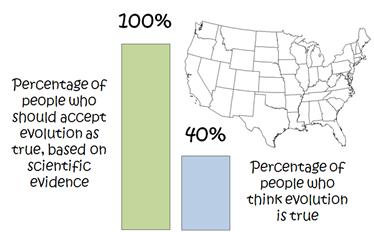
According to Gallup Poll, 40 percent of Americans accept evolution. Among them, 60 percent of democrats or independents versus 30 percent of republicans think evolution is true. Yet, there is no doubt among scientists that cosmic transformations and Darwinian evolution are factual. Gallup also reports that 58 percent of the general public think that climate change is occurring, versus 75 percent of democrats, 53 percent of independents, and 43 percent of republicans. But thousands of world researchers, advisors to the Intergovernmental Panel on Climate Change, have compiled chronological evidence of concerning fluctuations in climate.

Evolution aside, which formulation as a scientific reality dates back to, at least, 150 years, and to Charles Darwin’s seminal contributions (On the Origin of Species, 1859, and The Descent of Man, 1871), and whose on-and-off opponents always lose in the court of science and, frequently, in the court of law, the recent human-made corollaries of climate change are also factual despite the opinions of candidates, ideologies or congregations. But here is relevant trivia reported by Yale University and George Manson University Project/Center for Climate Change Communication: Americans trust President Obama (47 percent) more than former Governor Romney (21 percent) as “a source of information about global warming.”

“…what is expected from politicians by the public differs from what is observed in the electorate voting behavior…”

Remember that four in every five responders to the Science Debate Dot Org poll preferred science-inspired public policies rather than belief-based decisions. However what is expected from politicians by the public differs from what is observed in the electorate voting behavior. Who is telling the truth about evolution or climate change, President Obama or former Governor Romney? The answer is scientists! And that should be the point of reference for those seeking genuineness: learn what science says about reality, expect politicians to understand and match that view, and cast votes accordingly.

“… science… should be the point of reference for those seeking genuineness: learn what science says about reality, expect politicians to understand and match that view, and cast votes accordingly…”

Harris Interactive has surveyed that, despite medical researchers’ need of experimentation with stem cells to develop treatment or to prevent diabetes, Alzheimer or Parkinson disease, only 72 percent of the American public thinks such research should be allowed, in contrast to 82 percent of democrats, 73 percent of independents, and 58 percent of republicans. But misinformation about health can be even more scandalous, for example, one in every five adults believes that vaccines cause autism.

Above: Views about evolution, climate change, stem cell research, and alternative sources of energy by the American public, registered democrats, independents and republicans. Sources: Evolution: Gallup Poll 2007, Climate Change:  Gallup Poll 2012; Stem Cell Research: Harris Interactive 2010; Alternative Sources of Energy: Pew Research Center 2012.

The Pew Research Center has reported 52 percent of public support to developing alternative sources of energy –to oil, coal and gas; 65 percent of democrats, 55 percent of independents, and 36 percent of republicans agree with this view; not surprisingly 81 percent of progressives versus 52 percent of conservatives think that more federal funding should sponsor alternative energy research. And three quarters of the electorate trusts more the Environmental Protection Agency –to research, monitor, set standards and reinforce policies concerning pollution— than the US Congress.

“…Imagine, at last, a conversation over reality, facts, evidence, and rationality. …”

Statistics –reliable tools in the scientific method— strongly suggest that Americans want a presidential and congressional debate on science, innovation, health, and the environment, and that such dialog should exclude the personal opinions and beliefs of the candidates. Imagine, at last, a conversation over reality, facts, evidence, and rationality. If science becomes the backbone –better the brain— of candidates, and the voters are literate enough to assess it, a single debate shall suffice to unmask it all. — © 2012 by Guillermo Paz-y-Miño-C. all rights reserved

Related Articles:

United States ‘exceptionalism’ built on backs of the 99 percent

Can Atheists Be Our Leaders? – Editorial The Standard Times – Nov 6, 2010


New England Colleges and Universities: Acceptance of Evolution and Religiosity

Acceptance of Evolution and Religiosity in New England Colleges and Universities

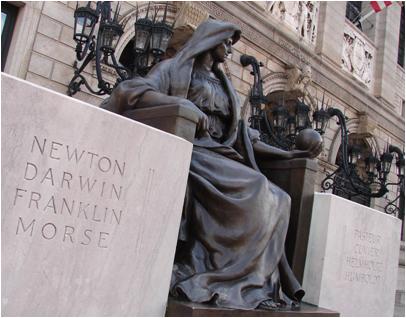
The Boston Public Library, a magnificent destination for enlightment (photo G. Paz-y-Miño-C — © 2010)

26% of the general faculty, 45% of the educators, and 35% of the students do not know that humans are apes…

15% of the general faculty, 32% of the educators, and 35% of the students believe, incorrectly, that the origin of the human mind cannot be explained by evolution…

30% of the general faculty, 59% of the educators, and 75% of the students are Lamarckian…

29% of the general faculty, 42% of the educators, and 37% of the students consider religion to be very important in their lives…

17% of the general faculty, 34% of the educators, and 28% of the students confess to pray daily…

To access complete post, statistics and link to original scientific article click on Acceptance of Evolution and Religiosity in New England Colleges and Universities

Atheists Survey On Science And Evolution

Atheists Science and Evolution Knowledge Survey

By Guillermo Paz-y-Miño-C. PhD  and Avelina Espinosa PhD — © 2011

American atheists understand the essence of science, are knowledgeable about evolution and well informed about the controversy over evolution versus creationism versus Intelligent Design (ID).

During the first two weeks of November 2011, we surveyed 133 atheists, non-believers and agnostics native to 35 states in the United States. Three hundred and thirty two members of Atheist Alliance of America (AAAmerica) received an email invitation to participate in an online anonymous and voluntary survey –40% of the contacted individuals responded. Among responders, 71.6% were males and 28.4% were females.

— Guillermo Paz-y-Miño-C. and Avelina Espinosa — © 2011 all rights reserved.

To access the survey results Click on:

Atheists Science And Evolution Survey

To test your understanding of science and evolution, you can respond to a shorter version of the survey and compare your responses to those of the 133 atheists, non-believers and agnostics who were polled in the study. Note that your responses will not affect the results already reported in the Atheists Science and Evolution Knowledge Survey. The server will simply help you compare and contrast your responses to those of the atheists, non-believers and agnostics polled in the study. You will be free to withdraw at any time by simply closing your browser. Click on SURVEY

Secular World Magazine published a summarized version of this study: Paz-y-Miño-C., G. & Espinosa A. 2012. Atheists’ knowledge about science and evolution. Secular World 8(1): 33-36 [PDF].

POLLS and SURVEYS on ACCEPTANCE of EVOLUTION and related topics

100 percent should accept evolution

GALLUP POLLS (click on links)

Gallup 2012: U.S. Confidence in Organized Religion at Low Point

Gallup 2012: In U.S., 46% Hold Creationist View of Human Origins

Gallup 2012: Four in 10 Americans are “very religious”

Gallup 2010: Four in 10 Americans Believe in Strict Creationism

Gallup 2010: Religion

Gallup 2010: Evolution, Creationism, Intelligent Design

Gallup 2009: On Darwin’s Birthday, Only 4 in 10 Believe in Evolution

Gallup 2008: Republicans, Democrats Differ on Creationism

Gallup 2007: Majority of Republicans Doubt Theory of Evolution

Gallup 2007: One-Third of Americans Believe the Bible Is Literally True

Gallup 2006: Almost Half of Americans Believe Humans Did Not Evolve

Gallup 2006: American Beliefs: Evolution vs. Bible’s Explanation of Human Origins

Gallup 2005: Most Americans Engaged in Debate About Evolution, Creation

Gallup 2005: Most Americans Tentative About Origin-of-Life Explanations

Gallup 2005: Darwin or Divine? Teens’ Views on Origin of Species

Gallup 2004: Third of Americans Say Evidence Has Supported Darwin’s Evolution Theory


PEW RESEARCH CENTER POLLS (click on links)

PEW 2010: U.S. Religious Knowledge Survey

PEW 2009: Public Praises Science; Scientists Fault Public, Media

PEW 2005: Public Divided on Origins of Life


CANADA (click on links)

2011: EKOS

2011: EKOS attitudes toward science

2008: Origin of life


UNITED KINGDOM (click on link)

2009: Faith and Darwin: Harmony, Conflict, or Confusion?


23 COUNTRIES (click on link)

2011: Ipsos Global advisory: Supreme Being(s), the Afterlife and Evolution


EDUCATION (click on links)

2012: State of State Science Standards

2011: Education Pays: Bureau of Labor Statistics

2011: How America Pays for College

2001-2010: Science and Nature by Polling Reports