Mauna Kea Telescopes To Sink in The Pacific

Mauna Kea Telescopes to Sink in the Pacific at TST

[click on subtitle to be redirected to The Standard Times]

By Guillermo Paz-y-Miño-C — © 2012

“…before the Dim End, all land telescopes will wear off and turn obsolete and… orbiting-the-planet observatories will likely replace them. Eventually, the shining domes resting on Mauna Kea will crumble while drifting away Northwest on their carrier, the late “Big Island.” These magnificent pieces of engineering will sink in the Pacific… when the summit of Mauna Kea succumbs to erosion, hence following the drowning fate of the Hawaiian Islands.”
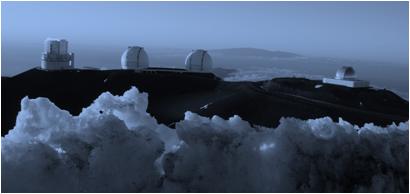
Telescopes Mauna Kea Hawaii Photo G Paz-y-Mino-C Evolution Literacy 2012

Telescopes on Mauna Kea, Hawaii, Photo GPC — © 2012 

Contemplating the night sky from the top of the largest volcano on Earth is spectacular. Indeed, on the Hawaiian Mauna Kea’s slopes, 13 astronomical observatories reach the universe through their light and radio-wave telescopes.

From base to summit, Mauna Kea (33,500 feet) raises taller than the Mahalangur-Himal Mount Chomolungma (29,000 feet) or, as renamed in the 1860s, “Everest.” The Royal Geographical Society, responsible for the authoritarian christening, eagerly sought to immortalize fellow member George Everest, a Welsh prominent topographer, who in youth was Surveyor General of India (1830s-40s). Thus the centuries-old Tibetan tradition of honoring the marvelous Chomolungma with a beautiful native name (of course surreal “Mother Goddess”) was lost.

But Mauna Kea, or “The White Mountain” (at times covered with snow), conserved its Hawaiian designation, traceable to the 11th century, and probably to the years 300-500, when Polynesians settled in the islands. The Mauna Wakea synonym, or “Mountain of the Deity Wakea,” is probably a more recent adoption since mythical traditions regarding the landscape customarily develop after the descriptive word-stock.

Despite the appalling American and European business-men conspiracy to overthrow the Kingdom of Hawaii (1893), followed by a short-lived pseudo-sovereign republic (1894-98), an annexation as territory to the United States (1898), a granted statehood (1959), and a final Apology Resolution by the US Congress (1993) –which was co-signed by President Bill Clinton— for the “deprivation of the rights of Native Hawaiians to self-determination,” the ancestral cultures reverberate in contemporary Hawaii.

Above: The Apology Resolution of 1993 -for the “deprivation of the rights of Native Hawaiians to self-determination”- was co-signed by the US Congress and President Bill Clinton

Mauna Kea’s volcanic foundations emerge from the mantle, deep below the Pacific tectonic plate. A hotspot fuels with magma the islands in the Hawaiian Ridge, and these “huge masses of interconnected rock” move slowly –at the speed our nails grow— toward the Northwest. The Big Island (0 to 600,000 years old), the newest formation and where Mauna Kea is located, rests on the hotspot, while the remaining smaller islands of the Maui cluster (1-2 million years old), Oahu (2-4 million years old) where Honolulu is situated, and the Kauai cluster (more than 5 million years old) continue to erode and sink away from the hotspot. The current archipelago is destined to disappear under the ocean and, if the hotspot remains active, to be replaced by new islands. Hawaii is an exemplar of the reality of an evolutionary tectonic process.

“…The current archipelago is destined to disappear under the ocean and, if the hotspot remains active, to be replaced by new islands. Hawaii is an exemplar of the reality of an evolutionary tectonic process…” Image: aerial view of The Big Island – Photo GPC — © 2012

Regardless of the sporadic snowy peaks, the atmosphere over Mauna Kea is cloudless most of the year, free of high-elevation particle pollution and very dark with no artificial-nightlight influence, key factors for telescopic observations. And $2-billion in infrastructure and equipment have been brought to the summit by a dozen countries which work in partnership with the University of Hawaii, active manager of the “Astronomy Precinct” within the Mauna Kea Science Reserve.

The Mauna Kea telescopes look grandiose in close proximity. Their white and silver domes stand out at twilight while waking up for their night runs: in 1968-70, the University of Hawaii built the first two large observatories (UH 0.9-m educational telescope and UH 2.2-m telescope); followed by the NASA Infrared Telescope Facility (1979), Canada-France-Hawaii Telescope (1979), UK Infrared Telescope (1979), James Clerk Maxwell Telescope (1987), CALTECH Submillimeter Observatory (1988), Very Long Baseline Array (1992), Keck I and II (1993-6), Subaru (1997), the Gemini North (1999), and the Submillimeter Array (2002). These instruments explore outer space under optical, infrared, submillimiter and radio spectra.

Above: Canada-France-Hawaii Telescope, Mauna Kea, Hawaii, Photo GPC — © 2012 

Above: Keck I and II observatories, Mauna Kea, Hawaii, Photo GPC — © 2012 

I found much mysticism, however, intertwined with cosmological facts, at Imiloa, an impressive, beautifully colored educational facility, which is advertised as “part science center, part indigenous peoples museum” by the University of Hawaii at Hilo. Imiloa merges scientific knowledge and sacred traditions about “origins” as if they were empirically compatible, but they are not. We do know, for example, that neither the Hawaiian Islands nor humans were created, but that the former emerged from magma piercing its way out through the Earth’s crust, while the latter evolved 180,000 years ago from African ancestors whose descendants, the Polynesians, arrived in Hawaii. And thanks to the Mauna Kean telescopes –plus two millennia of astronomy— we are certain that the universe evolved autonomously, independent from the invention of mythology, and that it will end when the last stars deplete their own fuel.
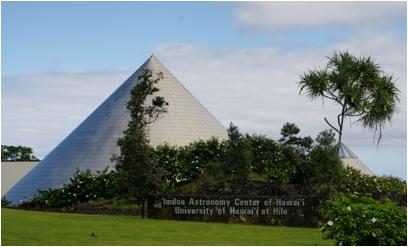
Above:  Imiloa Astronomy Center sponsored by the University of Hawaii at Hilo, Photo GPC — © 2012 

But before the Dim End, all land telescopes will wear off and turn obsolete and, if our species persists over a few more cosmic seconds in the time scale, orbiting-the-planet observatories will likely replace them. Eventually, the shining domes resting on Mauna Kea will crumble while drifting away Northwest on their carrier, the late “Big Island.” These magnificent pieces of engineering will sink in the Pacific, as archeological relics, when the summit of Mauna Kea succumbs to erosion, hence following the drowning fate of the Hawaiian Islands.  – © 2012 by Guillermo Paz-y-Miño-C. all rights reserved.

Above: the CALTECH Submillimeter Observatory, Mauna Kea, Hawaii, Photo GPC — © 2012 

On the Wrongly Called The God Particle

[click HERE to be redirected to The Standard Times]

Dr. Guillermo Paz-y-Miño-C — © 2012

New England Science Public

[A book-review format of this article is available at Amazon.com]

“…without mass, no atoms would exist, no galaxies or stars, no solar systems or planets with life, and no brains capable of thinking about it…”

Computer-generated image of a proton-proton collision recorded with the CMS detector at CERN (2012). The data is consistent with the decay of a Higgs-like-boson into photons (dashed yellow lines and green towers). Alternatively, the data could also be explained by background processes consistent with the Standard Model (image credit CMSCERN © 2012).

Nobel laureate Leon Lederman affirms that the title of his 1993 book “The God Particle: If the Universe is the Answer, What is the Question?” offended two groups: those who believe in God and those who do not. But this is another astute –and a posteriori— marketing pronouncement. If true, Lederman and coauthor Dick Teresi, a science writer, would have disappointed 95 percent of all Americans (the 80 percent of believers and the 15 percent of seculars), the book’s initial and major target audience.

     As particle physicist, Lederman’s intention with such an unfortunate and misleading heading –here I don’t only blame the publishers for scrambling science with the supernatural to secure sales— was to precisely reach the populous obsessed with science fiction, more than with science facts, and discuss the potential existence of the Higgs boson (a subatomic particle), which experimental demonstration, as predicted for decades, could bring major understanding to the essence of matter.

This past 4th of July, the European Organization for Nuclear Research, CERN, celebrated with its own “fireworks,” or highly energetic particle collisions, the discovery of a Higgs-like boson generated at the Large Hadron Collider (LHC), a magnificent underground instrument built to study the fundamental structuring blocks of all things.

I visited CERN, last year, located nearby Geneva, at the Swiss-Franco border. Its 17-mile circular accelerator speeds up, in opposite directions, subatomic “hadrons,” either hydrogen nuclei or lead ions, which gain energy after consecutive laps. At the instant of collision, scientists recreate the conditions immediately after the Big Bang, resembling the first events in the existence of our 14 billion-year-old universe. CERN is shockingly impressive; its amazing technology and scale of engineering caused me profound joy.

Square Galileo Galilei and THE GLOBE (Visitors Interpretation Center) at the European Organization for Nuclear Research, CERN, nearby Geneva — Swiss-Franco border (photos G. Paz-y-Miño-C — © 2011).

Hadron collisions produce short-lasting minuscule particles difficult to detect, and the Higgs boson has been indeed elusive. Its existence was postulated in 1964, in separate articles published in Physical Review Letters by Robert Brout and Francois Englert, Peter Higgs (alone), Gerald Guralnik, Richard Hagen and Tom Kibble. But CERN seems to have found it or, as cautiously announced, “measured the products of its decay,” thus inferring its existence.

  ATLAS control room at the European Organization for Nuclear Research, CERN (photo G. Paz-y-Miño-C — © 2011).

To help us imagine this day of discovery, or presumption that the Higgs boson is real, in his 1990s book Lederman traces back the history of particle physics to 2,600 years ago; sparkled by the Greek philosopher Thales of Miletus, who wondered about the simplest forms of matter, continuing with Democritus of Abdera (c 400 BP), who not only coined the term atom (“uncuttable”) but declared that “…nothing exists except for atoms and empty space; everything else is opinion,” and ending with the 1993 cancellation, by the US Congress, of the Superconducting Super Collider project to be built in Waxahachie, Texas, and which would have surpassed the LHC at CERN with a 54-mile-diameter particle accelerator.

Greek Philosopher Democritus of Abdera (460-370 BP) “…nothing exists except for atoms and empty space; everything else is opinion…”

What are Higgs bosons? Remember that atoms consist of positively charged protons and electrically neutral neutrons, both occurring at a nucleus. Electrons cloud around the nucleus and are negatively charged. The entire atom package is kept together by electromagnetic forces. If a nucleus of hydrogen –the simplest known element which is essentially a proton— is accelerated and rammed against another proton an explosion occurs, which liberates subatomic particles. Physicists rely on a body of scientific knowledge, called the Standard Model, to theorize and explore experimentally –currently at CERN— the properties of such subatomic particles.

About 60 of these particles have been hypothesized and/or documented to exist, and scientists classify them as bosons, hadrons and fermions (for technical terminology visit CERN’s Glossary). The Higgs is a boson and a crucial one to understand the properties of other elementary particles, for example, why some have mass and others, like the photons (components of light) don’t. Without mass, no atoms would exist, no galaxies or stars, no solar systems or planets with life, and no brains capable of thinking about it. (Note, however, that Higgs-like particles are expected to account for only a fraction of the total mass of the universe). CERN asserts that the characterization of Higgs will provide “the final missing ingredient in the Standard Model” and guide us in the comprehension of the forces acting at the microscopic core of nature.

Elementary subatomic particles (top: bosons, hadrons, fermions) and their interactions (bottom); source Public Domain.

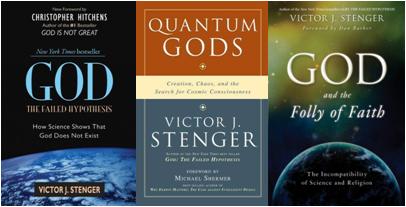
As for Lederman’s book (I belong to the 15 percent of seculars who detest its heading and insertions of subliminal mysticism into the facts), the prose offers an enjoyable ride, rich in historicity, sarcastic humor –rare for a physicist— and fantasizing dialogs with Democritus, Lederman’s imaginary physics peer. And to poise Lederman’s enlightenment about particle physics and its ramifications to modern cosmology with the views of one of his contemporary elementary-particles colleagues, I recommend reading Victor Stenger’s “God: The Failed Hypothesis” (2008), “Quantum Gods” (2009), and the latest “God And the Folly of Faith” (2012). – © 2012 by Guillermo Paz-y-Miño-C. all rights reserved.

Above, some of the books authored by Dr. Victor Stenger: “God: The Failed Hypothesis” (2008), “Quantum Gods” (2009), and “God And the Folly of Faith” (2012).

New England Colleges and Universities: Acceptance of Evolution and Religiosity

Acceptance of Evolution and Religiosity in New England Colleges and Universities

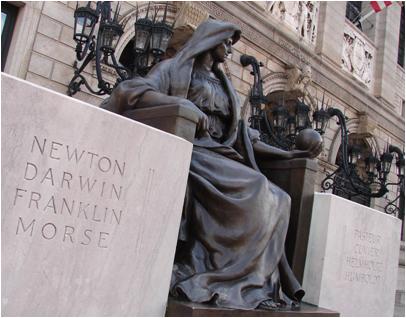
The Boston Public Library, a magnificent destination for enlightment (photo G. Paz-y-Miño-C — © 2010)

26% of the general faculty, 45% of the educators, and 35% of the students do not know that humans are apes…

15% of the general faculty, 32% of the educators, and 35% of the students believe, incorrectly, that the origin of the human mind cannot be explained by evolution…

30% of the general faculty, 59% of the educators, and 75% of the students are Lamarckian…

29% of the general faculty, 42% of the educators, and 37% of the students consider religion to be very important in their lives…

17% of the general faculty, 34% of the educators, and 28% of the students confess to pray daily…

To access complete post, statistics and link to original scientific article click on Acceptance of Evolution and Religiosity in New England Colleges and Universities

Massachusetts Gets an A- in Science Standards

Massachusetts Gets an A- in Science Standards

[click on title to be redirected to The Standard Times]

Dr. Guillermo Paz-y-Miño-C — © 2012

Department of Biology, University of Massachusetts Dartmouth

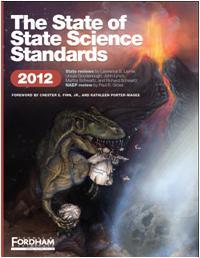
Massachusetts just got an A- on The State of State Science Standards, a 2012 report released by the Thomas B. Fordham Institute. Although “The Bay State” ranked fourth in the nation, after California (A), District of Columbia (A) and Indiana (A-), the other New England states did poorly: Connecticut ranked 14th, Vermont 24th, Maine 30th, New Hampshire 31st and Rhode Island 33rd.

“A majority of states’ standards remain mediocre to awful,” the report says. “The average grade across all states is — once again — a thoroughly undistinguished C. In fact, it’s a low C,” highlights the Foreword to a 217-page state-by-state scrutiny of the science education expectations in physics, earth and space, and life sciences.

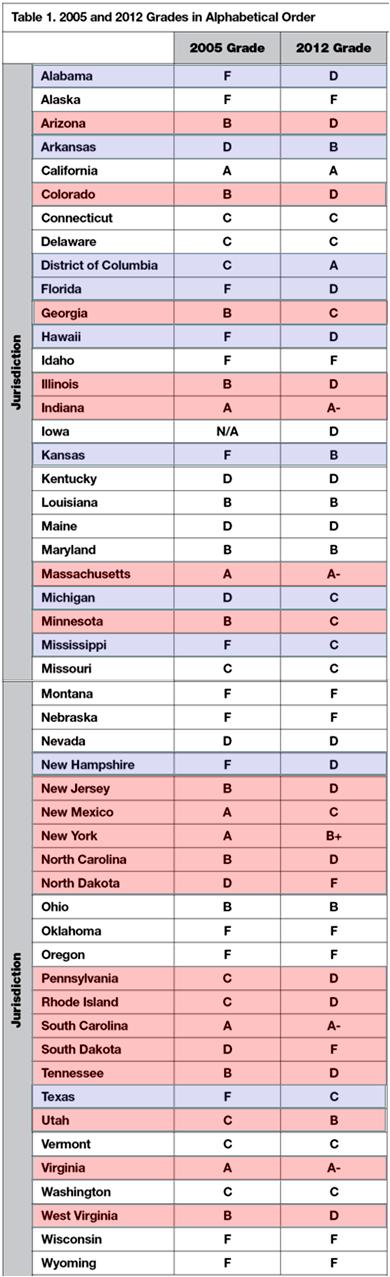
When contrasting the overall performance between 2005 and 2012, a reality emerges: only 11 states improved their grades, usually from F to higher — but still embarrassing — scores, except for the District of Columbia which went from a C to an exemplary A; 19 states worsen from a B or A to lower grades; and 20 states remained unchanged, half of them around F or D (see complete Table at the end of article).

In New England, Massachusetts was “degraded” from A to A-, Connecticut and Vermont remained in C, and Maine in D, Rhode Island decreased from C to D, and New Hampshire improved from F to D (image below).

The letter grades corresponded to numeric scores over 10 points; seven for content and rigor of state science standards and three for clarity and specificity. However, the assessment by the Fordham Institute was not about actual performance of students or teachers in physics, earth and space, or life sciences, but exclusively about the science expectations that schools are supposed to meet. Note that the U.S. world placement in math (25th), science (17th) and reading (14th) has been documented in previous studies.

A few questions emerge out of the Fordham results: If schools and teachers stick to a “C average” state of science standards, what quality of education are we really offering? If state science standards guide science education, how do we escape from this loop of poor standards and the expectation to follow them? Shouldn’t science teaching standards actually match the rigors of universal scientific progress? Should self-regulation in school curricula break apart from proper science education in the name of self-regulation?

The Fordham report stresses, nor surprisingly, four major problems inherent to these state science standards:

First, the undermining of evolution, a battle not only traceable to the Scopes Trial of 1925, in Tennessee, when the Butler Act (see original document) declared “unlawful to teach any theory, in public schools, that denies the Story of the Divine Creation of man as taught in the Bible,” but currently to the 2012 New Hampshire bill proposals to “require evolution to be taught as a theory, including the theorists’ political and ideological view points and their position on the concept of atheism” or “require science teachers to instruct pupils that proper scientific inquire results from not committing to any one theory or hypothesis, no matter how firmly it appears to be established.” Both bills are hymns to ignorance.

[Updates on the Anti Evolution Bills in New Hampshire]

Second, vagueness in the statements of expectations about what students should actually learn or be able to do after learning; 29 states scored 1 or 0 in the clarity and specificity score of the assessment, out of three points.

Third, poor integration of scientific inquiry, a pernicious malady nationwide; rather than helping students to acquire scientific content through discovery, there is “too much attention to engineering and technology, as well as to “science process skills,” which leads to a technical mind-set where true scientific thinking is lacking.

And fourth, poor foundations in mathematical skills; in essence, the most significant tool for modern scientific explorations, that is mathematics, is avoided as the centerpiece of proper science education: a fear of equations and rejection of complexity, or, as one of my excellent students ironically puts it, “there are too many numbers in math.”

An illustration by Sarah Samaroo (image left) is the only humorous, purposely macabre, aspect of the Fordham report. She depicts on the cover a Tyrannosaurus rex grossly salivating and crushing, before gulping, massive paper balls — as if they were carcasses of cellulose — of the “Science Standards.” In the background, a mega eruption and in the foreground an asteroid colliding with Earth warns us of the imminent extinction of magnificent science standards that we could have fully possessed or preserved if proper scientific inquiry had been in our minds. – © 2012 by Guillermo Paz-y-Miño-C. all rights reserved

“A majority of states’ standards remain mediocre to awful,” the report says. “The average grade across all states is — once again — a thoroughly undistinguished C. In fact, it’s a low C,” highlights the foreword to a 217-page state-by-state scrutiny of the science education expectations in physics, earth and space, and life sciences…

Below Complete State-by-state Grade Table Extracted and Adapted From the Fordham Report (grades 2005 vs. 2012):

LIGHT BLUE = grade improvement

WHITE = grade unchanged (or N/A)

PINK = grade worsen

Rejection of science threatens to be epidemic

Rejection of science threatens to be epidemic

[click on title to be redirected to The Standard Times]

Dr. Guillermo Paz-y-Miño-C — © 2012

Department of Biology, University of Massachusetts Dartmouth

“…There is a civic duty all citizens can exert to rectify the politics obscuring education: Cast our votes for candidates who sponsor proper schooling and support significant, not only profitable research. Escort out of office those who see fiction and facts compatible, or worship ignorance-based opinions as rightful views of equitable value to the empirical truth…”

Houston, we have a problem. And it has nothing to do with the explosion of an oxygen tank at 200,000 miles away from Earth that is threatening the lives of three astronauts cramped in a 1970s model of a spaceship, nor with an imminent meteor shower or solar radiation blast.

It is the rejection of science by elected officials and their constituents who, although privileged to grow up in a nation leading the most important quest of all, that of superb education and cutting-edge discoveries at prestigious universities, now dismiss the value of knowledge and of scientific realities essential to our existence.

And it is not only evolution that is rejected (my favorite topic, as a biologist and university faculty committed to education) but specifically space explorations, climate change research, stem cell studies, cloning and vaccinations.

The opposition resides, at times, on costs, a legitimate reason when prioritizing funding for billion-dollar projects like NASA’s Apollo (1960s-1970s), Shuttle (1980s-2000s) or International Space Station programs (1990s-2000s), but the resistance to the other fields is dubious under the economic justification (climate change) or relies on puritan thinking rather than on pro-health sincerity (stem cells, cloning and some vaccines).

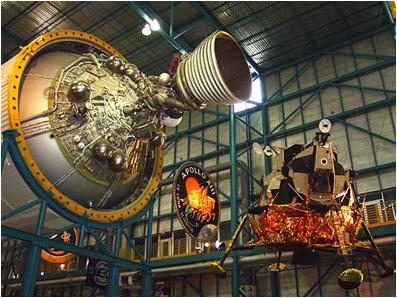
 Figure above: Apollo rocket and lunar module at Cape Canaveral — photo G. Paz-y-Miño-C — © 2001.

Figure above: Suttle Model, International Space Station Training Facilities at NASA Houston — photo G. Paz-y-Miño-C — © 2011.

It is impossible to honor knowledge when a nation’s admiration for it vanishes, when its students rank 25th in math and 17th in science worldwide, or when the youth of 14 other countries reads more than our own, or when the term “professorial” becomes an insult or a reprehensible trait in a public figure, as if the sophistication gained by formal education were a malady that must be eradicated to ensure “equality” and fair share of omnipresent unawareness of all issues.


Figure above: World Reading Math Science Ranks Evolution Literacy — OECD PISA Database © 2009.

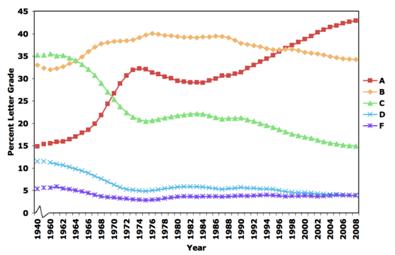
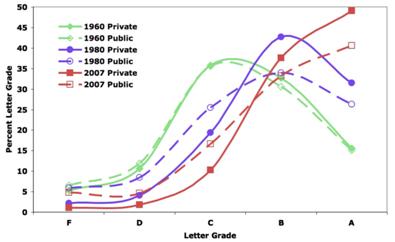
In the quest for attaining this absurd egalitarian recognition to low and high standards, the American colleges and universities have fallen into a pervasive grade-inflation. According to the Teachers College Record, a solid C was the most popular grade in the 1940s (35 percent), followed by B (below 35 percent), then by A (15 percent), and finally by D and F (above 10 and 5 percent, respectively). In the 1970s, the Vietnam War draft triggered a proliferation of A’s, which surpassed 30 percent. Today the A grade is fashionable (over 40 percent) and the “uncool” C is granted to only 15 percent of all college students — a situation accentuated at private institutions.

Figure above: Where A Is Ordinary: The Evolution of American College and University Grading 1940-2009 — Distribution of grades at American colleges and universities as a function of time— Rojstaczer & Healy — Teachers College Record © 2010.

Figure above: National average grading curves as a function of time, 1960, 1980, and 2007 for public and private schools — Rojstaczer & Healy– Teachers College Record © 2010. 

But trivializing education can be suicidal in a competitive job market where only earning a bachelor’s degree would keep a U.S. worker out of poverty. Indeed, education pays by reducing unemployment and rising income, and The Bureau of Labor Statistics has examined these trends: 15 percent of those without a high school diploma remained unemployed during 2010 and, if employed, they earned only $450 per week. Those who graduated from college reduced their unemployment to 5 percent and, if employed, earned more than $1,000 weekly. Only holders of master’s degrees and above — professional and doctorate degrees — secured a job more than 95 percent of the time and earned beyond $1,300 per week.

Figure above: Education Pays: Unemployment and Median Weekly Earnings as Function of Education — Bureau of Labor Statistics — © 2011.

Although the crisis in the current educational system is multi factorial and complex, there is a civic duty all citizens can exert to rectify the politics obscuring education: Cast our votes for candidates who sponsor proper schooling and support significant, not only profitable research. Escort out of office those who see fiction and facts compatible, or worship ignorance-based opinions as rightful views of equitable value to the empirical truth.

What can we achieve if public officials and their electors treasure education? An overwhelming support to science and reason; in fact, if citizens advance from holding a high school diploma to graduating from college, societal concurrence with major research topics will increase: space explorations from 50 to 70 percent; climate change from 45 to 58 percent; acceptance of evolution from 21 to 74 percent; embryonic stem-cell research from 51 to 71 percent; therapeutic cloning from 64 to 73 percent; and childhood immunization from 79 to 91 percent (data from Space Policy Journal, Gallup, Pew Research Center, Georgia Department of Human Resources and Coalition for the Advancement of Medical Research).

And going back to Houston, and specifically to NASA, our “competent sentinel” when cosmic menace approaches Earth, its terrestrial problem is now to secure $19 billion during 2012 — about 0.6 percent of the $3 trillion federal budget — and continue with the programs: science (planetary, astrophysics), aeronautics, space technology, exploration, space operations and education, the latter alone worth $138 million (click on NASA’s Positive Impact on Society). Indeed, world-quality research and education can be expensive; is someone willing to try ignorance? — © 2012 by Guillermo Paz-y-Miño-C. all rights reserved

Figure above: Space suit, International Space Station Training Facilities at NASA Houston — photo G. Paz-y-Miño-C — © 2011.


Figure above: Model vehicle for Mars exploration, International Space Station Training Facilities at NASA Houston — photo G. Paz-y-Miño-C — © 2011.

Atheists Survey On Science And Evolution

Atheists Science and Evolution Knowledge Survey

By Guillermo Paz-y-Miño-C. PhD  and Avelina Espinosa PhD — © 2011

American atheists understand the essence of science, are knowledgeable about evolution and well informed about the controversy over evolution versus creationism versus Intelligent Design (ID).

During the first two weeks of November 2011, we surveyed 133 atheists, non-believers and agnostics native to 35 states in the United States. Three hundred and thirty two members of Atheist Alliance of America (AAAmerica) received an email invitation to participate in an online anonymous and voluntary survey –40% of the contacted individuals responded. Among responders, 71.6% were males and 28.4% were females.

— Guillermo Paz-y-Miño-C. and Avelina Espinosa — © 2011 all rights reserved.

To access the survey results Click on:

Atheists Science And Evolution Survey

To test your understanding of science and evolution, you can respond to a shorter version of the survey and compare your responses to those of the 133 atheists, non-believers and agnostics who were polled in the study. Note that your responses will not affect the results already reported in the Atheists Science and Evolution Knowledge Survey. The server will simply help you compare and contrast your responses to those of the atheists, non-believers and agnostics polled in the study. You will be free to withdraw at any time by simply closing your browser. Click on SURVEY

Secular World Magazine published a summarized version of this study: Paz-y-Miño-C., G. & Espinosa A. 2012. Atheists’ knowledge about science and evolution. Secular World 8(1): 33-36 [PDF].

United States ‘exceptionalism’ built on backs of the 99 percent

United States ‘exceptionalism’ built on backs of the 99 percent

[click on title to be redirected to The Standard Times]

Dr. Guillermo Paz-y-Miño C. — © 2011

Department of Biology, University of Massachusetts Dartmouth 

“A sense of inner exceptional nature probably drives the existence of most individuals and seems to be a Darwinian adaptive trait. Tribal pride is not only ancestral but ubiquitous…”

Overconfidence, or “believing you are better than in reality, is advantageous because it increases ambition, morale, resolve, persistence or the credibility of bluffing, generating a self-fulfilling prophecy in which exaggerated confidence boosts up success,” write Dominic D.P. Johnson and James H. Fowler in their latest article, The Evolution of Overconfidence, published in Nature in September.

Johnson and Fowler remark that “populations become overconfident, as long as benefits from contested resources are large compared with the cost of competition. The fact that overconfident populations are evolutionarily stable in diverse environments may explain why overconfidence remains prevalent today, even if it contributes to hubris, market bubbles, financial collapses, policy failures, disasters and wars.”

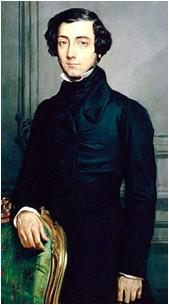
In “Democracy in America” (Volumes I, 1835, and II, 1840: visit Democracy in America Online), the French sociologist and historian Alexis de Tocqueville [image left] acknowledged and critically contemplated the originality and uniqueness of the 19th century emerging superpower, the United States. He called it “exceptional” for its generalized equality and constitutional democracy, and for its commercial habits and pragmatism.

In retrospect, his observations about American ideology, cultural cohesiveness and shared values were astute and visionary. But de Tocqueville also detected the underlying fabric of puritan thinking, the essence of our modern conservatism:

“Almost all the sects of the United States are comprised within the great unity of Christianity, and Christian morality is everywhere the same. In the United States the sovereign authority is religious, and consequently hypocrisy must be common; but there is no country in the whole world in which the Christian religion retains a greater influence over the souls of men than in America, and there can be no greater proof of its utility, and of its conformity to human nature, than that its influence is most powerfully felt over the most enlightened and free nation of the earth [Alexis de Tocqueville].”

The clause “American exceptionalism” was apparently used, depreciatively, by Joseph Stalin (1878-1953) while forecasting in the 1920s that the American wealth, technological pride and social fairness were temporary and fated to collapse, unless communism took over. Ironically, the Soviet system crumpled in the 1980s and its “restructuring” — Perestroika — led to political and economic reform by mimicking the market-based models of the West, which, paradoxically, became today’s fiasco in a landscape of deregulated money-making opportunities that did not benefit –mainly– the people.

Winston Churchill (UK), Franklin Roosevelt (USA) and Joseph Stalin (USSR), The “Big Three,” at The Yalta Conference, 1945. They met to discuss the future of Europe after World War II. [Click for VIDEOS The Yalta Conference].

The idea of exceptionalism consolidated in the United States and abroad after the 1950s, based on unparalleled industrial transformations, scientific achievements, competitive labor and education. Reality surpassed the cliche of uniqueness and actually disproved one of de Tocqueville’s assertions: that Americans’ exclusive trading interests “diverted their minds from the pursuit of science, literature and the arts” and that, therefore, exceptionalism was evident mainly in socio-economic affairs.

But living up to exclusiveness has proved difficult, and fast excessive wealth has led to ignore the history that created the “extraordinary.” It was judicious investment in rigorous education, basic science and technology that gave rise to the best universities in the world, the finest hospitals, unrivaled space explorations, magnificent natural history museums and ecologically managed national parks. Farms, factories, highway connectivity and urbanization prospered due to an agile economy that generated, in hindsight, short lasting bonanza.

“It was judicious investment in rigorous education, basic science and technology that gave rise to unrivaled space explorations” — Mission Control International Space Station — Houston, photo G. Paz-y-Miño C. © 2011

And it was an outstanding work force, driven by the highest standards of performance, that enriched today’s heartless, and sometimes brainless, “top 1 percent,” the financial conservative elite who opposes science, mocks intellectuals and ridicules college education. The overconfident mega-wealthy who question the reality of human-induced climate change, reject evolution, blame vaccines for causing mental retardation or autism, diminish the importance of biodiversity, and oppose environmental protection and clean energy.

Above: Cumulative Growh in Average After-tax Income, by Income Group (percentage change in income since 1979, adjusted for inflation); source US Congressional Budget Office, CBO Report October 2011

Above: Share of Total After-tax Income, by Income Group (percent); source US Congressional Budget Office, CBO Report October 2011

Yet, they claim the value of exceptionalism as their own and intend to renegotiate it for the upcoming elections, re-sell it to the voters — as in the profitable stock market — of course, without committing their assets, or taxes, to the continuation of the “extraordinary,” thus neglecting that “uniqueness” took a century to be erected over the human capital of workers, artists, scientists, musicians, teachers, novelists or poets, who invested themselves, and fully, to harvest collective good.

If a bailout is an “act of loaning or giving capital to a company, a country, or an individual that is in danger of collapsing, in an attempt to prevent ruin,” then the exceptionalism that we treasure must be rescued — “bailed out” — by the prosperous untouchable class that amassed fortune over the exceptional labor of their compatriots.  — © 2011 by Guillermo Paz-y-Miño-C. all rights reserved

World Extreme Poverty Map 2008

Source: for original document Click on 2008 World Development Indicators, The World Bank.

For World Statistics on Poverty visit Global Issues Poverty Facts


Above: Almost half the world — over three billion people — live on less than $2.50 a day. Source World Bank Development Indicators 2008.

Above: In 2005, the wealthiest 20% of the world accounted for 76.6% of total private consumption. The poorest fifth just 1.5%. Source World Bank Development Indicators 2008.

Recommended Book: The Price of Civilization, 2011, by Jeffrey D. Sachs

“…At the root of America’s economic crisis lies a moral crisis: the decline of civic virtue among America’s political and economic elite. A society of markets, laws, and elections is not enough if the rich and powerful fail to behave with respect, honesty, and compassion toward the rest of society and toward the world. America has developed the world’s most competitive market society but has squandered its civic virtue along the way. Without restoring an ethos of social responsibility, there can be no meaningful and sustained economic recovery…” says author Jeffrey D. Sachs.

On Francis Collins and Karl Giberson “The Language of Science and Faith”

On Francis Collins’ & Karl Giberson’s “The Language of Science and Faith”

By Guillermo Paz-y-Miño-C.  © 2011

“In matters of God’s nonexistence, the high-school-educated atheist is more lucid than the deeply religious scientist…”

“…A trilogy of spiritual books… has been written or sponsored by Francis Collins, Director of the National Institutes of Health NIH and former head of the Human Genome Project: The Language of God 2006, Belief: Readings on the Reason for Faith 2010, and the brand new –coauthored with… Karl Giberson– The Language of Science and Faith 2011…”

“…Shot-gun marriages like this, between evolution and faith, have never worked, despite the tradition of pointing the barrel at evolution’s head. The truth is that evolution likes it single. Free, with no stoppers of thought or restrains on logic. And when lured unknowingly into the altar by those who see facts and fiction compatible, evolution has consistently stood belief up and walked away, sometimes run, toward its secular turf…” — © 2011 by Guillermo Paz-y-Miño-C.

Trilogy Francis Collins Books“…the dream of arranging evolution’s wedding with belief will remain dormant for as long as evolution is awake.” Click on image to access complete article.

Boston’s Hayden Planetarium carries standard of scientific study – Editorial The Standard Times – Aug 17, 2011

[click on title to be redirected to The Standard Times]

Dr. Guillermo Paz-y-Miño C. — © 2011

Department of Biology, University of Massachusetts Dartmouth

Science is just a refined device for resolving ordinary curiosity and a powerful liberator of superstition. It is the subsistence kit to defeat re-emerging fundamentalism. And by recalling Giordano Bruno’s and Galileo’s past, as Santayana reasoned over the value of remembering history, we restate our right to learn the truth. This is why Boston’s Charles Hayden Planetarium is more than a “light show,” but a salutation to the triumph of scientific inquiry over blind belief…

Giordano Bruno was not as fortunate as Galileo to opt for the imprisonment of his body in trade for thinking and writing about cosmology under house arrest. The Roman Inquisition orchestrated Bruno’s “civil” burning in 1600, at age 52, for blasphemy and heresy, and for conjecturing that the sun was a star and that God and the universe were one and the same.

Giordano Bruno Evolution Literacy

Statue of Giordano Bruno by Ettore Ferrari (1845-1929), Campo de’ Fiori, Rome, Italy

Galileo’s fate, as philosopher, physicist and astronomer, was more honorable than Friar Bruno’s. Although the Catholic church did find Galileo “vehemently suspect of heresy” in 1633, for defending Copernicus’ proposal that the sun, not the Earth, was at the center of planetary orbiting, his precious mind could not be smoked by the clergy, nor smoldered by the populous, but rather retreated to concealed productivity. And so the church chaperoned Galileo’s brainpower until age 77.

Galileo Galilei Evolution Literacy

Galileo Galilei (as depicted by Justus Sustermans in 1636) and his “Faces of the Moon”

George Santayana Evolution Literacy“Those who cannot remember the past are condemned to repeat it” proclaimed the Spanish-American logician George Santayana (image left) [or “The One Who Does Not Remember History Is Bound To Live Through It Again“]. Indeed, recalling Bruno’s or Galileo’s tale is not pointless. It reminds us that exploring the cosmos can be obstructed by irrationalism, and that our worshipping for free science must continue to safeguard humanity’s scientific legacies. It alerts us that the word “obscurants” was coined to denounce those who veil facts from the public.

And this brings me to the cosmic celebration role played by the renovated Charles Hayden Planetarium in Boston, but not before urging an equal revamp of its host, the Museum of Science itself.

Nitpicking aside, each “Undiscovered Worlds,” “Explore the Universe,” “Cosmic Collisions” or “The Sky Tonight” show is a tribute to centuries of space explorations, and a joyful remembrance that, despite Bruno’s sadistic silencing and Galileo’s confinement, the empirical truth prevailed over institutionalized ignorance.

Zeiss Starmaster Projector Evolution LiteracyThe audience’s amazement while watching the planetarium animations is contagious. A Zeiss Starmaster projector (image left) creates the illusion of space travel and it is fun to go along. Visual and sound effects impress human senses and the virtual take-off in a helicopter, from the museum’s roof, while flying over Boston and metamorphosing into a spaceship that leaves Earth to immerse itself into galactic infinitude is magnificent.
Not surprisingly for an institution accountable for promoting science literacy, the planetarium has adopted clever marketing slogans: “Discover the beauty and wonder of the night sky that has fascinated humanity for millennia,” or “We have learned that our solar system is not alone in the universe, and we have had to redefine our understanding of planets and solar systems,” and my favorite “Explore cosmic collisions, the hypersonic impacts that drive the dynamic and continuing evolution of the universe.”

And pro evolution aphorisms are vital for the 40 percent of New Englanders who still do not accept the reality of evolution and seek —together with 70 percent of their equally incredulous American counterparts— air-conditioned recreation at summer museums.

And in a free-market society where the Book of Genesis sells more than the Book of Reason, the Boston Museum of Science and its planetarium must compete not only with reputable national co-exemplars of proper public outreach, but with impostor “sister institutions,” like the “creation museums” and “Genesis parks” emerging in the United States, where pseudoscience and intelligent design are smuggled in planetaria and aquaria format to depict foolishness, and so lure thousands of ticket buyers to harass plastic dinosaurs and inhale Eden.

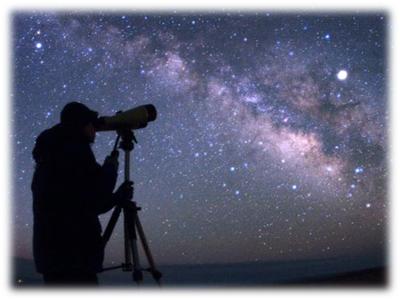
Night Sky Image by Babak TafreshiThe night sky image by Babak Tafreshi, Lennart Nilsson scientific photography prize, 2009

But the Boston Museum of Science has just deployed an antidote to such pseudo-dinosauria frenzy: the exhibit “Dinosaurs: Ancient Fossils, New Discoveries,” open until Aug. 21 (2011), is another tribute to genuine science, and a co-effort with accredited institutions, including the American Museum of Natural History, Houston Museum of Natural Science, California Academy of Sciences, The Field Museum, and the North Carolina Museum of Natural Sciences.

Science is just a refined device for resolving ordinary curiosity and a powerful liberator of superstition. It is the subsistence kit to defeat re-emerging fundamentalism. And by recalling Giordano Bruno’s and Galileo’s past, as Santayana reasoned over the value of remembering history, we restate our right to learn the truth. This is why Boston’s Charles Hayden Planetarium is more than a “light show,” but a salutation to the triumph of scientific inquiry over blind belief. — © 2011 by Guillermo Paz-y-Miño-C. all rights reserved

Galileo Explains Astronomy to Pope Evolution Literacy

Fluffy the Galileo of the lemmings Evolution Literacy

Fluffy, the “Galileo of the Lemmings,” with his stopwatch

Scientific Illiteracy

Is scientific literacy at risk of extinction?

Dr Guillermo Paz-y-Mino C image evolution literacyRead article by Natalie White, freelance writer and former reporter for the Standard-Times of New Bedford, Massachusetts, USA.

“What we see now is the United States losing its edge. If we want the nation to be cutting edge, then that nation must value science and realize that science is intrinsically important and practically important for progress,” Dr. Paz-y-Miño C. [Excerpt from the Spring 2011 issue of the University of Massachusetts-Dartmouth Alumni and Friends Magazine] click on image to access article.