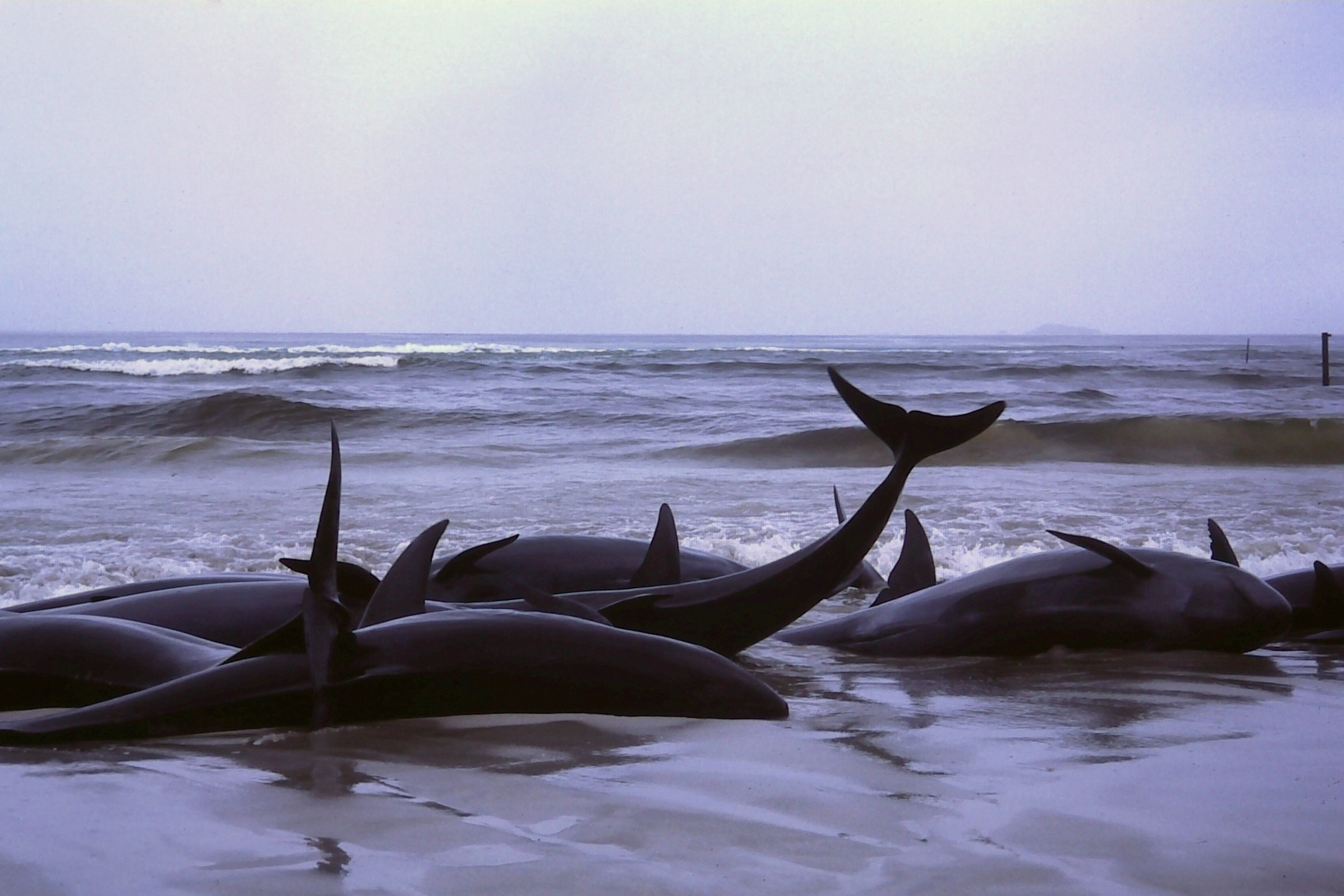
It Takes A Village To Boycott A Pop Science Book

“…Life [the book] is not the right target [for boycott], or perhaps is just an easy one. It demands much more courage, and by the entire scientific community, to individually and collectively go after the unquestionable adversaries of reason. Those who see facts and fiction indistinguishable, the ideologues and financiers of both the religion-in-science and the anti science movements…”

By Guillermo Paz-y-Miño-C

If scientists wish to boycott a book, religious scriptures could be their priority. The holy books are the foundation of the anti-evolution movement worldwide; the anti climate change rhetoric over the belief that a Protector will shield his disciples from human-induced global pollution; the source of pray healing and its conjoined meme that vaccines are heinous; the primeval justification to bigotryhomophobia and misogyny; the validation of both intolerance to any action that is perceived as offensive –above all, freedom of speech– and the crusade to secure society’s protection of the intolerant him/herself.
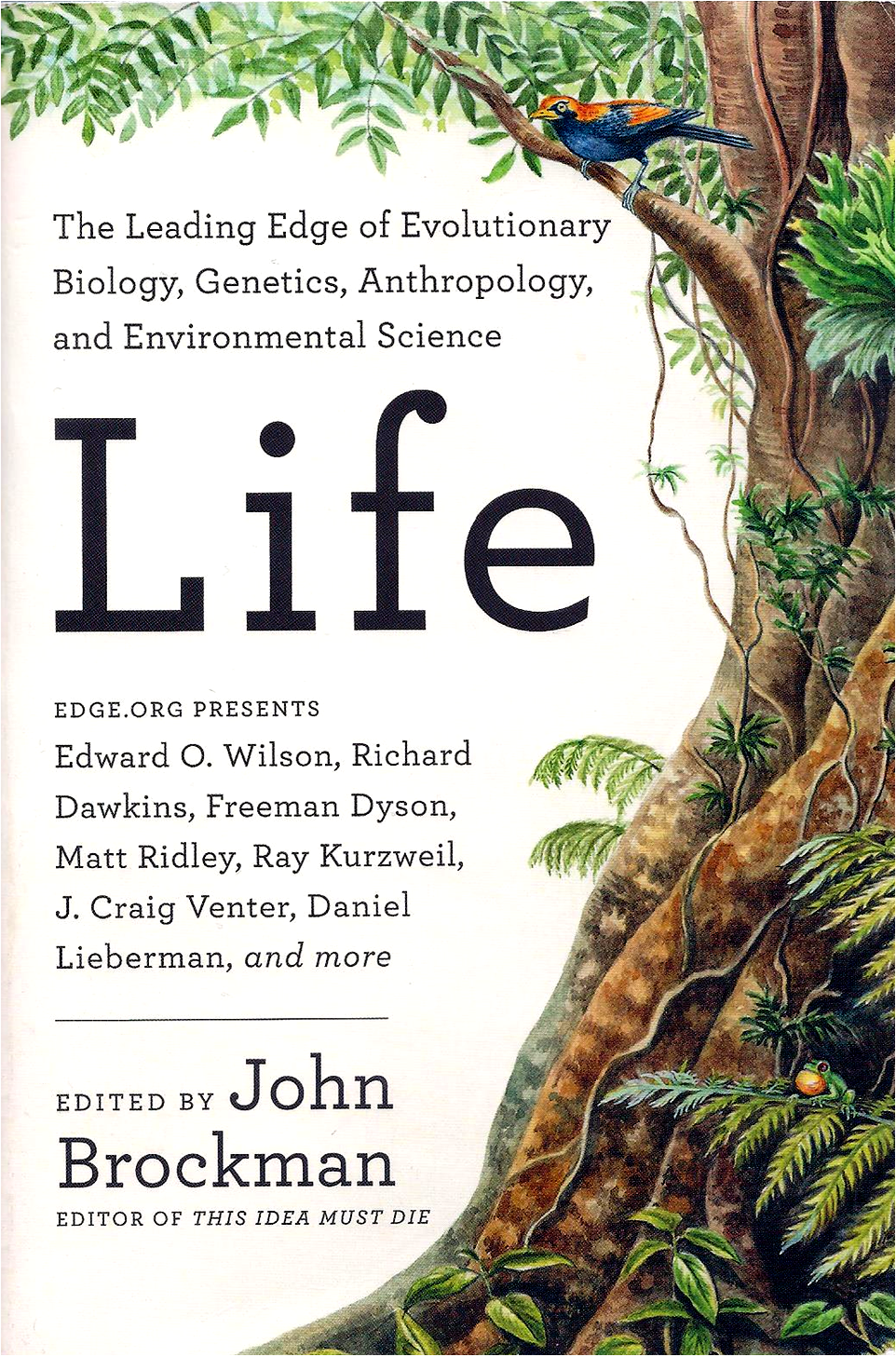
It Takes A Village To Boycott A Science Book - Cover LifeIn such broad anti science and anti intellectualism contexts, John Brockman has edited yet another volume about science and technology for popular consumption, Life: The Leading Edge of Evolutionary Biology, Genetics, Anthropology, and Environmental Science (2016). I have read this multi-author compilation with special attention, since, upon its release, biologists active in the social media became disappointed with Brockman (and, by default, with the co-writers) for not featuring women authors. And this was legitimate criticism. If Brockman and associates wanted to educate the public about current trends in the biological sciences, they must stop ignoring the diversities of peoples contributing to this global enterprise.

But, of course, I did not agree with the subsequent call to boycott Life, without even reading it, and the deploy of bee-workers and drones to sabotage the purchasing of the work. Boycotting books can be dangerous. It always reminds me of the “burnings of knowledge” by the Nazis, prior to and during World War II, and comparable atrocities led by the Latin American dictators in Argentina and Chile, in the 1970s-80s. I learned of the former by precisely reading about it in my father’s book collection on international affairs (which included Churchill’s The Second World War, and even Hitler’s sickening My Struggle), and of the latter while in high school by following the news of La Guerra Sucia (The Dirty War, term coined a posteriori in the United States) that targeted the creativity of university professors, novelists, musicians and poets. Their books and records flamed, their voices and bodies vanished.

“…Researchers ought to be aware of the popular science-, pseudo-science-, and anti-science books that distress or seem insulting to the public. And, for modern biologists, the list includes the deceptive writings of the intelligent design movement…”

Researchers ought to be aware of the popular science-, pseudo-science-, and anti-science books that distress or seem insulting to the public. And, for modern biologists, the list includes the deceptive writings of the intelligent design (ID) movement and its Undeniable: How Biology Confirms Our Intuition That Life Is Designed (2016), Evolution: Still a Theory in Crisis (2016), Debating Darwin’s Doubt: A Scientific Controversy That Can No Longer Be Denied (2015), Darwin’s Doubt: The Explosive Origin of Animal Life and the Case for Intelligent Design (2013), Science and Human Origins (2012), The Nature of Nature: Examining the Role of Naturalism in Science (2011), God and Evolution (2010), Intelligent Design Uncensored: An Easy-to-Understand Guide to the Controversy (2010), Signature in the Cell (2009), Intelligent Design 101 (2008), Dissent Over Descent: Intelligent Design Challenge to Darwinism (2008), Understanding Intelligent Design (2008), The Cell’s Design (2008), The Design of Life (2008), Explore Evolution: The Arguments for and Against Neo-Darwinism (2007), The Edge of Evolution (2007), Intelligent Design: The Bridge between Science and Theology (1999), Darwin’s Black Box: The Biochemical Challenge to Evolution (1996), and the villainous Of Pandas And People (1989), the foremost impostor exposed –and debunked– at the Kitzmiller versus Dover Area School District trial of 2005.
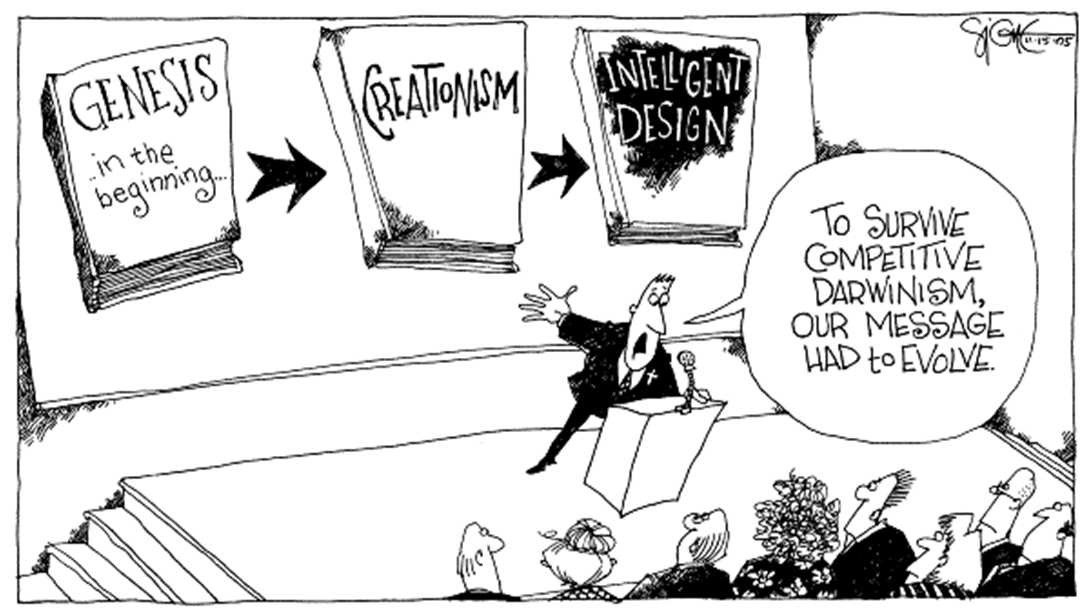
To Survive Darwinism ID had to evolve

Yes, I have these narratives of pseudo truths and quasi creeds, acquired over the years via used-books sellers –precisely to minimize supporting publishers of noxious fables (a micro sabotage of my own, one that does not discourage anyone to learn about ID). But I also possess the Holy Bible, the Qur’an, the Tanakh and The History of Western Philosophy of Religion (an academic series by Oxford UP, 2009), which I consider my duty to read as a secular scientist, and become aware of the idealistic beauty, historicity, obvious rooting in unreality, and evil, injurious teachings of religion.
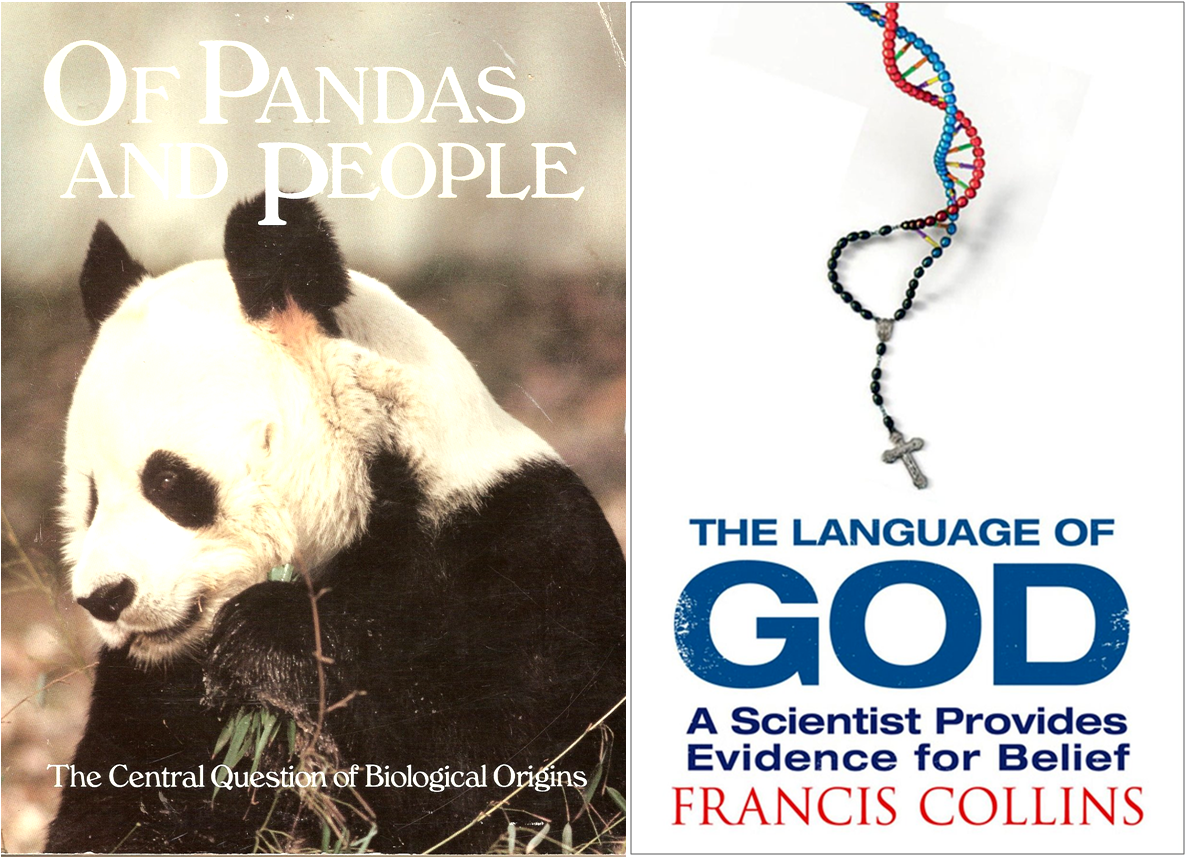
Of Pandas And People - The Language of GodNext to the ID bestsellers stand the pro-religion-in-science counterparts. Also sponsored by writers with doctoral degrees and in positions of power, committed to force-marriage evolution with the belief in supernatural causation, to see the fingerprints of God in DNA and molecular processes, to satisfy the populous’ hope to find the Maker, Designer, or Creator in the gaps of knowledge. Francis CollinsThe Language of God (2006), Belief: Readings on the Reason for Faith (2010), and The Language of Science and Faith (2011, coauthored with fellow evangelical Christian Karl Giberson) are iconic examples. Yet, none of these books deserves boycott despite their collective effect on disrupting, distorting, delaying or stopping the proper understanding and acceptance of evidence. But they do justify vigorous disapproval by scholars, who should uncover the capricious science emptiness of “evolutionary creation.”

“…Brockman’s edition of Life, despite its disgraceful exclusion of gender and cultural varieties among co-writers, is scientifically above –and by far– the ID’s pamphlets or the languages-[of God]-sequels’ by theistic evolutionists…”

John Brockman’s edition of Life, despite its disgraceful exclusion of gender and cultural varieties among co-writers, is scientifically above –and by far– the ID’s pamphlets or the “language-sequels” by theistic evolutionists. Life could be listed among the 100 required reads for graduate students in biology, and perhaps recommended to science majors in college, of course, with the warning that the contributors –busy reflecting about themselves– discounted Homo diversity as a crucial input in “the leading edge of evolutionary biology, genetics, anthropology, and environmental science.”

Life is “…the fifth volume in The Best of Edge series [edge.org], following Mind, Culture, Thinking, and The Universe…” As a collection of essays, interviews, transcripts of panel discussions, and biographical sketches of scientists and pop-science celebrities, the book is exciting, rich in brainy remarks and first-hand information. Eighteen pieces (from 2000 to 2015) summarize the major trends in science debates, applied DNA technologies, and bioengineering of the twentieth and twenty first centuries –the latter, superficially.
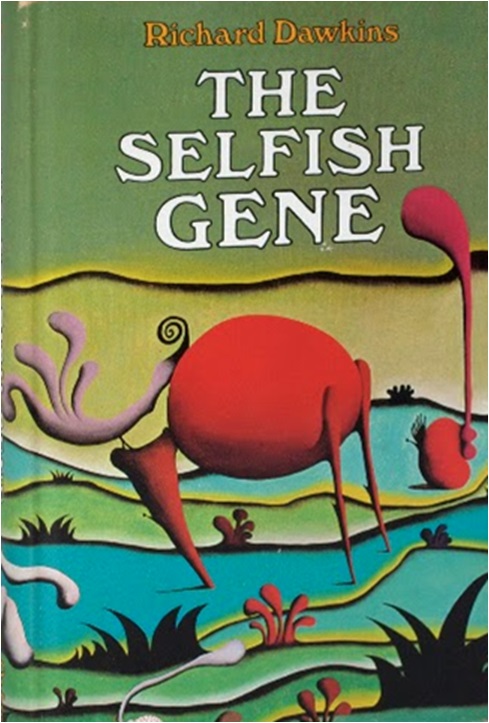
The_Selfish_GeneRichard Dawkins opens with Evolvability (2015), in part a recount of gene-centric evolution in the scenario in which The Selfish Gene (1976) was crafted, and the resulting discussions over replicators (genes), as units of selection, versus “vehicles” (the carriers of genes, our bodies). His classical analysis expands to “universal Darwinism” and the high probability that Darwinian selection of replicator-like molecules shall be a ubiquitous cosmic phenomenon if life exists beyond Earth.

The Dawkinsian argument, in elegant text, is followed by David Haig’s Genomic Imprinting (2002), Robert Trivers’ A Full-Force Storm with Gale Winds Blowing (2004), Ernst Mayr’s What Evolution Is (2001), Steve Jones’ Genetics Plus Time (2000), Edward O. Wilson’s A United Biology (2003), and Freeman Dyson’s Is Life Analog or Digital? (2001). Thus, Life relies on attractive topics, as well as familiar names in the pop-science arena, to lure readers.

“…Pages and reading hours elapse quickly… Soon, I find myself immersed in the book, joyful for learning material that I have missed… furious by the… broadcasting of long-ago-dismissed science concepts; but overall satisfied to have liked a book which I approached with so much skepticism…”

Pages and reading hours elapse quickly and Brockman succeeds at grabbing one’s attention. Soon, I find myself immersed in the book, joyful at times for learning material that I have missed over the years; disturbed occasionally when sensing plain egomania in the XY-only writers, who turn their texts into self-grooming bouts and testosterone excretion (an exception, not the only one, is Trivers’ auto-deprecating recollections, which are humorous and brilliant); furious by the redundant broadcasting of long-ago-dismissed science concepts; but overall satisfied to have liked a book which I approached with so much skepticism.

Chapter 8 (Life: What a Concept!) is the longest, with one hundred pages, and most captivating. It transcribes a panel discussion (2007) among Dyson, J. Craig Venter, George Church, Dimitar Sasselov, Seth Lloyd, Robert Shapiro, Ting Wu (not included in the list of authors), and moderator Brockman.

As introduction to the dialogue, Dyson, a theoretical physicist, discusses the garbage-bag-model of life. The origin of life, he explains, probably started with metabolism only. “…We know modern life has both metabolism and replication, but they’re carried out by separate groups of molecules. Metabolism… by proteins and all kinds of small molecules, and replication… by DNA and RNA. That may be a clue to the fact that [these processes] started out separate, rather than together… The early cells were just little bags of some kind of cell membrane, which might have been oily or… a metal oxide. And, inside, you had a more-or-less random collection of organic molecules, with the characteristic that small molecules could diffuse in through the membrane, but big molecules could not diffuse out. By converting small molecules into big molecules, you could concentrate the organic contents on the inside, thus the cells would become more concentrated and the chemistry would gradually become more efficient. So, these things could evolve without any kind of replication. It’s a simple statistical inheritance. When a cell became so big that it got cut in half, or shaken in half by some rainstorm or environmental disturbance, it would then produce two cells, which would be its daughters and would inherit, more or less, but only statistically, the chemical machinery inside. Evolution could work under those conditions.”

Columbia Glacier Landsat Satellite NASA 2014

Freeman Dyson: “…We know modern life has both metabolism and replication, but they’re carried out by separate groups of molecules. Metabolism… by proteins and all kinds of small molecules, and replication… by DNA and RNA. That may be a clue to the fact that [these processes] started out separate, rather than together…” – Earth, a planet with life, Columbia Glacier Landsat Satellite NASA 2014

“…Dyson’s garbage-bag hypothesis may be garbageous, but despite its teleological nature it is intellectually intriguing…” 

If these statements provoke in you, as bookworm, any of the emotions described earlier (i.e. joy, disturbed, furious, satisfied), your reactions are comparable to those of the panel. Dyson’s garbage-bag hypothesis may be garbageous (i.e. the divide metabolism versus replication is artificial, and relying on heavy statistical randomness diminishes how natural selection operates, or did in the past, in primordial soups), but despite its teleological nature it is intellectually intriguing. Irrespective of the transcript’s dryness, it happens that the sharp cuts, irony, disagreements and rescuing of the discussion by the panelists themselves grow evident while reading the fascinating exchange. And Brockman moderates it with minimal input, except for the sporadic injection of extra fuel to ignite healthy controversy.

The second half of the book proceeds with a one-on-one chat between Dawkins and Venter, refereed by Brockman, in The Gene-Centric View: A Conversation (2008), followed by Armand Marie Leroi’s The Nature of Normal Human Variety (2005), Daniel Lieberman’s Brains Plus Brawn (2012), Svante Pääbo’s Mapping the Neanderthal Genome (2009), and a transcript of On Biocomputation (2005), a TED event (Technology, Entertainment, Design) featuring Venter, Ray Kurzweil and Rodney Brooks.

Life closes with pieces by Drew Endy, on Engineering Biology (2008), Kary Mullis’ Eat Me Before I Eat You: A New Foe for Bad Bugs (2010), Richard Prum’s Duck Sex and Aesthetic Evolution (2014), Robert Sapolsky’s Toxo (2009), and Stuart Kauffman’s The Adjacent Possible (2003). All mix personal experiences with the authors’ making and living the developments of their own fields.

“…The lay reader might simply take pleasure in the journalistic ride and claim proficiency in pop-science culture at the end of the journey…”

Three out of five stars - Life edited by John Brockman 2016Titles like Life sell fine. The scientist reader can locate in the book historical relevance and depth if he/she looks for and wants to see them. The lay reader might simply take pleasure in the journalistic ride and claim proficiency in pop-science culture at the end of the journey. The spot-the-error copy editor will never forget, nor forgive, that the cover of Life lists “Matt Ridley” as contributor, a science personality nowhere else to be found (at least in the copy I have –see image above), a regrettable carelessness in book production. Plus, there is no leading edge in the compilation of articles, the average publication date (2006) is ten years too old.

It may take a village to boycott a pop science book, but Life is not the right target, or perhaps is just an easy one. It demands much more courage, and by the entire scientific community, to individually and collectively go after the unquestionable adversaries of reason. Those who see facts and fiction indistinguishable, the ideologues and financiers of both the religion-in-science and the anti science movements. — EvoLiteracy © 2016.

Cartoon by Rina Piccolo Book-burning Club

Book-burning Club, cartoon by Rina Piccolo (click on image to enlarge)

You can contact Guillermo Paz-y-Miño-C via email at guillermo.pazyminoc@gmail.com — Follow us on Twitter @gpazymino and Facebook.

*  *  *  *  *     *  *  *  *  *     *  *  *  *  *

D - Headline Book Measuring the Evolution Controversy 2016

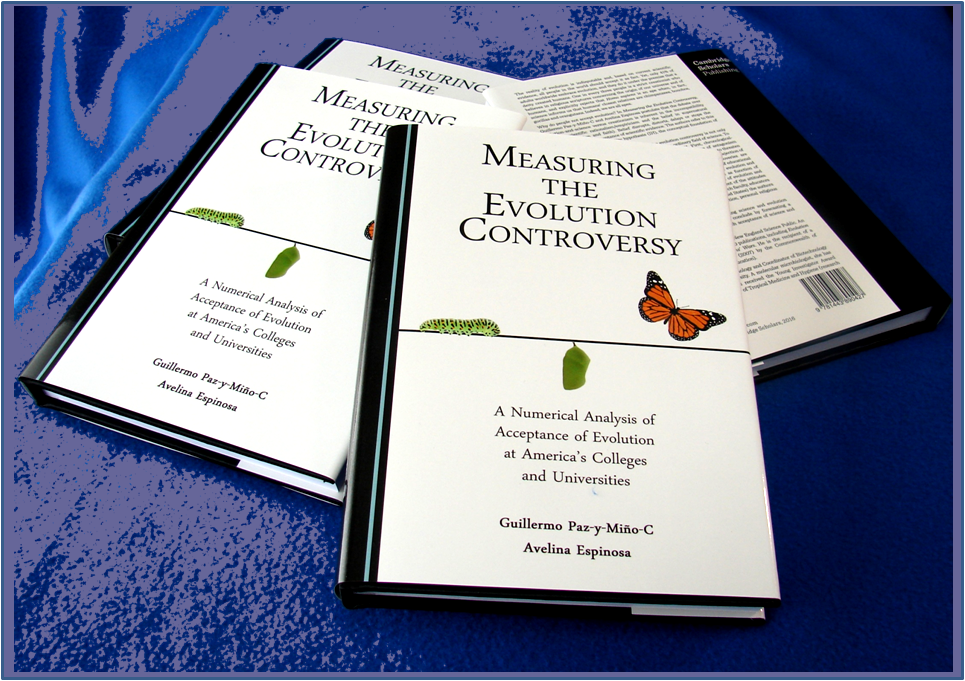
Paz-y-Miño-C, G & Espinosa, A. 2016. Measuring the Evolution Controversy: A Numerical Analysis of Acceptance of Evolution at America’s Colleges and Universities. Cambridge Scholars Publishing, Newcastle, United Kingdom. ISBN (10): 1-4438-9042-1, ISBN (13): 978-1-4438-9042-7.
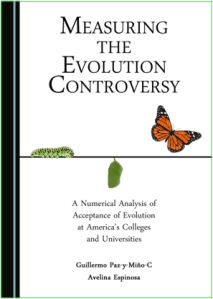
BOOK small format - Measuring the Evolution Controversy 2016Measuring the Evolution Controversy can be ordered directly from Cambridge Scholars Publishing, Amazon US, or Amazon CA . The publisher has made available a “VIEW EXTRACT” (in PDF), which includes the first 30-pages of the book: Cover, Table of Contents, Acknowledgments, Preface, Chapter ONE and the beginning of Chapter TWO. For PDF of color illustrations go to Image Resources of Didactic Relevance.

“The great contribution of ‘Measuring the Evolution Controversy’ is the rich content of data and analysis that asks detailed questions about the social, economic and political backgrounds of those who tend to reject evolution vs. those who accept evolution as science. Paz-y-Miño-C and Espinosa deftly analyze their data drawn from institutions of higher learning in the United States and particularly New England —which stands as a microcosm of the rest of the country, and indeed elsewhere in the world. It is their scientific approach to these issues which makes this book stand out as a uniquely original contribution.” — Niles Eldredge, PhD, Curator Emeritus of Paleontology at The American Museum of Natural History, New York.

“Pro-science activists and educators constantly bemoan the resistance to the teaching of evolution in the United States. All of us have anecdotes about encounters with the public, parents and students who are misinformed by their churches, Religious-Right groups, and creationist organizations. Paz-y-Miño-C and Espinosa present hard data that support the anecdotal evidence. They also show that although anti-evolutionism typically begins with religion, it is a multi-faceted problem that intersects with political and cultural ideologies. Gathered through careful research over a period of years, their data will enable scientists and defenders of science education to comprehend the roots of the evolution controversy and counteract resistance to evolution more strategically and effectively.”Barbara Forrest, PhD, co-author with Paul R. Gross of Creationism’s Trojan Horse: The Wedge of Intelligent Design (2007), and expert witness for plaintiffs, Kitzmiller et al. v. Dover Area School District (2005).

*  *  *  *  *     *  *  *  *  *     *  *  *  *  *
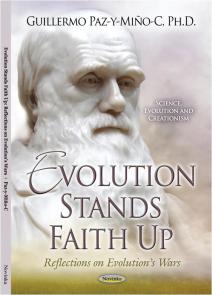
Paz-y-Mino-C_Book_Cover_Evolution_Stands_Faith_Up_JPEGPaz-y-Miño-C., G. 2013. Evolution Stands Faith Up: Reflections on Evolution’s Wars. NOVA Publishers, New York. By NOVA Publishers, New York Soft Cover. Find it at Barnes & Noble, Amazon.comAmazon UK

“The sweet spot of this collection of essays is the interface of science, history and literacy. Paz-y-Miño-C is, in essence, a champion of rationalism and a passionate defender of literacy standards. His essays deftly weave hard survey data and memorable turns of phrase with evocative imagery… While the essays in this collection are vast in coverage —from climate change to energy policy, stem cell research, vaccinations and, especially, evolution— a clear underlying theme emerges: [the author’s] goal is no less than to counter, through the lens of history and the majesty of rationalism, social forces that sanction ignorance, celebrate denial and… continue to diminish our global status in the fields of science and technology.” Jeff Podos, PhD, Professor of Biology, University of Massachusetts Amherst, USA.

“Paz-y-Miño-C  is a firm believer in evolutionary processes. He would like to see decisions made on the basis of facts, not unsupported opinion. He abhors and fears irrational thinking, especially ‘the views of those who see evil in truth and menace in the realities discovered by science.’ He marvels at the intricacy and diversity of life, and how it came about through natural selection… and is clearly frustrated by the unwillingness of so many to see the beauty and majesty in this view of the world and all that it explains.” – Jan A. Pechenik, PhD, Professor of Biology, Tufts University, USA, author of The Readable Darwin: The Origin of Species, as Edited for Modern Readers.

The IDeA of Washington DC

Washington’s character is intrinsic to its museums, splendors of the arts and sciences, and the humanities of modern culture. They lead the world not by their past, which is recent (mid 1800s) in contrast to their European counterparts, but the future because they project the direction in which creativity, discovery and the human intellect should go.

G The Hunt Museum Nat Hist Washington DC - Photo G-Paz-y-Mino-C 2016

The Hunt – National Museum of Natural History in Washington DC. The Hall Of Human Origins at the Smithsonian is one of the best in the world. Photo G. Paz-y-Miño-C.

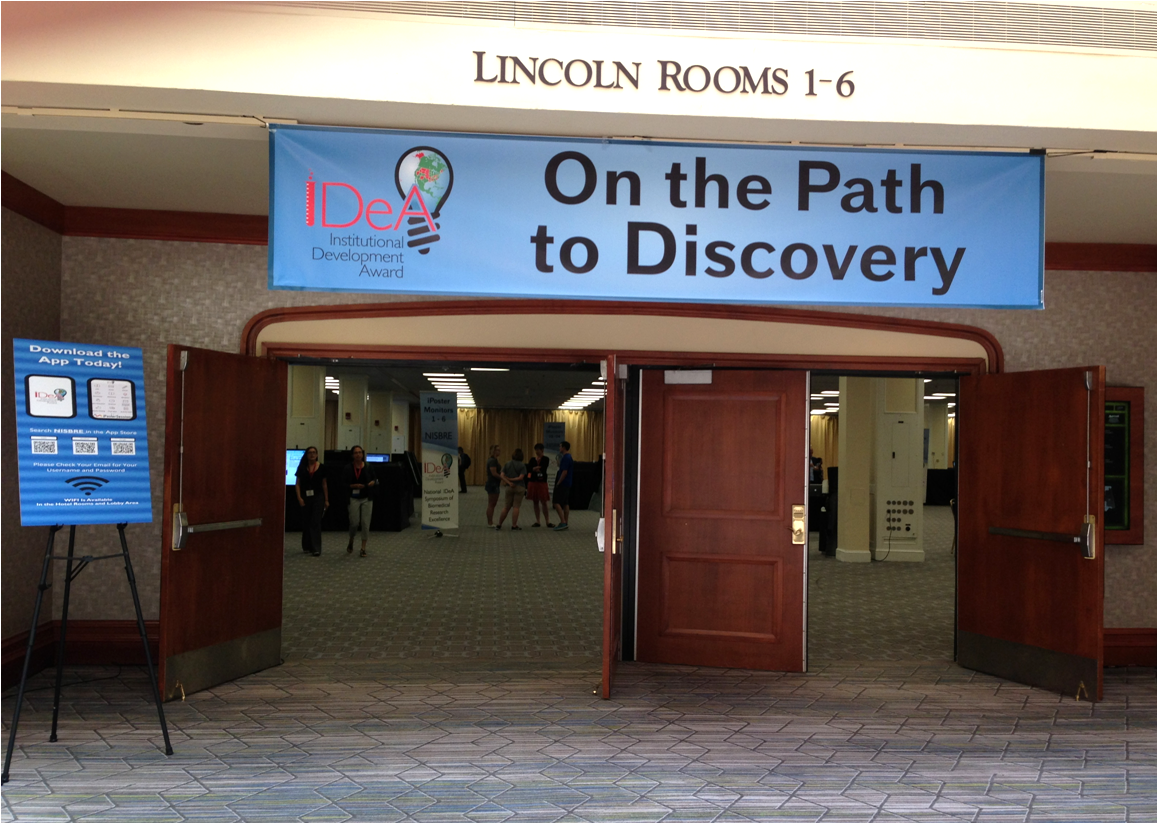
I finally sketched this chronicle. During June 26-28, 2016, I participated at the Institutional Development Award meeting (IDeA) in Washington DC. As per its website, the “IDeA program broadens the geographic distribution of NIH [National Institutes of Health] funding for biomedical research. The program fosters health-related research and enhances the competitiveness of investigators at institutions located in states in which the aggregate success rate for applications to NIH has historically been low… IDeA [supports] faculty development and research infrastructure enhancement at institutions in 23 states and Puerto Rico.”

The gathering included 1000 attendees (scientists, postdocs, graduate and undergraduate students, and science administrators), the presentation of 180 posters (on the research sponsored by IDeA), about 20 plenary talks, workshops and small(er)-group discussions. These meetings are important for catching up with information about trends in modern research topics suitable for NIH funding, new granting policies by the agency (which are always a moving target), expansion-contraction or ending of programs, emergence of new ones, and the idiosyncrasies of administrative and bureaucratic science-funding work. I have never met a scientist who likes these meetings, but all find them crucial to attend.

I am indirectly involved with IDeA via my research collaboration with Avelina Espinosa on the mechanisms of taxa-, clone- and kin-discrimination in protists (i.e. Entamoeba spp. –see publications). Avelina has been sponsored by IDeA Networks of Biomedical Research Excellence (INBRE) during the past ten years.

INBRE puts the IDeA approach into action.” It enhances “research infrastructure through support of a statewide system of institutions with a multidisciplinary, thematic scientific focus… INBRE’s goal is to “[develop] biomedical research (in Avelina’s case, her studies with pathogenic amebozoans)… and strengthen the research capabilities of… faculty, and provide access to… resources for promising undergraduate students throughout the eligible states (e.g. Roger Williams University in Rhode Island).”

As always, Avelina and I took time –before and after the meeting– to explore the museums, libraries and monuments, and to learn as much as possible about the local history and culture. But, with a difference on this occasion; the District of Columbia is quite known to us. We have been traveling to DC since the early 1990s, at first yearly, for professional reasons (I was a biodiversity intern/consultant at the World Bank in the Summer of 1993, as part of a Graduate Certificate in Tropical Biology and Conservation at the University of Missouri St. Louis), and later to visit the NIH medical campus. We did the latter for a decade and became familiar with Bethesda, DC, restaurants (many but not all in Adams Morgan), the metro system and public transportation. A great exposure to the “Washingtonian life.”

Washington’s character is intrinsic to its museums, splendors of the arts and sciences, and the humanities of modern culture. They lead the world not by their past, which is recent (mid 1800s) in contrast to their European counterparts, but the future because they project the direction in which creativity, discovery and the human intellect should go.

Below are some images in no hierarchical order, but they do show events in which we were involved during the trip and in a semi-chronological fashion, starting with the IDeA meeting and drifting into a combination of meeting-plus-traveling to the Washington Mall for the rest of the day, and to finally visiting Washington all day long. Most photos are in low definition and have little or no editing (click on them to enlarge). Please note that images are copyrighted, all rights reserved, enjoy watching them! — Guillermo Paz-y-Miño-C – EvoLiteracy © 2016.

A - MTEC at National Zoo in DC - Photo G-Paz-y-Mino-C 2016

Above: To start with humor, upon arrival to Washington DC, our book Measuring The Evolution Controversy, visited the Panda facilities at the National Zoo. Selfie with the “Giant Panda” sculpture by Eric Berg (2006).

Giant Panda feeding National Zoo Washington DC - Photo G-Paz-y-Mino-C 2016

Above: Giant Panda feeding at the National Zoo in Washington DC. Wild animals belong in the wild…

IDeA name tag - Photo G-Paz-y-Mino-C 2016

Above: Prior to the IDeA meeting. I like meetings in which everything they give you fits in a 2-GB flash drive… which is part of the ID tag… and with all the presentations and posters in it.

B IDeA Meeting Washington DC - Photo G-Paz-y-Mino-C 2016

Above: The IDeA opening session.

A IDeA Meeting Washington DC - Photo G-Paz-y-Mino-C 2016

Above: And the left side of the room, IDeA meeting in Washington DC.

C the iPosters at Washington DC - Photo G-Paz-y-Mino-C 2016

Above: The iPoster session; all posters were presented on touch screens.

CC the iPosters at Washington DC - Photo G-Paz-y-Mino-C 2016

Above: At the electronic poster session, as they called it, the iPosters. The cup was for tips…

IDeA flashdrive - Photo G-Paz-y-Mino-C 2016

Above:  If anything, THIS IS ALL THEY SHOULD GIVE YOU TO TAKE HOME… at / from a scientific meeting (i.e. three days, 1000 participants, 180 posters, about 20 plenary talks, symposia and small discussions). All in a flash-drive, no paper, no pens (of which you have plenty in your office), no meeting-bags (which usually stay at the hotel-room –they are ugly). In fact, organizers should only give you –a priori– just a weblink to find everything which was uploaded to the flash-drive. So, no flash-drive in the future.

New Escalators Washington DC - Photo G-Paz-y-Mino-C 2016

Above: On our way to the Washington Mall. Brand new escalators in the DC’s Metro… very bright… easy to see.

Panoramic Library of Congress - Photo G-Paz-y-Mino-C 2016

Above: The majestic Library of Congress… Washington DC.

Interior Library of Congress - Photo G-Paz-y-Mino-C 2016

Above: The interior of the Library of Congress, Washington DC.

Main Reading Room Library of Congress Washington DC - Photo G-Paz-y-Mino-C 2016

Above: The main reading room (central building), Library of Congress in Washington DC.

Decorations Library of Congress Washington DC - Photo G-Paz-y-Mino-C 2016

Above: Decorations at the Library of Congress in Washington DC… The main building was completed in the late 1890s.

Ceiling Library of Congress Washington DC - Photo G-Paz-y-Mino-C 2016

Above: The ceiling “flower” ornaments, Library of Congress, Washington DC.

MTEC at Library of Congress US - Photo G-Paz-y-Mino-C 2016

Above: Our book, Measuring the Evolution Controversy, posing for selfie at the main hall, Library of Congress, Washington DC.

Library of Congress Washington DC - Photo G-Paz-y-Mino-C 2016

Above: One of our last stops by the Library of Congress… Washington DC.

Tunnel to Library of Congress - Photo G-Paz-y-Mino-C 2016

Above: The “tunnel” from the Capitol to the Library of Congress (goes both ways), Washington DC.

The US Capitol - Photo G-Paz-y-Mino-C 2016

Above: The Capitol renovation continues. The dome, already finished, looks amazingly white, polished and shiny… Washington DC.

Constantino Brumidi painting US Capitol - Photo G-Paz-y-Mino-C 2016

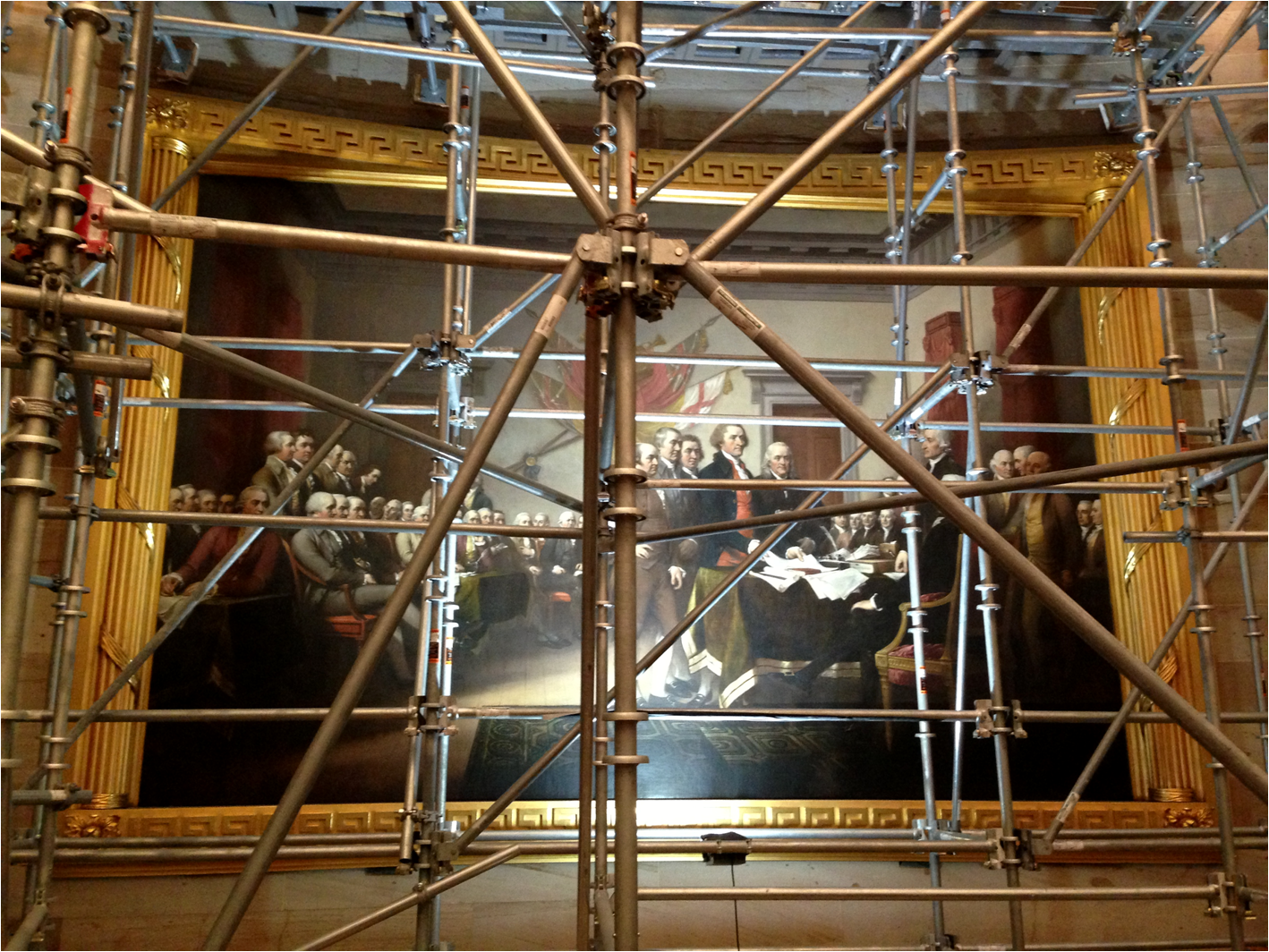
Above: Despite the renovation going on at the U.S. Capitol, we could see the Constantino Brumidi’s paintings.

William Jennings Bryan and Junípero Serra - Photo G-Paz-y-Mino-C 2016

Above: TALKING ABOUT CONTRAST – Nebraska chose William Jennings Bryan as the most prominent native to represent the state at the U.S. Capitol. California went for Junípero Serra. Indiana, in the back, a bit pale.

Museum African American History Culture Washington DC - Photo G-Paz-y-Mino-C 2016

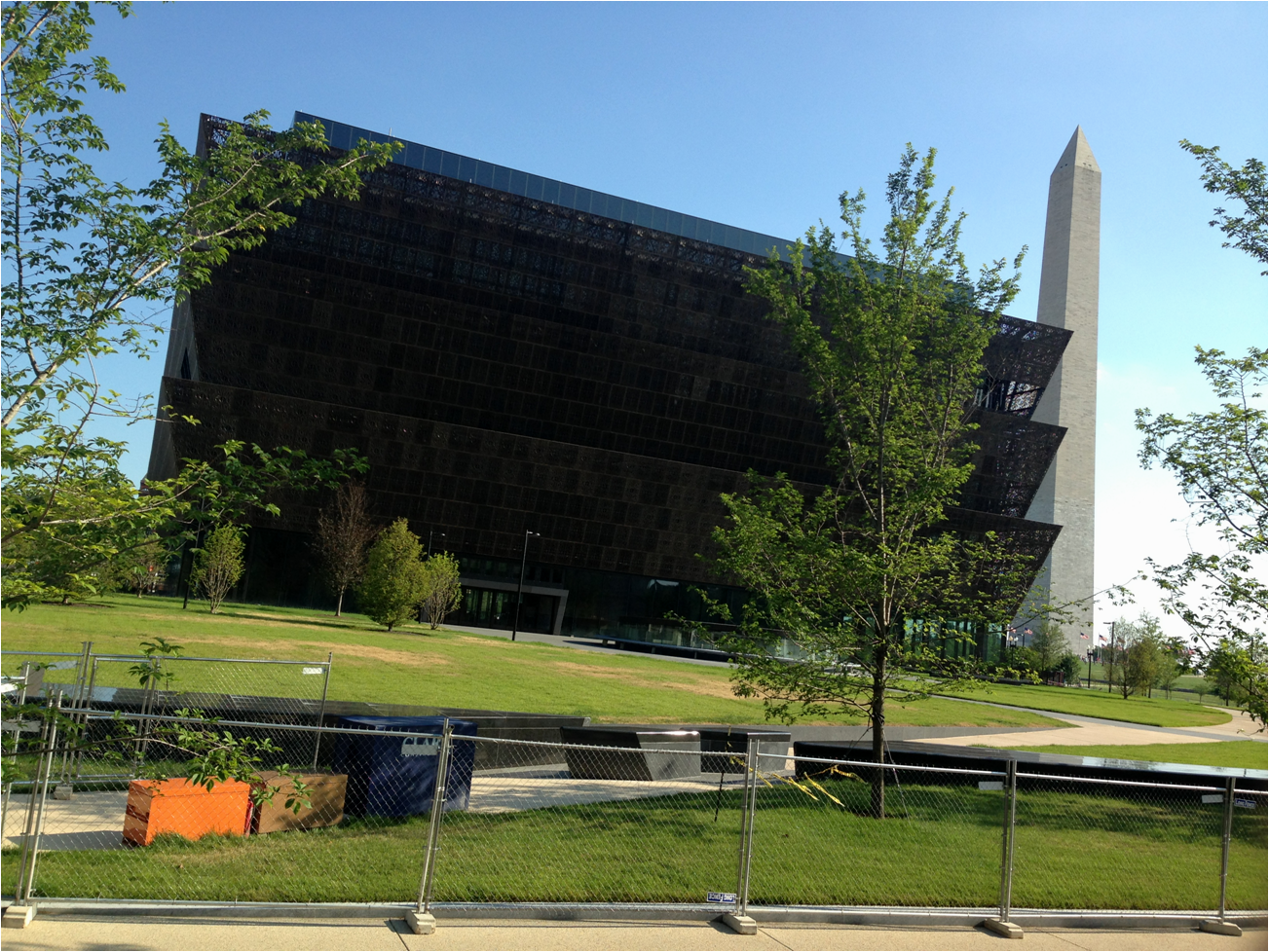
Above: The new building of the National Museum of African American History and Culture (still under construction), it shall open before the end of 2016, Washington DC.

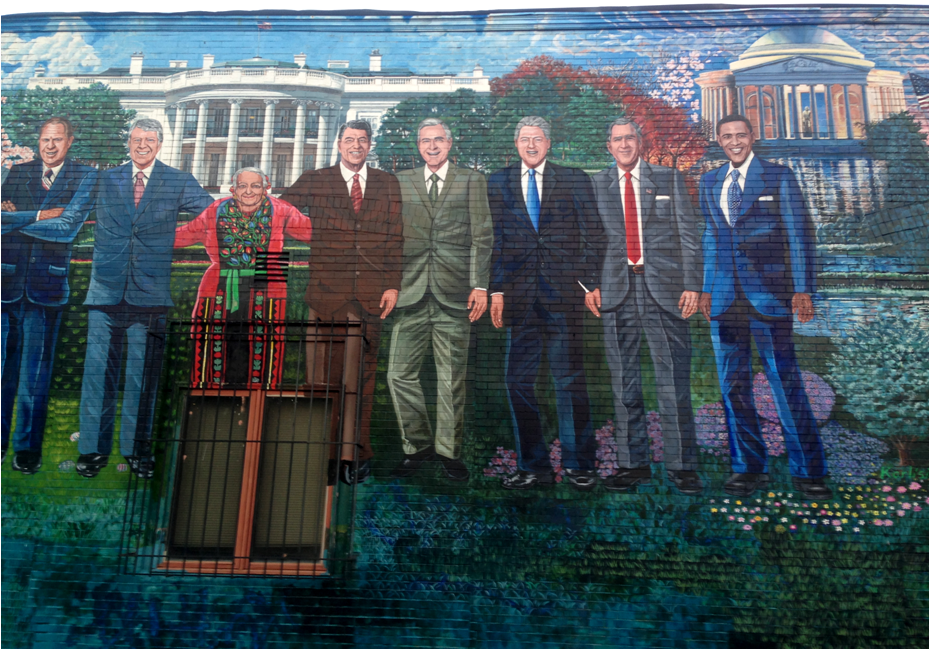
Presidential 2 of 3 Mural Mama Ayeshas Rest Washington DC - Photo G-Paz-y-Mino-C 2016

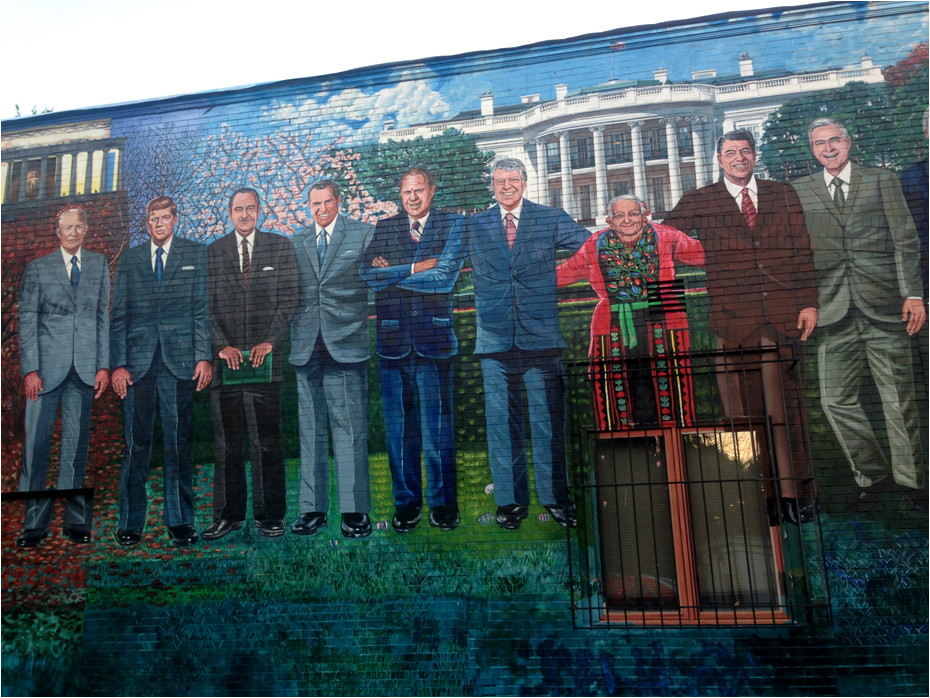
Above: The Presidential Mural at the Mama Ayesha’s restaurant in Adams Morgan (Part I)…

Presidential 3 of 3 Mural Mama Ayeshas Rest Washington DC - Photo G-Paz-y-Mino-C 2016

Above: The Presidential Mural at the Mama Ayesha’s restaurant in Adams Morgan (Part II)…

D Hippo and Okapi Museum Nat Hist Washington DC - Photo G-Paz-y-Mino-C 2016

Above: Up close – Hippo and Okapi at the National Museum of Natural History in Washington DC.

Jaguar National Museum of Natural History - Photo G-Paz-y-Mino-C 2016

Above: Melanic Jaguar, National Museum of Natural History, Washington DC.

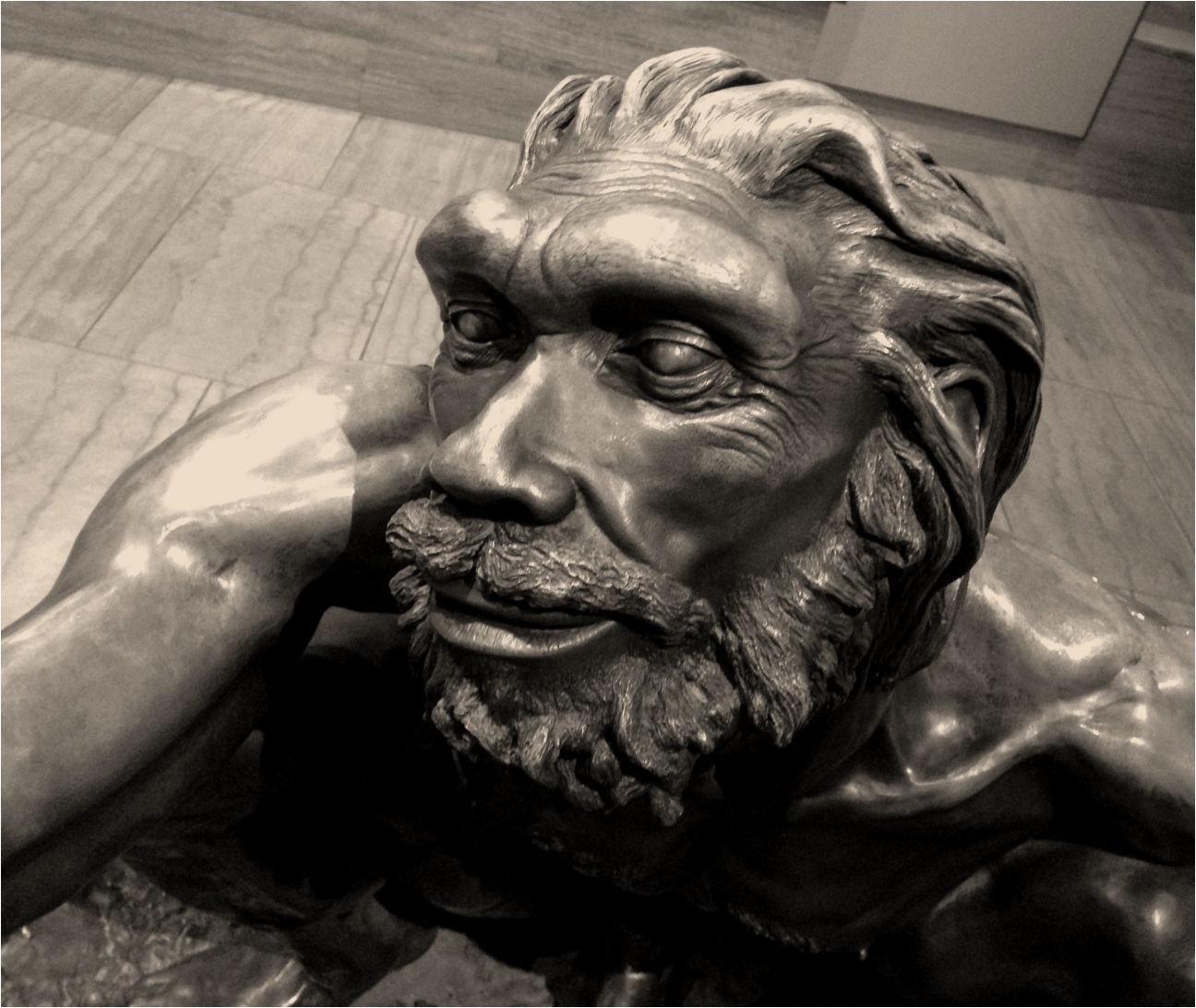
F Homo heidelbergensis Museum Nat Hist Washington DC - Photo G-Paz-y-Mino-C 2016

Above: Homo heidelbergensis – National Museum of Natural History in Washington DC. The Human Origins Exhibit at the Smithsonian is one of the best in the world…

E Children at Museum Nat Hist Washington DC - Photo G-Paz-y-Mino-C 2016

Above: PRIMATES – Children (next to bronze chimp statue) watching video about Morganucodon, the first mammals, and the extinction of dinosaurs. National Museum of Natural History in Washington DC.

L Morganucodon Museum Nat Hist Washington DC - Photo G-Paz-y-Mino-C 2016

Above: And the Morganucodon Award goes to… National Museum of Natural History in Washington DC.

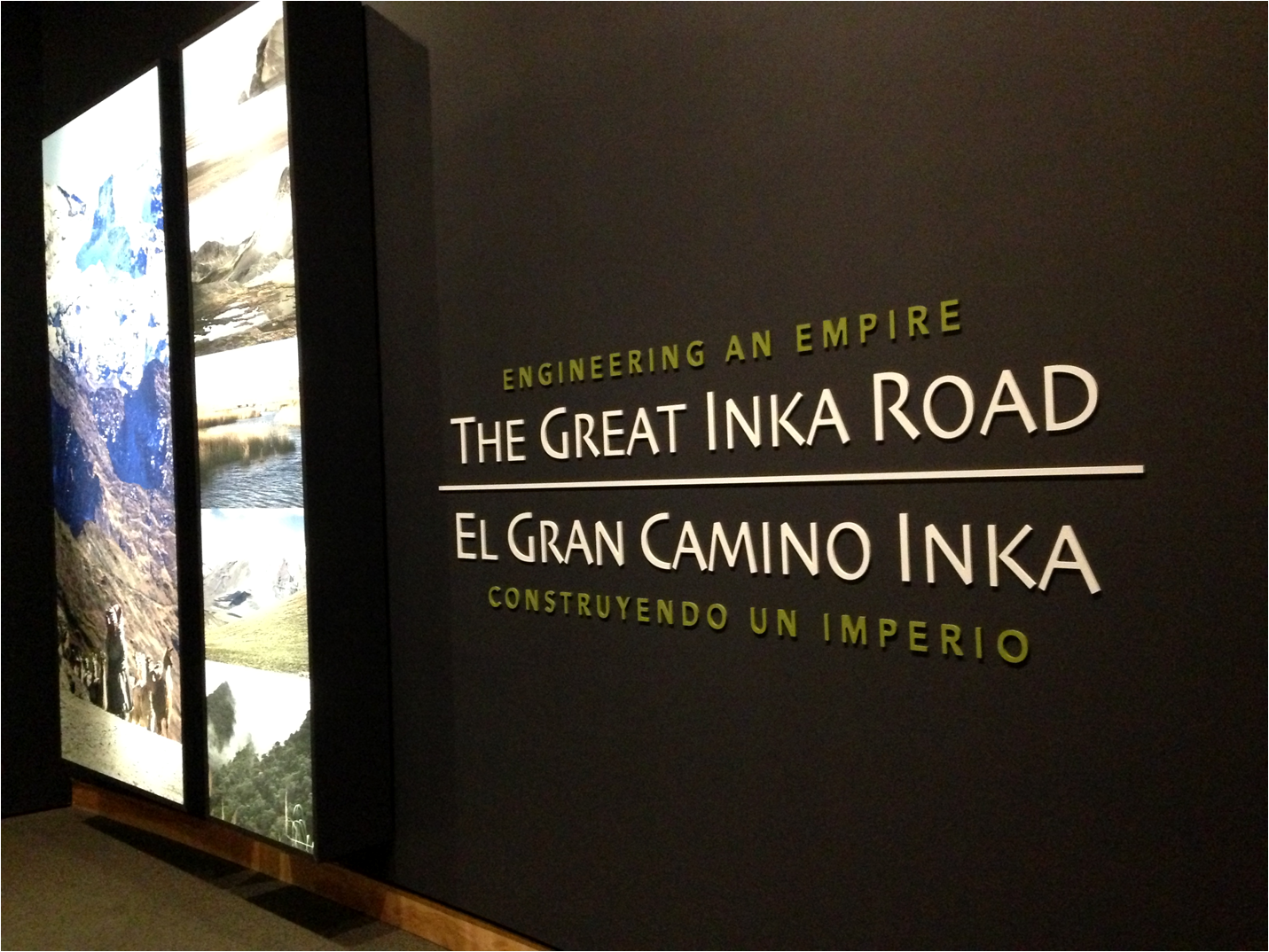
A Great Inca Road Exhibit Nat Museum Ame Indian - Photo G-Paz-y-Mino-C 2016

Above: At the GREAT INKA ROAD EXHIBIT, Smithsonian National Museum of the American Indian in Washington DC. It summarizes the history of the Inka (Inca) Empire, open until 2018. Impressive, with excellent didactic options (touch screens).

B Great Inca Road Exhibit Nat Museum Ame Indian - Photo G-Paz-y-Mino-C 2016

Above: INKA ROAD EXHIBIT, Smithsonian National Museum of the American Indian in Washington DC.

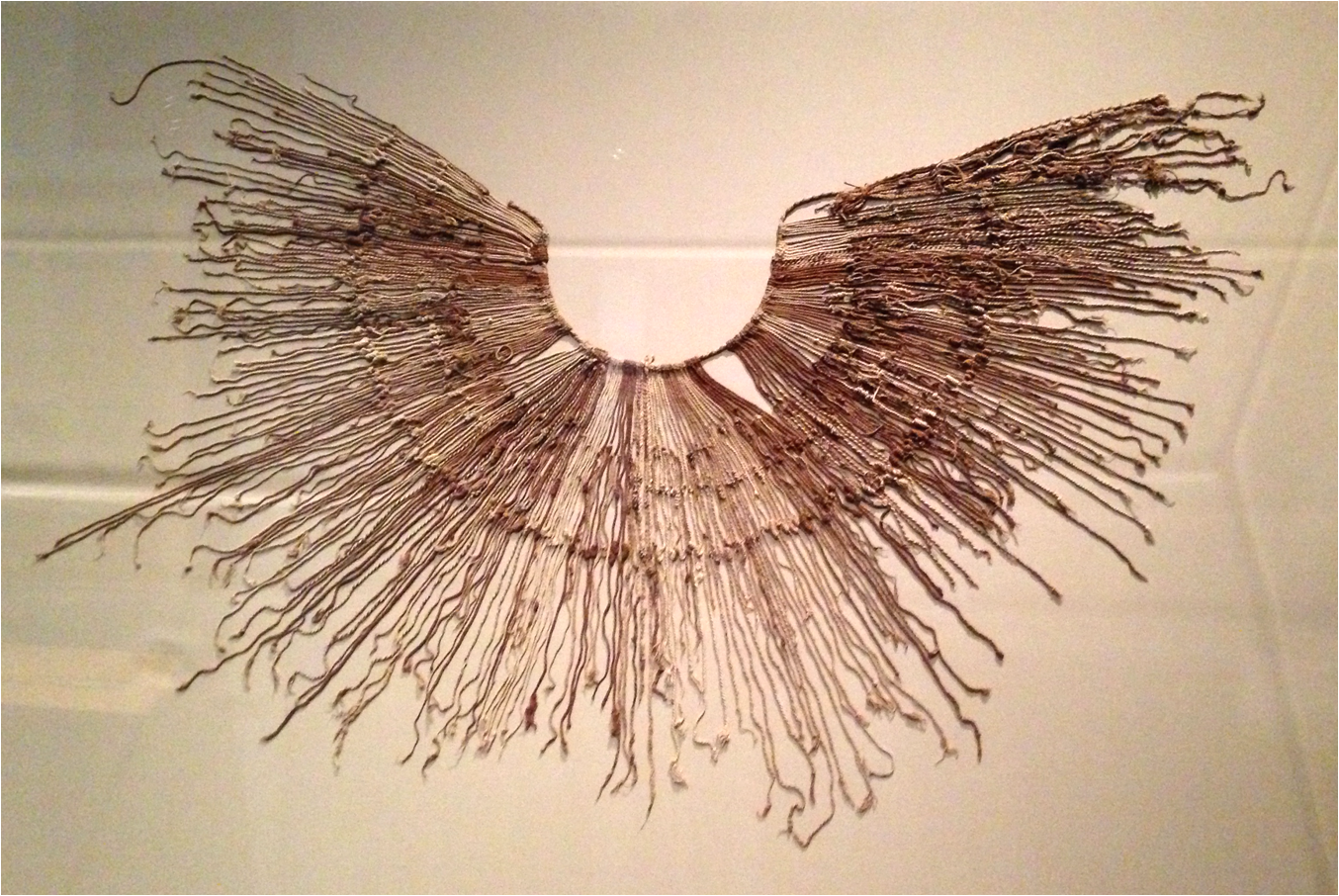
C Great Inca Road Exhibit Nat Museum Ame Indian - Photo G-Paz-y-Mino-C 2016

Above: INKA ROAD EXHIBIT, Smithsonian National Museum of the American Indian in Washington DC. Inka khipu (years 1400-1600s) Peru. Cotton, Agave fiber.

D Great Inca Road Exhibit Nat Museum Ame Indian - Photo G-Paz-y-Mino-C 2016

Above: INKA ROAD EXHIBIT, Smithsonian National Museum of the American Indian in Washington DC. This is a very good museum.

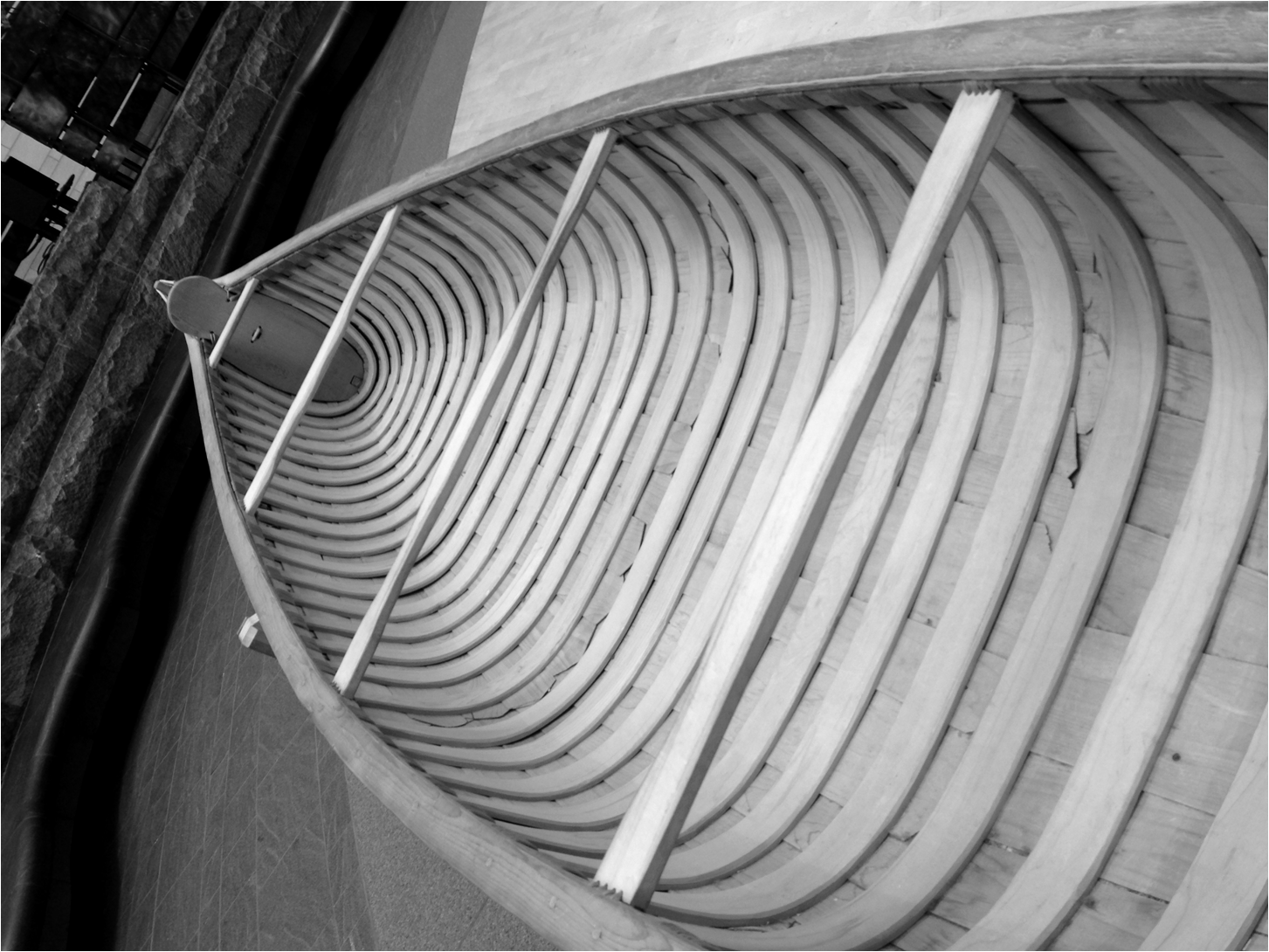
OJIBWE Birch Bark Canoe National Museum of the American Indian - Photo G-Paz-y-Mino-C 2016

Above: OJIBWE Birch Bark Canoe at the National Museum of the American Indian, Washington DC.

Inside of OJIBWE Birch Bark Canoe - Photo G-Paz-y-Mino-C 2016

Above: Inside OJIBWE Birch Bark Canoe at the National Museum of the American Indian, Washington DC.

Pineapple lily Eucomis sp US Botanic Garden - Photo G-Paz-y-Mino-C 2016

Above: Pineapple lily, Eucomis sp., US Botanic Garden, Washington DC.

Another take Arlington National Cemetery - Photo G-Paz-y-Mino-C 2016

Above: At the main entrance to the Arlington National Cemetery in Virginia…

Memorial Amphitheater Arlington National Cemetery - Photo G-Paz-y-Mino-C 2016

Above: The impressive Memorial Amphitheater at the Arlington National Cemetery in Virginia. It resembles –in architecture– the Greek archeological amphitheaters of Europe…

MTEC at the Arlington National Cemetery - Photo G-Paz-y-Mino-C 2016

Above: Our book visiting the Memorial Amphitheater at the Arlington National Cemetery in Virginia…

NATIONAL PORTRAIT GALLERY in Washington DC - Photo G-Paz-y-Mino-C 2016

Above: The NATIONAL PORTRAIT GALLERY in Washington DC. This is a world-class museum, Smithsonian quality, impressive, very well conceptualized and representative of the American portrait culture and legacy (a specialized collection on/about the United States). Entrance to the museum is free, as to all Smithsonian museums in Washington. Free education for anyone, from anywhere in the world, who decides to visit. You need an entire day to explore it well. What a treat!

Corridors NATIONAL PORTRAIT GALLERY in Washington DC - Photo G-Paz-y-Mino-C 2016

Above: Halls and corridors at the NATIONAL PORTRAIT GALLERY in Washington DC.

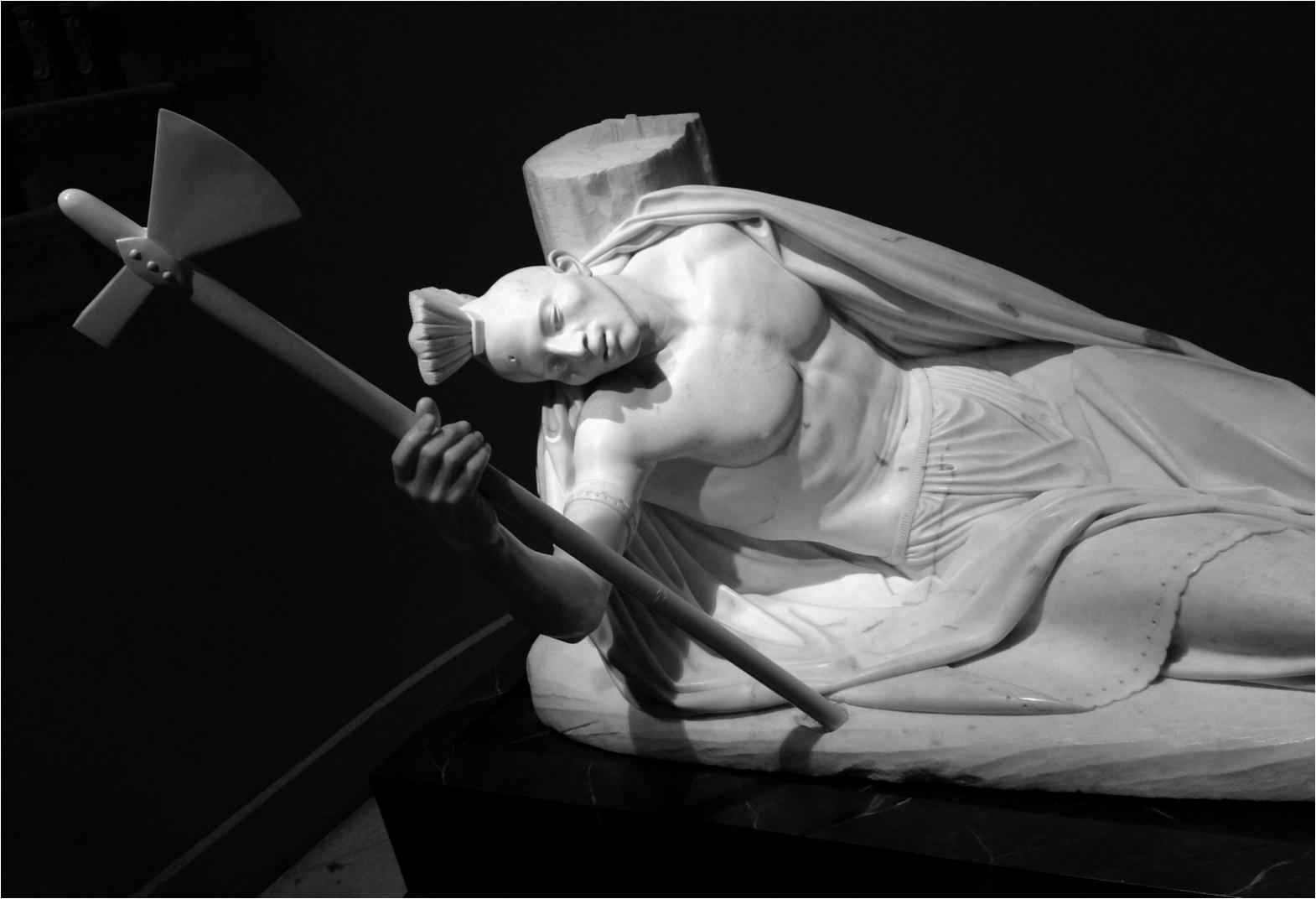
THE DYING TECUMSEH - National Portrait Gallery - Photo G-Paz-y-Mino-C 2016

Above: THE DYING TECUMSEH by Ferdinand Pettrich (about 1850s) National Portrait Gallery, Washington DC. Marble with painted copper. The beauty is that if you stare at the sculpture, Tecumseh seems to continue dying, he never ends dying.

Mohamed Ali National Portrait Gallery - Photo G-Paz-y-Mino-C 2016

Above: Mohamed Ali at the National Portrait Gallery in Washington DC.

Rosa Parks by Marshall Rumbaugh National Portrait Gallery - Photo G-Paz-y-Mino-C 2016

Above: ROSA PARKS, by Marshall Rumbaugh, 1983, National Portrait Gallery, Washington DC. Painted limewood (sculptured).

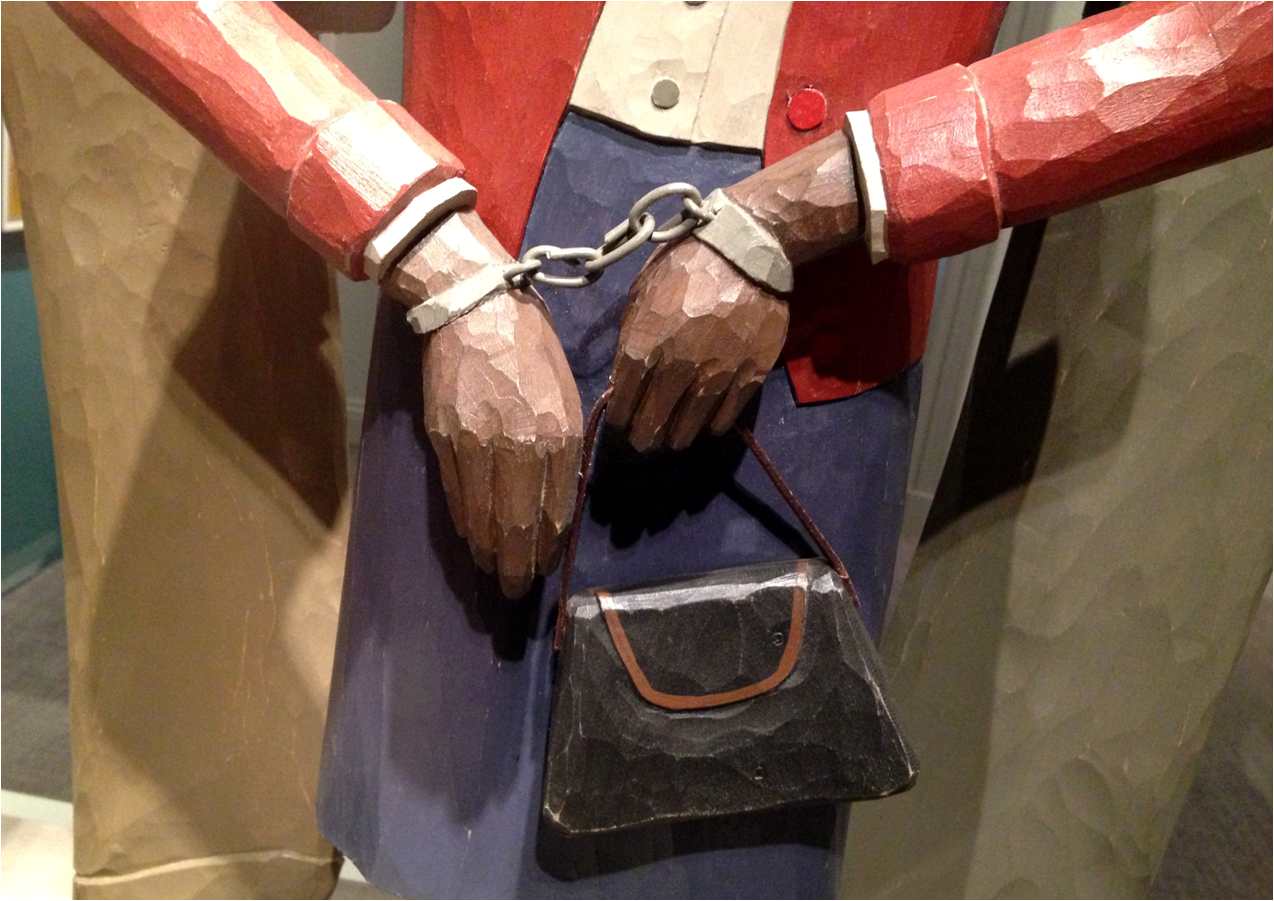
Close up Rosa Parks by Marshall Rumbaugh National Portrait Gallery - Photo G-Paz-y-Mino-C 2016

Above: And detail of ROSA PARKS, by Marshall Rumbaugh, 1983, National Portrait Gallery, Washington DC. Painted limewood (sculptured).

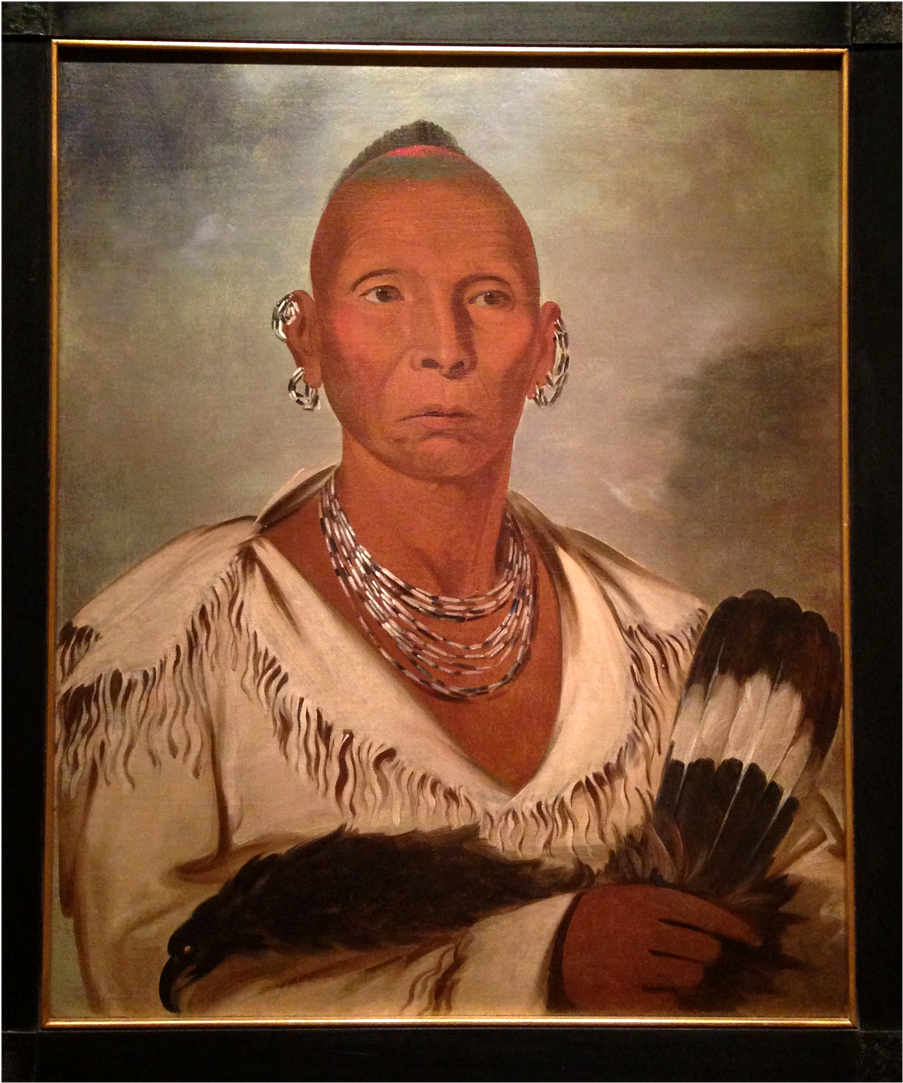
BLACK HAWK Nat Portrait Gallery - Photo G-Paz-y-Mino-C 2016

Above: BLACK HAWK, by George Catlin, oil on canvas, about 1835. National Portrait Gallery in Washington DC.

Einstein by Jo Davidson Nat Portrait Gallery - Photo G-Paz-y-Mino-C 2016

Above: Up close: terra cotta and a cell-phone camera. – Work of Jo Davidson, terra cotta, 1934, National Portrait Gallery in Washington DC.

EO Wilson by Jennie Summerall - Photo G-Paz-y-Mino-C 2016

Above: Edward O. Wilson by Jennie Summerall, National Portrait Gallery, Washington DC. Oil on canvas (2006).

WJC - National Portrait Gallery - Photo G-Paz-y-Mino-C 2016

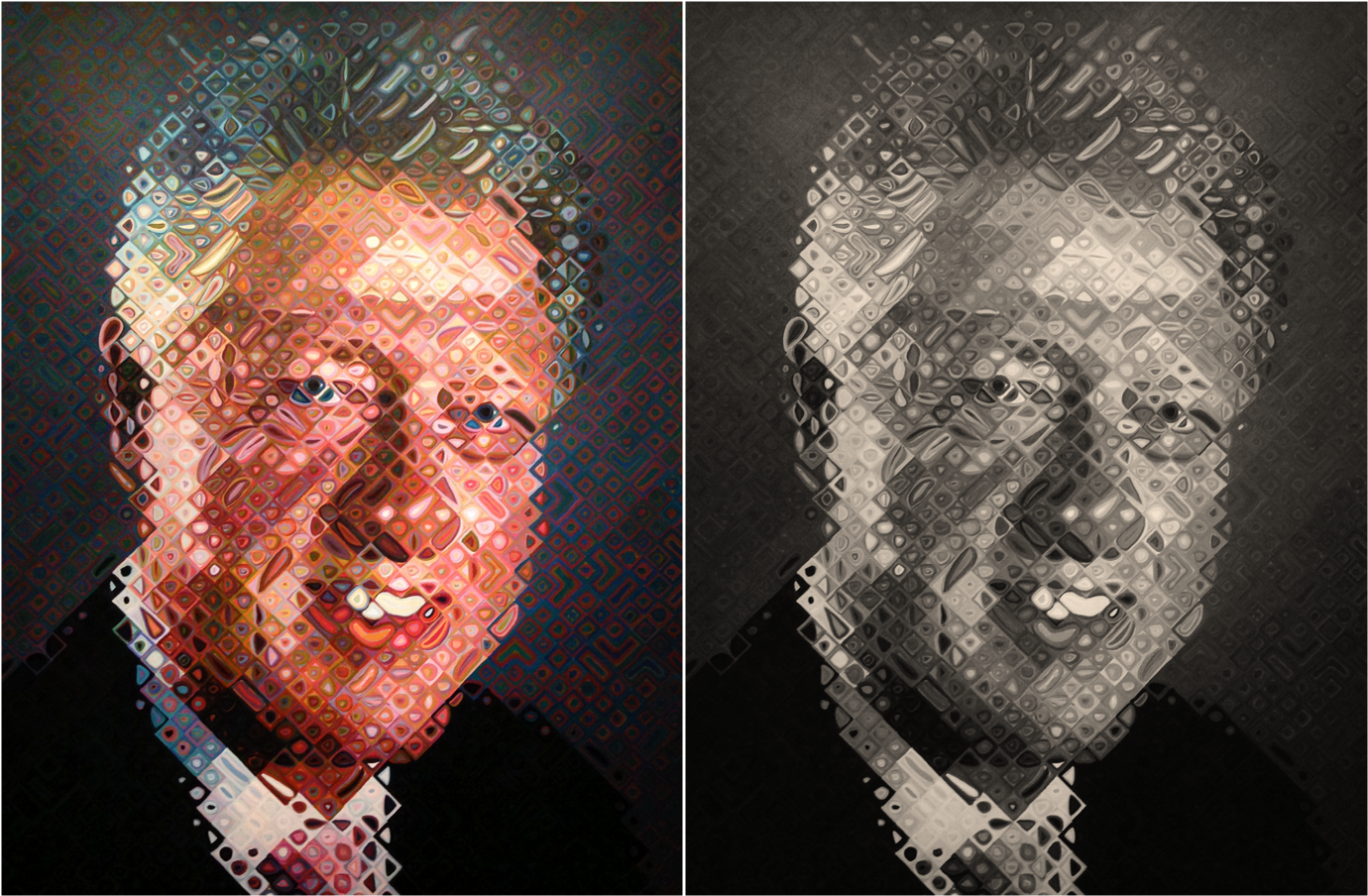
Above: WJC – National Portrait Gallery, Washington DC, by Chuck Close, oil on canvas (2006).

ACHELOUS AND HERCULES and ONE AND ANOTHER National Portrait Gallery - Photo G-Paz-y-Mino-C 2016

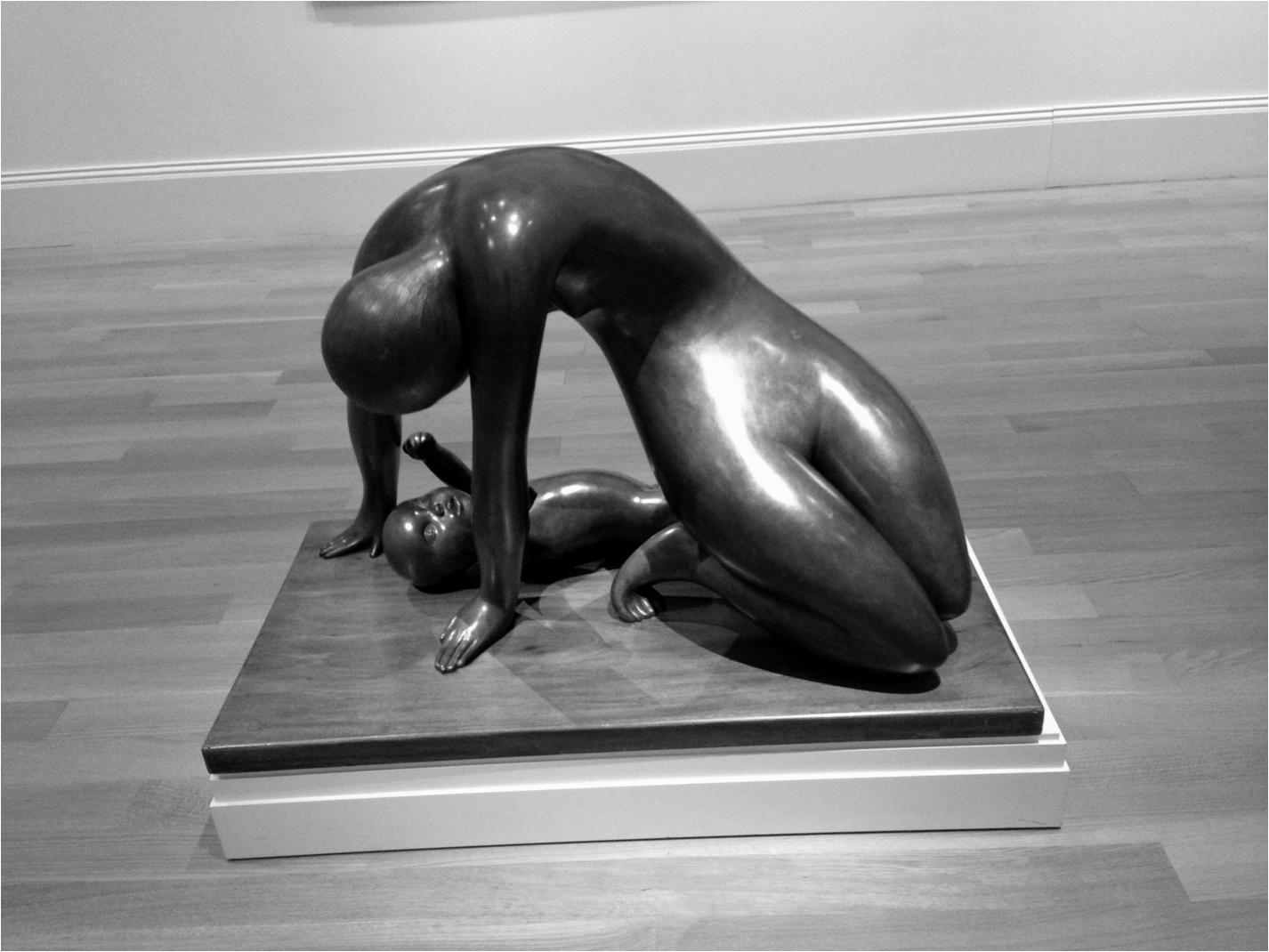
Above: ACHELOUS AND HERCULES (back) by Thomas Hart Benton, and ONE AND ANOTHER (front) by Hugo Robus, National Portrait Gallery, Washington DC.

One And Another NATIONAL PORTRAIT GALLERY in Washington DC - Photo G-Paz-y-Mino-C 2016

Above: ONE AND ANOTHER (1934), bronze on wood base, by Hugo Robus. National Portrait Gallery in Washington DC. This is such a beautiful piece, human size. An entire room for it. The paintings around seem static, almost watching at One And Another…

Close up ACHELOUS AND HERCULES National Portrait Gallery - Photo G-Paz-y-Mino-C 2016

Above: ACHELOUS AND HERCULES, oil on canvas (1947), by Thomas Hart Benton, National Portrait Gallery, Washington DC.

Babbon National Portrait Gallery - Photo G-Paz-y-Mino-C 2016

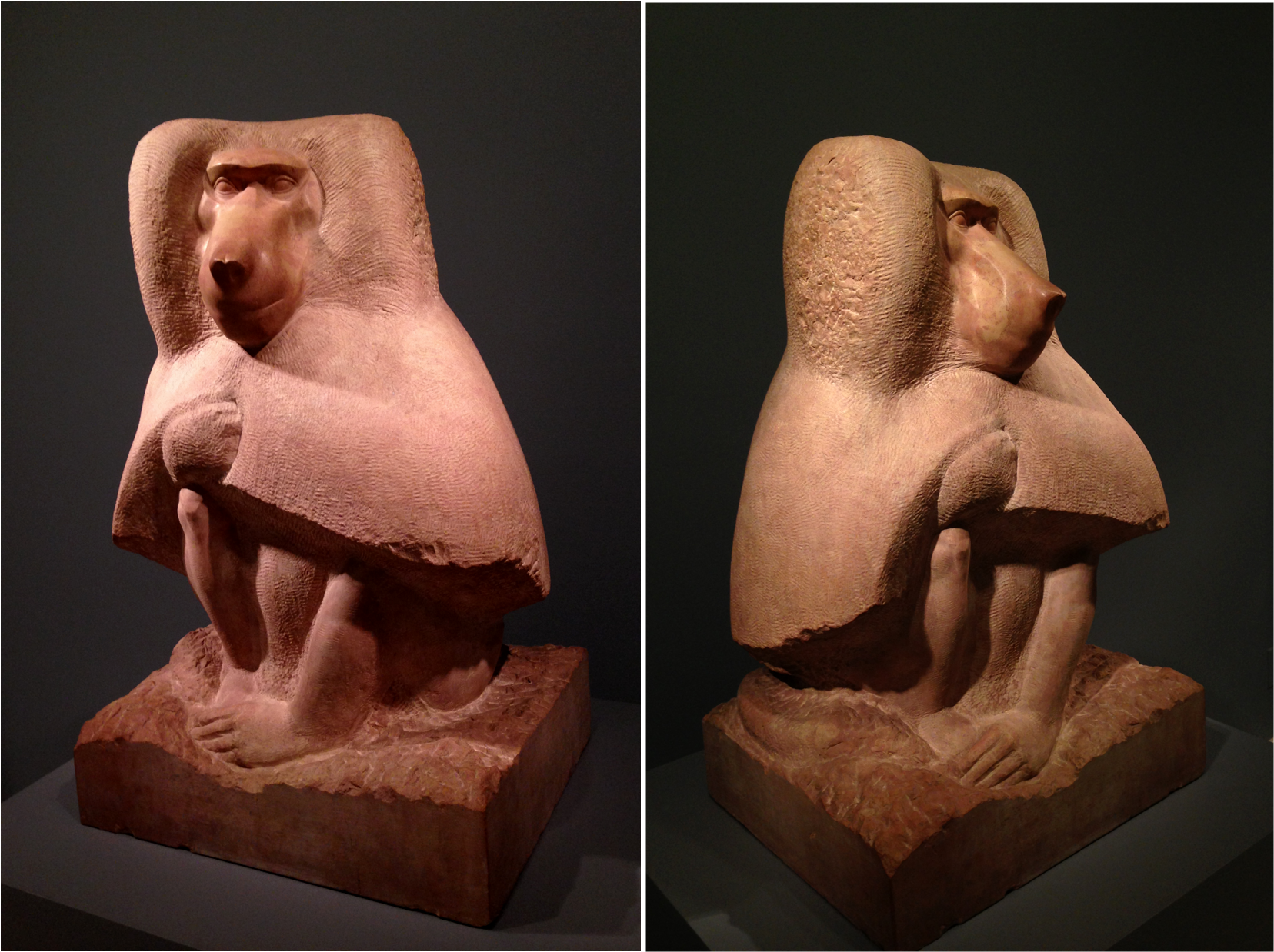
Above: Baboon (1930s) by Bessie Stough Callender, National Portrait Gallery in Washington DC. It reminded us of the Egyptian baboons…

Babbon B&W National Portrait Gallery - Photo G-Paz-y-Mino-C 2016

Above: Close up of Baboon (1930s), in B&W, by Bessie Stough Callender; National Portrait Gallery in Washington DC.

Falcons National Portrait Gallery - Photo G-Paz-y-Mino-C 2016

Above: Falcons (left unfinished, right finished, 1937) on black Belgian marble, by Bessie Stough Callender, National Portrait Gallery in Washington DC.

Washington Sea Eagle National Portrait Gallery - Photo G-Paz-y-Mino-C 2016

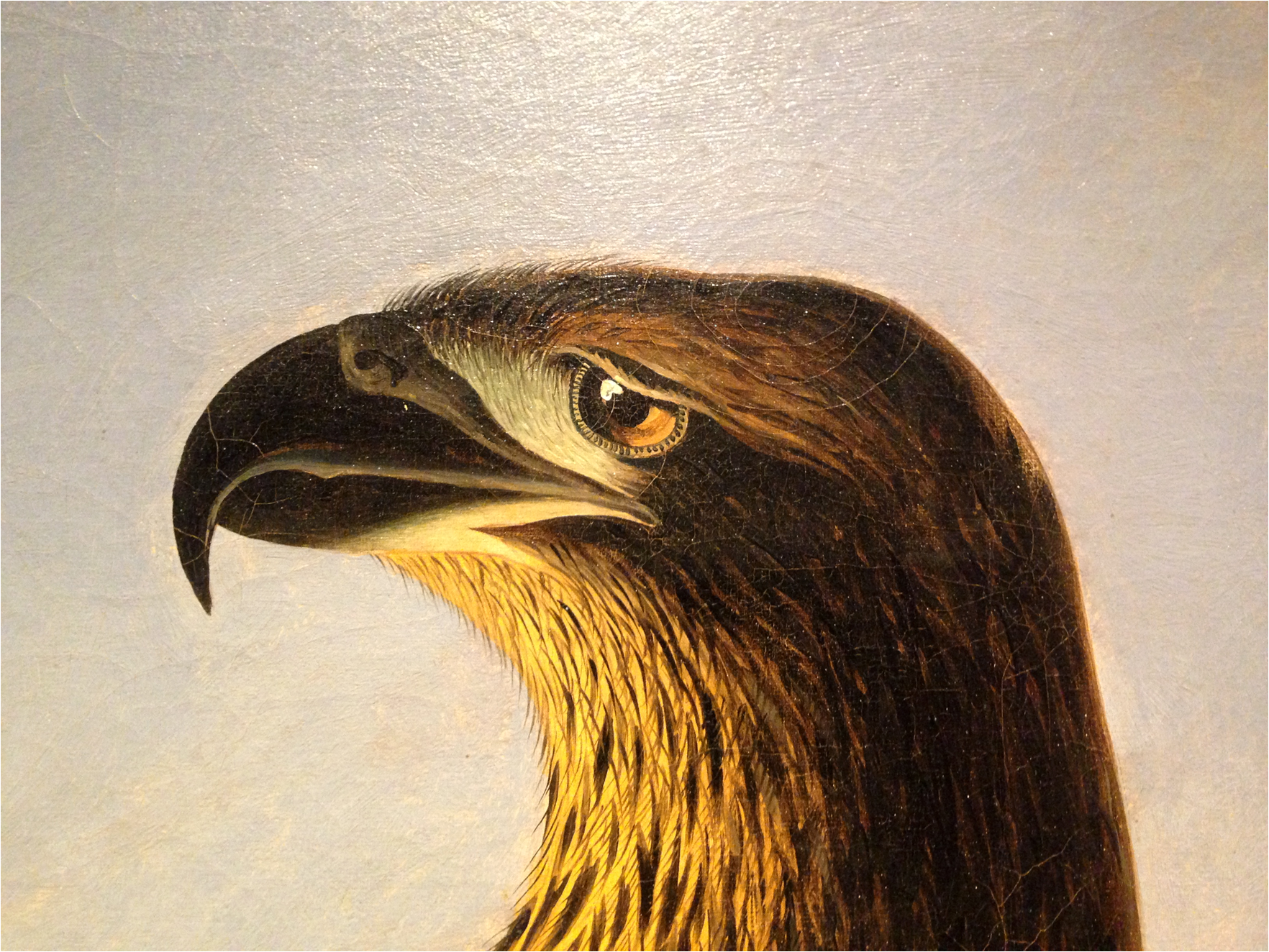
Above: Washington Sea Eagle (1836-39) by John James Audubon, oil on canvas. Zoom in, you can see the carks on the canvas. National Portrait Gallery in Washington DC.

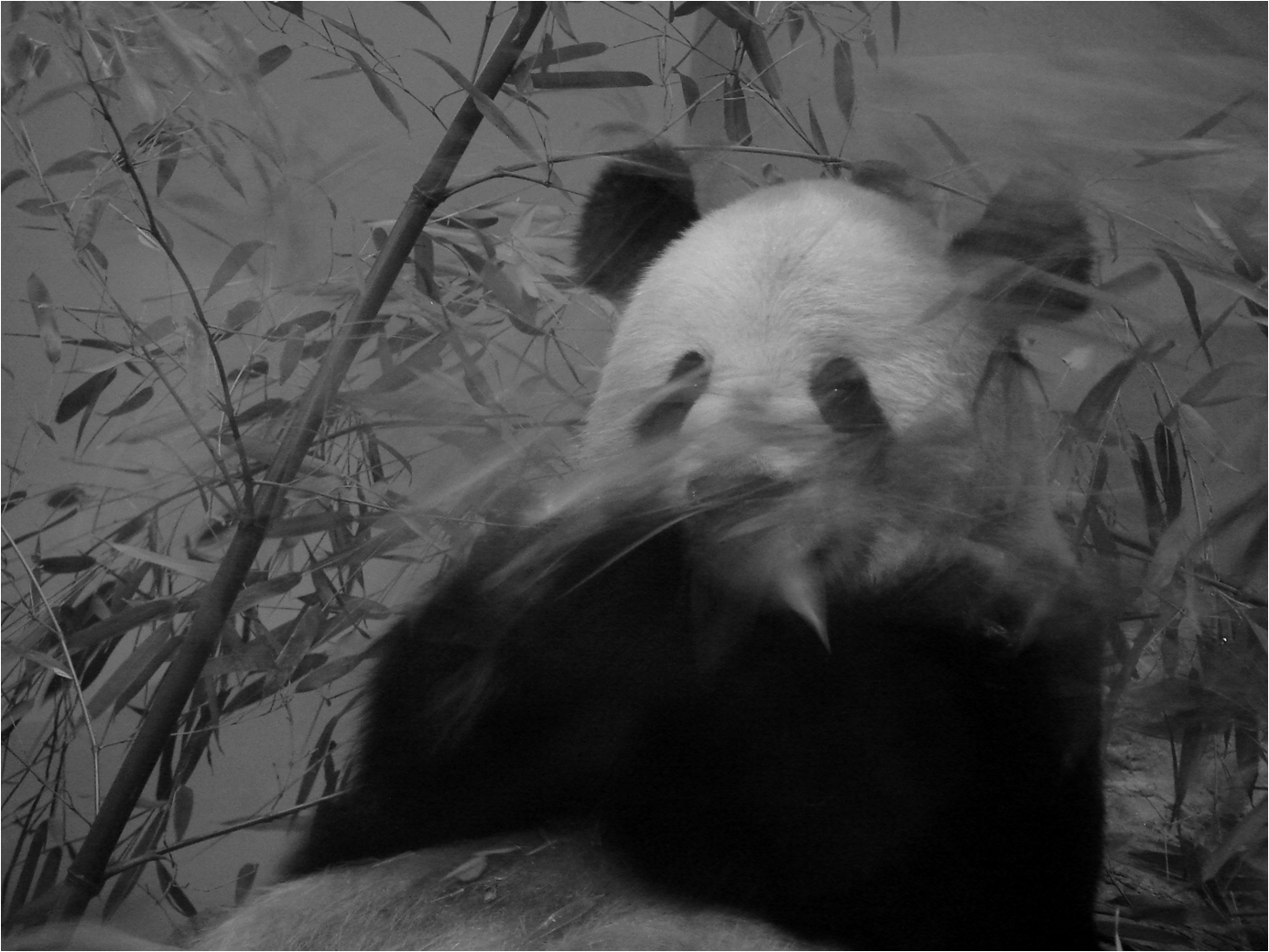
Giant Panda B&W feeding National Zoo Washington DC - Photo G-Paz-y-Mino-C 2016

Above: Giant Panda feeding on bamboo, National Zoo, Washington DC. Wild animals belong in the wild…

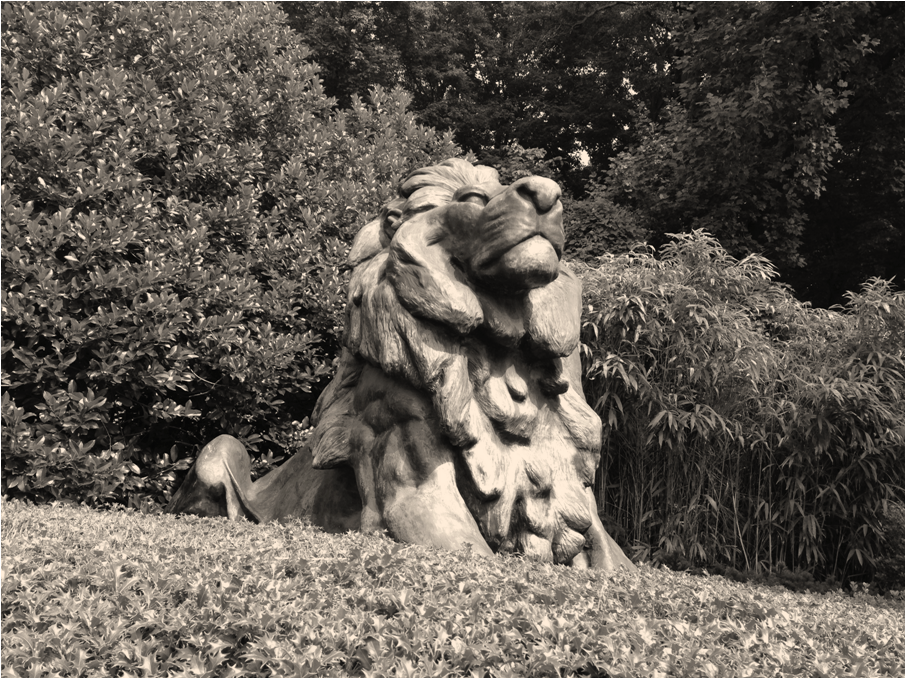
Welcoming Lion National Zoo Washington DC - Photo G-Paz-y-Mino-C 2016

Above: Welcoming Lion, National Zoo, Washington DC.

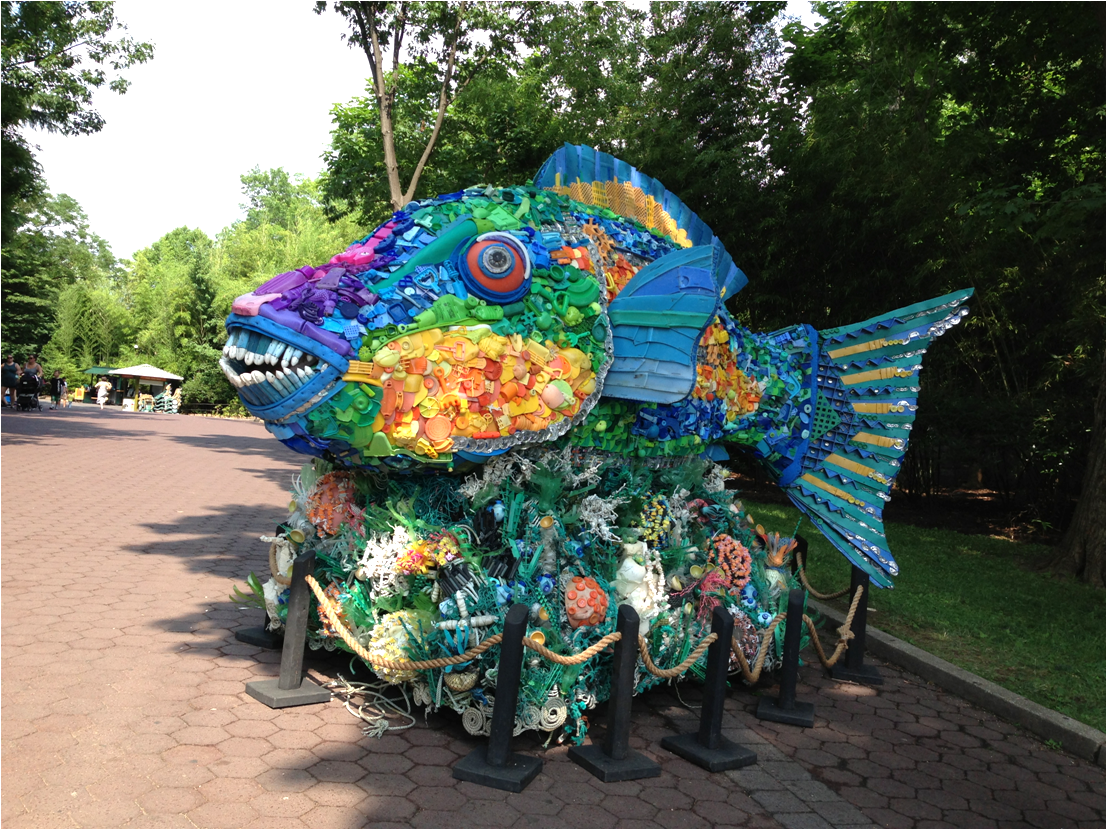
Priscilla The Parrot Fish National Zoo Washington DC - Photo G-Paz-y-Mino-C 2016

Above: Priscilla The Parrot Fish at the National Zoo, Washington DC.

Electronic Superhighway Nat Portrait Gallery - Photo G-Paz-y-Mino-C 2016

Above: Electronic Superhighway (2002) by Nam June Paik (born in Korea), pioneer of video-art. National Portrait Gallery in Washington DC.

H The White House Washington DC - Photo G-Paz-y-Mino-C 2016

Above: The White House, as close as you can get nowadays…

Jefferson Memorial Washington DC - Photo G-Paz-y-Mino-C 2016

Above: The Jefferson Memorial awakening… by the Potomac, Washington DC

Jefferson Memorial Washington DC color - Photo G-Paz-y-Mino-C 2016

Above: The Jefferson Memorial, another view, Washington DC

MTEC US Supreme Court - Photo G-Paz-y-Mino-C 2016

Above: Remember EDWARDS V. AGUILLARD? The 1987 (June 19) US Supreme Court ruling concerning “…a Louisiana law (i.e. Creationism Act) requiring that creation science be taught in public schools, along with evolution, violated the Establishment Clause of the First Amendment because the law was specifically intended to advance a particular religion…” Well, MTEC visited the US Supreme Court to reflect about that specific ruling. It was a beautiful, sunny day, dry and perfect to pose for selfies.

Pillars US Supreme Court - Photo G-Paz-y-Mino-C 2016

Above: The imposing architecture of the U.S. Supreme Court in Washington DC.

The famous staircase at the US Supreme Court - Photo G-Paz-y-Mino-C 2016

Above: The famous staircase at the U.S. Supreme Court in Washington DC. There are two of these beautiful stairways in the building.

When water breaks Bethesda MD - Photo G-Paz-y-Mino-C 2016

Above: When Water Breaks, It Always Does, Bethesda.

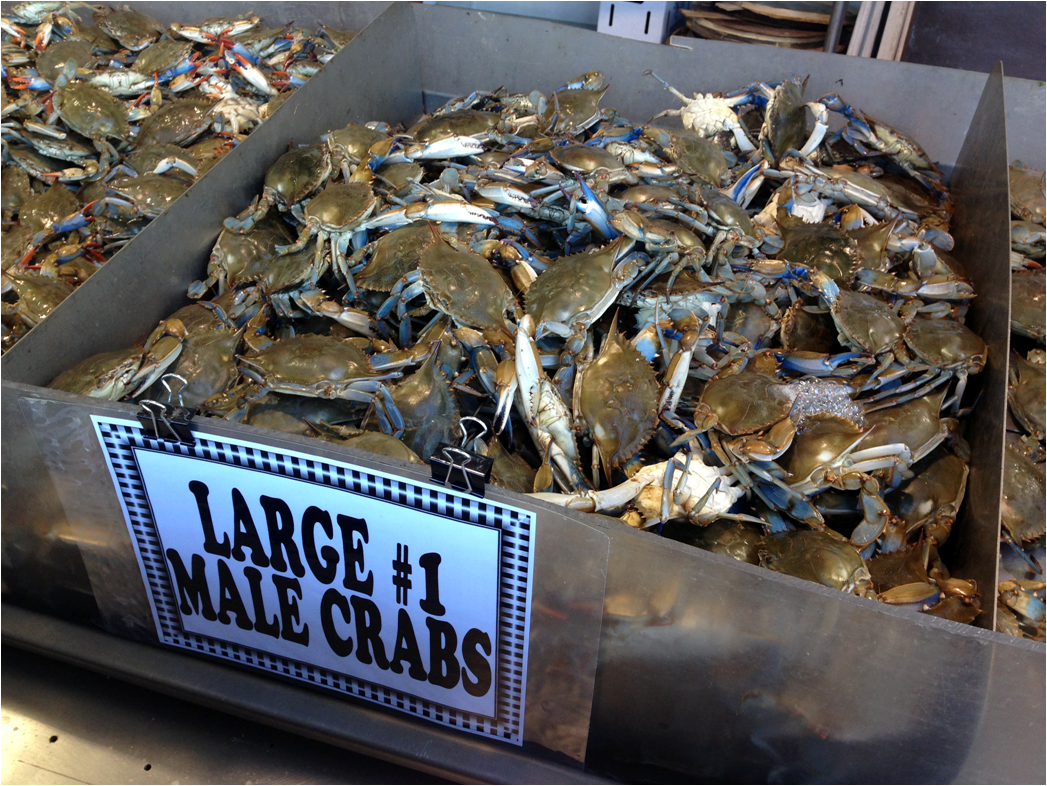
Chesapeake Bays Fish Market Washington DC - Photo G-Paz-y-Mino-C 2016

Above: We visited the famous Chesapeake Bay’s Fish marketplace. This made the day!

Chesapeake B Bays Fish Market Washington DC - Photo G-Paz-y-Mino-C 2016

Above: Close ups of the Chesapeake Bay’s Fish market.

Crabs Chesapeake Bays Fish Market Washington DC - Photo G-Paz-y-Mino-C 2016

Above: And even closer… Chesapeake Bay’s Fish market, Washington DC.

Sooner or Later Nat Museum Ame Indian - Photo G-Paz-y-Mino-C 2016

Above: Sooner or Later, National Museum of the American Indian, Washington DC.

MTEC at the US Supreme Court - Photo G-Paz-y-Mino-C 2016

Above: Our Book at the US Supreme Court. MTEC took some time to visit the building. Here, the volume is posing with one of the Cherub sculptures (the “Pen and Mace”) of the flagpole base. Both look radiant.

You can contact Guillermo Paz-y-Miño-C via email at guillermo.pazyminoc@gmail.com — Follow us on Twitter @gpazymino and Facebook.

*  *  *  *  *     *  *  *  *  *     *  *  *  *  *

Promotion Measuring the Evolution Controversy Paz-y-Mino-C & Espinosa 2016

Paz-y-Miño-C, G & Espinosa, A. 2016. Measuring the Evolution Controversy: A Numerical Analysis of Acceptance of Evolution at America’s Colleges and Universities. Cambridge Scholars Publishing, Newcastle, United Kingdom. ISBN (10): 1-4438-9042-1, ISBN (13): 978-1-4438-9042-7.

BOOK small format - Measuring the Evolution Controversy 2016Measuring the Evolution Controversy can be ordered directly from Cambridge Scholars Publishing, Amazon US, or Amazon CA . The publisher has made available a “VIEW EXTRACT” (in PDF), which includes the first 30-pages of the book: Cover, Table of Contents, Acknowledgments, Preface, Chapter ONE and the beginning of Chapter TWO. For PDF of color illustrations go to Image Resources of Didactic Relevance.

“The great contribution of ‘Measuring the Evolution Controversy’ is the rich content of data and analysis that asks detailed questions about the social, economic and political backgrounds of those who tend to reject evolution vs. those who accept evolution as science. Paz-y-Miño-C and Espinosa deftly analyze their data drawn from institutions of higher learning in the United States and particularly New England —which stands as a microcosm of the rest of the country, and indeed elsewhere in the world. It is their scientific approach to these issues which makes this book stand out as a uniquely original contribution.” — Niles Eldredge, PhD, Curator Emeritus of Paleontology at The American Museum of Natural History, New York.

“Pro-science activists and educators constantly bemoan the resistance to the teaching of evolution in the United States. All of us have anecdotes about encounters with the public, parents and students who are misinformed by their churches, Religious-Right groups, and creationist organizations. Paz-y-Miño-C and Espinosa present hard data that support the anecdotal evidence. They also show that although anti-evolutionism typically begins with religion, it is a multi-faceted problem that intersects with political and cultural ideologies. Gathered through careful research over a period of years, their data will enable scientists and defenders of science education to comprehend the roots of the evolution controversy and counteract resistance to evolution more strategically and effectively.”Barbara Forrest, PhD, co-author with Paul R. Gross of Creationism’s Trojan Horse: The Wedge of Intelligent Design (2007), and expert witness for plaintiffs, Kitzmiller et al. v. Dover Area School District (2005).

*  *  *  *  *     *  *  *  *  *     *  *  *  *  *

Paz-y-Mino-C_Book_Cover_Evolution_Stands_Faith_Up_JPEGPaz-y-Miño-C., G. 2013. Evolution Stands Faith Up: Reflections on Evolution’s Wars. NOVA Publishers, New York. By NOVA Publishers, New York Soft Cover. Find it at Barnes & Noble, Amazon.comAmazon UK

“The sweet spot of this collection of essays is the interface of science, history and literacy. Paz-y-Miño-C is, in essence, a champion of rationalism and a passionate defender of literacy standards. His essays deftly weave hard survey data and memorable turns of phrase with evocative imagery… While the essays in this collection are vast in coverage —from climate change to energy policy, stem cell research, vaccinations and, especially, evolution— a clear underlying theme emerges: [the author’s] goal is no less than to counter, through the lens of history and the majesty of rationalism, social forces that sanction ignorance, celebrate denial and… continue to diminish our global status in the fields of science and technology.” Jeff Podos, PhD, Professor of Biology, University of Massachusetts Amherst, USA.

“Paz-y-Miño-C  is a firm believer in evolutionary processes. He would like to see decisions made on the basis of facts, not unsupported opinion. He abhors and fears irrational thinking, especially ‘the views of those who see evil in truth and menace in the realities discovered by science.’ He marvels at the intricacy and diversity of life, and how it came about through natural selection… and is clearly frustrated by the unwillingness of so many to see the beauty and majesty in this view of the world and all that it explains.” – Jan A. Pechenik, PhD, Professor of Biology, Tufts University, USA, author of The Readable Darwin: The Origin of Species, as Edited for Modern Readers.

Science Writing and the Pseudoscience Trap

“…Error magnification is the single most vicious and pervasive meme in popular science miscommunication. It is seeded and driven by the science communicator him/herself and feed-back-looped into society, creating a cycle of half truths rather than educating the public…” — GPC

Science Writing Evolution Literacy

By Guillermo Paz-y-Miño-C

I am not fond of giving unsolicited advice, I almost never welcome it, although one should be open to internalizing constructive guidance when sincerely offered to us. And writers of any kind need editors to help us spot mistakes in our articles and improve format and content.

But I do have some experience writing about science for the general public. Occurrences that I can share with all.

My first article (1987), for El Comercio, explored the impact of aggressive shrimp-farming on the pristine mangrove ecosystems of Ecuador. The piece summarized a hands-on and in situ research project conducted as a biology undergraduate. Not only did it ignite my interest in investigative coverage, but led me to editorialize –ever since– on science, technology and the environment. Twenty-plus full-page reports –text and pictures– followed up to 1993 in Diario Hoy (another leading newspaper in Quito) and wildlife magazines. When I came to the United States to attend graduate school, I contributed 35 op pieces to El Popular (1996 to 2000), the foremost Hispanic newspaper in Toronto.

“…English has an advantage, it is the currency of modern science. It is an idiom of exploration, almost anything goes. Unfortunately, junk-writing is also part of this trial-and-error…”

Over time, I transitioned to writing almost exclusively in English (my second language), which has its own science etiquette, quite distinctive from Spanish. But English has an advantage, it is the currency of modern science. It is an idiom of exploration; anything goes. Unfortunately, junk-writing is also part of this trial and error.

Writing about science for the American readership –lay or specialized– is always a challenge. The landscapes (e.g. editorials, chronicles, reports, notes, blogs), styles, theme trends, and audiences’ interests change constantly. The internet has brought dynamism to sharing science news, via imaging (photos and video), more than text, or in short reports (150 to 300 words, rather than the usual 600 to 800 expected by publishers in the past), and quick and dirty delivery. The latter is a powerful temptation that a cautious columnist should avoid.

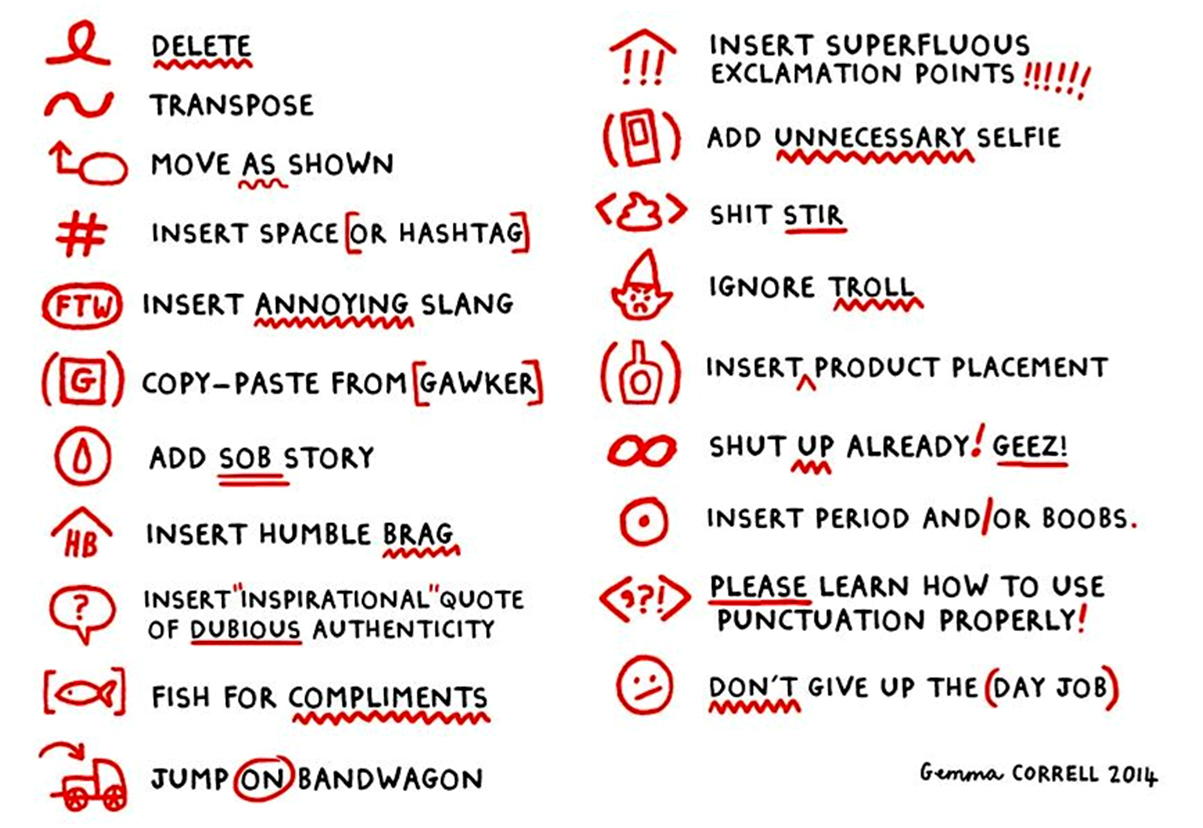
Editing Proofreading Marks for use on blogs and social media

Proofreading marks were used in the past for copy-editing scientific manuscripts and articles. They are extinct nowadays (the image shows a humorous version of proofreading symbols broadly shared in the social media). The edition and copy-edition of manuscripts is currently done automatically on computers and online servers. Still, human intervention is needed.

“…I do not consider myself a science writer, although I have been called ‘science journalist,’ as an insult, by a rodentologist incapable of graceful interaction with people…”

Before advancing any further, note that I do not consider myself a science writer, although I have been called “science journalist,” as an insult, by a rodentologist incapable of graceful interaction with people. But, I am a biologist who happens to write about science. I come from a background of journalists (my grandfather, father and a sister), essayists (two brothers who are professors in academia and regular contributors to newspapers), and a novelist sister. Plus, my father’s line run, for decades, a publishing initiative. Books were around us. Still, my only assertion here is that the publication process, from paper to ink on it, or to the sorting of pages and final binding of volumes, is the foundation of my cultural imprinting.

Learning to Spot Mistakes

A good, skeptical eye is essential in a writer, and this can be acquired by training. In my case, I worked as a copy editor for the journal Biotropica while I was a graduate student and, later, a postdoc (1996 to 2003). I revised 80 manuscripts by world authors and on multiple subjects. My responsibility was to find mistakes (typos, grammar errors, non-sense sentences, contradictions and, occasionally, bring content issues to the attention of the editors). That experience taught me to minimize the errors I still make while preparing scientific papers and perspectives. Perfection is never achieved, only sharpness to spot what seems incorrect and improve the outcome.

“…The skill of spotting mistakes shall make anyone a better author…”

And not to forget, I was also production editor and copy editor for Animal Behaviour (2001 – 2003), something I remember with mix feelings: although I did not revise as many manuscripts as for Biotropica, the AB Editorial Office in Indiana passed on to me difficult, long manuscripts, loaded with problems, arid science, although written by famous ethologists. In retrospect, I am grateful to my colleagues for the tedious assignments, and for forcing me to examine unpolished papers. The skill of spotting mistakes shall make anyone a better author.

Learning to Be an Editor

From 2003 to 2012, I became founder editor of The Conservation Behaviorist, a biannual periodical of the Animal Behavior Society’s Conservation Committee, which I chaired for three years (2003 – 2006). I edited and produced, from scratch, each of the issues of the ten volumes published during that decade.

“…One must avoid the pseudo science trap, sequel of adopting language that feeds the readers’ unsophisticated comfort zones, at the expense of hurting scientific rigor via distortion…”

What I value most from that activity is that I discovered how to adapt the texts submitted by scientists —in the interface animal behavior / conservation biology— to a media-friendly format, language and delivery. I spent hours reshaping the prose without changing the intention of the writers or the scientific accuracy of their proposals. And that is key in science writing. One must avoid the pseudoscience trap, sequel of adopting language that feeds the readers’ unsophisticated comfort zones, at the expense of hurting scientific rigor via distortion.

This malady is widespread in the work published in major newspapers, magazines, blogs and social media. Here is an example: claiming that naked mole rats are “cancer free” is not only falsehood, but it does not make scientific sense (i.e. relative lower incidence of cancer in a given organism, in respect to others, including humans, does not mean cancer-immunity, nor its absence; UPDATE: for a comprehensive review see Cancer Across The Tree of Life: Cooperation and Cheating in Multicellularity). As much as it was questionable, when in the 1990s, the “shark- cartilage pill industry” made a fortune ecociding sharks, milling their dried skeletons and selling “miracle powder” in anti-cancer capsules for the pro-natural-medicine ignoramus. Science writers must not fall in love with inaccuracies or fables like these.

The point here is that, by being an editor, one can learn to honor science, respect its integrity rather than allow free ride to sensationalism by promoting “breaking news” soon-to-be debunked.

Network of Science Communication Lemerg dot com - Evolution Literacy

The Network of Science Communication. The pseudoscience trap is inherent to networking. Science writers must not fall in love with inaccuracies and fables (image iStockphoto/Thinkstock).

Developing Your Own Style

You do not need to please everyone, particularly family, friends, colleagues or supervisors. Actually, it works best to stay away from their never unbiased reviews (except if they are writers themselves). But it is important to define the type of science writer you want to be, and develop a style with which a readership identifies you.

“…it is important to define what type of science writer you want to be, and develop a style with which a readership identifies you…”

When I wrote my initial op piece for The Standard Times in 2010, it was welcomed instantly, but two subsequent editorials were rejected. I spoke with the Editor in Chief and persuaded him that we needed to develop –together– a readership for the types of articles I would offer: an analysis of science topics with my personal take, rather than a report-story vast in empty phrases like “scientists say” or “according to researchers” or “in the opinion of experts.” Reluctantly, he agreed and months later we enjoyed the interaction with the readers and their feedback; positive and, sometimes, disapproving.

The Standard Times and I published 28 editorials (2010 – 2015) under the “Your View” column, thus conveying that I, as a writer, was one more member of the community, discharging from the inside my criteria and views about dissimilar or related topics, including: the relevance of curiosity-based research, the anti-vaccine movement, the collapse of basic science under the for-profit model, the scientific challenges to the reputation of the Stradivari violins, the wrongly called God-particle (Higgs boson), or the false beliefs in faith healing (for complete access to articles go to publications).

Being Aware of Your Skills

Because pop science writing lacks the editorial process of a scientific article, it is tempting to avoid fact-checks. Editorial reviewers of newspapers and magazines pay more attention to the journalistic aspects of the story than to its scientific accuracy. Many science writers have a bachelor’s or master’s degree in the humanities, with some training in science and technology (note that this is evolving and today’s media firms hire contributors with graduate certifications and previous experience in the job). If they possess a doctoral degree, it often lacks the postdoctoral practice that a recently-graduated student needs. And if a postdoctoral training is under the belt, the exercise of peer-reviewing (or being peer-reviewed), editing, publishing and, most importantly, reading thousands of scientific papers is just not there.

Peer Review Process Evolution Literacy

The Peer-review System of Scientific Papers

“…If, as a science writer, you feel confident with your grasping of scientific papers, think twice. You are probably wrong…”

Not only science writing is difficult, but also reading and correctly translating what the scientists communicate in their publications. Cutting-edge research is usually understood by highly specialized investigators. The best a science writer can do is to seek the original source and obtain interpretations of findings directly from the horse’s mouth. Do not rely, to write your own report, on other writers’ stories in the media. That will only magnify the error. And error magnification is the single most vicious and pervasive meme in popular science miscommunication. It is seeded and driven by the science communicator him/herself (including the press-releases from university campuses about their faculty’s discoveries) and feed-back-looped into society, creating a cycle of half truths rather than educating the public.

If, as a science writer, you feel confident with your grasping of scientific papers, think twice. You are probably wrong. Principal investigators all over the country read the same articles you claim to understand and discuss them in journal clubs with colleagues, postdocs, and graduate students. They dissect the articles to a level of extreme, yet fine criticism and end up comprehending the experiments, the math and statistics, the theoretical context and significance of the studies. If they struggle collectively in this effort, what makes you think that you have it clear?

“…It is up to you, therefore, to publish well-documented perspectives or copious shallow reports…”

In addition, writing hundreds of 300-to-600-word notes about science is not equivalent to preparing a single peer-review publication for a scientific journal. If you do investigative coverage, which might take days, weeks or months (to confirm the veracity of the info), any average science writer could surpass you in production by spawning hourly articles. It is up to you, therefore, to publish well-documented perspectives or copious shallow reports.

Your Work Is Needed

Society needs science communicators, and science writers are crucial in this respect. But be realistic, just examine the turnout of science writers at any major newspaper or magazine (info available online under “contributors”), and realize that, after a few years, the entire staff might have crossed the revolving door. Although there are still more job opportunities for science writers than for TV or documentary anchors. Writing for radio is also an alternative, yet with limited employment. Freelancing, therefore, shall be your probable route.

If you have passion for writing about science, it can be an enjoyable journey. However, here are additional tips:

  • Obtain the highest education possible and dismiss the notion to not pursue formal schooling and, instead, “learn on the job.” The latter is damaging advice, usually given by people without specialized education, or by those who benefit from your unpreparedness. If you actually get the job, you will always “learn the praxis” while on it. But you will never compensate, “on the job,” for the formal education you missed. Science, math and technology are not taught in the streets.
  • Read by far more topics than you can write about; develop a sense for science.
  • Travel internationally to scientific meetings and try to understand the cultural contexts in which science is done elsewhere; this could be difficult since we all see the planet through parochial preconceptions. However, modern science is done collaboratively and international partnerships are ubiquitous. Writing from home will keep your mind at home.
  • Write about science itself, rather than people in science. Do not celebritize individuals, but grant credit to all who deserve it.
  • Do not become enticed by the ivory-tower institutions as the sole source of science stories to report; that will turn you into a snob writer.
  • And remember that a good science tale should be good by itself, no matter its origin, but only a good story teller would make it shine.

Science writing can be art or artistic, profound and beautiful, but also commercial and prone to “likes” and “shares” in the social media, which are addicting. If you want to “go viral,” then consequential science communication might not be the path to take. It is not for you. After all, the most significant science books and articles for the general public are written by scientists (some in collaboration with reporters), not by science writers. But you can create a niche for yourself as science communicator-facilitator in a way that servers your local community and society. — EvoLiteracy © 2016.

Acknowledgment: I thank Avelina Espinosa for editorial comments and feedback to improve this article.

You can contact Guillermo Paz-y-Miño-C via email at guillermo.pazyminoc@gmail.com — Follow us on Twitter @gpazymino and Facebook.

*  *  *  *  *     *  *  *  *  *     *  *  *  *  *

Measuring The Evolution Controversy - FourBooks - Paz-y-Mino-C & Espinosa 2016

Paz-y-Miño-C, G & Espinosa, A. 2016. Measuring the Evolution Controversy: A Numerical Analysis of Acceptance of Evolution at America’s Colleges and Universities. Cambridge Scholars Publishing, Newcastle, United Kingdom. ISBN (10): 1-4438-9042-1, ISBN (13): 978-1-4438-9042-7.

BOOK small format - Measuring the Evolution Controversy 2016Measuring the Evolution Controversy can be ordered directly from Cambridge Scholars Publishing, Amazon US, or Amazon CA . The publisher has made available a “VIEW EXTRACT” (in PDF), which includes the first 30-pages of the book: Cover, Table of Contents, Acknowledgments, Preface, Chapter ONE and the beginning of Chapter TWO. For PDF of color illustrations go to Image Resources of Didactic Relevance.

“The great contribution of ‘Measuring the Evolution Controversy’ is the rich content of data and analysis that asks detailed questions about the social, economic and political backgrounds of those who tend to reject evolution vs. those who accept evolution as science. Paz-y-Miño-C and Espinosa deftly analyze their data drawn from institutions of higher learning in the United States and particularly New England —which stands as a microcosm of the rest of the country, and indeed elsewhere in the world. It is their scientific approach to these issues which makes this book stand out as a uniquely original contribution.” — Niles Eldredge, PhD, Curator Emeritus of Paleontology at The American Museum of Natural History, New York.

“Pro-science activists and educators constantly bemoan the resistance to the teaching of evolution in the United States. All of us have anecdotes about encounters with the public, parents and students who are misinformed by their churches, Religious-Right groups, and creationist organizations. Paz-y-Miño-C and Espinosa present hard data that support the anecdotal evidence. They also show that although anti-evolutionism typically begins with religion, it is a multi-faceted problem that intersects with political and cultural ideologies. Gathered through careful research over a period of years, their data will enable scientists and defenders of science education to comprehend the roots of the evolution controversy and counteract resistance to evolution more strategically and effectively.”Barbara Forrest, PhD, co-author with Paul R. Gross of Creationism’s Trojan Horse: The Wedge of Intelligent Design (2007), and expert witness for plaintiffs, Kitzmiller et al. v. Dover Area School District (2005).

*  *  *  *  *     *  *  *  *  *     *  *  *  *  *

Paz-y-Mino-C_Book_Cover_Evolution_Stands_Faith_Up_JPEGPaz-y-Miño-C., G. 2013. Evolution Stands Faith Up: Reflections on Evolution’s Wars. NOVA Publishers, New York. By NOVA Publishers, New York Soft Cover. Find it at Barnes & Noble, Amazon.comAmazon UK

“The sweet spot of this collection of essays is the interface of science, history and literacy. Paz-y-Miño-C is, in essence, a champion of rationalism and a passionate defender of literacy standards. His essays deftly weave hard survey data and memorable turns of phrase with evocative imagery… While the essays in this collection are vast in coverage —from climate change to energy policy, stem cell research, vaccinations and, especially, evolution— a clear underlying theme emerges: [the author’s] goal is no less than to counter, through the lens of history and the majesty of rationalism, social forces that sanction ignorance, celebrate denial and… continue to diminish our global status in the fields of science and technology.” Jeff Podos, PhD, Professor of Biology, University of Massachusetts Amherst, USA.

“Paz-y-Miño-C  is a firm believer in evolutionary processes. He would like to see decisions made on the basis of facts, not unsupported opinion. He abhors and fears irrational thinking, especially ‘the views of those who see evil in truth and menace in the realities discovered by science.’ He marvels at the intricacy and diversity of life, and how it came about through natural selection… and is clearly frustrated by the unwillingness of so many to see the beauty and majesty in this view of the world and all that it explains.” – Jan A. Pechenik, PhD, Professor of Biology, Tufts University, USA, author of The Readable Darwin: The Origin of Species, as Edited for Modern Readers.

Russia: A Saturation of Beauty

“…There is so much history in Russia, a cultural legacy for the world. Its splendor is overwhelming. The fantasy in the architecture of its cathedrals and palaces; the colors of joy on its paintings; the ballerinas dancing in the snow at the tempo of always original music; the transcendent prose and verse of its writers, above all –to me– the perfection of Tolstoy’s Anna Karenina. A nation of great contrasts like all mega homelands. Of imposed extreme inequality and oppression by its past ruling Tsars, shamelessly sheltered by the co-conspirator Orthodoxy, the Church and its wicked Patriarchs, enticers of the populous. Its 1917 Revolution was inevitable, as it later was the Cold War with the West, which sequels still mark the divide between the peoples of Russia and ‘the capitalists.’ But what impresses me most of Russia is its capacity to have rebuilt itself after the significant obliteration of its land during World War II. Only a collective mind that treasures culture could reconstruct it, despite its 27-million casualties while battling Nazism. — One day, in the distant future, just before the subversive cells of my skin take over the rest of the organs and inflict their final harm, I would like to see the Russian Cathedrals again. Not because an Atheist needs conversion before death; that will never happen, I will always reject Fraud. But because these ‘now museums’ represent the saturation of art-beauty that I have been looking for…” — GPC.

We just returned from Russia after attending the Moscow Forum Protists – 2016 held at Lomonosov Moscow State University, from June 6th to 10th. The program, sponsored by the International Society of Protistologists (ISOP), included five plenary sessions with keynote speakers, general oral presentations, two symposia (integrative co-evolution between mitochondria and their hosts, and protists of marine sediments), and poster presentations (two sessions with about 50 posters each) on diverse topics, including: evolution and phylogeny, taxonomy, systematics and DNA barcoding, genomics and molecular biology, cell biology, organismal biology, parasitology, diversity and biogeography, ecology of soil protists, ecology of aquatic protists, bioindicators and palaeoecology. The 200 participants had time to exchange ideas during informal, social gatherings.

Avelina Espinosa and I participated with a poster (something we have not done in years, perhaps since we were postdocs, although our students present posters often) titled “Aggregative Behavior, Cell Signaling and Morphometrics: Entamoeba Discrimination Studies.” It summarized our latest papers (2016) featured on the Journal of Eukaryotic Microbiology (for details and links to articles see Symposium Kin-Discrimination in Protists just featured on JEUK). Here is the poster, you can click on the image to enlarge:

Aggregative Behav Cell Signaling Morphometrics Entamoeba Discrimination Studies 2016

The meeting included a pre-conference trip to Saint Petersburg and a post-conference tour to the Golden Ring of Russia; we joined both. Plus three excursions, two of which we did on our own (the Armoury Chamber and the Moscow Kremlin), and a visit to the State Tretyakov Gallery, which we missed due to a conflict on our schedule.

Below, I include some of the images of our trip, in no particular order. On purpose, I often use a phone-camera to document our traveling. Most images are in low definition and have little or no editing (click on them to enlarge). Please note that images are copyrighted, all rights reserved, enjoy watching them! — EvoLiteracy © 2016.

MTEC at downtown campus Lomonosov Moscow State University - Photo G-Paz-y-Mino-C 2016

Above: Our book, Measuring the Evolution Controversy (2016), at the downtown campus of Lomonosov Moscow State University. Quite a stop to start our official visit. The old campus is located nearby the Kremlin. The new campus is located South of the city’s center.

Opening ISOP 2016 - Photo G-Paz-y-Mino-C 2016

Above: Opening at Moscow Forum Protists – 2016. The Faculty of Biology Building, Lomonosov Moscow State University.

Main Building COLOR Lomonosov Moscow State University - Photo G-Paz-y-Mino-C 2016

Above: Main Building Lomonosov Moscow State University. There are seven identical buildings in Moscow, one of them belongs to the University.

VDNKH Metro Station in Moscow - Photo G-Paz-y-Mino-C 2016

Above: VDNKH Metro Station in Moscow. Tiles covering an entire wall (18 x 6 feet). While we were admiring this “tile-mosaic,” a young couple, plus a boy with his mother, stopped by to take pictures, an indication that this was an appreciated spot.

Cathedral of the Nativity of the Virgin in Suzdal Russia - Photo G-Paz-y-Mino-C 2016

Above: Cathedral of the Nativity of the Virgin in Suzdal, Russia. My favorite; blue is the right color.

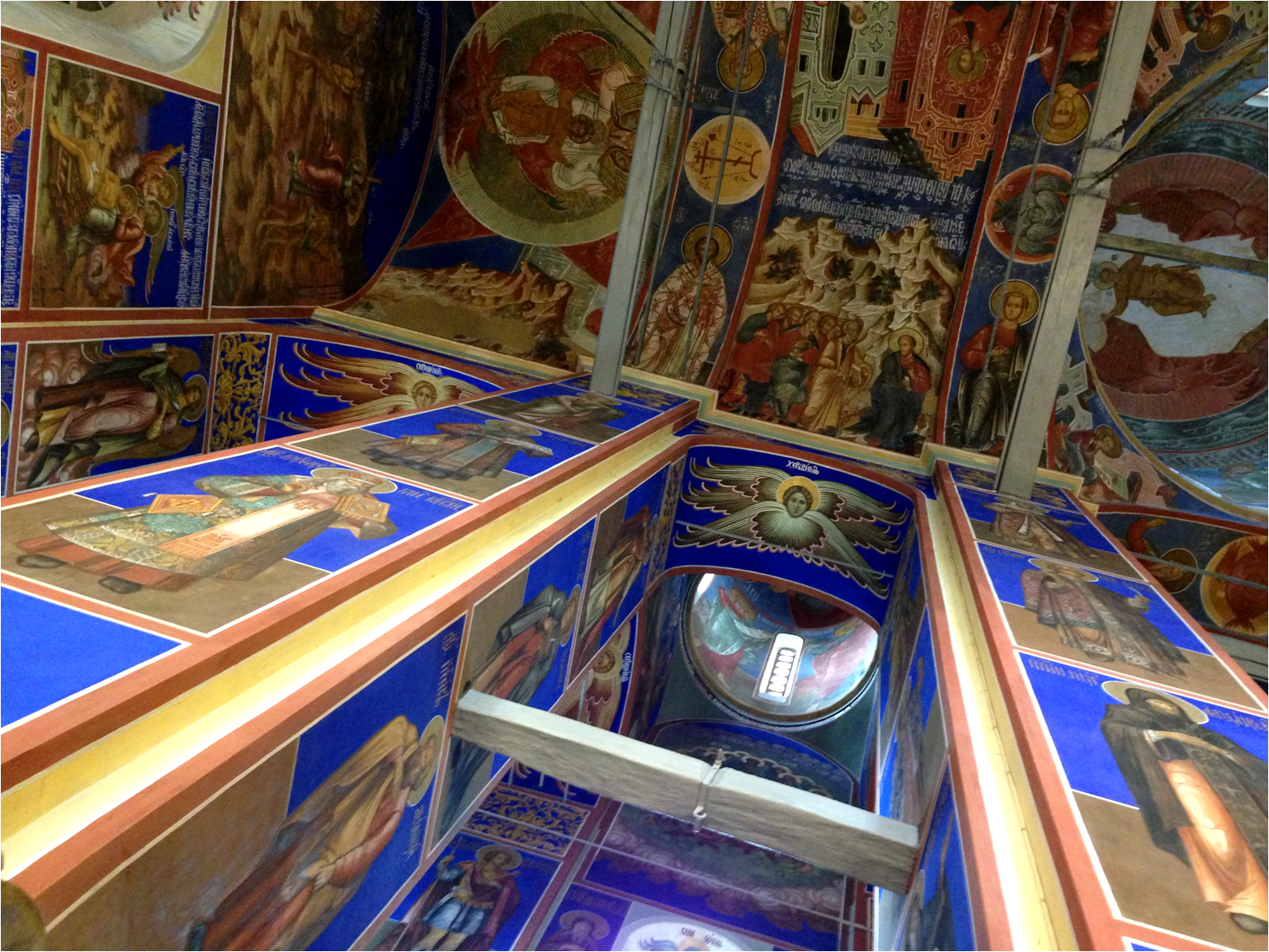
Cathedral of the Nativity of the Virgin INSIDE Suzdal Russia - Photo G-Paz-y-Mino-C 2016

Above: Inside the Cathedral of the Nativity of the Virgin in Suzdal, Russia.

The Senate and The Secret Gardens Kremlin Moscow - Photo G-Paz-y-Mino-C 2016

Above: The Senate and The Secret Gardens, Kremlin, Moscow.

Kremlin Wall with tower - Photo G-Paz-y-Mino-C 2016

Above: The iconic Kremlin Wall with tower, Moscow. The Kremlin buildings (government and museums) are enclosed by the wall.

The Grand Kremlin Palace Moscow - Photo G-Paz-y-Mino-C 2016

Above: The Grand Kremlin Palace in Moscow.

MTEC exploring Moscow Map - Photo G-Paz-y-Mino-C 2016

Above: Our book, Measuring the Evolution Controversy, planning the next day’s activities in Moscow. The Metro system is quite efficient to explore the city’s historic buildings, monuments and museums.

Russian State Library Main Hall - Photo G-Paz-y-Mino-C 2016

Above: Russian State Library, Main Hall, Moscow. An old palace in current renovation.

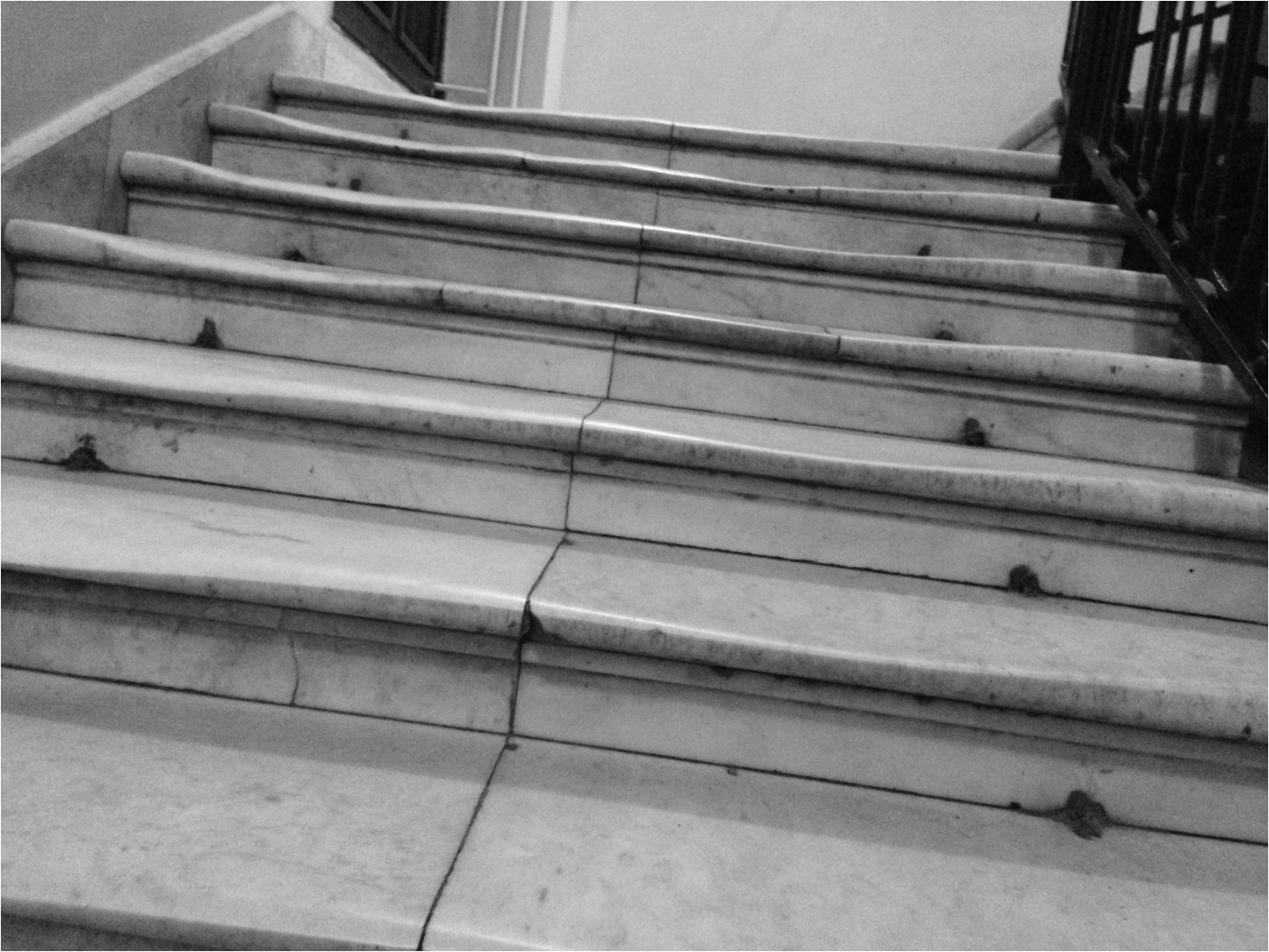
Marble stairs at the Russian State Library - Photo G-Paz-y-Mino-C 2016

Above: Marble stairs at the Russian State Library; history polished on marble, perhaps by millions of people over the years, Moscow.

View of Kermlin from Russian State Library Moscow - Photo G-Paz-y-Mino-C 2016

Above: View of the Kremlin from the Russian State Library in Moscow.

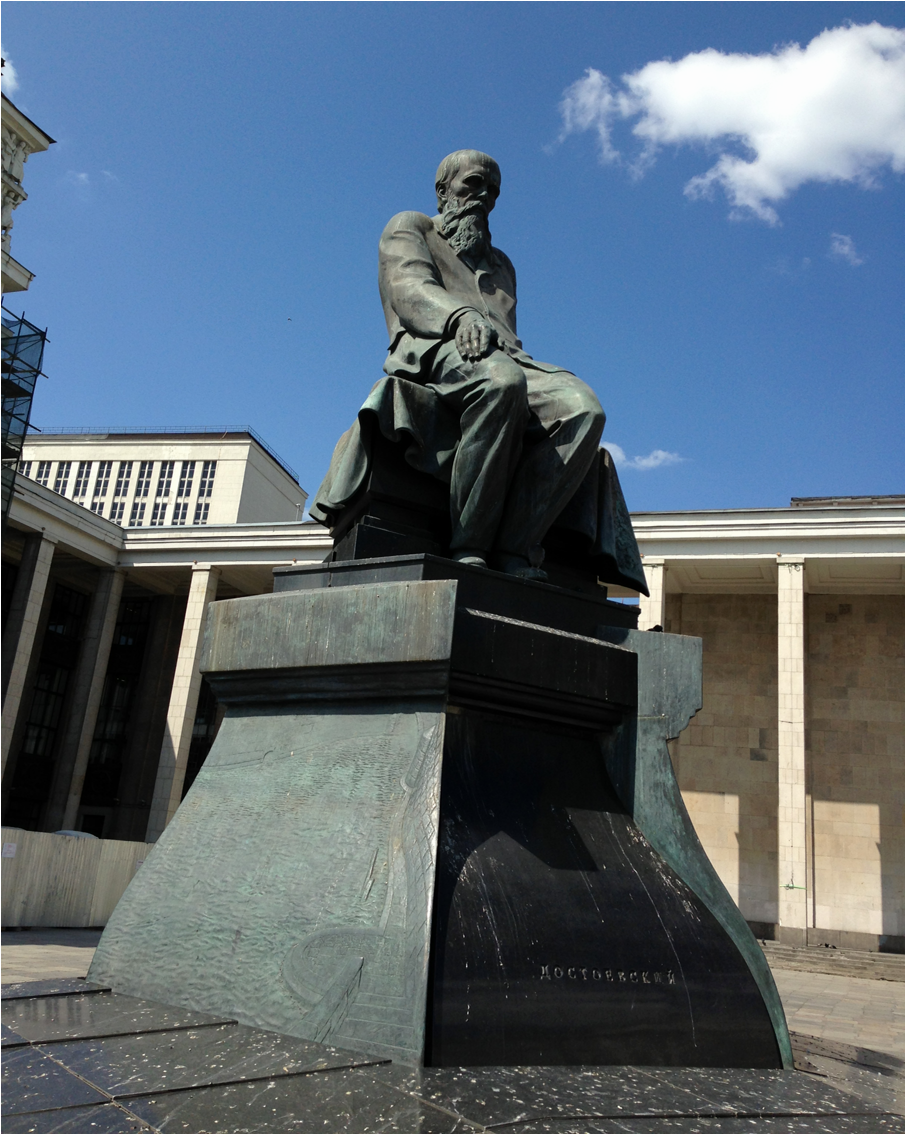
Fyodor Dostoyevsky Russian State Library - Photo G-Paz-y-Mino-C 2016

Above: Fyodor Dostoyevsky statue at the Russian State Library, frequented spot by pigeons and birdlife. Quiet, little explored by pedestrians now that the surroundings are in renovation.

Detail of Facade Russian State Library - Photo G-Paz-y-Mino-C 2016

Above: Detail of façade at the Russian State Library, Moscow.

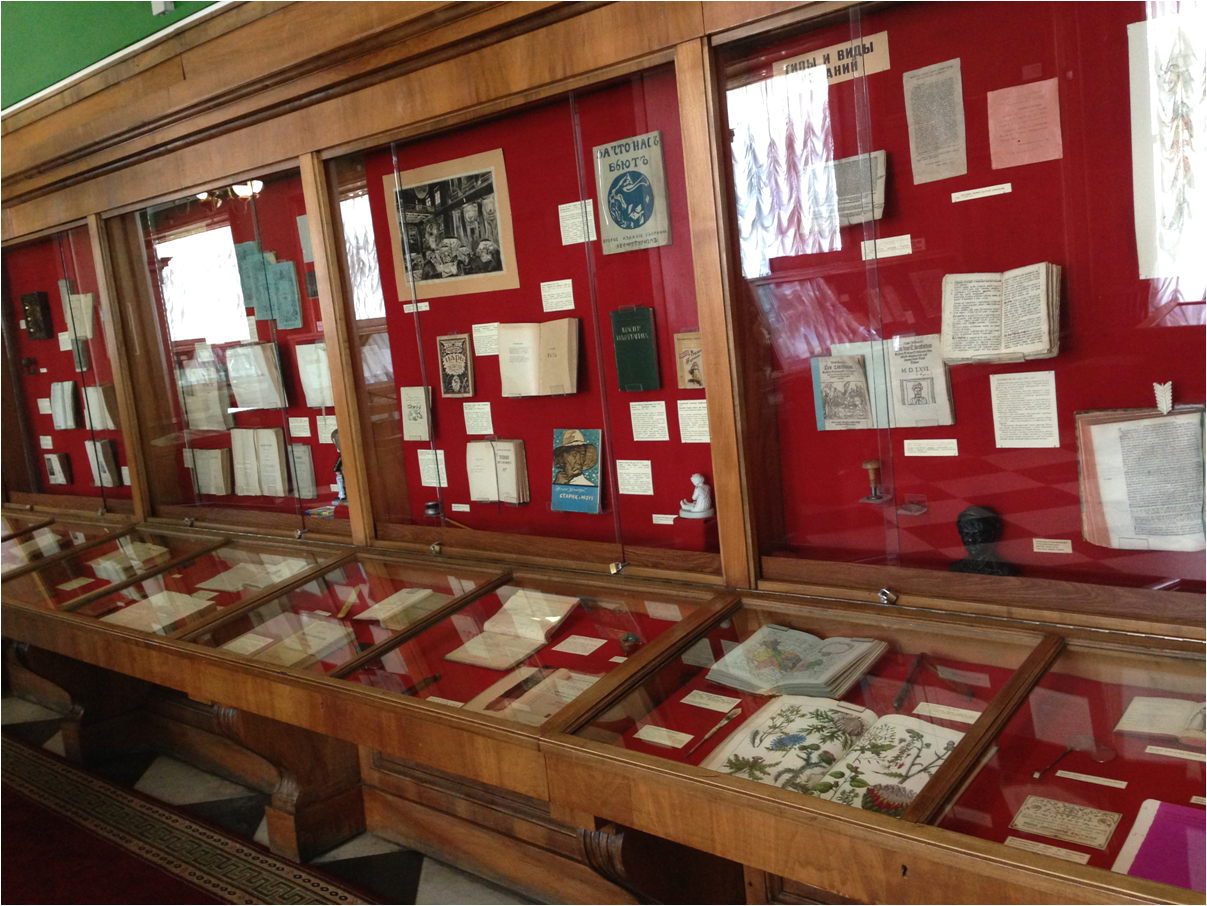
Book Museum View - Russian State Library - Photo G-Paz-y-Mino-C 2016

Above: Book Museum at the Russian State Library. Its collection of old books is impressive, hundreds of volumes.

SURVEYING VOYAGES Book Museum Russian State Library - Photo G-Paz-y-Mino-C 2016

Above: Darwin’s SURVEYING VOYAGES (1839) at the Book Museum of the Russian State Library, Moscow.

HUMANI CORPORIS FABRICA Book Museum Moscow - Photo G-Paz-y-Mino-C 2016

Above: The original HUMANI CORPORIS FABRICA by Andreas Vesalius (1543) at the Book Museum, Russian Sate Library, Moscow. I have seen this book twice, the first time at the Library of Medicine, National Institutes of Health, Bethesda, in the US.

DON QVIXOTE OF LA MANCHA Book Museum Russian State Library - Photo G-Paz-y-Mino-C 2016

Above: DON QVIXOTE OF LA MANCHA (1616), Book Museum, Russian State Library, Moscow.

1867 Das Kapital - Book Museum - Russian State Library - Photo G-Paz-y-Mino-C 2016

Above: 1867 edition of Das Kapital by Karl Marx, Book Museum, Russian State Library, Moscow.

MTEC at Library Lomonosov Moscow State University - Photo G-Paz-y-Mino-C 2016

Above: Our book, Measuring the Evolution Controversy, enjoying a lovely day outside the Library of Lomonosov Moscow State University. MTEC was not allowed in the Library due to lack of proper “pass,” which was required for visitors. In any event, the book took some time for selfies and promotion.

Modern Moscow at sunset - Photo G-Paz-y-Mino-C 2016

Above: Modern Moscow at sunset, a view from our hotel.

Moscow River and Kremlin - Photo G-Paz-y-Mino-C 2016

Above: Moskva River and Kremlin (on the right), Moscow.

Saint Basil's Cathedral Moscow NIGHT - Photo G-Paz-y-Mino-C 2016

Above: Saint Basil’s Cathedral (night), Moscow.

Saint Basil's Cathedral Moscow - Photo G-Paz-y-Mino-C 2016

Above: Saint Basil’s Cathedral, Moscow, panoramic view.

Saint Basil's Cathedral Moscow closeup - Photo G-Paz-y-Mino-C 2016

Above: Saint Basil’s Cathedral, close up, Moscow.

Orthodox Moscow - Photo G-Paz-y-Mino-C 2016

Above: Orthodox Moscow, next to Saint Basil’s Cathedral.

The Historical Museum at Red Square Moscow - Photo G-Paz-y-Mino-C 2016

Above: The Historical Museum at Red Square, Moscow. It has an excellent collection of artifacts related to Russian history, starting from Homo erectus (the first archeological discoveries in Russian landscapes) up to the 20th Century.

The GUM Building at Red Square Moscow - Photo G-Paz-y-Mino-C 2016

Above: The GUM Building at Red Square, Moscow.

Annunciation Cathedral side-view Kremlin Moscow - Photo G-Paz-y-Mino-C 2016

Above: Annunciation Cathedral, side-view, Kremlin, Moscow.

Annunciation Cathedral B&W Kremlin Moscow - Photo G-Paz-y-Mino-C 2016

Above: Annunciation Cathedral in B&W, Kremlin, Moscow.

The Ivan The Great Bell Tower - Kremlin Moscow - Photo G-Paz-y-Mino-C 2016

Above: Ivan The Great Bell Tower, Kremlin Moscow.

Cathedral of Christ the Saviour Moscow - Photo G-Paz-y-Mino-C 2016

Above: Cathedral of Christ the Saviour, Moscow.

Bolshoi Theatre Moscow - Photo G-Paz-y-Mino-C 2016

Above: Bolshoi Theatre, Moscow.

Bolshoi Theatre Stage Moscow - Photo G-Paz-y-Mino-C 2016

Above: Bolshoi Theatre’s stage, Moscow. We were fortunate to get tickets for the Opera Katerina Izmailova, an adaptation of Shostakovich’s opera Lady Macbeth of the Mtsensk District.

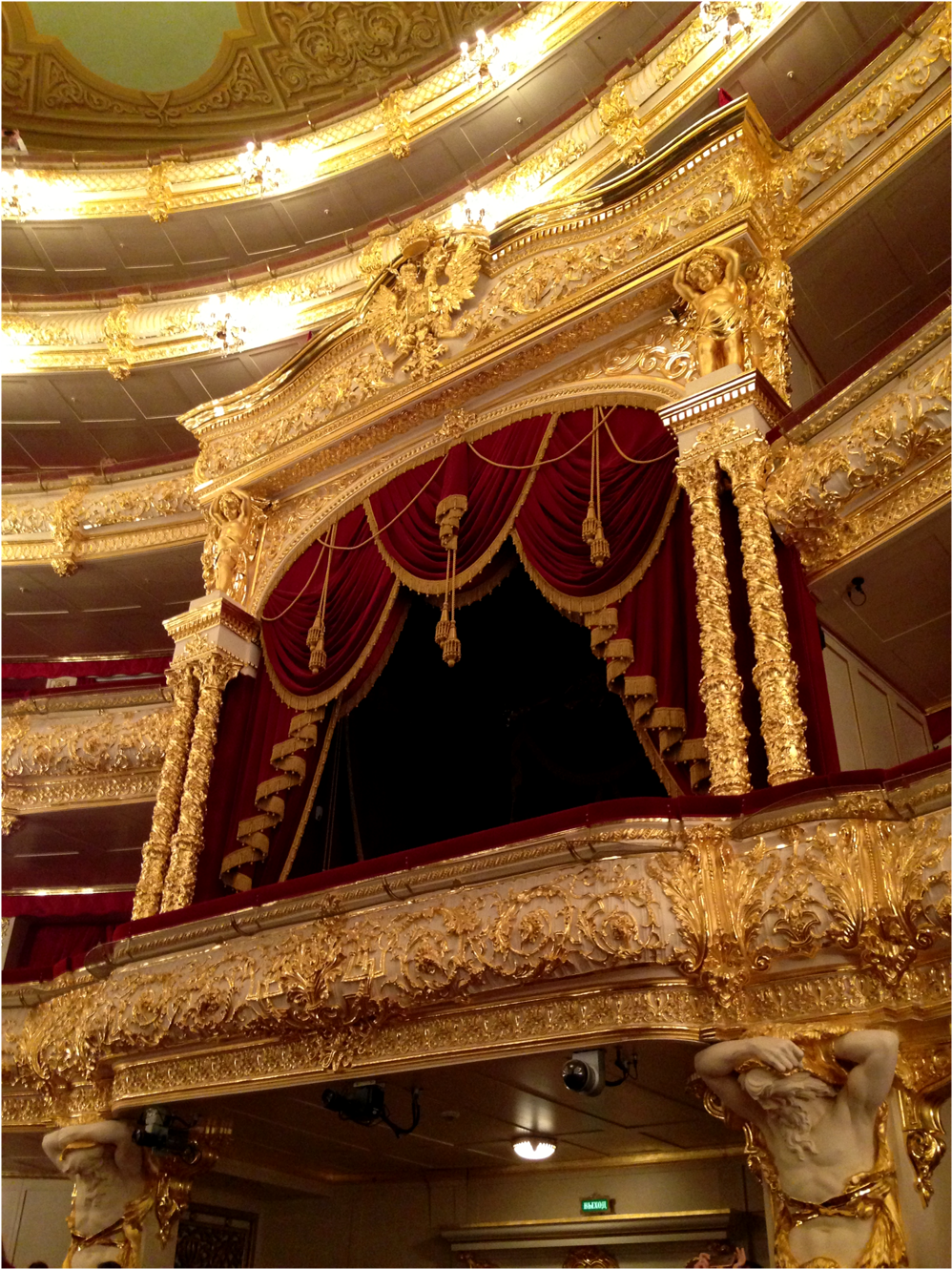
Bolshoi Theatre Central Balcony Moscow - Photo G-Paz-y-Mino-C 2016

Above: Bolshoi Theatre Central Balcony, Moscow.

Beautiful Moscow by night - Photo G-Paz-y-Mino-C 2016

Above: Beautiful Moscow by night.

Diptic MEMORIAL MUSEUM OF COSMONAUTICS Moscow - Photo G-Paz-y-Mino-C 2016

Above: At the MEMORIAL MUSEUM OF COSMONAUTICS, Moscow.

MTEC at MEMORIAL MUSEUM OF COSMONAUTICS Moscow - Photo G-Paz-y-Mino-C 2016

Above: Our book, Measuring the Evolution Controversy, at the MEMORIAL MUSEUM OF COSMONAUTICS, Moscow.

Back View of Lenin's Mausoleum - Photo G-Paz-y-Mino-C 2016

Above: Back view of Lenin’s Mausoleum, Kremlin, Moscow.

Karl Marx Monument Moscow - Photo G-Paz-y-Mino-C 2016

Above: Karl Marx monument in Moscow.

Handcrafted Nature Boxes St Petersburg - Photo G-Paz-y-Mino-C 2016

Above: Handcrafted Nature Boxes, St. Petersburg.

Casual Moscow with Fast Food - Photo G-Paz-y-Mino-C 2016

Above: Casual Moscow… fast-food style.

Kazan Cathedral Moscow - Photo G-Paz-y-Mino-C 2016

Above: Kazan Cathedral, Red Square, Moscow.

MTEC posing before The Senate Kremlin Moscow - Photo G-Paz-y-Mino-C 2016

Above: Our book, Measuring the Evolution Controversy, posing before The Senate, Kremlin Moscow.

STONE FLOWER FOUNTAIN in Moscow - Photo G-Paz-y-Mino-C 2016

Above: STONE FLOWER FOUNTAIN in Moscow.

The Friendship of People Fountain Moscow - Photo G-Paz-y-Mino-C 2016

Above: The Friendship of People Fountain, Moscow.

ARCHITECTURAL DETAIL CENTRAL PAVELION Moscow - Photo G-Paz-y-Mino-C 2016

Above: Architectural detail, Central Pavilion, Moscow.

Kazan Cathedral St Petersburg - Photo G-Paz-y-Mino-C 2016

Above: Kazan Cathedral in St. Petersburg.

Church of the Savior on Spilled Blood St Petersburg - Photo G-Paz-y-Mino-C 2016

Above: Church of the Savior on Spilled Blood, St. Petersburg.

Church of the Savior on Spilled Blood St Petersburg CLOSE UP - Photo G-Paz-y-Mino-C 2016

Above: Close up of Church of the Savior on Spilled Blood, St. Petersburg.

B&W Church on The Spilled Blood St Petersburg - Photo G-Paz-y-Mino-C 2016

Above: Church on The Spilled Blood, St. Petersburg. The church is so colorful that even in B&W the viewer can imagine the colors.

Close up Hermitage Museum St Petersburg - Photo G-Paz-y-Mino-C 2016

Above: Close up of The Hermitage Museum, St. Petersburg.

The Royal Throne Hermitage Museum St Petersburg - Photo G-Paz-y-Mino-C 2016

Above: The Royal Throne at The Hermitage Museum, St. Petersburg.

Wooden Floor Winter Palace Hermitage Museum St Petersburg - Photo G-Paz-y-Mino-C 2016

Above: Wooden Floor at The Winter Palace, The Hermitage Museum, St. Petersburg.

RUSSIAN ACADEMY OF SCIENCES St Petersburg - Photo G-Paz-y-Mino-C 2016

Above: The old building of the Russian Academy of Sciences in St. Petersburg.

Main Entrance Summer Palace St Petersburg - Photo G-Paz-y-Mino-C 2016

Above: Main Entrance to The Summer Palace, St. Petersburg.

Meet me at the bridge St Petersburg - Photo G-Paz-y-Mino-C 2016

Above: Meet me at the bridge, St. Petersburg.

The last red phone St Petersburg - Photo G-Paz-y-Mino-C 2016

Above: The last red phone, St. Petersburg.

Dormition Cathedral Vladimir - Photo G-Paz-y-Mino-C 2016

Above: Dormition Cathedral in Vladimir, Russia.

Matryoshkas from the 1920s Trinity Church Vladimir - Photo G-Paz-y-Mino-C 2016

Above: Matryoshkas from the 1920s, Trinity Church, Vladimir, Russia. In the old(er) days, the dolls were of pale colors, which changed over the years to a more colorful design.

A Fowl Trinity Church Vladimir - Photo G-Paz-y-Mino-C 2016

Above: A Fowl at the Trinity Church in Vladimir, Russia.

Lenin Stalin Trinity Church Vladimir Russia - Photo G-Paz-y-Mino-C 2016

Above: Lenin and Stalin on glass, Trinity Church, Vladimir, Russia.

Town of Suzdal Russia - Photo G-Paz-y-Mino-C 2016

Above: Town of Suzdal, Russia.

B&W House in Suzdal Russia - Photo G-Paz-y-Mino-C 2016

Above: Traditional old-house in the town of Suzdal, Russia.

Colorful Russia Suzdal - Photo G-Paz-y-Mino-C 2016

Above: Colorful Russia, the town of Suzdal.

Saint Euthymius Monastery Russia - Photo G-Paz-y-Mino-C 2016

Above: Saint Euthymius Monastery, Suzdal, Russia.

Detail of ceiling at Trinity Church Vladimir - Photo G-Paz-y-Mino-C 2016

Above: Detail of ceiling at Trinity Church in Vladimir, Russia.

The Former KGB - Photo G-Paz-y-Mino-C 2016

Above: The Former KGB building in Moscow.

Water reflection Convent Bogolyubovo Vladimir region Russia - Photo G-Paz-y-Mino-C 2016

Above: Water reflection of Convent Bogolyubovo in the Vladimir region, Russia.

Old Village Suzdal Russia - Photo G-Paz-y-Mino-C 2016

Above: Old Village in the town of Suzdal, Russia.

More of the Saint Euthymius Monastery Russia - Photo G-Paz-y-Mino-C 2016

Above: Saint Euthymius Monastery, Suzdal, Russia.

Golden Gate Vladimir Russia - Photo G-Paz-y-Mino-C 2016

Above: Golden Gate, Vladimir, Russia.

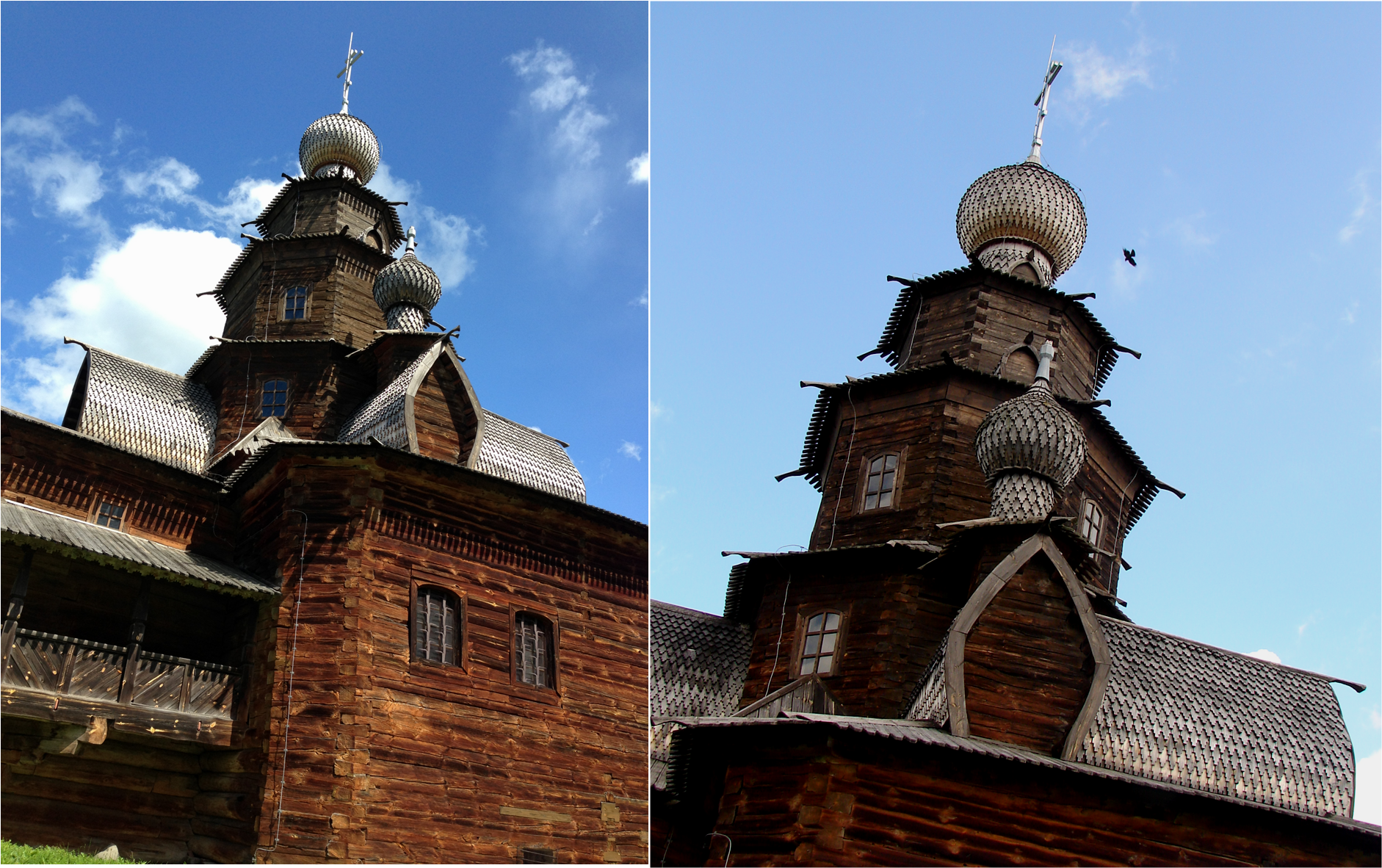
Church of The Transfiguration Russia - Photo G-Paz-y-Mino-C 2016

Above: Church of The Transfiguration, Suzdal, Russia.

Church of The Transfiguration Russia Close Ups - Photo G-Paz-y-Mino-C 2016

Above: The Church of The Transfiguration is completely built on wood, Suzdal, Russia.

Convent Bogolyubovo Vladimir region Russia - Photo G-Paz-y-Mino-C 2016

Above: Convent Bogolyubovo, Vladimir region, Russia.

Matryoshkas in color St Petersburg - Photo G-Paz-y-Mino-C 2016

Above: Matryoshkas in color, St. Petersburg.

MTEC inside the Russian State Library - Photo G-Paz-y-Mino-C 2016

Above: Our book, Measuring the Evolution Controversy, enjoying a visit to one of the reading rooms at the Russian State Library in Moscow.

You can contact Guillermo Paz-y-Miño-C via email at guillermo.pazyminoc@gmail.com — Follow us on Twitter @gpazymino and Facebook.

Suggested Readings

Kin Recognition or Kin Discrimination in Single-Celled Organisms – Protists

Symposium Kin-Discrimination in Protists just featured on JEUK

Protisto-Biologists Flock to Seville for ECOP-ISOP Scientific Meeting

Anna Karenina by Leo Tolstoy full text

*  *  *  *  *     *  *  *  *  *     *  *  *  *  *

D - Headline Book Measuring the Evolution Controversy 2016

Paz-y-Miño-C, G & Espinosa, A. 2016. Measuring the Evolution Controversy: A Numerical Analysis of Acceptance of Evolution at America’s Colleges and Universities. Cambridge Scholars Publishing, Newcastle, United Kingdom. ISBN (10): 1-4438-9042-1, ISBN (13): 978-1-4438-9042-7.

BOOK small format - Measuring the Evolution Controversy 2016Measuring the Evolution Controversy can be ordered directly from Cambridge Scholars Publishing, Amazon US, or Amazon CA . The publisher has made available a “VIEW EXTRACT” (in PDF), which includes the first 30-pages of the book: Cover, Table of Contents, Acknowledgments, Preface, Chapter ONE and the beginning of Chapter TWO. For PDF of color illustrations go to Image Resources of Didactic Relevance.

“The great contribution of ‘Measuring the Evolution Controversy’ is the rich content of data and analysis that asks detailed questions about the social, economic and political backgrounds of those who tend to reject evolution vs. those who accept evolution as science. Paz-y-Miño-C and Espinosa deftly analyze their data drawn from institutions of higher learning in the United States and particularly New England —which stands as a microcosm of the rest of the country, and indeed elsewhere in the world. It is their scientific approach to these issues which makes this book stand out as a uniquely original contribution.” — Niles Eldredge, PhD, Curator Emeritus of Paleontology at The American Museum of Natural History, New York.

“Pro-science activists and educators constantly bemoan the resistance to the teaching of evolution in the United States. All of us have anecdotes about encounters with the public, parents and students who are misinformed by their churches, Religious-Right groups, and creationist organizations. Paz-y-Miño-C and Espinosa present hard data that support the anecdotal evidence. They also show that although anti-evolutionism typically begins with religion, it is a multi-faceted problem that intersects with political and cultural ideologies. Gathered through careful research over a period of years, their data will enable scientists and defenders of science education to comprehend the roots of the evolution controversy and counteract resistance to evolution more strategically and effectively.”Barbara Forrest, PhD, co-author with Paul R. Gross of Creationism’s Trojan Horse: The Wedge of Intelligent Design (2007), and expert witness for plaintiffs, Kitzmiller et al. v. Dover Area School District (2005).

Measuring the Evolution Controversy — 2016 book

A Numerical Analysis of Acceptance of Evolution at America’s Colleges and Universities – Cambridge Scholars Publishing UK

Small-Cover Book Measuring Evolution Controversy Paz-y-Mino-C & Espinosa 2016

“The reality of evolution is indisputable and, based on current scientific evidence, all people in the world should accept it. Yet, only 41% of adults worldwide embrace evolution, and they do it under the premise that a deity created humans. One in every three people are strict creationists who believe in religious scriptures concerning the origin of our universe and of humans, and explicitly reject that Homo sapiens is an ape —when, in fact, science informs us that humans’ closest relatives are chimpanzees, bonobos, gorillas and orangutans. Indeed, we are all apes.”

Our new book is out. It includes 210-pages, more than 100 data figures, maps, tables and explanatory boxes. In addition, a color-page centerfold (“Image Resources of Didactic Relevance“) is also provided. Below, I summarize information shared by the Publisher, Cambridge Scholars Publishing – United Kingdom, including endorsements, book description, table of contents, exemplar figures (from the centerfold) and text excerpts (Preface). Hope the readers enjoy it! – GPC

Endorsements

Many thanks to Niles Eldredge and Barbara Forrest for their kind statements about the book:

“The great contribution of ‘Measuring the Evolution Controversy’ is the rich content of data and analysis that asks detailed questions about the social, economic and political backgrounds of those who tend to reject evolution vs. those who accept evolution as science. Paz-y-Miño-C and Espinosa deftly analyze their data drawn from institutions of higher learning in the United States and particularly New England —which stands as a microcosm of the rest of the country, and indeed elsewhere in the world. It is their scientific approach to these issues which makes this book stand out as a uniquely original contribution.” — Niles Eldredge, PhD, Curator Emeritus of Paleontology at The American Museum of Natural History, New York.

“Pro-science activists and educators constantly bemoan the resistance to the teaching of evolution in the United States. All of us have anecdotes about encounters with the public, parents and students who are misinformed by their churches, Religious-Right groups, and creationist organizations. Paz-y-Miño-C and Espinosa present hard data that support the anecdotal evidence. They also show that although anti-evolutionism typically begins with religion, it is a multi-faceted problem that intersects with political and cultural ideologies. Gathered through careful research over a period of years, their data will enable scientists and defenders of science education to comprehend the roots of the evolution controversy and counteract resistance to evolution more strategically and effectively.”Barbara Forrest, PhD, co-author with Paul R. Gross of Creationism’s Trojan Horse: The Wedge of Intelligent Design (2007), and expert witness for plaintiffs, Kitzmiller et al. v. Dover Area School District (2005).

D - Headline Book Measuring the Evolution Controversy 2016

Why do people not accept evolution?

“In Measuring the Evolution Controversy, Guillermo Paz-y-Miño-C and Avelina Espinosa postulate that the debate over evolution-and-science versus creationism is inherent to the incompatibility between scientific rationalism/empiricism and the belief in supernatural causation (religion and faith). Belief disrupts, distorts, delays or stops the comprehension and acceptance of scientific evidence. The authors refer to this proposal as the incompatibility hypothesis (IH), the conceptual foundation of this book.”

Cover Book Measuring Evolution Controversy Paz-y-Mino-C & Espinosa 2016“Paz-y-Miño-C and Espinosa explain that the evolution controversy is not only measurable, descriptively, but also testable as in an ordinary field of science. To accomplish this, they examine three predictions of IH. First, chronological-conflict-and-accommodation (i.e. the historical re-emergence of antagonism between evolution and religion when advances in science continue to threaten the belief in supernatural causation; in such situations, creationists’ rejection of and subsequent partial acceptance of the new scientific discoveries are expected). Second, change in evolution’s acceptance as function of educational attainment (i.e. the positive association between acceptance of evolution and level of education). Third, change in evolution’s acceptance as function of religiosity (i.e. the negative association between acceptance of evolution and level of religious beliefs). By relying on an ample assessment of the attitudes toward evolution by highly-educated audiences (i.e. research faculty, educators of prospective teachers, and college students in the United States) the authors characterize their understanding of science and evolution, personal religious convictions, and political ideology.”

“The authors make recommendations for improving science and evolution literacy, as well as evolution’s acceptance. They end the book by forecasting a probable world-socio-cultural landscape in which acceptance of science and evolution will take place.”

TABLE OF CONTENTS

Acknowledgements

Preface

Chapter One – Why Do People Not Accept Evolution?

Chapter Two – The Incompatibility Hypothesis: Evolution vs. Supernatural Causation

Chapter Three – A Conceptual Landscape to Depict Acceptance of Evolution

Chapter Four – Educators of Prospective Teachers Hesitate to Embrace Evolution: A National Sample in the United States

Chapter Five – Influence of Political Ideology on Acceptance of Evolution

Chapter Six – Comparisons: Researchers vs. Educators vs. College Students

Chapter Seven – Comparisons: Students at Public vs. Private vs. Religious Institutions

Chapter Eight – Recommendations and the Future of Evolution’s Acceptance: The U.S.

Chapter Nine – Evolution and the Upcoming Challenges of a Predictable Landscape

Appendix A – Survey Methods

Appendix B – Supplementary Figures to Chapter Four

Authors’ Bionotes

Exemplar Images

Fig 5 Centerfold Measuring Evolution Controversy Paz-y-Mino-C & Espinosa 2016

Above: Acceptance of evolution or creationism among educators of prospective teachers in the United States. The majority of educators accept evolution openly; creationism is accepted openly mainly in the South and West of the country.

Fig 3 Centerfold Measuring Evolution Controversy Paz-y-Mino-C & Espinosa 2016

Above: Science and evolution knowledge have a negative association with religiosity; both decline with increasing religious beliefs, as documented for the New England researchers, educators of prospective teachers in the U.S., and New England college students (a-b). Note how evolution knowledge increases with increasing science knowledge in the three groups (c), a positive association of variables.

Fig 4 Centerfold Measuring Evolution Controversy Paz-y-Mino-C & Espinosa 2016

Above: Science and evolution knowledge among the non-religious (top; religiosity index = 0.0) and the deeply religious (bottom; religiosity index = 3.0). The non-religious New England researchers, educators of prospective teachers in the U.S., and New England college students score highest in science/evolution knowledge: values ranging from 2.59 (high) to 1.67 (low). In contrast, the deeply religious, score lowest in science/evolution knowledge: values ranging from 2.0 (high) to 1.35 (low).

Excerpts from the Preface

“In Chapters One to Three, we introduce the reader to the conceptual premises to studying the evolution controversy as a scientific field of investigation. In Chapters Four and Five, we examine acceptance of evolution in our case-study population of educators of prospective teachers in the U.S.; we explore their overall understanding of science/evolution, and the effects of distinctive levels of religiosity on their views about science and evolution. We also discuss the influence of political ideology and conservative thinking on these educators’ perceptions of evolution.”

“In Chapter Six, we compare acceptance of evolution among New England researchers (affiliated with some of the elite universities in the U.S.) vs. the educators of prospective teachers in the U.S., and vs. our samples of New England college students. In Chapter Seven, we contrast views about science/evolution among college students at public vs. private vs. religious institutions. And, in Chapter Eight, we provide recommendations for improving science and evolution literacy, as well as evolution’s acceptance, by each of these populations. We close, in Chapter Nine, with a forecast of a probable world-socio-cultural landscape in which acceptance of science and evolution will take place in the future.”

The Future of Evolution’s Acceptance

“Because the U.S. is projected to become slightly less religious and more unaffiliated by 2050 (primarily due to faith switching and secularization of the “nones” –non-believers, agnostics and atheists), we speculate that acceptance of evolution in this nation will increase during the next four decades. However, America’s fascination with reinventing variants of creationism (e.g. theistic evolution, creation science, young earth creationism, Intelligent Design, BioLogos, evolutionary creation) to challenge evolution, or insert a Creator or Designer in the background of causality (distant creationism), shall probably continue in the future, although in an improved, more-favorable-to-evolution landscape. A forecast that we make with cautious optimism.”

United States Measuring Evolution Controversy Paz-y-Mino-C & Espinosa 2016

Above: The U.S. will experience substantial population growth during the next forty years, from 310.4 million, in 2010, to 394.4 million by 2050 (a 21.3% increase). The current Christian majority will decrease by 2050 (from 77.4% to 65.8%) and the unaffiliated will increase during the same time period (from 17.1% to 25.6%). The fertility rates (2010 – 2015) will continue to be higher among the religious vs. the unaffiliated (Muslims 2.7, Christians 2.1, Hindus 2.1, Buddhists 2.1, Jews 2.0, and unaffiliated 1.6). The U.S. shall become less religious primarily due to the rise of the unaffiliated. Thus, public acceptance of evolution —excluding humans— will increase in the U.S. above its current ≈40%.

Measuring the Evolution Controversy can be ordered directly from Cambridge Scholars Publishing, Amazon US, or Amazon CA . The publisher has made available a “VIEW EXTRACT” (in PDF), which includes the first 30-pages of the book: Cover, Table of Contents, Acknowledgments, Preface, Chapter ONE and the beginning of Chapter TWO. For PDF of color illustrations go to Image Resources of Didactic Relevance. — GPC — EvoLiteracy 2016.

How to cite the book:

Paz-y-Miño-C, G & Espinosa, A. 2016. Measuring the Evolution Controversy: A Numerical Analysis of Acceptance of Evolution at America’s Colleges and Universities. Cambridge Scholars Publishing, Newcastle, United Kingdom. ISBN (10): 1-4438-9042-1, ISBN (13): 978-1-4438-9042-7.

You can contact Guillermo Paz-y-Miño-C via email at guillermo.pazyminoc@gmail.com — Follow us on Twitter @gpazymino and Facebook.

Suggested Readings and Related Links

The Incompatibility Hypothesis: Evolution vs. Supernatural Causation

Evolution Stands Faith Up: Reflections on Evolution’s Wars

Darwin’s Skepticism about God

Evolution Wars: Debunk II

*  *  *  *  *     *  *  *  *  *     *  *  *  *  *

Evolution Stands Faith Up: Reflections on Evolution’s Wars (2013). By NOVA Publishers, New York Soft Cover. Find it at Barnes & Noble, Amazon.comAmazon UK.

Paz-y-Mino-C_Book_Cover_Evolution_Stands_Faith_Up_JPEG“The sweet spot of this collection of essays is the interface of science, history and literacy. Paz-y-Miño-C is, in essence, a champion of rationalism and a passionate defender of literacy standards. His essays deftly weave hard survey data and memorable turns of phrase with evocative imagery… While the essays in this collection are vast in coverage —from climate change to energy policy, stem cell research, vaccinations and, especially, evolution— a clear underlying theme emerges: [the author’s] goal is no less than to counter, through the lens of history and the majesty of rationalism, social forces that sanction ignorance, celebrate denial and… continue to diminish our global status in the fields of science and technology.” Jeff Podos, PhD, Professor of Biology, University of Massachusetts Amherst, USA.

“Paz-y-Miño-C  is a firm believer in evolutionary processes. He would like to see decisions made on the basis of facts, not unsupported opinion. He abhors and fears irrational thinking, especially ‘the views of those who see evil in truth and menace in the realities discovered by science.’ He marvels at the intricacy and diversity of life, and how it came about through natural selection… and is clearly frustrated by the unwillingness of so many to see the beauty and majesty in this view of the world and all that it explains.” – Jan A. Pechenik, PhD, Professor of Biology, Tufts University, USA, author of The Readable Darwin: The Origin of Species, as Edited for Modern Readers.

Another Blow Against Intelligent Design ID – Design Creationism

EvoLiteracy News 03 16 2016

The late Intelligent Design, or Design Creationism, continues to decompose. Indeed, pseudo-science has never been able to withstand the power of science. And the story below is quite compelling, not because scientists interested in studying the molecular sophistication of the bacterial flagellum had in mind to further debunk ID. In fact, the researchers (Beeby et al.) did not even mention Design Creationism in their work. But because their study, just published in PNAS, gives US, the people, the opportunity to extrapolate, once more, that there is not a hint of evidence in support to “irreducible complexity” in the anatomy or function of the bacterial flagellum. A reassurance that Design Creationism will forever be wrong. – Guillermo Paz-y-Miño-C

3D model bacterial propeller By Morgan Beeby Imperial College London

Three-dimensional models of bacterial propellers (rotors) in Vibrio (left) and Campylobacter (right). Images by Morgan Beeby Imperial College London (2016). Keep in mind that the rotors are made of proteins (read about it in Stepwise formation of the bacterial flagellar system, PNAS 2007).

Remember the bacterial flagellum? The pet-example of the late Intelligent Design movement? The alleged “case-study” of irreducible complexity? Well, there are more bad news for Design Creationism. A paper on the bacterial flagellum, recently published in the Proceedings of the National Academy of Sciences (PNAS), explores even further the motor (in reality, the flagellum’s rotor) diversity in two species of bacteria (Campylobacter and Vibrio, plus the study makes comparisons to a third species, Salmonella). Unfortunately, the article is not friendly written, and it can be difficult to understand; the science, however, is exquisite.

Before I summarize the study, watch this 22-sec video about the general structure of the bacterial flagellum. It is simple and will help you understand everything else below:

Here, I try to explain the paper by paraphrasing it: Beeby et al. (a total of six coauthors) have found evidence that “bacteria have tuned their swimming abilities [to their surrounding environments] by evolving structural adaptations to their flagellar motors [which are made of proteins], and that [have resulted] in altered torque generation.” [Note that torque is the twisting force that causes rotation of the flagellum]. In essence, “different bacteria show different swimming [styles], [plus different flagellar-motor anatomies], strikingly illustrated by [their] abilities to bore through viscous fluids (for example, the gastrointestinal mucus) in which other bacteria are [unable to swim].”

Bacterial motors with different torque By Morgan Beeby Imperial College London

There is plenty of evidence of gradually evolved differential complexity among flagellar-motors. Bacterial motors with different torque (Salmonella, Vibrio and Campylobacter). Images by Morgan Beeby Imperial College London (see article in PNAS 2016).

Although the authors say nothing about Intelligent Design in their study, for obvious reasons, i.e. who bothers to allude to a non-scientific proposal (ID) in a serious scientific paper (PNAS). We, the readers, however, can extrapolate from the Beeby et al.’s elegant study that there is NOT a hint of evidence in support to “irreducible complexity” in the form or function of the bacterial flagellum, as proposed by Design Creationists. But rather, there is plenty of evidence of gradually evolved differential complexity among flagellar-motors. This complexity is rooted in ancestry, from absence of the rotor in ancient forms of bacteria, to presence and diversity of rotors in more recent forms of bacteria. That is, “gradual change with modification” (or classical Darwinian evolution), exactly the opposite to the irreducibly-complex flagellum designed by a “Designer of Nature,” the imaginary force of causality invoked by Intelligent Designers. In conclusion, the science story about the bacterial flagellum is, by far, more exciting than the pseudo-science, creationist tale of ID. – Evolution Literacy

Related Story

Intelligent Design and Design Creationism Make it to PLoS ONE

Intelligent Design and Design Creationism Make it to PLoS ONE

EvoLiteracy News 03 03 2016

Breaking – PLoS ONE Retracts Paper by Liu M-J et al.

PLoS ONE retraction of paper

Click on image to be redirected to PLoS ONE decision.

Nature Calls it “Social Selection”

Nature calls it Social Selection

Click on image to be redirected to article in Nature.

The INDEPENDENT “Scientific Paper Sparks Controversy”

The Independent on PLoS ONE human hand Creator Intelligent Design

Click on image to be redirected to the Independent article.

Pocket Watch Hand Media ImagesThe paper by Liu M-J et al. (Biomechanical Characteristics of Hand Coordination in Grasping Activities of Daily Living) must be retracted from PLoS ONE, and its editor, Renzhi Han (Ohio State University Medical Center), dismissed from the journal for carelessness in processing the manuscript, to say the least. Here is why: the authors (apparent sympathizers of Intelligent Design) invoke the “Creator” in the Abstract, Introduction, Discussion, and also in the Comments section of the online version of their article, in which they respond to criticisms by the readers and editors at PLoS. And this is not an error of translation, nor a struggle in the authors’ attempt to explain, in English, the contrast between the evolutionary origin of the mechanic dexterity of the human hand and its alternative, unsupported hypothesis, “DESIGN CREATIONISM” responsible for it. No, the authors, with the blessings of the journal’s editor, insist that a Creator, or Designer, made the hand almost perfect. This is bad science and terrible editing by PLoS ONE. Below, I summarize the case and provide links to the journal and PDF. But keep in mind that PLoS ONE might retract the article, terminate the editor, and the information from the journal website might be removed. In any event, the paper by Liu M-J et al. must go from PLoS ONE to ZERO. – Guillermo Paz-y-Miño-C

The paper by Liu M-J et al. was received by PLoS ONE on October 28, 2015; accepted on December 14, 2015; and published on January 5, 2016. I missed it, but became aware of it by allusions to it in the social media (Retraction Watch alerted it on March 2, 2016).

Citation: Liu M-J, Xiong C-H, Xiong L, Huang X-L (2016) Biomechanical Characteristics of Hand Coordination in Grasping Activities of Daily Living. PLoS ONE 11(1): e0146193. doi:10.1371/journal.pone.0146193.

What is the paper about?

In the authors’ own words “…This study explores a method to identify the proper explanation for the hand architecture of muscular-articular connections from the analysis of behavioral result…”

Liu M-J et al. examine the biomechanics of the human hand; its dexterity and relationships between anatomy and function. The authors aim at conveying the message that any robotic attempt to mimic the ability of the human hand should pay close attention to its anatomy (and physiology), which, according to Liu M-J et al., would lead to best outcomes in robotic-engineering design. So far, so good. But what follows below is unacceptable, and for that reason the paper must be retracted and its editor, Renzhi Han (Ohio State University Medical Center), dismissed from PLoS ONE.

Tasks Performed by Human Hands Liu M-J et al PLoS ONE 2016

A hand wearing an instrumented glove demonstrates diverse types of dexterity (click on image to enlarge). Source Liu M-J et al. PLoS ONE 2016.

This is what the authors state in the ABSTRACT:

Hand coordination can allow humans to have dexterous control with many degrees of freedom to perform various tasks in daily living. An important contributing factor to this important ability is the complex biomechanical architecture of the human hand… It is not understood which biomechanical characteristics are responsible for hand coordination and what specific effect each biomechanical characteristic has. To explore this link, we first inspected the characteristics of hand coordination during daily tasks… from thirty right-handed subjects during a multitude of grasping tasks. Then, the functional link between biomechanical architecture and hand coordination was drawn by establishing the clear corresponding causality between the tendinous connective characteristics of the human hand and the coordinated characteristics during daily grasping activities. The explicit functional link indicates that the biomechanical characteristic of tendinous connective architecture between muscles and articulations is the proper design by the Creator to perform a multitude of daily tasks in a comfortable way. The clear link between the structure and the function of the human hand also suggests that the design of a multifunctional robotic hand should be able to better imitate such basic architecture.”

Thus, Liu M-J et al. invoked “design intervention” to account for complexity.

This is what the authors state in the INTRODUCTION:

The human hand is an amazing instrument that can perform a multitude of functions, such as the power grasp and precision grasp of a vast array of objects. The excellent behaviors of the human hand are enabled by a highly complex structure, with 19 articulations, 31 muscles and more than 25 degrees of freedom (DOF). While the abundant functions are favorable, this complex structure also raises a challenging problem of how the human body controls such a large number of mechanical DOFs with ease and an absence of effort…”

To help readers understand, we can simply call DOF “dexterity,” or the readiness and grace in physical activity, the skill and ease in using the hands.

Liu M-J et al. continue: “…Studies indicate that digits do not move alone in isolation of adjacent digits during functional activity, even when a specific movement requires an individual digit. On the contrary, the movements of multiple digits are correlated, and movement information of the human hand is redundant, so that only a small number of components account for most variances. The human hand adopts coordinated movements to reduce the number of independent DOFs and simplify the complexity of the control problem. Thus, hand coordination affords humans the ability to flexibly and comfortably control the complex structure to perform numerous tasks. Hand coordination should indicate the mystery of the Creator’s invention…”

Once again, Liu M-J et al. invoked a “Creator’s intervention” to account for complexity.

This is what the authors state in the DISCUSSION:

In closing the article, Liu M-J et al. reaffirm: “…the architecture is the biomechanical basis of the dexterous movement that provides the human hand with the amazing ability to perform a multitude of daily tasks in a comfortable way. In conclusion, our study can improve the understanding of the human hand and confirm that the mechanical architecture is the proper design by the Creator for dexterous performance of numerous functions following the evolutionary remodeling of the ancestral hand for millions of years. Moreover, functional explanations for the mechanical architecture of the muscular-articular connection of the human hand can also aid in developing multifunctional robotic hands by designing them with similar basic architecture.”

Now, this is what Liu M-J et al. and the Academic Editor, Renzhi Han, do not understand about alleged “design” in nature or “design creationism:”

The doctrine of Intelligent Design (ID), or Design Creationism, born in the 1980s, proposes that a Designer is responsible, ultimately, for the assemblage of complexity in biological systems; according to ID, evolution cannot explain holistically the origin of the natural world, nor the emergence of intricate molecular pathways essential to life, nor the immense phylogenetic differentiation of life, and instead ID proposes an intelligent agent as the ultimate cause of nature. In conceptually mistaken, type-I-error-based arguments to discredit evolution, ID has attributed randomness to molecular change, deleterious nature to single-gene mutations, insufficient geological time or population size for molecular improvements to occur, and invoked “design intervention” to account for complexity in molecular structures and biological processes. In 2005, ID was exposed in court (Dover, Pennsylvania, Kitzmiller et al. versus Dover School District et al. 2005) for violating the rules of science by “invoking and permitting supernatural causation” in matters of evolution, and for “failing to gain acceptance in the scientific community” (excerpt from Paz-y-Miño-C and Espinosa 2013, 2014).

And this is what Liu M-J et al. and the Academic Editor at PLoS have done: invoke and permit supernatural causation in matters of evolution.

Notification from PLOS Staff

Yesterday, March 2, 2016, the very journal PLoS ONE posted the following notification on its website (Comments section of article):

“… A number of readers have concerns about sentences in the article that make references to a ‘Creator’. The PLOS ONE editors apologize that this language was not addressed internally or by the Academic Editor during the evaluation of the manuscript. We are looking into the concerns raised about the article with priority and will take steps to correct the published record.”

But the reaction from PLOS just happened, after two months of the paper being on air. Look at this exchange between one of the readers of PLoS ONE and the first author of the paper, Mr. Liu M-J.

On February 15, 2016, Jason Friedman posted on the Comments section of PLoS ONE the following:

In the abstract (and similarly later in the paper) it is claimed: The explicit functional link indicates that the biomechanical characteristic of tendinous connective architecture between muscles and articulations is the proper design ‘by the Creator’ to perform a multitude of daily tasks in a comfortable way. I am interested to hear from the authors why one should come to this conclusion? I could not find any support for this claim in the article, and it seems out of place in this article…”

Mr. Liu M-J responded also on February 15, 2016:

Thanks for your comments. As we know, human hand is an amazing instrument that can perform a multitude of functions, such as the power grasp and precision grasp of a vast array of objects, with ease and an absence of effort. Although expended great attempts by scientists and engineers, there is no artificial hand matching the amazing capacity of human hand. The origins of human hand remain unclear. It is too miraculous to let us think that human hand is the masterwork of Creator and indicates the mystery of nature. The further discussion about the Creator is indeed out of place in our article…”

In addition, today, March 3, 2016, Mr. Liu M-J, posted this note at PLoS Comments:

We are sorry for drawing the debates about creationism. Our study has no relationship with creationism. English is not our native language. Our understanding of the word Creator was not actually as a native English speaker expected. Now we realized that we had misunderstood the word Creator. What we would like to express is that the biomechanical characteristic of tendious connective architecture between muscles and articulations is a proper design by the NATURE (result of evolution) to perform a multitude of daily grasping tasks. We will change the Creator to nature in the revised manuscript. We apologize for any troubles may have caused by this misunderstanding.”

A bit late, the analogy NATURE = Creator is not new among spiritualists (or even religions), the problem is that it was used in a scientific paper by professionals in a scientific field. And the Academic Editor at PLoS allowed it a complete ride up to publication. And that is the issue we are discussing. And the authors, and editor, must know that a “Creator” (unequivocally invoked three times in the paper and once in the Comments) has no place in Science.

What should PLOS and PLoS ONE do?

It is evident that neither the authors, nor the Academic Editor, understand how evolution via natural selection works. Worse, none is aware of the fallacies intrinsic to Intelligent Design, or Design Creationism. Here a common-knowledge principle applies “not knowing the law does not exempt anyone from having the law being applied to everyone.” What law? At least one and two bylaws: natural selection (which explains the origin and evolution of the human hand), plus the bylaws of publication of articles in scientific journals (i.e. substantiation by evidence, not by the whim of the authors or editors, and sound editorial process). [For accuracy, be aware that natural selection is not a “law,” I am using it here as an unavoidable mechanism that helps us explain much of the evolutionary processes; selection imposes restrictions on randomness and helps us dismiss, quite easily, the fallacy of “design creationism”]. What should be done now that we, the people, caught this “error” at PLoS, after two months since publication?

The allusions to the Creator or Designer by Liu M-J et al. are out of place, but they do invoke and permit supernatural causation in matters of evolution. Unfortunately, there is no evidence of a problem in translation, from the authors’ native language into English. In fact, the authors insist in the Abstract, Introduction, Discussion, and in the Comments section of their article that they do give credit, in a scientific publication, to the long-time debunked hypothesis of Intelligent Design, Design Creationism. The paper must be retracted from PLoS ONE, the Academic Editor, Renzhi Han (Ohio State University Medical Center), must be dismissed from PLOS, and the journal must assure the scientific community that the Public Library of Science (PLoS) will never, ever embrace design creationism in its publications. The paper by Liu M-J et al. must go from PLoS ONE to ZERO. — Evolution Literacy

On March 4, 2016, PLoS ONE officially retracted the paper:

Retraction by PLoS ONE 03 04 2016

Click on image to be redirected to PLoS ONE retraction announcement.

Suggested Reading

A Comprehensive Survey of Retracted Articles from the Scholarly Literature

Related Stories

Darwin’s Skepticism about God

Evolution Wars Debunk II

Why the Notion that “The Theory of Evolution is Not an Explanation for the Origin of Life” is Wrong

Evolution Stands Faith Up – On Francis Collins’ and Karl Giberson’s “The Language of Science and Faith”

World Visitors to EvoLiteracy

EvoLiteracy News 02 17 2016

World Visitors to EVOLUTION LITERACY – Readers from 103 countries visited EvoLiteracy during 2015. Three in every four readers were from the United States. About one in every five visitors were from Brazil, Canada, UK, Germany, India, Ecuador, France, Australia and Spain. And one in every ten cyberworms came from 93 other countries. EvoLiteracy is growing thanks to our world friends and followers. – Guillermo Paz-y-Miño-C.

UPDATE – a supplementary post to this one is available at EvoLiteray January 1, 2017.

World Visitors to Evolution Literacy 2015

There are 190+ countries in the world (member states of the United Nations). EvoLiteracy reaches half of them (52%). The image below includes flags of nations, which total 230+. We still need to reach as many nations as possible. Please share EvoLiteracy with others.

Flags of the World

Flags of 230+ nations in the world. Click on image to enlarge. Source Danilka’s Blog.

Top 25 Most Read Posts of 2015

Here are the most popular postings of 2015. I was glad to discover that the biology science videos made much of an impact, particularly among science educators. I also liked that three crucial postings about higher education (marked with an asterisk * below) were well received. To my surprise (and I thank the readers for liking it), the posting about Ecuador’s Academy of Science was ranked top 10. My personal favorite was Science Challenges Golden Age of Violin Making, and this is because I am fascinated with string instruments (classic guitars, ukuleles, charangos); I learned much while investigating the violin ancestry. But I cannot close without admitting how much pleasure gave me to see our readers liking Evolution Wars Debunk II (ranked 13th, a lucky number). Plus the most commented story was Shroud of Turin, Poor Science, and the Persistence of a Myth, which was reposted in various blogs and generated two weeks of discussions. Thanks to all for supporting EvoLiteracy. – GPC
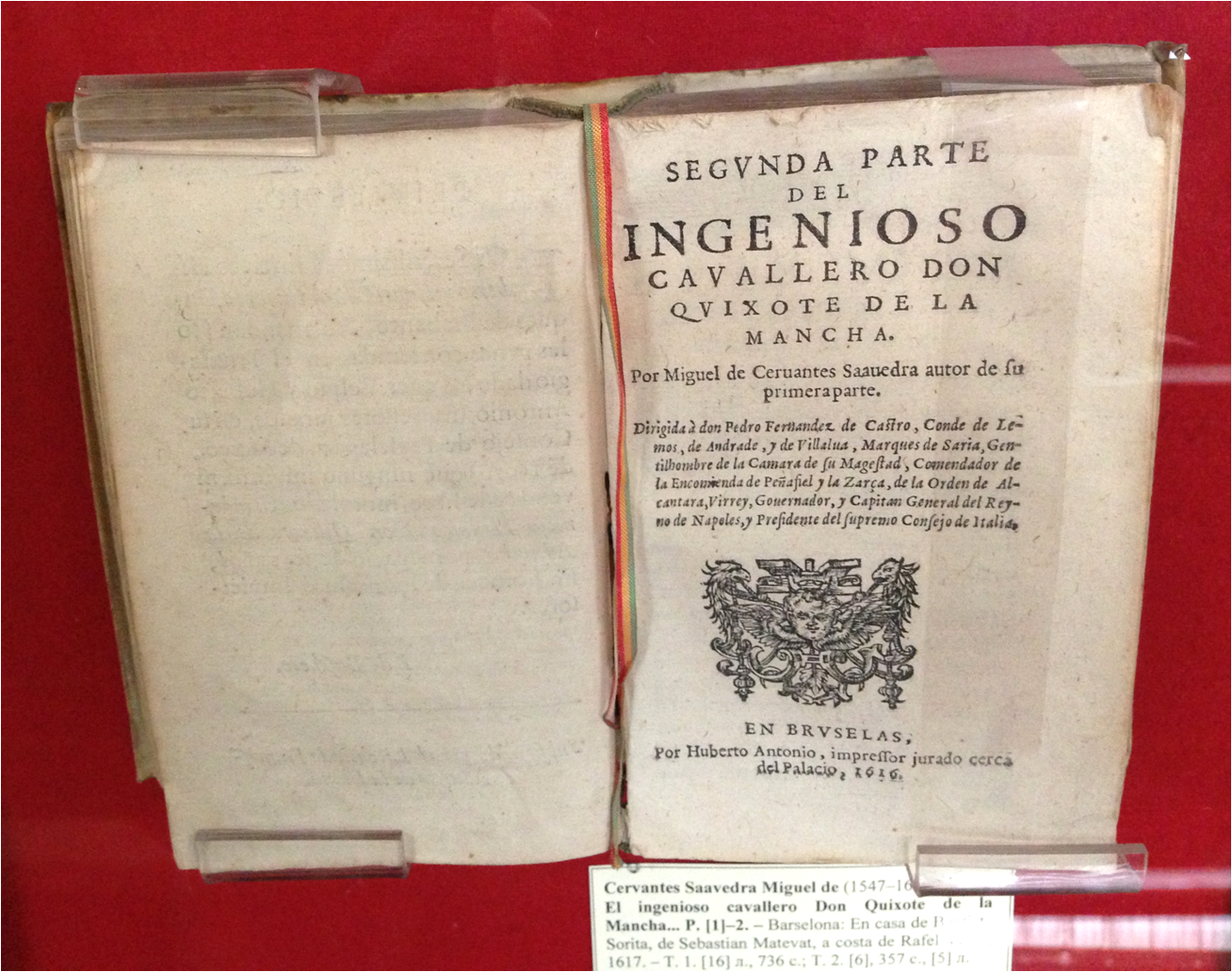
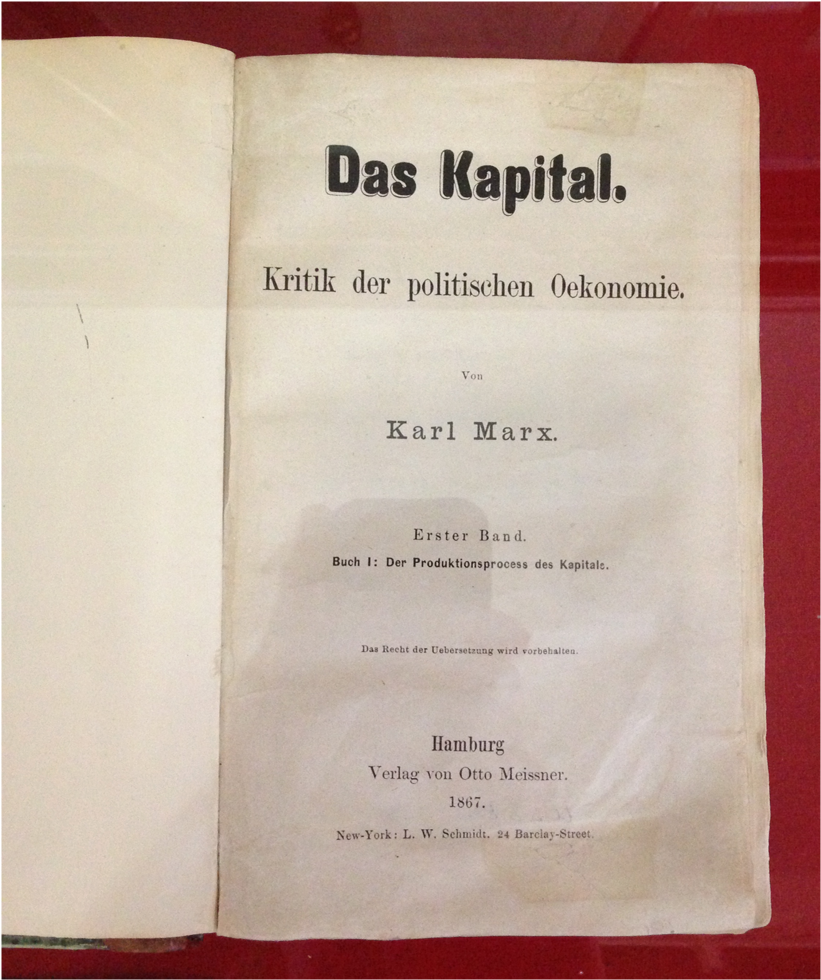
EvoLiteracy – Biology and Science Videos

Photography – Wildlife – Fossils – Landscapes – Museums – Monuments – Cities

GPC Scientific Publications

Evolution Controversy and the Incompatibility of Science and Religion

5 GPC BioArt

EvoLiteracy News 10 26 2015 Shroud of Turin, Poor Science, and the Persistence of a Myth

A Secular Humanist’s Plea for Dzhokhar Tsarnaev’s Life

2015 Nobel Prize in Chemistry Goes to Curiosity-Based Research

Antivaxxers and the Educated-Public-Herd Effect

10 Ecuador’s Academy of Sciences Earns International Recognition

11 Science Challenges Golden Age of Violin Making

12 The “Jackprot Simulation”

13 Evolution Wars: Debunk II

14 EvoLiteracy News 05 08 2015 Should scientific journals request authors to change their practices for presenting continuous data in small sample size studies?

15 The Incompatibility Hypothesis: Evolution vs Supernatural Causation

16 At The Down House: Darwin’s Home

17 The Art Of Nature: Sculptures Of Dinosaur Tracks and Traces

18 College Educated But Deeply In Debt For An Overpriced Degree *

19 New Book: Why does Evolution Matter? The Importance of Understanding Evolution

20 Imminent Collapse of Basic Science Under For-profit Model *

21 Dehumanizing Academia by Dismantling the Humanities *

22 EvoLiteracy News 03 19 2015 US Senator Ted Cruz Distorts NASA’s Mission Budget

23 Hiking among Trilobites, Ancient Whales and Dinosaurs

24 EvoLiteracy News 09 09 2015 Protisto-Biologists Flock to Seville for ECOP-ISOP Scientific Meeting

25 Reviews of Book Evolution Stands Faith Up – Reflections on Evolution’s War

Today: International Darwin Day 02 12 2016

EvoLiteracy News 02 12 2016

“Darwin Day… signifies the celebration of the achievements of reason, science, and the advancement of human knowledge. The igniting moments in human history when light was brought into our own origins, when understanding that ordinary apes, like Homo, were capable of the extraordinary, of discovering the truth and debunking obscurantism; yet we still struggle to make science the sole guiding star in our survival decisions, the reliable source of concern and joy, the toolkit to plan our departure from Earth –before our Sun in agonizing heat engulfs its nearest orbiting planets– and seek home somewhere else in the cosmos”Guillermo Paz-y-Miño-C

A few images and Evolution-Literacy links to celebrate International Darwin Day. — An update on our New England Science Public Series Evolution Volumes 1 and 2, including open access to the studies on acceptance of evolution in the United States. — Links to our Incompatibility Hypothesis papers (evolution versus supernatural causation). — A recount of a visit to the Down House (Darwin’s home). — And an article, from 2013, about the “history of Darwin Day” at the US Congress. Enjoy. – GPC

Here are some photos of Darwin’s statue at the British Museum of Natural History in London, taken back in 2010.

A - Darwin British Museum Nat Hist - Photo G-Paz-y-Mino-C 2010

Above: an overall view of Darwin’s statue (marble) at the British Museum of Natural History in London.

B - Darwin British Museum Nat Hist - Photo G-Paz-y-Mino-C 2010

Above: a close up of Darwin’s rostrum.

C - Darwin British Museum Nat Hist - Photo G-Paz-y-Mino-C 2010

Above: and another close up of this beautiful carving on marble.

E - Darwin British Museum Nat Hist - Photo G-Paz-y-Mino-C 2010

Above: the main hall at the British Museum of Natural History in London. Darwin’s statue is in the back, just at the end of the first level of the stairs.

F - British Museum Nat Hist - Photo G-Paz-y-Mino-C 2010

Above: the outdoors of the British Museum of Natural History in London.

Paz-y-Mino-C_Book_Cover_Evolution_Stands_Faith_Up_JPEGNOVA Publishers (New York) used one of these images for the cover of our book Evolution Stands Faith Up: Reflections on Evolution’s Wars (2013). “Paz-y-Miño-C doesn’t ask the reader to ‘believe’ in evolution. He provides overwhelming evidence, clearly written, that shows how scientific inquiry leads to important and practical results, while superstition and faith lead nowhere. Although we may not be able to reason someone out of what they were never reasoned into, the author presents a roadmap for those whose minds are open to discover the wonders and beauty of science.” – Herb Silverman, PhD, author of Candidate Without a Prayer: An Autobiography of a Jewish Atheist in the Bible Belt. Find Evolution Stands Faith Up at NOVA: Soft Cover, Barnes & Noble, Amazon.comAmazon UK.

Update on NESP Series Evolution

The open access New England Science Public Series Evolution continues to be highly downloaded. Here are some updates:

NESP Series Evolution Vol 1 No 1 20131,670+ downloads of Volume 1, Number 1: Paz-y-Miño-C G & Espinosa A. 2013. Attitudes toward Evolution at New England Colleges and Universities, United States. New England Science Public: Series Evolution 1(1): 1-32 (ISSN: 2326-0971). The authors compile the most significant results of their conceptual and quantitative studies on the patterns of acceptance of evolution at New England colleges and universities, conducted between 2009 and 2012. They examine the views of New England Faculty and Educators of Prospective Teachers (higher-education faculty themselves, specialized in training future teachers) from 35 colleges and universities, as well as a representative sample of College Students from a Public, Private and two Religious institutions who were polled in three areas: the controversy over evolution versus creationism versus Intelligent Design; their understanding of how science and the evolutionary process work; and their personal convictions concerning the evolution and/or creation of humans in the context of their religiosity… Read MORE open access.

NESP Series Evolution Vol 2 No 1 2014430+ downloads of Volume 2, Number 1: Paz-y-Miño-C G & Espinosa A. 2014. Acceptance of Evolution by America’s Educators of Prospective Teachers. New England Science Public: Series Evolution 2(1): 1-92 (ISSN: 2326-0971). In NESP Series Evolution Vol 2 No 1, Paz-y-Miño-C and Espinosa use the conceptual framework of the Incompatibility Hypothesis (i.e. science/evolution and belief in supernatural causation are incompatible) to document the patterns of acceptance of evolution of 495 Educators of Prospective Teachers affiliated with 281 colleges and universities widely distributed in 4 regions, 9 divisions, and 50 states in the United States. These higher-education professionals (65% PhD-, 22% doctorate-holders) were polled in five areas: (i) their views about evolution, creationism and Intelligent Design, (ii) their understanding of how science and the evolutionary process work, (iii) their position about the hypothetical ‘harmony or compatibility’ between science/evolution and supernatural causation, (iv) their awareness of the age of the Earth, its moon, our solar system and the universe, and the application of the concept of evolution to the cosmos, and (v) their personal convictions concerning the evolution and/or creation of humans in the context of the educators’ religiosity… Read MORE open access.

The Incompatibility Hypothesis: evolution vs. supernatural causation

Incompatibility Hypothesis Paz-y-Mino-C Espinosa

“Like the oil vs. water experiment, evolution and supernatural causation don’t mix. Evolution raises to the surface.”

Supernatural causation (i.e. the belief in a Supreme Being, creator and sustainer of the universe, omnipresent, omnipotent, omniscient) is a cultural pollutant, incompatible with empirical reality. “Belief” disrupts, distorts, delays and/or stops (3Ds+S) the correct comprehension and acceptance of evidence. We have postulated that the controversy over evolution-and-science versus creationism is inherent to the incompatibility between scientific rationalism/empiricism and the belief in supernatural causation. This hypothesis (= incompatibility) helps us understand and explain the everlasting and fluctuating antagonism –in cycles, from moderate to intense opposition during human history– in the relationship between science/evolution and religion… Read MORE and access free PDFs of scientific articles, including  Evolution Controversy: A Phenomenon Prompted by the Incompatibility between Science and Religious Beliefs published in the International Journal of Science in Society (abstract below) [PDF].

Cover Int Journal Science Society Paz-y-Mino-C and Espinosa 2015Evolution Controversy – Science in Society: Paz-y-Miño-C G & Espinosa A. 2015. Evolution Controversy: A Phenomenon Prompted by the Incompatibility between Science and Religious Beliefs. Int. J. Sci. Soc. 7(2). ISSN 1836-6236. The incompatibility between science and the belief in supernatural causation helps us understand why people do not accept evolution. Belief disrupts, distorts, delays, or stops (3Ds + S) the acceptance of scientific evidence. Here we examine the evolution controversy under three predictions of the incompatibility hypothesis. First, chronological-conflict-and-accommodation, which explains the historical re-emergence of antagonism between evolution and religion when advances in science continue to threaten the belief in supernatural causation; in such situations, creationists’ rejection of and subsequent partial acceptance of the new scientific discoveries are expected. Second, change in evolution’s acceptance is a function of educational attainment, which explains the positive association between acceptance of evolution and level of education. And third, change in evolution’s acceptance is a function of religiosity, which explains the negative association between acceptance of evolution and level of religious beliefs… We emphasize that harmonious coexistence between science and religion is illusory. If co-persisting in society, their relationship will fluctuate from moderate to intense antagonism. Read MORE open access [PDF].

At the Down House: Darwin’s Home

Down House Side View from gardens“I visited the Down House, Darwin’s Home, in July 2010. Here are a few pictures I wanted to share in celebration of the International Darwin Day, February 12. Prior to visiting the Down House, which is located just a few miles South East of London, I went to Canterbury, Kent, to attend the International Society of Protistologists (ISoP) annual meeting, at the University of Kent. Coincidentally, back in 1991, as an undergraduate student, I obtained a Diploma in Endangered Species Management from the University of Kent, which offered such certification in partnership with the Jersey Wildlife Preservation Trust (nowadays Durrell Wildlife Conservation Trust)”… Read MORE.

Some History about Darwin Day at the US Congress

Paul Broun R Georgia on Evolution

Click on image to watch video. Paul Broun (R) “All that stuff I was taught about evolution… all that is lies straight from the pit of Hell”

“…Bill H.Res.41, itself, embodies the never-ending battle against irrationalism, the latter vividly present in the views of those who see evil in truth and menace in the realities discovered by science. Take, for example, last year’s remarks by congressman Paul Broun (R), from Georgia, a physician and member of the House of Representatives Committee on Science, Space and Technology (the very Committee to which the “Darwin Day bill” was referred), who declared: “God’s word is true. I’ve come to understand that. All that stuff I was taught about evolution and embryology and the big bang theory, all that is lies straight from the pit of Hell.”

And Mr. Broun went on, as documented in video watched worldwide: “It’s lies to try to keep me and all the folks who were taught that from understanding that they need a savior.” “You see, there are a lot of scientific data that I’ve found out as a scientist that actually show that this is really a young Earth.” “I don’t believe that the earth’s but about 9,000 years old.” “I believe it was created in six day as we know them.” “That’s what the Bible says.” Read MORE.

Related Stories

Darwin’s Skepticism about God

Evolution Wars Debunk II

Why the Notion that “The Theory of Evolution is Not an Explanation for the Origin of Life” is Wrong

Evolution Stands Faith Up – On Francis Collins’ and Karl Giberson’s “The Language of Science and Faith”

Darwin’s Skepticism about God

EvoLiteracy News 02 08 2016 – Darwin’s Week

The yearly celebration of International Darwin Day (February 12) is approaching. Here are some of Darwin’s writings, which reveal how skeptical he became –with age and wisdom– about the existence of God. Despite this historical evidence, the pro-religion-in-science crowds, or para-creationists (i.e. theistic evolution, creation science, evolutionary creation), continue to mislead the public by spreading the meme that Darwin was, deep in his soul, a religious naturalist. And that is false. In 1879, Darwin wrote: “…an Agnostic would be the more correct description of my state of mind.” But read below what else Darwin wrote about The Old and New Testaments, Christianity and God in his Autobiography and later documents. – Guillermo Paz-y-Miño-C

On November 24, 1880 (two years before his dead), Darwin wrote in a “Private” letter:

Dear Sir

I am sorry to have to inform you that I do not believe in the Bible as Divine revelation, & therefore not in Jesus Christ as the son of God. Yours faithfully Ch. Darwin

Darwin's Letter Nov 24 1880

Darwin responded to Francis McDermott, who had requested in a note to Darwin: “…if I am to have pleasure in reading your books I must feel that at the end I shall not have lost my faith in the New Testament. My reason in writing to you therefore is to ask you to give me a Yes or No to the question Do you believe in the New Testament…” (Read McDermott’s complete letter here).

In Darwin’s Autobiography (excerpts below), first compilation published in 1958 (see complete text here), his skepticism about Christianity and God’s existence was obvious:

On the Old and New Testaments

“… But I found it more and more difficult, with free scope given to my imagination, to invent evidence which would suffice to convince me. Thus disbelief crept over me at very slow rate, but was at last complete. The rate was so slow that I felt no distress, and have never since doubted even for a single second that my conclusion was correct…”

I had gradually come… to see that the Old Testament from its manifestly false history of the world, with the Tower of Babel, the rainbow at sign… and from its attributing to God the feelings of a revengeful tyrant, was no more to be trusted than the sacred books of the Hindoos, or the beliefs of any barbarian.

Darwin's Dangerous Idea

“disbelief crept over me at very slow rate, but was at last complete”

By further reflecting that the clearest evidence would be requisite to make any sane man believe in the miracles by which Christianity is supported, — that the more we know of the fixed laws of nature the more incredible do miracles become, — that the men at that time were ignorant and credulous to a degree almost incomprehensible by us, — that the Gospels cannot be proved to have been written simultaneous with the events, — that they differ in many important details, far too important as it seemed to me to be admitted as the usual inaccuracies of eyewitnesses; — by such reflections as these, which I give not as having the least noveltry or value, but as they influenced me, I gradually came to disbelieve in Christianity as a divine revelation.

The fact that many false religions have spread over large portions of the earth like wild-fire had some weight on me. Beautiful as is the morality of the New Testament, it can hardly be denied that its perfection depends in part on the interpretation which we now put on metaphors and allegories.

But I was very unwilling to give up my belief; — I feel sure of this for I can well remember often and often inventing day-dreams of old letters between distinguished Romans and manuscripts being discovered at Pompeji or elsewhere which confirmed in the most striking manner all that was written in the Gospels.

But I found it more and more difficult, with free scope given to my imagination, to invent evidence which would suffice to convince me. Thus disbelief crept over me at very slow rate, but was at last complete. The rate was so slow that I felt no distress, and have never since doubted even for a single second that my conclusion was correct.

I can indeed hardly see how anyone ought to wish Christianity to be true; for if so the plain language of the text seems to show that the men who do not believe, and this would include my Father, Brother and almost all of my friends, will be everlasting punished.

On Paley’s Argument for Design

“…There seems to be no more design in the variability of organic beings, and in the action of natural selection, than in the course which the wind blows…”

Bivalve Image Umbo

“the beautiful hinge of a bivalve shell”

Although I did not think much about the existence of a personal God until a considerably later period of my life, I will here give the vague conclusions to which I have been driven. The old argument from design in Nature, as given by Paley, which formerly seemed to me so conclusive, fails, now that the law of natural selection has been discovered. We can no longer argue that, for instance, the beautiful hinge of a bivalve shell must have been made by an intelligent being, like the hinge of a door by man. There seems to be no more design in the variability of organic beings, and in the action of natural selection, than in the course which the wind blows. Everything in nature is the result of fixed laws. But I have discussed this subject at the end of my book on the ‘Variations of Domesticated Animals and Plants,’ and the argument there given has never, as far as I can see, been answered.

On Suffering and Happiness in Nature

“…According to my judgment happiness decidedly prevails, though this would be very difficult to prove. If the truth of this conclusion be granted, it harmonizes well with the effects which we might expect from natural selection…”

Croc and Wildbeast

The problem of “suffering in nature”

But passing over the endless beautiful adaptations which we every­where meet with, it may be asked how can the generally beneficent arrangement of the world be accounted for? Some writers indeed are so much impressed with the amount of suffering in the world, that they doubt, if we look to all sentient beings, whether there is more of misery or of happiness; whether the world as a whole is a good or bad one. According to my judgment happiness decidedly prevails, though this would be very difficult to prove. If the truth of this conclusion be granted, it harmonizes well with the effects which we might expect from natural selection. If all the individuals of any species were habitually to suffer to an extreme degree, they would neglect to propagate their kind; but we have no reason to believe that this has ever, or at least often occurred. Some other considerations, moreover, lead to the belief that all sentient beings have been formed so as to enjoy, as a general rule, happiness.

On the Mental Organs, Perception of Pain, Hunger, Thirst, Fear and Pleasure

“…suffering is quite compatible with the belief in Natural Selection, which is not perfect in its action, but tends only to render each species as successful as possible in the battle for life with other species, in wonderfully complex and changing circumstances…”

Every one who believes, as I do, that all the corporeal and mental organs (excepting those which are neither advantageous nor disadvantageous to the possessor) of all beings have been developed through natural selection, or the survival of the fittest, together with use or habit, will admit that these organs have been formed so that their possessors may compete successfully with other beings, and thus increase in number. Now an animal may be led to pursue that course of action which is most beneficial to the species by suffering, such as pain, hunger, thirst, and fear; or by pleasure, as in eating and drinking, and in the propagation of the species… or by both means combined, as in the search for food.

But pain or suffering of any kind, if long continued, causes depression and lessens the power of action, yet is well adapted to make a creature guard itself against any great or sudden evil.

Chimps Hugging by Fernando Turmo

“We see [natural selection] in the pleasure from exertion, even occasionally from great exertion of the body or mind …especially in the pleasure derived from sociability, and from loving our families”

Pleasurable sensations, on the other hand, may be long continued without any depressing effect; on the contrary, they stimulate the whole system to increased action. Hence it has come to pass that most or all sentient beings have been developed in such a manner, through natural selection, that pleasurable sensations serve as their habitual guides. We see this in the pleasure from exertion, even occasionally from great exertion of the body or mind, (in the pleasure of our daily meals, and especially in the pleasure derived from sociability, and from loving our families). The sum of such pleasures as these, which are habitual or frequently recurrent, give, as I can hardly doubt, to most sentient beings an excess of happiness over misery, although many occasionally suffer much. Such suffering is quite compatible with the belief in Natural Selection, which is not perfect in its action, but tends only to render each species as successful as possible in the battle for life with other species, in wonderfully complex and changing circumstances.

On the Argument Against the Existence of an Intelligent “First Cause”

“…A being so powerful and so full of knowledge as a God who could create the universe, is to our finite minds omnipotent and omniscient, and it revolts our understanding to suppose that his benevolence is not unbounded, for what advantage can there be in the suffering of millions of the lower animals throughout almost endless time?”

Dead Whales What For

“the number of men in the world is as nothing compared with that of all other sentient beings, and they often suffer greatly without any moral improvement”

That there is much suffering in the world no one disputes. Some have attempted to explain this with reference to man by imagining that it serves for his moral improvement. But the number of men in the world is as nothing compared with that of all other sentient beings, and they often suffer greatly without any moral improvement. A being so powerful and so full of knowledge as a God who could create the universe, is to our finite minds omnipotent and omniscient, and it revolts our understanding to suppose that his benevolence is not unbounded, for what advantage can there be in the suffering of millions of the lower animals throughout almost endless time? This very old argument from the existence of suffering against the existence of an intelligent First Cause seems to me a strong one; whereas, as just remarked, the presence of much suffering agrees well with the view that all organic beings have been developed through variation and natural selection.

At the present day the most usual argument for the existence of an intelligent God is drawn from the deep inward conviction and feelings which are experienced by most persons. But it cannot be doubted that Hindoos, Mahomadans and others might argue in the same manner and with equal force in favour of the existence of one God, or of many Gods, or as with the Buddhists of no God. There are also many barbarian tribes who cannot be said with any truth to believe in what we call God: they believe indeed in spirits or ghosts, and it can be explained, as Tyler [cf. Edward Burnett Tylor] and Herbert Spencer have shown, how such a belief would be likely to arise.

On the Existence of Feelings as Argument for the Existence of God

“…I do not think that the religious sentiment was ever very strongly developed in me…”

“… It may be truly said that I am like a man who has become colour-blind, and the universal belief by men of the existence of redness makes my present loss of perception of not the least value as evidence. This argument would be a valid one if all men of all races had the same inward conviction of the existence of one God; but we know that this is very far from being the case…”

Formerly I was led by feelings such as those just referred to (although I do not think that the religious sentiment was ever very strongly developed in me), to the firm conviction of the existence of God, and of the immortality of the soul. In my Journal I wrote that whilst standing in the midst of the grandeur of a Brazilian forest, “it is not possible to give an adequate idea of the higher feelings of wonder, admiration, and devotion, which fill and elevate the mind.” I well remember my conviction that there is more in man than the mere breath of his body. But now the grandest scenes would not cause any such convictions and feelings to rise in my mind. It may be truly said that I am like a man who has become colour-blind, and the universal belief by men of the existence of redness makes my present loss of perception of not the least value as evidence. This argument would be a valid one if all men of all races had the same inward conviction of the existence of one God; but we know that this is very far from being the case.

Conductor Andris Nelsons Boston Symphony Orchestra

“The state of mind which grand scenes formerly excited in me, and which was intimately connected with a belief in God, did not essentially differ from that which is often called the sense of sublimity… [But] it can hardly be advanced as an argument for the existence of God, any more than the powerful though vague and similar feelings excited by music.”

Therefore I cannot see that such inward convictions and feelings are of any weight as evidence of what really exists. The state of mind which grand scenes formerly excited in me, and which was intimately connected with a belief in God, did not essentially differ from that which is often called the sense of sublimity; and however difficult it may be to explain the genesis of this sense, it can hardly be advanced as an argument for the existence of God, any more than the powerful though vague and similar feelings excited by music.

On Immortality as an Instinctive Belief

With respect to immortality, nothing shows me (so clearly) how strong and almost instinctive a belief it is, as the consideration of the view now held by most physicists, namely, that the sun with all the planets will in time grow too cold for life, unless indeed some great body dashes into the sun, and thus gives it fresh life.

The Sun

Immortality? Darwin: “the sun with all the planets will in time grow too cold for life”

Believing as I do that man in the distant future will be a far more perfect creature than he now is, it is an intolerable thought that he and all other sentient beings are doomed to complete annihilation after such long-continued slow progress. To those who fully admit the immortality of the human soul, the destruction of our world will not appear so dreadful.

On the Mystery of the Beginning of All and Self-characterization as Agnostic

“…This conclusion [the “First Cause”] was strong in my mind about the time, as far as I can remember, when I wrote the ‘Origin of Species;’ and it is since that time that it has very gradually, with many fluctuations, become weaker…”

Darwin Painting

“I deserve[d] to be called a Theist. This conclusion was strong in my mind about the time… when I wrote the ‘Origin of Species;’ and it is since that time that it has very gradually, with many fluctuations, become weaker.”

Another source of conviction in the existence of God, connected with the reason, and not with the feelings, impresses me as having much more weight. This follows from the extreme difficulty or rather impossibility of conceiving this immense and wonderful universe, including man with his capacity of looking far backwards and far into futurity, as the result of blind chance or necessity. When thus reflecting I feel compelled to look to a First Cause having an intelligent mind in some degree analogous to that of man; and I deserve to be called a Theist. This conclusion was strong in my mind about the time, as far as I can remember, when I wrote the ‘Origin of Species;’ and it is since that time that it has very gradually, with many fluctuations, become weaker. But then arises the doubt;– can the mind of man, which has, as I fully believe, been developed from a mind as low as that possessed by the lowest animals, be trusted when it draws such grand conclusions? May not these be the result of the connection between cause and effect which strikes us as a necessary one, but probably depends merely on inherited experience? Nor must we overlook the probability of the constant inculcation in a belief in God on the minds of children producing so strong and perhaps an inherited effect on their brains not fully developed, that it would be as difficult for them to throw off their belief in God, as for the monkey to throw off its instinctive fear and hatred of a snake.

“…[We must not] overlook the probability of the constant inculcation in a belief in God on the minds of children producing so strong and perhaps an inherited effect on their brains not fully developed, that it would be as difficult for them to throw off their belief in God, as for the monkey to throw off its instinctive fear and hatred of a snake…”

I cannot pretend to throw the least light on such abstruse problems. The mystery of the beginning of all things is insoluble by us; and I for one must be content to remain an Agnostic.

Corollary

In 1879, Darwin wrote a letter to James Fordyce:

What my own (religious) views may be is a question of no consequence to any one but myself. But, as you asked, I may state that my judgment often fluctuates… In my most extreme fluctuations I have never been an Atheist in the sense of denying the existence of a God. I think that generally (and more and more as I grow older), but not always, that an Agnostic would be the more correct description of my state of mind. — Evolution Literacy

Note: There are numerous extractions of “Darwin’s beliefs” from his Autobiography, some more exhaustive than others (see, for example, letters in What Did Darwin Believe?). Above, I summarized the text, broke it into shorter paragraphs, and introduced modern images and subtitles to facilitate the reading of the original narrative. I advise the reader to consult the original Autobiography for completeness.– Guillermo Paz-y-Miño-C