Intelligent Design and Design Creationism Make it to PLoS ONE

EvoLiteracy News 03 03 2016

Breaking – PLoS ONE Retracts Paper by Liu M-J et al.

PLoS ONE retraction of paper

Click on image to be redirected to PLoS ONE decision.

Nature Calls it “Social Selection”
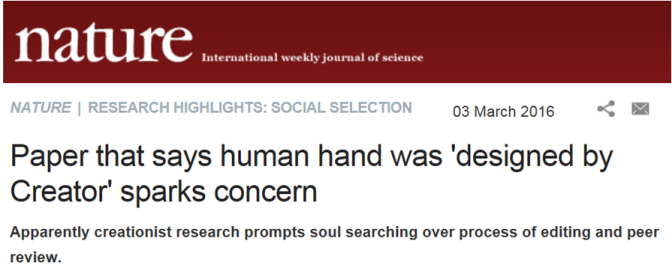
Nature calls it Social Selection

Click on image to be redirected to article in Nature.

The INDEPENDENT “Scientific Paper Sparks Controversy”
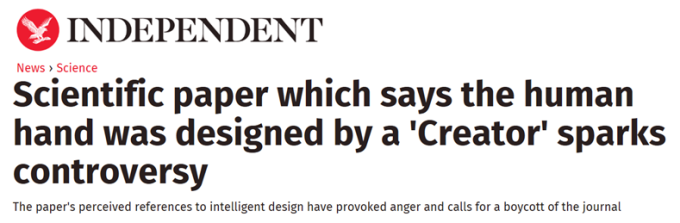
The Independent on PLoS ONE human hand Creator Intelligent Design

Click on image to be redirected to the Independent article.

Pocket Watch Hand Media ImagesThe paper by Liu M-J et al. (Biomechanical Characteristics of Hand Coordination in Grasping Activities of Daily Living) must be retracted from PLoS ONE, and its editor, Renzhi Han (Ohio State University Medical Center), dismissed from the journal for carelessness in processing the manuscript, to say the least. Here is why: the authors (apparent sympathizers of Intelligent Design) invoke the “Creator” in the Abstract, Introduction, Discussion, and also in the Comments section of the online version of their article, in which they respond to criticisms by the readers and editors at PLoS. And this is not an error of translation, nor a struggle in the authors’ attempt to explain, in English, the contrast between the evolutionary origin of the mechanic dexterity of the human hand and its alternative, unsupported hypothesis, “DESIGN CREATIONISM” responsible for it. No, the authors, with the blessings of the journal’s editor, insist that a Creator, or Designer, made the hand almost perfect. This is bad science and terrible editing by PLoS ONE. Below, I summarize the case and provide links to the journal and PDF. But keep in mind that PLoS ONE might retract the article, terminate the editor, and the information from the journal website might be removed. In any event, the paper by Liu M-J et al. must go from PLoS ONE to ZERO. – Guillermo Paz-y-Miño-C

The paper by Liu M-J et al. was received by PLoS ONE on October 28, 2015; accepted on December 14, 2015; and published on January 5, 2016. I missed it, but became aware of it by allusions to it in the social media (Retraction Watch alerted it on March 2, 2016).

Citation: Liu M-J, Xiong C-H, Xiong L, Huang X-L (2016) Biomechanical Characteristics of Hand Coordination in Grasping Activities of Daily Living. PLoS ONE 11(1): e0146193. doi:10.1371/journal.pone.0146193.

What is the paper about?

In the authors’ own words “…This study explores a method to identify the proper explanation for the hand architecture of muscular-articular connections from the analysis of behavioral result…”

Liu M-J et al. examine the biomechanics of the human hand; its dexterity and relationships between anatomy and function. The authors aim at conveying the message that any robotic attempt to mimic the ability of the human hand should pay close attention to its anatomy (and physiology), which, according to Liu M-J et al., would lead to best outcomes in robotic-engineering design. So far, so good. But what follows below is unacceptable, and for that reason the paper must be retracted and its editor, Renzhi Han (Ohio State University Medical Center), dismissed from PLoS ONE.

Tasks Performed by Human Hands Liu M-J et al PLoS ONE 2016

A hand wearing an instrumented glove demonstrates diverse types of dexterity (click on image to enlarge). Source Liu M-J et al. PLoS ONE 2016.

This is what the authors state in the ABSTRACT:

Hand coordination can allow humans to have dexterous control with many degrees of freedom to perform various tasks in daily living. An important contributing factor to this important ability is the complex biomechanical architecture of the human hand… It is not understood which biomechanical characteristics are responsible for hand coordination and what specific effect each biomechanical characteristic has. To explore this link, we first inspected the characteristics of hand coordination during daily tasks… from thirty right-handed subjects during a multitude of grasping tasks. Then, the functional link between biomechanical architecture and hand coordination was drawn by establishing the clear corresponding causality between the tendinous connective characteristics of the human hand and the coordinated characteristics during daily grasping activities. The explicit functional link indicates that the biomechanical characteristic of tendinous connective architecture between muscles and articulations is the proper design by the Creator to perform a multitude of daily tasks in a comfortable way. The clear link between the structure and the function of the human hand also suggests that the design of a multifunctional robotic hand should be able to better imitate such basic architecture.”

Thus, Liu M-J et al. invoked “design intervention” to account for complexity.

This is what the authors state in the INTRODUCTION:

The human hand is an amazing instrument that can perform a multitude of functions, such as the power grasp and precision grasp of a vast array of objects. The excellent behaviors of the human hand are enabled by a highly complex structure, with 19 articulations, 31 muscles and more than 25 degrees of freedom (DOF). While the abundant functions are favorable, this complex structure also raises a challenging problem of how the human body controls such a large number of mechanical DOFs with ease and an absence of effort…”

To help readers understand, we can simply call DOF “dexterity,” or the readiness and grace in physical activity, the skill and ease in using the hands.

Liu M-J et al. continue: “…Studies indicate that digits do not move alone in isolation of adjacent digits during functional activity, even when a specific movement requires an individual digit. On the contrary, the movements of multiple digits are correlated, and movement information of the human hand is redundant, so that only a small number of components account for most variances. The human hand adopts coordinated movements to reduce the number of independent DOFs and simplify the complexity of the control problem. Thus, hand coordination affords humans the ability to flexibly and comfortably control the complex structure to perform numerous tasks. Hand coordination should indicate the mystery of the Creator’s invention…”

Once again, Liu M-J et al. invoked a “Creator’s intervention” to account for complexity.

This is what the authors state in the DISCUSSION:

In closing the article, Liu M-J et al. reaffirm: “…the architecture is the biomechanical basis of the dexterous movement that provides the human hand with the amazing ability to perform a multitude of daily tasks in a comfortable way. In conclusion, our study can improve the understanding of the human hand and confirm that the mechanical architecture is the proper design by the Creator for dexterous performance of numerous functions following the evolutionary remodeling of the ancestral hand for millions of years. Moreover, functional explanations for the mechanical architecture of the muscular-articular connection of the human hand can also aid in developing multifunctional robotic hands by designing them with similar basic architecture.”

Now, this is what Liu M-J et al. and the Academic Editor, Renzhi Han, do not understand about alleged “design” in nature or “design creationism:”

The doctrine of Intelligent Design (ID), or Design Creationism, born in the 1980s, proposes that a Designer is responsible, ultimately, for the assemblage of complexity in biological systems; according to ID, evolution cannot explain holistically the origin of the natural world, nor the emergence of intricate molecular pathways essential to life, nor the immense phylogenetic differentiation of life, and instead ID proposes an intelligent agent as the ultimate cause of nature. In conceptually mistaken, type-I-error-based arguments to discredit evolution, ID has attributed randomness to molecular change, deleterious nature to single-gene mutations, insufficient geological time or population size for molecular improvements to occur, and invoked “design intervention” to account for complexity in molecular structures and biological processes. In 2005, ID was exposed in court (Dover, Pennsylvania, Kitzmiller et al. versus Dover School District et al. 2005) for violating the rules of science by “invoking and permitting supernatural causation” in matters of evolution, and for “failing to gain acceptance in the scientific community” (excerpt from Paz-y-Miño-C and Espinosa 2013, 2014).

And this is what Liu M-J et al. and the Academic Editor at PLoS have done: invoke and permit supernatural causation in matters of evolution.

Notification from PLOS Staff

Yesterday, March 2, 2016, the very journal PLoS ONE posted the following notification on its website (Comments section of article):

“… A number of readers have concerns about sentences in the article that make references to a ‘Creator’. The PLOS ONE editors apologize that this language was not addressed internally or by the Academic Editor during the evaluation of the manuscript. We are looking into the concerns raised about the article with priority and will take steps to correct the published record.”

But the reaction from PLOS just happened, after two months of the paper being on air. Look at this exchange between one of the readers of PLoS ONE and the first author of the paper, Mr. Liu M-J.

On February 15, 2016, Jason Friedman posted on the Comments section of PLoS ONE the following:

In the abstract (and similarly later in the paper) it is claimed: The explicit functional link indicates that the biomechanical characteristic of tendinous connective architecture between muscles and articulations is the proper design ‘by the Creator’ to perform a multitude of daily tasks in a comfortable way. I am interested to hear from the authors why one should come to this conclusion? I could not find any support for this claim in the article, and it seems out of place in this article…”

Mr. Liu M-J responded also on February 15, 2016:

Thanks for your comments. As we know, human hand is an amazing instrument that can perform a multitude of functions, such as the power grasp and precision grasp of a vast array of objects, with ease and an absence of effort. Although expended great attempts by scientists and engineers, there is no artificial hand matching the amazing capacity of human hand. The origins of human hand remain unclear. It is too miraculous to let us think that human hand is the masterwork of Creator and indicates the mystery of nature. The further discussion about the Creator is indeed out of place in our article…”

In addition, today, March 3, 2016, Mr. Liu M-J, posted this note at PLoS Comments:

We are sorry for drawing the debates about creationism. Our study has no relationship with creationism. English is not our native language. Our understanding of the word Creator was not actually as a native English speaker expected. Now we realized that we had misunderstood the word Creator. What we would like to express is that the biomechanical characteristic of tendious connective architecture between muscles and articulations is a proper design by the NATURE (result of evolution) to perform a multitude of daily grasping tasks. We will change the Creator to nature in the revised manuscript. We apologize for any troubles may have caused by this misunderstanding.”

A bit late, the analogy NATURE = Creator is not new among spiritualists (or even religions), the problem is that it was used in a scientific paper by professionals in a scientific field. And the Academic Editor at PLoS allowed it a complete ride up to publication. And that is the issue we are discussing. And the authors, and editor, must know that a “Creator” (unequivocally invoked three times in the paper and once in the Comments) has no place in Science.

What should PLOS and PLoS ONE do?

It is evident that neither the authors, nor the Academic Editor, understand how evolution via natural selection works. Worse, none is aware of the fallacies intrinsic to Intelligent Design, or Design Creationism. Here a common-knowledge principle applies “not knowing the law does not exempt anyone from having the law being applied to everyone.” What law? At least one and two bylaws: natural selection (which explains the origin and evolution of the human hand), plus the bylaws of publication of articles in scientific journals (i.e. substantiation by evidence, not by the whim of the authors or editors, and sound editorial process). [For accuracy, be aware that natural selection is not a “law,” I am using it here as an unavoidable mechanism that helps us explain much of the evolutionary processes; selection imposes restrictions on randomness and helps us dismiss, quite easily, the fallacy of “design creationism”]. What should be done now that we, the people, caught this “error” at PLoS, after two months since publication?

The allusions to the Creator or Designer by Liu M-J et al. are out of place, but they do invoke and permit supernatural causation in matters of evolution. Unfortunately, there is no evidence of a problem in translation, from the authors’ native language into English. In fact, the authors insist in the Abstract, Introduction, Discussion, and in the Comments section of their article that they do give credit, in a scientific publication, to the long-time debunked hypothesis of Intelligent Design, Design Creationism. The paper must be retracted from PLoS ONE, the Academic Editor, Renzhi Han (Ohio State University Medical Center), must be dismissed from PLOS, and the journal must assure the scientific community that the Public Library of Science (PLoS) will never, ever embrace design creationism in its publications. The paper by Liu M-J et al. must go from PLoS ONE to ZERO. — Evolution Literacy

On March 4, 2016, PLoS ONE officially retracted the paper:
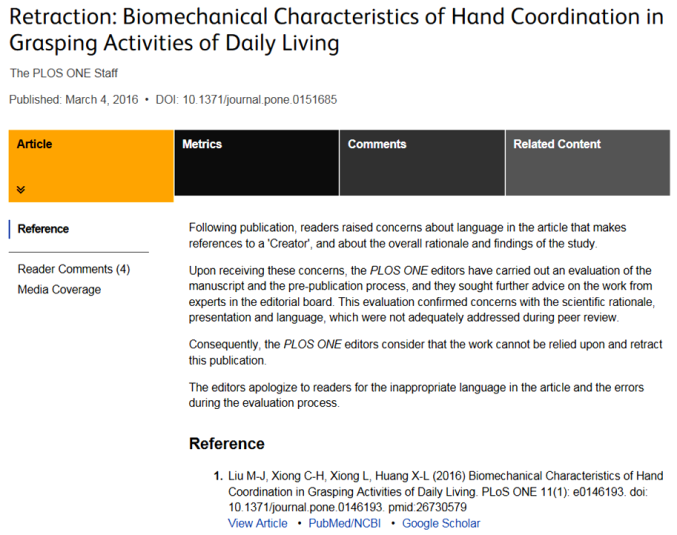
Retraction by PLoS ONE 03 04 2016

Click on image to be redirected to PLoS ONE retraction announcement.

Suggested Reading

A Comprehensive Survey of Retracted Articles from the Scholarly Literature

Related Stories

Darwin’s Skepticism about God

Evolution Wars Debunk II

Why the Notion that “The Theory of Evolution is Not an Explanation for the Origin of Life” is Wrong

Evolution Stands Faith Up – On Francis Collins’ and Karl Giberson’s “The Language of Science and Faith”

The Friendship Paradox vs. the Happiness Paradox

EvoLiteracy News 02 22 2016

Cartoon BizarroComics - EvoLiteracy 2016If you are on Twitter (or Facebook), you have probably asked yourself two questions: Am I less popular than my social-media friends? Am I less happy than them? These phenomena (i.e. cyber popularity or cyber happiness) are both real and perceptual.

A paper, by Bollen et al. (total four coauthors), which is available as manuscript (The Happiness Paradox: Your Friends Are Happier Than You), caught my attention. The authors provide evidence of complex associations between the “friendship paradox” and the “happiness paradox.” Enjoy. – Guillermo Paz-y-Miño-C

What is the Friendship Paradox? The perception that YOU are less popular than your friends (on average).

What is the Happiness Paradox? The perception that YOU are less happy than your friends (on average).

What is the issue (so what)? The friendship paradox has been documented in the scientific literature (see Suggested Readings below), but the happiness paradox has remained untested, without quantitative demonstration that it actually happens. Or that, if it does, it occurs in association –somehow– with the friendship paradox. The paper by Bollen et al. makes such connection.

To make it easier for our readers, I will summarize the Bollen et al. study in a digestible manner, although the authors themselves do a fine job explaining the theory, the data and the implications of the research to a specialized audience (see PDF of manuscript). But, for the non-scientists, my summary below might help.

The observations in nature (the social environment):

Online social networking is associated with elevated levels of loneliness, anxiety, displeasure, and dissatisfaction. For example, many times you are on Twitter (or Facebook, or alike social media), you experience an overall sensation that your average contacts (i.e. friends, people you follow, or your followers) have more friends or followers than you do, or are happier than you are.

When measured in number of friends-connections, most people tend to have fewer friends than their own friends do on average. Why? Watch the short video posted below (1 minute 36 seconds of your time) for a friendly introduction to the Friendship Paradox.

Now, let us examine numerically how the Friendship Paradox emerges from a simple example. Imagine a social network of four people, as depicted in the image below: Ana has 1 friend (Bill). Bill has 3 friends (Ana, Carla and Dan). Carla and Dan have 2 friends each (Bill, and each other).

Cartoon The Friendship Paradox - EvoLiteracy 2016

There are 8 friends in the network (1 + 3 + 2 + 2). Thus, on average, each person has 2 friends (8/4 = 2).

However, how many friends does each person’s friends have (i.e. how many friends of friends)? Ana is connected to +3 friends of friends, via Bill (who has 3 friends), a subtotal of 3 friends of friends. Bill is connect to 1 + 2 + 2 friends of friends (Ana has 1, Carla has 2, and Dan has 2), a sub total of 5 friends of friends. Carla is connected to 3 + 2 friends of friends (Bill has 3 and Dan has 2), a sub total of 5 friends of friends. And Dan is connected to 3 + 2 friends of friends (Bill has 3 and Carla has 2), a sub total of 5 friends of friends. Therefore, the grand total of friends of friends in the network is 18.

What is the average number of friends of friends? We obtain this number by dividing the total number of friends of friends in the network (=18) by the total number of friends in the network (=8), which gives us a value of 2.25. The Friendship Paradox becomes evident for Ana, Carla and Dan since their average number of friends in the network (=2.0) is lower than the average number of friends of friends in the network (=2.25). The phenomenon is particularly acute for Ana since she has a single friend (Bill) and, therefore, her friendship relations are clearly below both the average number of friends in the network (2.0) and the average number of friends of friends in the network (2.25).

This overall sampling bias effect (= the Friendship Paradox) results –in part– from Bill’s presence in the network. Bill has the most friends and is more often counted in the friends of friends tabulation, thus rising the average value (to 2.25).

The hypothesis

At least in part, Bollen et al. tested the hypothesis that the friendship and happiness paradoxes are predictable byproducts (effects) of universal social network connectivity patterns. And that associations between friendship and happiness also derived from such connectivity (note that the Friendship Paradox has been demonstrated numerous times, but Bollen et al. demonstrated it again with their sample to be able to link it to the Happiness Paradox, the central aspect of their paper).

The phenomena “friendship paradox” or “happiness paradox” result from the inherent structural bias in social networks that favor popular individuals (like Bill, above), who are, by definition, more likely to belong to someone’s social circle. For example, when individuals like you and I equate popularity of our cyber-friends with their cyber-prestige, and compare our own popularity to theirs, we tend to increase our levels of dissatisfaction with ourselves (i.e. we tend to enhance, in our minds, the effects of the friendship-paradox- or the happiness-paradox).

The predictions

Bollen et al. predicted that the effects of the friendship paradox will extend beyond popularity. If popular individuals tend to be happier, then their elevated happiness will become more prevalent as well. Thus, friendship-levels and happiness-levels (as per both paradoxes) should correlate, and this relationship should be measurable.

The authors also predicted that unhappiness will contribute more directly to the negative psycho-social effects of social networking, since it will affect how individuals assess their own subjective wellbeing (i.e. general happiness/unhappiness or life satisfaction/dissatisfaction relative to that of others).

The friendship paradox or the happiness paradox will generate predictable distributions of data, as shown in Fig. 1, below:

Figure 1 Friendship vs Happiness Paradoxes - EvoLiteracy 2016

Figure 1. Predictable distributions of data expected if the Friendship or Happiness paradoxes are supported by the data (redrawn and adapted from Bollen et al.).

The study

Bollen et al. examined 40,000 Twitter users connected by reciprocal friendship (i.e. people that follow each other).

Two distinctive groups were characterized, the Unhappy group and the Happy group, by applying a subjective assessment of their wellbeing (derived from the Twitter-users’ interactions with their cyber-neighbors), which ranged in a scale from -1.0 (unhappy) to +1.0 (happy).

As shown in Fig. 2, below, both the Unhappy and Happy groups experienced evident friendship-paradox effects (i.e. members of both groups did have, or thought that their friends had, more friends, on average, than themselves). Interestingly, the intensity of the friendship paradox was weaker in the Unhappy group (left) than in the Happy group (right).

Figure 2 Friendship vs Happiness Paradoxes - EvoLiteracy 2016

Figure 2. Friendship-paradox effects on the Unhappy (left) and Happy (right) groups. Note how the intensity of the friendship paradox was weaker in the Unhappy group than in the Happy group. The “clouds” of data correspond to point distributions of each of the 40,000 Twitter users in the study (modified from Bollen et al.).

In addition, as Fig. 3, below, suggests, both the Happy (top) and Unhappy (bottom) groups experienced clear happy-paradox effects. However, the intensity of the happiness paradox was stronger in the Unhappy group (see the very steep slope in the data point distribution, plus the amount of data points over the main line) than in the Happy group (see the not-so-steep slope in the data point distribution, plus the amount of data points over the main line). In essence, the majority of the sampled Twitter users were less happy (or more unhappy) than their friends on average. These findings support the idea that the Happiness Paradox is real.

Figure 3 Friendship vs Happiness Paradoxes - EvoLiteracy 2016

Figure 3. Scatter point distributions of an individual’s (exemplified by YOU) sense of happiness as function of his/her (exemplified by YOUR) friends’ average sense of happiness (modified from Bollen et al.).

Individual Happiness and average friends’ Happiness were more strongly related within the Unhappy group than within the Happy group (Fig. 3). Bollen et al. refer to the clustering of unhappy users with themselves, and happy users also with themselves, as being homophilic or assortative in their social networking (both are common terms in behavioral sciences).

Figure 4, below, corroborates the finding that Unhappy Twitter users had fewer friends, on average, than the Happy Twitter users had, on average.

Figure 4 Friendship vs Happiness Paradoxes - EvoLiteracy 2016

Figure 4. Unhappy Twitter users had fewer friends, on average, than the Happy Twitter users had, on average (modified from Bollen et al.).

Figure 5, below, corroborates the finding that the Happiness Paradox affected more the Unhappy Twitter users, on average, than the Happy Twitter users, on average.

Figure 5 Friendship vs Happiness Paradoxes - EvoLiteracy 2016

Figure 5. The Happiness Paradox affected more the Unhappy Twitter users, on average, than the Happy Twitter users, on average (modified from Bollen et al.).

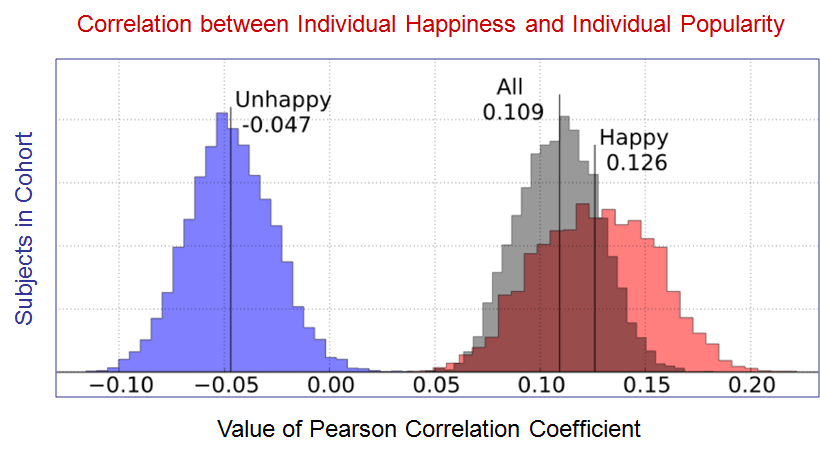
Paradoxically, however, as shown in Fig. 6, below, there was a weak correlation between individual happiness and individual popularity for the Unhappy group (Pearson’s R = -0.047; range -0.08 to -0.013). For the Happy group, the correlation was more pronounced (Pearson’s R = 0.126; range 0.081 to 0.171).

Figure 6 Friendship vs Happiness Paradoxes - EvoLiteracy 2016

Figure 6. There was a weak correlation between individual happiness and individual popularity for the Unhappy group. For the Happy group, the correlation was more pronounced (modified from Bollen et al.).

The overall results suggest that unhappy Twitter users were more strongly affected by the lower happiness of their friends, possibly explaining why this group exhibited a stronger Happiness Paradox (Figs. 3 and 5) in the absence of a strong correlation between Happiness and Popularity (Fig. 6).

Warnings

Bollen et al. warn us that:

Observations of decreased happiness among social media users may result directly from a widespread inflated perception of the happiness of one’s friends.

Given the large role that social media (e.g. Twitter, Facebook) plays in the social lives of billions of individuals, the authors suggest that these environments may induce long-term changes in the public’s social behavior and may, over time, alter the very nature of social relations themselves. — EvoLiteracy.

Suggested Readings:

Why are your friends more popular than you?

Why your friends have more friends than you do?

Friends you can count on.

Your friends are more interesting than you.

Generalized friendship paradox in complex networks: The case of scientific collaboration.

World Visitors to EvoLiteracy

EvoLiteracy News 02 17 2016

World Visitors to EVOLUTION LITERACY – Readers from 103 countries visited EvoLiteracy during 2015. Three in every four readers were from the United States. About one in every five visitors were from Brazil, Canada, UK, Germany, India, Ecuador, France, Australia and Spain. And one in every ten cyberworms came from 93 other countries. EvoLiteracy is growing thanks to our world friends and followers. – Guillermo Paz-y-Miño-C.

UPDATE – a supplementary post to this one is available at EvoLiteray January 1, 2017.

World Visitors to Evolution Literacy 2015

There are 190+ countries in the world (member states of the United Nations). EvoLiteracy reaches half of them (52%). The image below includes flags of nations, which total 230+. We still need to reach as many nations as possible. Please share EvoLiteracy with others.

Flags of the World

Flags of 230+ nations in the world. Click on image to enlarge. Source Danilka’s Blog.

Top 25 Most Read Posts of 2015

Here are the most popular postings of 2015. I was glad to discover that the biology science videos made much of an impact, particularly among science educators. I also liked that three crucial postings about higher education (marked with an asterisk * below) were well received. To my surprise (and I thank the readers for liking it), the posting about Ecuador’s Academy of Science was ranked top 10. My personal favorite was Science Challenges Golden Age of Violin Making, and this is because I am fascinated with string instruments (classic guitars, ukuleles, charangos); I learned much while investigating the violin ancestry. But I cannot close without admitting how much pleasure gave me to see our readers liking Evolution Wars Debunk II (ranked 13th, a lucky number). Plus the most commented story was Shroud of Turin, Poor Science, and the Persistence of a Myth, which was reposted in various blogs and generated two weeks of discussions. Thanks to all for supporting EvoLiteracy. – GPC

EvoLiteracy – Biology and Science Videos

Photography – Wildlife – Fossils – Landscapes – Museums – Monuments – Cities

GPC Scientific Publications

Evolution Controversy and the Incompatibility of Science and Religion

5 GPC BioArt

EvoLiteracy News 10 26 2015 Shroud of Turin, Poor Science, and the Persistence of a Myth

A Secular Humanist’s Plea for Dzhokhar Tsarnaev’s Life

2015 Nobel Prize in Chemistry Goes to Curiosity-Based Research

Antivaxxers and the Educated-Public-Herd Effect

10 Ecuador’s Academy of Sciences Earns International Recognition

11 Science Challenges Golden Age of Violin Making

12 The “Jackprot Simulation”

13 Evolution Wars: Debunk II

14 EvoLiteracy News 05 08 2015 Should scientific journals request authors to change their practices for presenting continuous data in small sample size studies?

15 The Incompatibility Hypothesis: Evolution vs Supernatural Causation

16 At The Down House: Darwin’s Home

17 The Art Of Nature: Sculptures Of Dinosaur Tracks and Traces

18 College Educated But Deeply In Debt For An Overpriced Degree *

19 New Book: Why does Evolution Matter? The Importance of Understanding Evolution

20 Imminent Collapse of Basic Science Under For-profit Model *

21 Dehumanizing Academia by Dismantling the Humanities *

22 EvoLiteracy News 03 19 2015 US Senator Ted Cruz Distorts NASA’s Mission Budget

23 Hiking among Trilobites, Ancient Whales and Dinosaurs

24 EvoLiteracy News 09 09 2015 Protisto-Biologists Flock to Seville for ECOP-ISOP Scientific Meeting

25 Reviews of Book Evolution Stands Faith Up – Reflections on Evolution’s War

Today: International Darwin Day 02 12 2016

EvoLiteracy News 02 12 2016

“Darwin Day… signifies the celebration of the achievements of reason, science, and the advancement of human knowledge. The igniting moments in human history when light was brought into our own origins, when understanding that ordinary apes, like Homo, were capable of the extraordinary, of discovering the truth and debunking obscurantism; yet we still struggle to make science the sole guiding star in our survival decisions, the reliable source of concern and joy, the toolkit to plan our departure from Earth –before our Sun in agonizing heat engulfs its nearest orbiting planets– and seek home somewhere else in the cosmos”Guillermo Paz-y-Miño-C

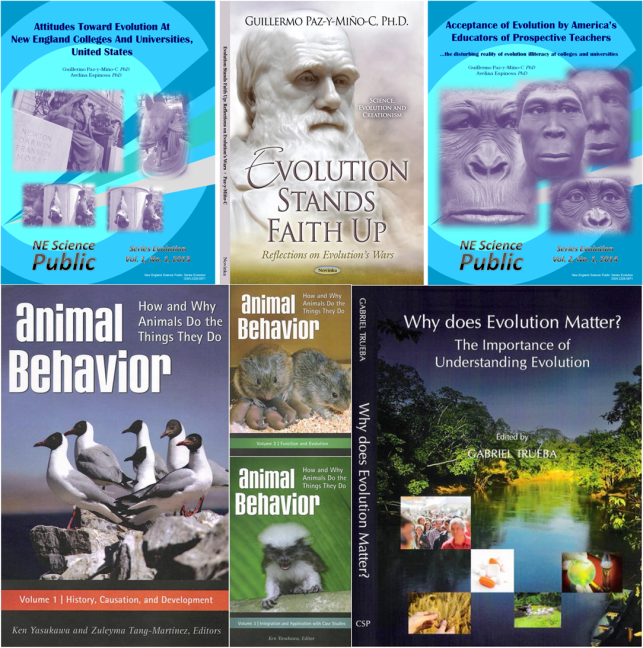
A few images and Evolution-Literacy links to celebrate International Darwin Day. — An update on our New England Science Public Series Evolution Volumes 1 and 2, including open access to the studies on acceptance of evolution in the United States. — Links to our Incompatibility Hypothesis papers (evolution versus supernatural causation). — A recount of a visit to the Down House (Darwin’s home). — And an article, from 2013, about the “history of Darwin Day” at the US Congress. Enjoy. – GPC

Here are some photos of Darwin’s statue at the British Museum of Natural History in London, taken back in 2010.

A - Darwin British Museum Nat Hist - Photo G-Paz-y-Mino-C 2010

Above: an overall view of Darwin’s statue (marble) at the British Museum of Natural History in London.

B - Darwin British Museum Nat Hist - Photo G-Paz-y-Mino-C 2010

Above: a close up of Darwin’s rostrum.

C - Darwin British Museum Nat Hist - Photo G-Paz-y-Mino-C 2010

Above: and another close up of this beautiful carving on marble.

E - Darwin British Museum Nat Hist - Photo G-Paz-y-Mino-C 2010

Above: the main hall at the British Museum of Natural History in London. Darwin’s statue is in the back, just at the end of the first level of the stairs.

F - British Museum Nat Hist - Photo G-Paz-y-Mino-C 2010

Above: the outdoors of the British Museum of Natural History in London.

Paz-y-Mino-C_Book_Cover_Evolution_Stands_Faith_Up_JPEGNOVA Publishers (New York) used one of these images for the cover of our book Evolution Stands Faith Up: Reflections on Evolution’s Wars (2013). “Paz-y-Miño-C doesn’t ask the reader to ‘believe’ in evolution. He provides overwhelming evidence, clearly written, that shows how scientific inquiry leads to important and practical results, while superstition and faith lead nowhere. Although we may not be able to reason someone out of what they were never reasoned into, the author presents a roadmap for those whose minds are open to discover the wonders and beauty of science.” – Herb Silverman, PhD, author of Candidate Without a Prayer: An Autobiography of a Jewish Atheist in the Bible Belt. Find Evolution Stands Faith Up at NOVA: Soft Cover, Barnes & Noble, Amazon.comAmazon UK.

Update on NESP Series Evolution

The open access New England Science Public Series Evolution continues to be highly downloaded. Here are some updates:

NESP Series Evolution Vol 1 No 1 20131,670+ downloads of Volume 1, Number 1: Paz-y-Miño-C G & Espinosa A. 2013. Attitudes toward Evolution at New England Colleges and Universities, United States. New England Science Public: Series Evolution 1(1): 1-32 (ISSN: 2326-0971). The authors compile the most significant results of their conceptual and quantitative studies on the patterns of acceptance of evolution at New England colleges and universities, conducted between 2009 and 2012. They examine the views of New England Faculty and Educators of Prospective Teachers (higher-education faculty themselves, specialized in training future teachers) from 35 colleges and universities, as well as a representative sample of College Students from a Public, Private and two Religious institutions who were polled in three areas: the controversy over evolution versus creationism versus Intelligent Design; their understanding of how science and the evolutionary process work; and their personal convictions concerning the evolution and/or creation of humans in the context of their religiosity… Read MORE open access.

NESP Series Evolution Vol 2 No 1 2014430+ downloads of Volume 2, Number 1: Paz-y-Miño-C G & Espinosa A. 2014. Acceptance of Evolution by America’s Educators of Prospective Teachers. New England Science Public: Series Evolution 2(1): 1-92 (ISSN: 2326-0971). In NESP Series Evolution Vol 2 No 1, Paz-y-Miño-C and Espinosa use the conceptual framework of the Incompatibility Hypothesis (i.e. science/evolution and belief in supernatural causation are incompatible) to document the patterns of acceptance of evolution of 495 Educators of Prospective Teachers affiliated with 281 colleges and universities widely distributed in 4 regions, 9 divisions, and 50 states in the United States. These higher-education professionals (65% PhD-, 22% doctorate-holders) were polled in five areas: (i) their views about evolution, creationism and Intelligent Design, (ii) their understanding of how science and the evolutionary process work, (iii) their position about the hypothetical ‘harmony or compatibility’ between science/evolution and supernatural causation, (iv) their awareness of the age of the Earth, its moon, our solar system and the universe, and the application of the concept of evolution to the cosmos, and (v) their personal convictions concerning the evolution and/or creation of humans in the context of the educators’ religiosity… Read MORE open access.

The Incompatibility Hypothesis: evolution vs. supernatural causation

Incompatibility Hypothesis Paz-y-Mino-C Espinosa

“Like the oil vs. water experiment, evolution and supernatural causation don’t mix. Evolution raises to the surface.”

Supernatural causation (i.e. the belief in a Supreme Being, creator and sustainer of the universe, omnipresent, omnipotent, omniscient) is a cultural pollutant, incompatible with empirical reality. “Belief” disrupts, distorts, delays and/or stops (3Ds+S) the correct comprehension and acceptance of evidence. We have postulated that the controversy over evolution-and-science versus creationism is inherent to the incompatibility between scientific rationalism/empiricism and the belief in supernatural causation. This hypothesis (= incompatibility) helps us understand and explain the everlasting and fluctuating antagonism –in cycles, from moderate to intense opposition during human history– in the relationship between science/evolution and religion… Read MORE and access free PDFs of scientific articles, including  Evolution Controversy: A Phenomenon Prompted by the Incompatibility between Science and Religious Beliefs published in the International Journal of Science in Society (abstract below) [PDF].

Cover Int Journal Science Society Paz-y-Mino-C and Espinosa 2015Evolution Controversy – Science in Society: Paz-y-Miño-C G & Espinosa A. 2015. Evolution Controversy: A Phenomenon Prompted by the Incompatibility between Science and Religious Beliefs. Int. J. Sci. Soc. 7(2). ISSN 1836-6236. The incompatibility between science and the belief in supernatural causation helps us understand why people do not accept evolution. Belief disrupts, distorts, delays, or stops (3Ds + S) the acceptance of scientific evidence. Here we examine the evolution controversy under three predictions of the incompatibility hypothesis. First, chronological-conflict-and-accommodation, which explains the historical re-emergence of antagonism between evolution and religion when advances in science continue to threaten the belief in supernatural causation; in such situations, creationists’ rejection of and subsequent partial acceptance of the new scientific discoveries are expected. Second, change in evolution’s acceptance is a function of educational attainment, which explains the positive association between acceptance of evolution and level of education. And third, change in evolution’s acceptance is a function of religiosity, which explains the negative association between acceptance of evolution and level of religious beliefs… We emphasize that harmonious coexistence between science and religion is illusory. If co-persisting in society, their relationship will fluctuate from moderate to intense antagonism. Read MORE open access [PDF].

At the Down House: Darwin’s Home

Down House Side View from gardens“I visited the Down House, Darwin’s Home, in July 2010. Here are a few pictures I wanted to share in celebration of the International Darwin Day, February 12. Prior to visiting the Down House, which is located just a few miles South East of London, I went to Canterbury, Kent, to attend the International Society of Protistologists (ISoP) annual meeting, at the University of Kent. Coincidentally, back in 1991, as an undergraduate student, I obtained a Diploma in Endangered Species Management from the University of Kent, which offered such certification in partnership with the Jersey Wildlife Preservation Trust (nowadays Durrell Wildlife Conservation Trust)”… Read MORE.

Some History about Darwin Day at the US Congress

Paul Broun R Georgia on Evolution

Click on image to watch video. Paul Broun (R) “All that stuff I was taught about evolution… all that is lies straight from the pit of Hell”

“…Bill H.Res.41, itself, embodies the never-ending battle against irrationalism, the latter vividly present in the views of those who see evil in truth and menace in the realities discovered by science. Take, for example, last year’s remarks by congressman Paul Broun (R), from Georgia, a physician and member of the House of Representatives Committee on Science, Space and Technology (the very Committee to which the “Darwin Day bill” was referred), who declared: “God’s word is true. I’ve come to understand that. All that stuff I was taught about evolution and embryology and the big bang theory, all that is lies straight from the pit of Hell.”

And Mr. Broun went on, as documented in video watched worldwide: “It’s lies to try to keep me and all the folks who were taught that from understanding that they need a savior.” “You see, there are a lot of scientific data that I’ve found out as a scientist that actually show that this is really a young Earth.” “I don’t believe that the earth’s but about 9,000 years old.” “I believe it was created in six day as we know them.” “That’s what the Bible says.” Read MORE.

Related Stories

Darwin’s Skepticism about God

Evolution Wars Debunk II

Why the Notion that “The Theory of Evolution is Not an Explanation for the Origin of Life” is Wrong

Evolution Stands Faith Up – On Francis Collins’ and Karl Giberson’s “The Language of Science and Faith”

Darwin’s Skepticism about God

EvoLiteracy News 02 08 2016 – Darwin’s Week

The yearly celebration of International Darwin Day (February 12) is approaching. Here are some of Darwin’s writings, which reveal how skeptical he became –with age and wisdom– about the existence of God. Despite this historical evidence, the pro-religion-in-science crowds, or para-creationists (i.e. theistic evolution, creation science, evolutionary creation), continue to mislead the public by spreading the meme that Darwin was, deep in his soul, a religious naturalist. And that is false. In 1879, Darwin wrote: “…an Agnostic would be the more correct description of my state of mind.” But read below what else Darwin wrote about The Old and New Testaments, Christianity and God in his Autobiography and later documents. – Guillermo Paz-y-Miño-C

On November 24, 1880 (two years before his dead), Darwin wrote in a “Private” letter:

Dear Sir

I am sorry to have to inform you that I do not believe in the Bible as Divine revelation, & therefore not in Jesus Christ as the son of God. Yours faithfully Ch. Darwin

Darwin's Letter Nov 24 1880

Darwin responded to Francis McDermott, who had requested in a note to Darwin: “…if I am to have pleasure in reading your books I must feel that at the end I shall not have lost my faith in the New Testament. My reason in writing to you therefore is to ask you to give me a Yes or No to the question Do you believe in the New Testament…” (Read McDermott’s complete letter here).

In Darwin’s Autobiography (excerpts below), first compilation published in 1958 (see complete text here), his skepticism about Christianity and God’s existence was obvious:

On the Old and New Testaments

“… But I found it more and more difficult, with free scope given to my imagination, to invent evidence which would suffice to convince me. Thus disbelief crept over me at very slow rate, but was at last complete. The rate was so slow that I felt no distress, and have never since doubted even for a single second that my conclusion was correct…”

I had gradually come… to see that the Old Testament from its manifestly false history of the world, with the Tower of Babel, the rainbow at sign… and from its attributing to God the feelings of a revengeful tyrant, was no more to be trusted than the sacred books of the Hindoos, or the beliefs of any barbarian.

Darwin's Dangerous Idea

“disbelief crept over me at very slow rate, but was at last complete”

By further reflecting that the clearest evidence would be requisite to make any sane man believe in the miracles by which Christianity is supported, — that the more we know of the fixed laws of nature the more incredible do miracles become, — that the men at that time were ignorant and credulous to a degree almost incomprehensible by us, — that the Gospels cannot be proved to have been written simultaneous with the events, — that they differ in many important details, far too important as it seemed to me to be admitted as the usual inaccuracies of eyewitnesses; — by such reflections as these, which I give not as having the least noveltry or value, but as they influenced me, I gradually came to disbelieve in Christianity as a divine revelation.

The fact that many false religions have spread over large portions of the earth like wild-fire had some weight on me. Beautiful as is the morality of the New Testament, it can hardly be denied that its perfection depends in part on the interpretation which we now put on metaphors and allegories.

But I was very unwilling to give up my belief; — I feel sure of this for I can well remember often and often inventing day-dreams of old letters between distinguished Romans and manuscripts being discovered at Pompeji or elsewhere which confirmed in the most striking manner all that was written in the Gospels.

But I found it more and more difficult, with free scope given to my imagination, to invent evidence which would suffice to convince me. Thus disbelief crept over me at very slow rate, but was at last complete. The rate was so slow that I felt no distress, and have never since doubted even for a single second that my conclusion was correct.

I can indeed hardly see how anyone ought to wish Christianity to be true; for if so the plain language of the text seems to show that the men who do not believe, and this would include my Father, Brother and almost all of my friends, will be everlasting punished.

On Paley’s Argument for Design

“…There seems to be no more design in the variability of organic beings, and in the action of natural selection, than in the course which the wind blows…”

Bivalve Image Umbo

“the beautiful hinge of a bivalve shell”

Although I did not think much about the existence of a personal God until a considerably later period of my life, I will here give the vague conclusions to which I have been driven. The old argument from design in Nature, as given by Paley, which formerly seemed to me so conclusive, fails, now that the law of natural selection has been discovered. We can no longer argue that, for instance, the beautiful hinge of a bivalve shell must have been made by an intelligent being, like the hinge of a door by man. There seems to be no more design in the variability of organic beings, and in the action of natural selection, than in the course which the wind blows. Everything in nature is the result of fixed laws. But I have discussed this subject at the end of my book on the ‘Variations of Domesticated Animals and Plants,’ and the argument there given has never, as far as I can see, been answered.

On Suffering and Happiness in Nature

“…According to my judgment happiness decidedly prevails, though this would be very difficult to prove. If the truth of this conclusion be granted, it harmonizes well with the effects which we might expect from natural selection…”

Croc and Wildbeast

The problem of “suffering in nature”

But passing over the endless beautiful adaptations which we every­where meet with, it may be asked how can the generally beneficent arrangement of the world be accounted for? Some writers indeed are so much impressed with the amount of suffering in the world, that they doubt, if we look to all sentient beings, whether there is more of misery or of happiness; whether the world as a whole is a good or bad one. According to my judgment happiness decidedly prevails, though this would be very difficult to prove. If the truth of this conclusion be granted, it harmonizes well with the effects which we might expect from natural selection. If all the individuals of any species were habitually to suffer to an extreme degree, they would neglect to propagate their kind; but we have no reason to believe that this has ever, or at least often occurred. Some other considerations, moreover, lead to the belief that all sentient beings have been formed so as to enjoy, as a general rule, happiness.

On the Mental Organs, Perception of Pain, Hunger, Thirst, Fear and Pleasure

“…suffering is quite compatible with the belief in Natural Selection, which is not perfect in its action, but tends only to render each species as successful as possible in the battle for life with other species, in wonderfully complex and changing circumstances…”

Every one who believes, as I do, that all the corporeal and mental organs (excepting those which are neither advantageous nor disadvantageous to the possessor) of all beings have been developed through natural selection, or the survival of the fittest, together with use or habit, will admit that these organs have been formed so that their possessors may compete successfully with other beings, and thus increase in number. Now an animal may be led to pursue that course of action which is most beneficial to the species by suffering, such as pain, hunger, thirst, and fear; or by pleasure, as in eating and drinking, and in the propagation of the species… or by both means combined, as in the search for food.

But pain or suffering of any kind, if long continued, causes depression and lessens the power of action, yet is well adapted to make a creature guard itself against any great or sudden evil.

Chimps Hugging by Fernando Turmo

“We see [natural selection] in the pleasure from exertion, even occasionally from great exertion of the body or mind …especially in the pleasure derived from sociability, and from loving our families”

Pleasurable sensations, on the other hand, may be long continued without any depressing effect; on the contrary, they stimulate the whole system to increased action. Hence it has come to pass that most or all sentient beings have been developed in such a manner, through natural selection, that pleasurable sensations serve as their habitual guides. We see this in the pleasure from exertion, even occasionally from great exertion of the body or mind, (in the pleasure of our daily meals, and especially in the pleasure derived from sociability, and from loving our families). The sum of such pleasures as these, which are habitual or frequently recurrent, give, as I can hardly doubt, to most sentient beings an excess of happiness over misery, although many occasionally suffer much. Such suffering is quite compatible with the belief in Natural Selection, which is not perfect in its action, but tends only to render each species as successful as possible in the battle for life with other species, in wonderfully complex and changing circumstances.

On the Argument Against the Existence of an Intelligent “First Cause”

“…A being so powerful and so full of knowledge as a God who could create the universe, is to our finite minds omnipotent and omniscient, and it revolts our understanding to suppose that his benevolence is not unbounded, for what advantage can there be in the suffering of millions of the lower animals throughout almost endless time?”

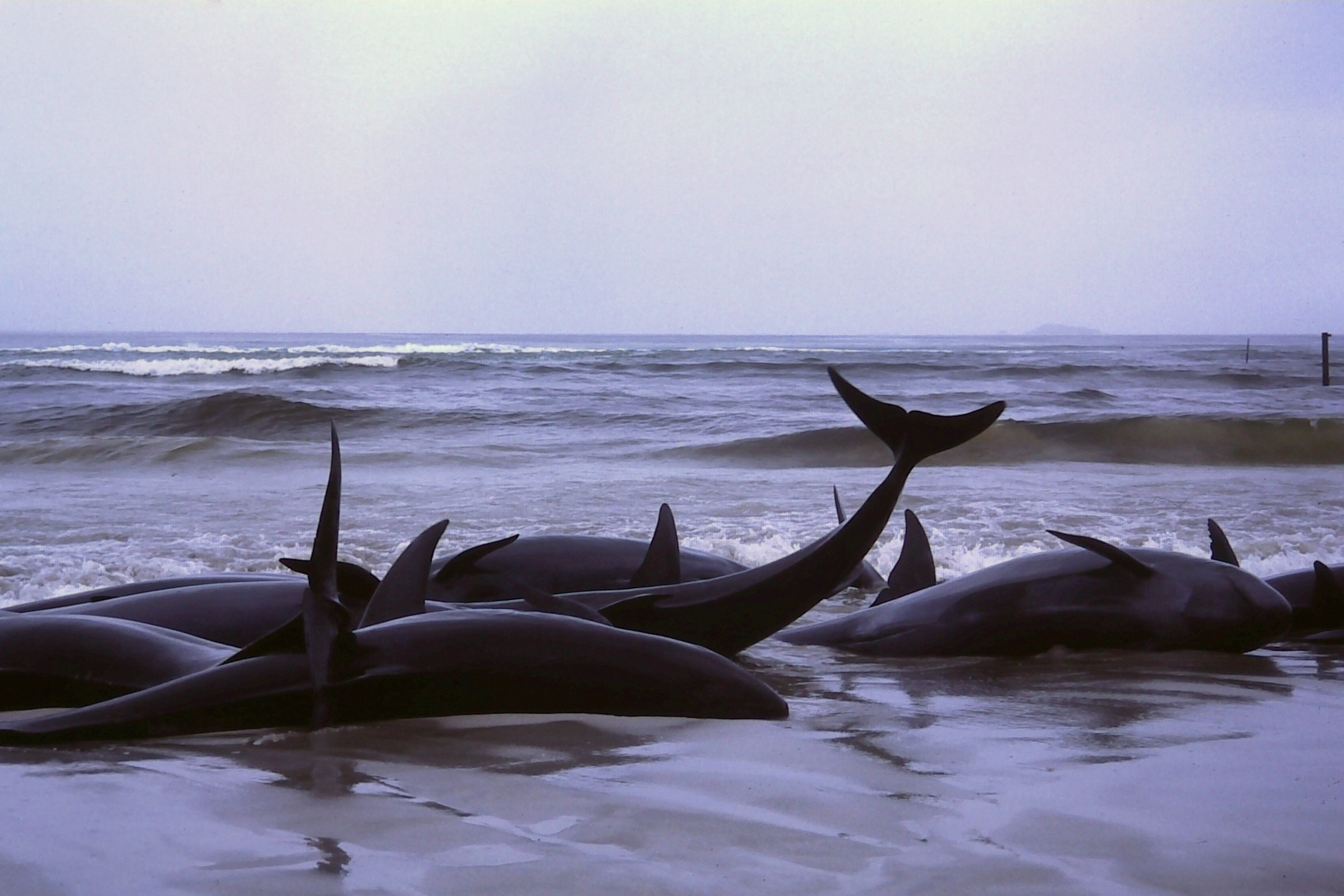
Dead Whales What For

“the number of men in the world is as nothing compared with that of all other sentient beings, and they often suffer greatly without any moral improvement”

That there is much suffering in the world no one disputes. Some have attempted to explain this with reference to man by imagining that it serves for his moral improvement. But the number of men in the world is as nothing compared with that of all other sentient beings, and they often suffer greatly without any moral improvement. A being so powerful and so full of knowledge as a God who could create the universe, is to our finite minds omnipotent and omniscient, and it revolts our understanding to suppose that his benevolence is not unbounded, for what advantage can there be in the suffering of millions of the lower animals throughout almost endless time? This very old argument from the existence of suffering against the existence of an intelligent First Cause seems to me a strong one; whereas, as just remarked, the presence of much suffering agrees well with the view that all organic beings have been developed through variation and natural selection.

At the present day the most usual argument for the existence of an intelligent God is drawn from the deep inward conviction and feelings which are experienced by most persons. But it cannot be doubted that Hindoos, Mahomadans and others might argue in the same manner and with equal force in favour of the existence of one God, or of many Gods, or as with the Buddhists of no God. There are also many barbarian tribes who cannot be said with any truth to believe in what we call God: they believe indeed in spirits or ghosts, and it can be explained, as Tyler [cf. Edward Burnett Tylor] and Herbert Spencer have shown, how such a belief would be likely to arise.

On the Existence of Feelings as Argument for the Existence of God

“…I do not think that the religious sentiment was ever very strongly developed in me…”

“… It may be truly said that I am like a man who has become colour-blind, and the universal belief by men of the existence of redness makes my present loss of perception of not the least value as evidence. This argument would be a valid one if all men of all races had the same inward conviction of the existence of one God; but we know that this is very far from being the case…”

Formerly I was led by feelings such as those just referred to (although I do not think that the religious sentiment was ever very strongly developed in me), to the firm conviction of the existence of God, and of the immortality of the soul. In my Journal I wrote that whilst standing in the midst of the grandeur of a Brazilian forest, “it is not possible to give an adequate idea of the higher feelings of wonder, admiration, and devotion, which fill and elevate the mind.” I well remember my conviction that there is more in man than the mere breath of his body. But now the grandest scenes would not cause any such convictions and feelings to rise in my mind. It may be truly said that I am like a man who has become colour-blind, and the universal belief by men of the existence of redness makes my present loss of perception of not the least value as evidence. This argument would be a valid one if all men of all races had the same inward conviction of the existence of one God; but we know that this is very far from being the case.

Conductor Andris Nelsons Boston Symphony Orchestra

“The state of mind which grand scenes formerly excited in me, and which was intimately connected with a belief in God, did not essentially differ from that which is often called the sense of sublimity… [But] it can hardly be advanced as an argument for the existence of God, any more than the powerful though vague and similar feelings excited by music.”

Therefore I cannot see that such inward convictions and feelings are of any weight as evidence of what really exists. The state of mind which grand scenes formerly excited in me, and which was intimately connected with a belief in God, did not essentially differ from that which is often called the sense of sublimity; and however difficult it may be to explain the genesis of this sense, it can hardly be advanced as an argument for the existence of God, any more than the powerful though vague and similar feelings excited by music.

On Immortality as an Instinctive Belief

With respect to immortality, nothing shows me (so clearly) how strong and almost instinctive a belief it is, as the consideration of the view now held by most physicists, namely, that the sun with all the planets will in time grow too cold for life, unless indeed some great body dashes into the sun, and thus gives it fresh life.

The Sun

Immortality? Darwin: “the sun with all the planets will in time grow too cold for life”

Believing as I do that man in the distant future will be a far more perfect creature than he now is, it is an intolerable thought that he and all other sentient beings are doomed to complete annihilation after such long-continued slow progress. To those who fully admit the immortality of the human soul, the destruction of our world will not appear so dreadful.

On the Mystery of the Beginning of All and Self-characterization as Agnostic

“…This conclusion [the “First Cause”] was strong in my mind about the time, as far as I can remember, when I wrote the ‘Origin of Species;’ and it is since that time that it has very gradually, with many fluctuations, become weaker…”

Darwin Painting

“I deserve[d] to be called a Theist. This conclusion was strong in my mind about the time… when I wrote the ‘Origin of Species;’ and it is since that time that it has very gradually, with many fluctuations, become weaker.”

Another source of conviction in the existence of God, connected with the reason, and not with the feelings, impresses me as having much more weight. This follows from the extreme difficulty or rather impossibility of conceiving this immense and wonderful universe, including man with his capacity of looking far backwards and far into futurity, as the result of blind chance or necessity. When thus reflecting I feel compelled to look to a First Cause having an intelligent mind in some degree analogous to that of man; and I deserve to be called a Theist. This conclusion was strong in my mind about the time, as far as I can remember, when I wrote the ‘Origin of Species;’ and it is since that time that it has very gradually, with many fluctuations, become weaker. But then arises the doubt;– can the mind of man, which has, as I fully believe, been developed from a mind as low as that possessed by the lowest animals, be trusted when it draws such grand conclusions? May not these be the result of the connection between cause and effect which strikes us as a necessary one, but probably depends merely on inherited experience? Nor must we overlook the probability of the constant inculcation in a belief in God on the minds of children producing so strong and perhaps an inherited effect on their brains not fully developed, that it would be as difficult for them to throw off their belief in God, as for the monkey to throw off its instinctive fear and hatred of a snake.

“…[We must not] overlook the probability of the constant inculcation in a belief in God on the minds of children producing so strong and perhaps an inherited effect on their brains not fully developed, that it would be as difficult for them to throw off their belief in God, as for the monkey to throw off its instinctive fear and hatred of a snake…”

I cannot pretend to throw the least light on such abstruse problems. The mystery of the beginning of all things is insoluble by us; and I for one must be content to remain an Agnostic.

Corollary

In 1879, Darwin wrote a letter to James Fordyce:

What my own (religious) views may be is a question of no consequence to any one but myself. But, as you asked, I may state that my judgment often fluctuates… In my most extreme fluctuations I have never been an Atheist in the sense of denying the existence of a God. I think that generally (and more and more as I grow older), but not always, that an Agnostic would be the more correct description of my state of mind. — Evolution Literacy

Note: There are numerous extractions of “Darwin’s beliefs” from his Autobiography, some more exhaustive than others (see, for example, letters in What Did Darwin Believe?). Above, I summarized the text, broke it into shorter paragraphs, and introduced modern images and subtitles to facilitate the reading of the original narrative. I advise the reader to consult the original Autobiography for completeness.– Guillermo Paz-y-Miño-C 

The Elegant Feral Chickens of Hawaii – Moa

EvoLiteracy News 02 04 2016

I am gradually returning to posting on EvoLiteracy after some intense traveling (Hawaii) and finishing manuscripts that could not wait. Not unusual at the end of each year. Plus, I have a book in the making (coauthored with Avelina Espinosa), actually it is in production and shall be out soon.

Speaking of Hawaii. While in Oahu, Nature published a note on the feral chickens of Kauai, one of the smaller islands in the Hawaiian archipelago, located West of Oahu. I have been to Kauai once (2014); it is another amazing island, full of nature and less populated than Oahu (where Honolulu is located), or Maui, or the Big Island, which have substantial human development, large towns and cities.

The Hawaiian Archipelago Geology Com

Satellite view of the Hawaiian Archipelago (East islands). Image from Geology.com, click to enlarge.

The note on the feral chickens is short (you can read it here), but I found the beautiful illustration by Emily Willoughby (below) quite informative, a graphic summary of the story. Keep in mind that “feralization” is NOT domestication in reverse. Evolution does not work backwards, or in return to a previous stage; at least not in the way that some people may think. For example, if humans are left in the wild for many generations, say thousands of years, they will not “turn into” Neanderthals or early Cro-Magnons. That will simply not happen… Anyway, that is material for another posting.

As much as domestication, feralization is a complex evolutionary phenomena. Domestication is heavily driven by artificial selection (humans select); feralization is driven by natural selection (nature selects). To this we must add the fact that domestic and feral chickens are freely and constantly hybridizing in Hawaii. Therefore, the reader can imagine a continuum of phenotypes (and genotypes) in Hawaiian Gallus.

Feral Chickens Hawaii Illustration by Emily Willoughby

Illustration by Emily Willoughby, click on image to enlarge.

The feral chickens of Hawaii (Moa in Hawaiian) are indeed descendants of junglefowl ancestors (Gallus gallus) brought to the islands by Polynesian settlers (at least 1,000 years ago), but because some of the early birds lived in close proximity to humans, they developed domestic features, now hybridized with wild-type-like features “freely ranging” within the birds. For example, the comb size is under heavy sexual-selection pressure among the feral chickens, but it is under more relaxed selection among the domesticated birds. Overall, feral chickens have larger and more intensely colored combs than domestic chickens.

The domesticated birds do not incubate their eggs (a byproduct of humans constantly removing the eggs) as much as the feral chickens, and the feral hens seem to lay eggs less frequently (possibly seasonally) than their domesticated sisters. The feral birds grow faster than the domestic ones, which makes them, as adults, smaller than the domesticated chickens. The feral birds have grey legs, the domestic have yellow legs; however, both yellow- and grey-legs are common among the feral chickens of Kauai (does that tell you something?).

Finally, the plumage color is illustrative of the hybrid ancestry of today’s free-ranging roosters and hens of Kauai (i.e. a mix of junglefowl red-black plumage with the white feathers typical of the domestic chickens).

If interested in scientific info about the mixed ancestry and admixture in Kauai’s feral chickens, take a look at Gering et al. (2015), or the hybrid origin of the domestic chicken by Eriksson et al. (2008), or the genetic basis of traits that differentiate modern domestic species from their wild counterparts by Flink et al. (2013), or comparative analysis of the chicken genome by Hillier et al. (2004). Next time you visit Hawaii remember to honor these elegant birds. They are everywhere. — GPC

Twin Cascades Wailua Falls Kauai Photo G-Paz-y-Mino-C 2014

Aerial View of the Twin Cascades, Wailua Falls, Kauai. Photo GPC 2014

White-rumped shama Kauai Photo G-Paz-y-Mino-C 2014

Another introduced species in the Hawaiian Islands, the white-rumped shama (Copsychus malabaricus), photo taken in Kauai Island, GPC 2014

Suggested Readings

EvoLiteracy Update from Hawaii

Mauna Kea Telescopes to Sink in the Pacific


EvoLiteracy Update from Hawaii

Best wishes for 2016. A bit late, but I am still traveling and will resume the Evolution Literacy postings shortly. This last part of the journey comes from Hawaii.

Below, I share a few images from the island of Oahu. I have been coming to Hawaii yearly since 2012. Prior to that, I traveled to the Galapagos –yearly and non-stop– from 2005 to 2011. Comparatively, these archipelagos are amazing (i.e. volcanic origin, hot spots, endemism, adaptive radiation). Spectacular exemplars of evolution on islands.

For now, enjoy the images. I will discuss themes related to evolution on islands in the postings to come. You can find some of these images, and many more, on Twitter @gpazymino and Facebook. Aloha. – GPC

Shark Bernice P Bishop Museum Honolulu - Photo G-Paz-y-Mino-C 2016

Above: A suspended-in-air shark at the Bernice P Bishop Museum, Honolulu.

Plumerias in bloom Koko Bot Garden Oahu - Photo G-Paz-y-Mino-C 2016

Above: Plumerias in bloom Koko Bot Garden Oahu, Hawaii.

Golden Barrel Cactus Koko Bot Garden Oahu - Photo G-Paz-y-Mino-C 2016

Above: They look like moving, rolling as a group. Golden Barrel Cactus at the Koko Crater Botanical Garden, Oahu, Hawaii.

Golden Barrel Cactus close up Koko Bot Garden Oahu - Photo G-Paz-y-Mino-C 2016

Above: Golden Barrel Cactus at the Koko Crater Botanical Garden, Oahu, Hawaii.

Lady Columbia Honolulu Memorial - Photo G-Paz-y-Mino-C 2016

Above: The beautiful Lady Columbia, Honolulu Memorial, Hawaii.

The Bernice P Bishop Museum Honolulu - Photo G-Paz-y-Mino-C 2016

Above: The Bernice P. Bishop Museum (main building), Honolulu, Hawaii.

Sperm Whale Bishop Museum Honolulu - Photo G-Paz-y-Mino-C 2016

Above: Sperm whale cast at the Bernice P. Bishop Museum, Honolulu, Hawaii.

Sperm Whale inside Bishop Museum Honolulu - Photo G-Paz-y-Mino-C 2016

Above: Real skeleton inside sperm whale cast at the Bernice P. Bishop Museum, Honolulu, Hawaii.

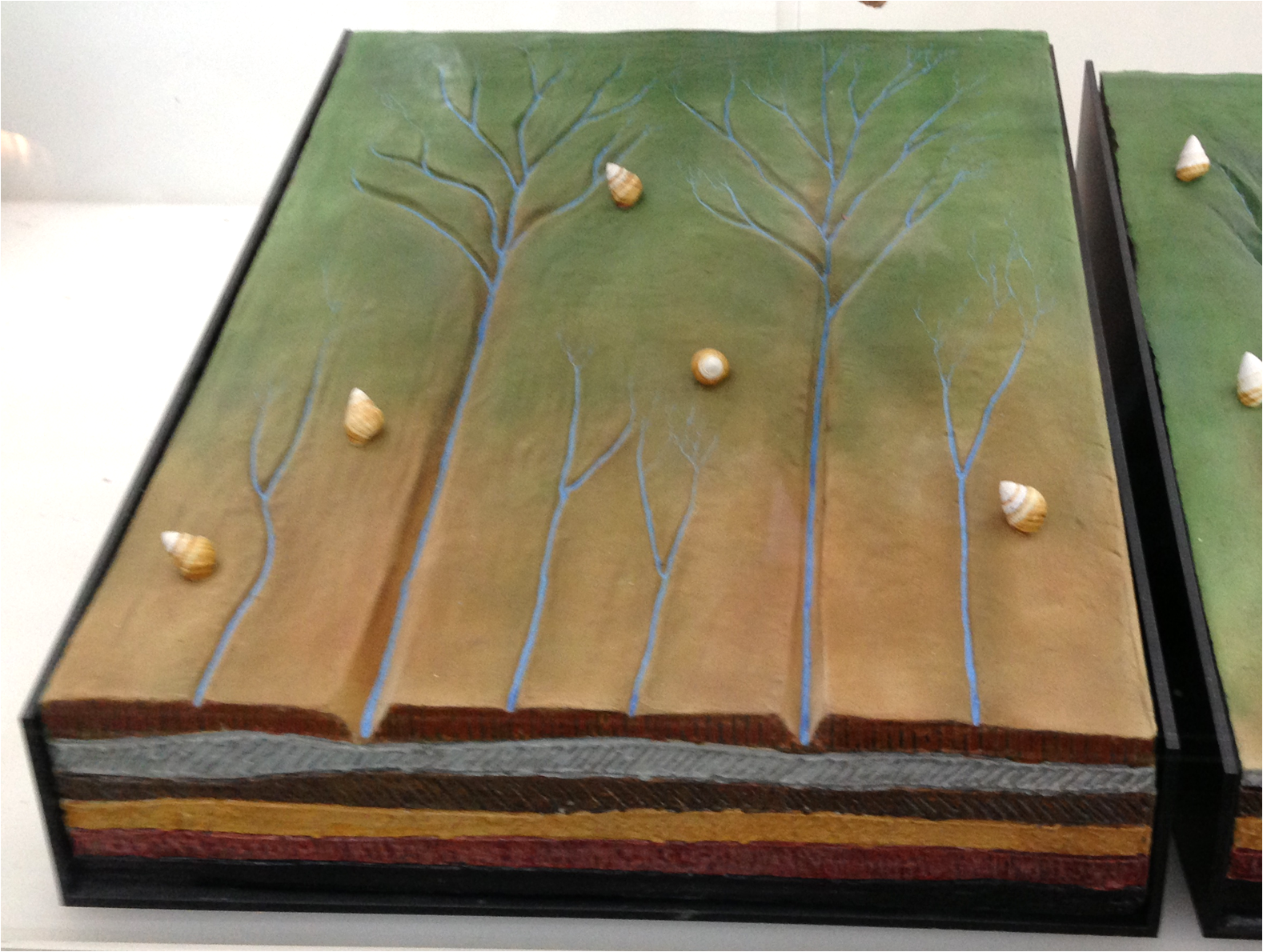
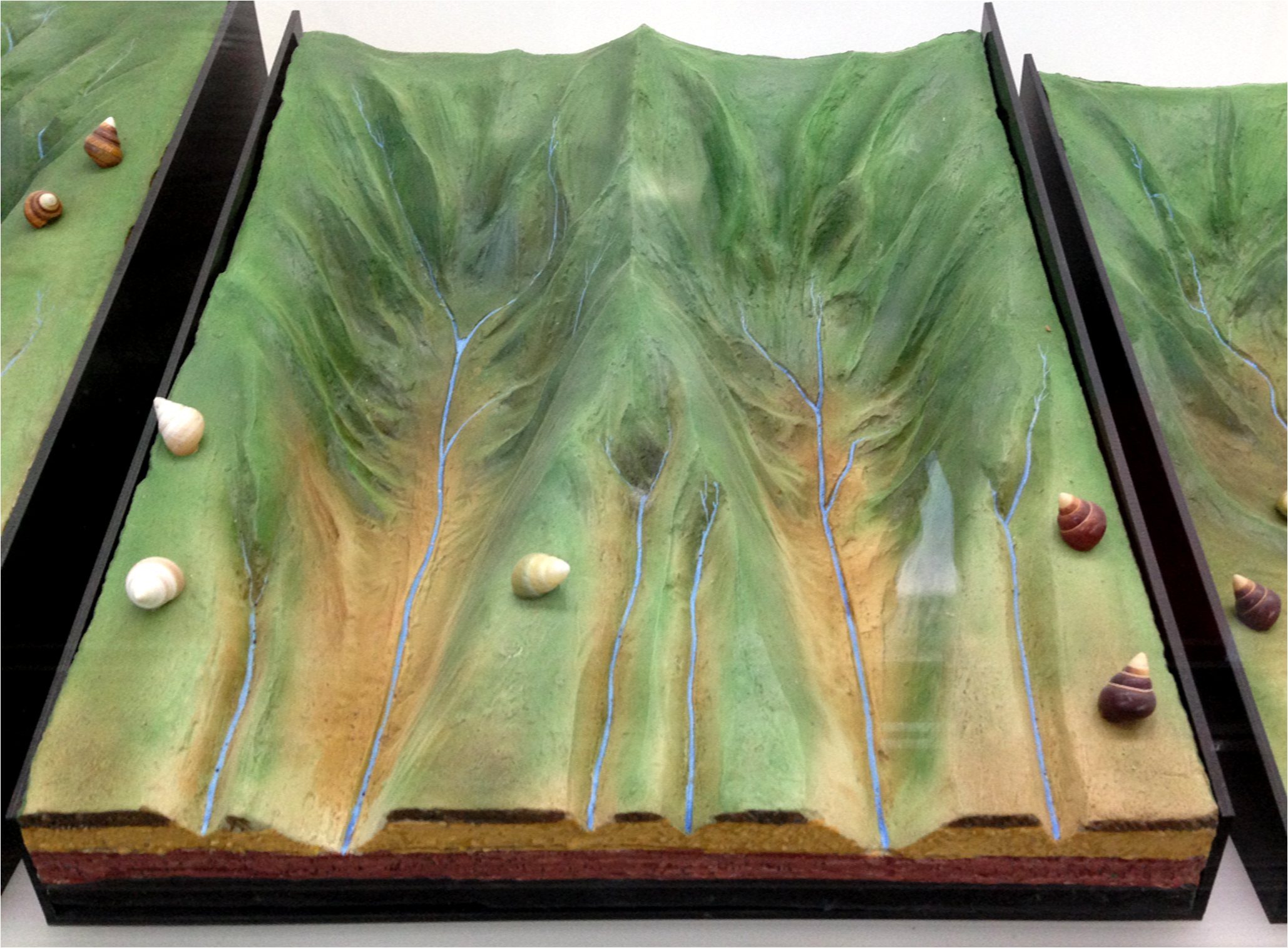
A - Achatinella spp evolution Hawaii - Photo G-Paz-y-Mino-C 2016

Above: Great didactic model (A) of Achatinella spp. snail evolution in Hawaii: “giant” introduction (for kids).

B - Achatinella spp evolution Hawaii - Photo G-Paz-y-Mino-C 2016

Above: Model B of Achatinella spp. snail evolution in Hawaii: real snails (very small, about 2 cm, less than an inch).

C - Achatinella spp evolution Hawaii - Photo G-Paz-y-Mino-C 2016

Above: Model C of Achatinella spp. snail evolution in Hawaii: real snails.

D - Achatinella spp evolution Hawaii - Photo G-Paz-y-Mino-C 2016

Above: Model D of Achatinella spp. snail evolution in Hawaii: real snails.

E - Achatinella spp evolution Hawaii - Photo G-Paz-y-Mino-C 2016

Above: Model E of Achatinella spp. snail evolution in Hawaii: real snails.

Achatinella spp snail diversity Hawaii - Photo G-Paz-y-Mino-C 2016

Above: Outcome F of Achatinella spp. snail evolution in Hawaii: real snail diversity (40+ species).

Wooden slit drums of Vanuatu Bishop Museum Honolulu - Photo G-Paz-y-Mino-C 2016

Above: Wooden slit drums of Vanuatu represent Hawaiian ancestors and ancestors’ voices. Bernice P Museum, Honolulu.

Plumerias Koko Bot Garden Oahu - Photo G-Paz-y-Mino-C 2016

Above: The beautiful Plumerias at the Koko Crater Bot Garden, Oahu, Hawaii.

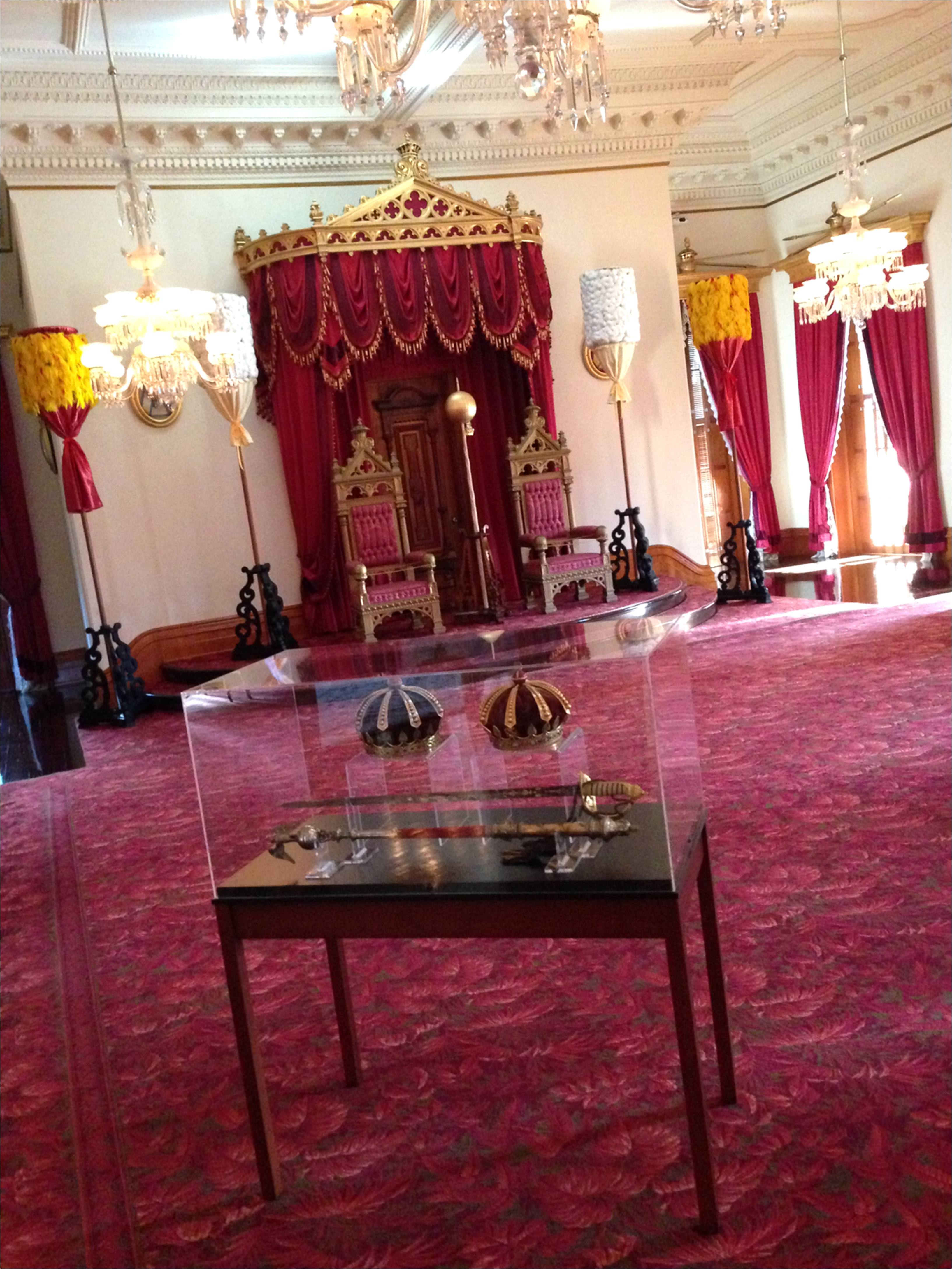
Iolani Palace Honolulu Hawaii - Photo G-Paz-y-Mino-C 2016

Above: The majestic Iolani Palace, Honolulu, Hawaii.

Iolani Palace Red Room Honolulu Hawaii - Photo G-Paz-y-Mino-C 2016

Above: Iolani Palace, the Red Room, Honolulu, Hawaii.

Iolani Palace Red Room close up Honolulu Hawaii - Photo G-Paz-y-Mino-C 2016

Above: Iolani Palace, close up of the Red Room, Honolulu, Hawaii.

Sausage Tree Campus UH Manoa - Photo G-Paz-y-Mino-C 2016

Above: “Sausage Tree” (looks like a giant tamarindo, although distantly related to the latter). In the genus Kigelia sp. (from Africa). Each fruit can weigh up to 15 pounds. I found this one at the University of Hawaii Manoa.

The Forest Tree Koko Bot Garden Oahu - Photo G-Paz-y-Mino-C 2016

Above: The forest at the Koko Botanical Garden, Oahu Island, Hawaii.

The Forest Koko Bot Garden Oahu - Photo G-Paz-y-Mino-C 2016

Above: The forest at the Koko Botanical Garden, Oahu Island, Hawaii.

The Forest Giant Cactus Koko Bot Garden Oahu - Photo G-Paz-y-Mino-C 2016

Above: The forest at the Koko Botanical Garden, Oahu Island, Hawaii.

The Cactus Section B Koko Bot Garden Oahu - Photo G-Paz-y-Mino-C 2016

Above: The forest at the Koko Botanical Garden, Oahu Island, Hawaii.

Pachypodium Koko Bot Garden Oahu - Photo G-Paz-y-Mino-C 2016

Above: Pachypodium (native to Madagascar) at the Koko Botanical Garden, Oahu Island, Hawaii.

The Cactus Section at Koko Bot Garden Oahu - Photo G-Paz-y-Mino-C 2016

Above: The impressive cacti at the Koko Botanical Garden, Oahu Island, Hawaii.

Ukuleles four Hawaii - Photo G-Paz-y-Mino-C 2016

Above: My ukuleles, the first one is a Mele from Maui (the box is built on mango wood); second, a miniature Kanile’a from the Big Island (koa wood); third is s DeVine from Oahu (mostly koa wood); and the last one is a tenor Kanile’a (koa) also from the Big Island.

Sunset Light House B&W Honolulu - Photo G-Paz-y-Mino-C 2016

Above: Evening in Honolulu – I don’t like sunsets much, but occasionally it is fun to play with an amateur camera and a lighthouse.

Sunset Sailing Boat House Honolulu - Photo G-Paz-y-Mino-C 2016

Above: Oahu sunset, Hawaii.

USS Arizona Memorial Pearl Harbor Hawaii - Photo G-Paz-y-Mino-C 2016

Above: USS Arizona Memorial, Pearl Harbor, Hawaii.

Related Posts:

Mauna Kea Telescopes to Sink in the Pacific

The Art Of Nature: Sculptures Of Dinosaur Tracks and Traces

By Guillermo Paz-y-Miño-C PhD — © 2015

New England Science Public – An Initiative for the Public Understanding of Science – on Twitter @gpazymino@EvoLiteracy – Facebook – ResearchGateAcademia.edu

An Amazing Museum in the Heart of Massachusetts

[click on subtitle to be redirected to The Standard Times]

“…Edward Hitchcock’s collection of fossilized tracks and traces of dinosaurs is one of the largest in the world and the Beneski Museum of Natural History exhibits them as fine art, carved by nature… Under soft lighting, a saturation of textures emerges from or deepens into the flat rocks. The 200-million-year-old footprints are so exquisite…”

Anchisauripus and Grallator tracks - Photo G-Paz-y-Mino-C Beneski Museum 2015

Cast of Anchisauripus and Grallator tracks at the Beneski Museum of Natural History – Photo GPC

The United States houses the world’s best exhibits of natural history. From the Smithsonian National Museum in Washington D.C., which opened in 1910 and now cares for 126 million specimens (the largest collection ever), to smaller local displays of high quality, like the University of Nebraska State Museum, in Lincoln (85,000 specimens catalogued since 1871). Its “Elephant Hall” and skeletons of the North American megafauna —which vanished 5,000-10,000 years ago— are spectacular.

Beneski Earth Sciences Building - Photo G-Paz-y-Mino-C 2015

Beneski Earth Sciences Building – Photo GPC

But my latest encounter with fossils just happened at the Beneski Museum of Natural History in Amherst College, where precious casts of dinosaurs’ footprints are showcased as fine art, sculptured by nature. An award-winning facility (for its architecture), the Beneski Earth Sciences Building (2006) blends a permanent exhibit for the public with a research collection of 200,000 objects available to scholars and students, and the teaching labs.

I returned to inland Massachusetts attending an invitation to present a seminar at the UMass Amherst Graduate Program in Organismic and Evolutionary Biology. A privilege to reach an audience of 70, including faculty, postdocs and graduate students, and discuss with them my research on acceptance of evolution. Professor Jeffrey Podos, the host, organized a visit to the Beneski Museum during my two-day stay. What a treat.

“…More than feeding the public’s dinosauria-frenzy, the goal of the Museum is to educate about the geology and paleontology of New England by taking advantage of the fossils’ beauty…”

Although the collection of dinosaur tracks is the main treasure guarded by the Beneski Museum, its 1,700 objects on display for the general public are, not only introductory for what the visitor will experience once face-to-face with the fossilized footprints, but also cleverly distributed in three floors within the building’s brick, steel and glass structure. More than feeding the public’s dinosauria-frenzy, the goal of the Museum is to educate about the geology and paleontology of New England by taking advantage of the fossils’ beauty.

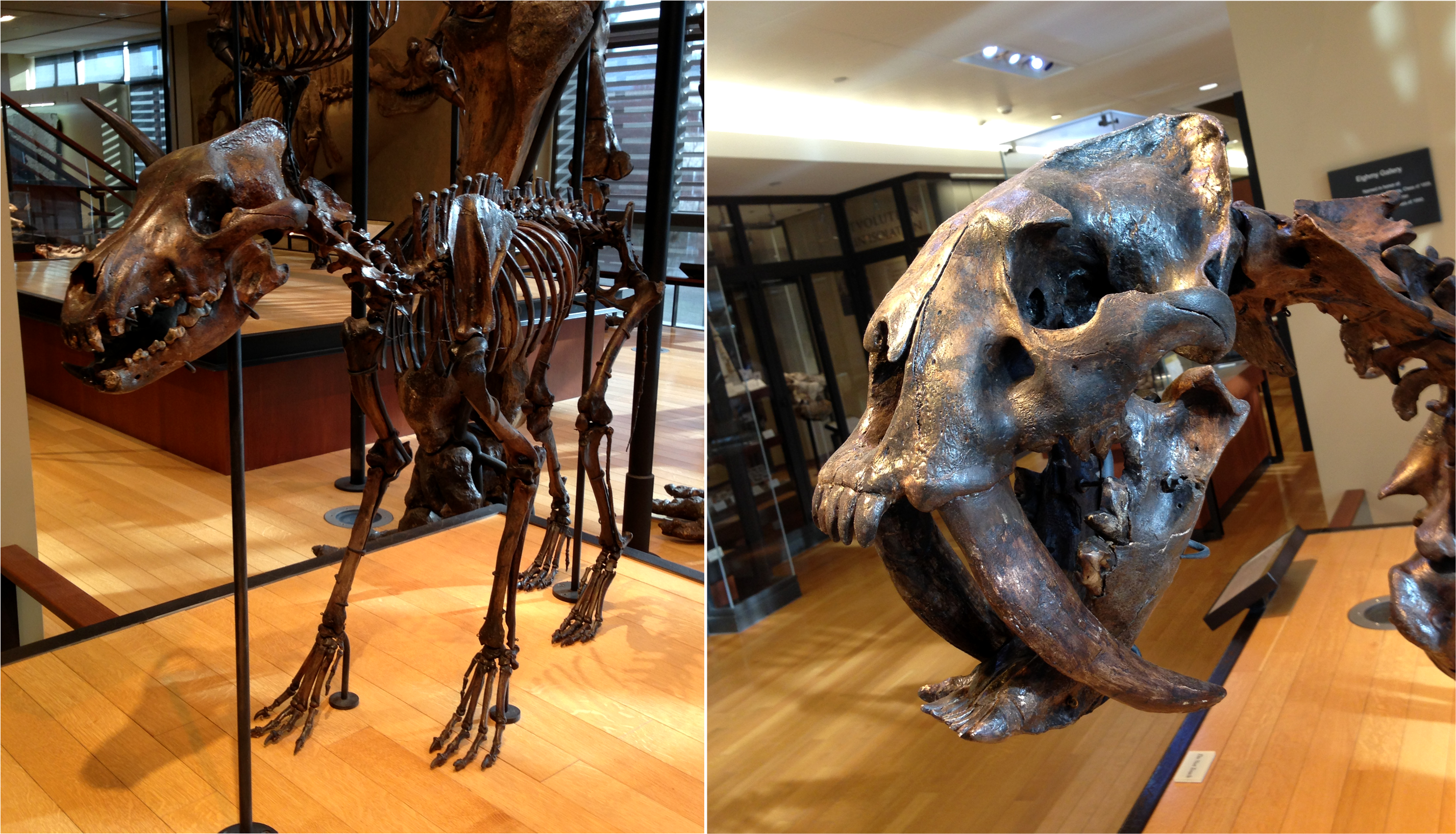
Dire wolf and Sabertoothed Cat - Photo G-Paz-y-Mino-C Beneski Museum 2015

Dire wolf (left) and Sabertoothed Cat (right) at the Beneski Museum of Natural History – Photo GPC

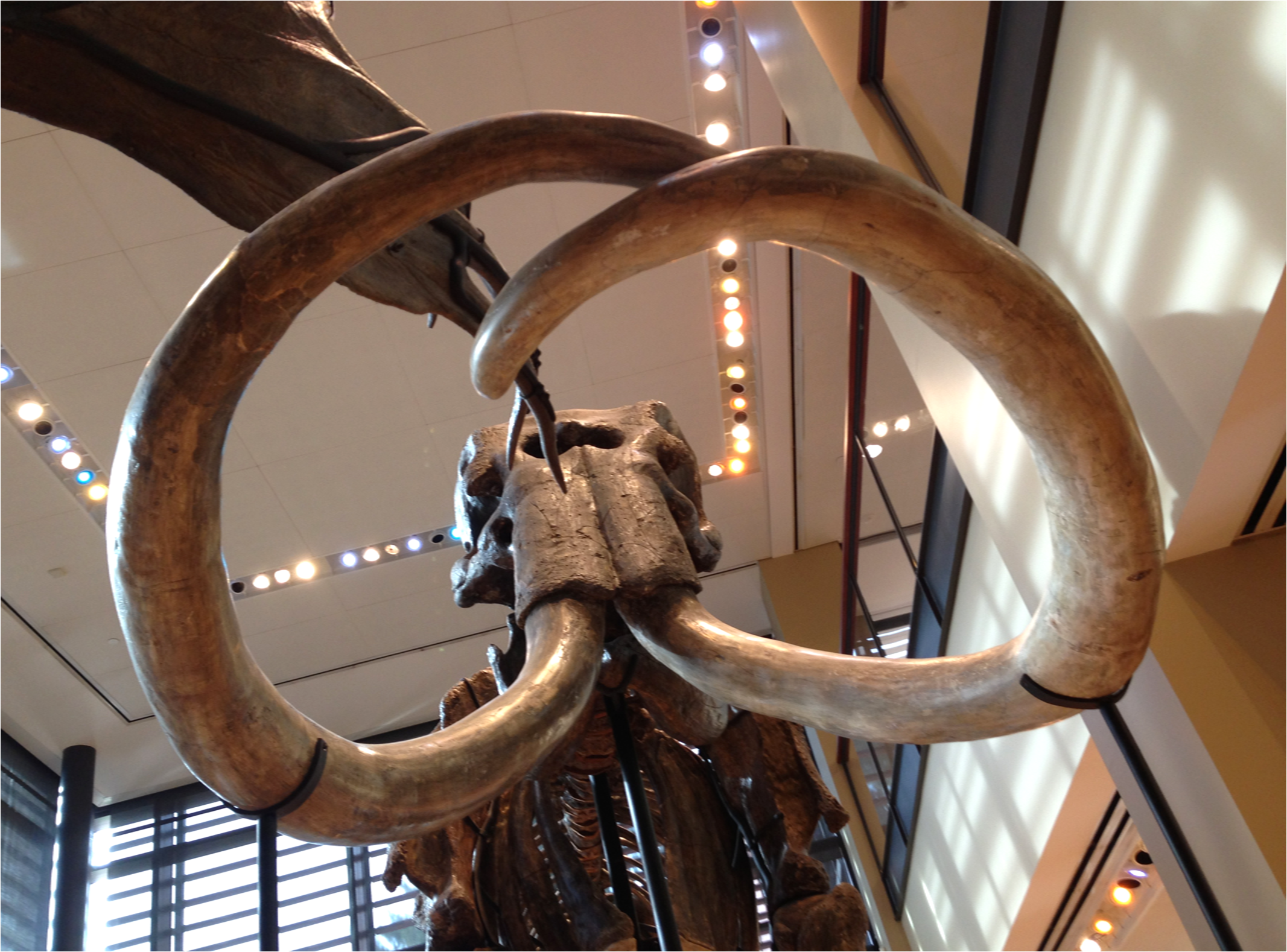
Beneski’s main hall welcomes the visitor with gentle, almost unpretentious bone casts of a dire wolf and a sabertoothed cat (both roamed 100,000 years ago). Behind them, however, enormous skeletons of a mammoth and a mastodon capture all the attention, to the point that the wolf, cat, and the soon-to-be-seen cave bear and Irish elk appear small in contrast to the tusks protruding out of the proboscideans‘ (elephants’) skulls.

Mammoth and Mastodon - Photo G-Paz-y-Mino-C Beneski Museum 2015

Mammoth and Mastodon at the Beneski Museum of Natural History – Photo GPC

This floor includes two more displays. The evolution of the Equids (horses), which took place almost entirely in North America, from ancestral forms of dog-sized quadrupeds, which over 50 million years —since the Eocene— gradually increased in mass, decreased in the number of toes —from 5 to 3 and to the single middle digit on which modern horses gallop— and changed their diet from browsing to grassing, as revealed by their teeth. All visible traits in the fossil record and unequivocal evidence in support to Darwinian evolution.

“…Brontops was a browser shaped like a colossal rhino and with two blunt horns over the snout. On display, its cast shrinks the presence of its wall-of-fame, equally extinct hoofed companions…”

The Ungulate Wall of Fame - Photo G-Paz-y-Mino-C Beneski Museum 2015

The Ungulate Wall of Fame, with Brontops at the bottom, Beneski Museum of Natural History – Photo GPC

The last prominent display in the main lobby is of ungulates. On a wall, half of their skeletons, as seen from aside, come out as 3D sculptures mounted on the silhouettes of their flesh. The largest is a Brontothere, member of a lineage that became extinct 30 million years ago, and that was remotely related to today’s rhinoceroses, which, by the way, belong to the odd-toed mammals (together with horses and tapirs). This Brontops was a browser shaped like a colossal rhino and with two blunt horns over the snout. On display, its cast shrinks the presence of its wall-of-fame, equally extinct hoofed companions.

The Museum’s tradition goes back to the foundation of Amherst College (1821) and the hire of Edward Hitchcock, who by 1825 had left the Congregational ministry to become Professor of Chemistry and Natural History. His “Ichnology Collection” of fossilized tracks and traces of dinosaurs became one of the largest in the world and the Beneski Museum exhibits casts of them in its lower level. I counted 25 by 15 steps while assessing the tracks’ gallery. It was divided in four alleys with eight parallel displaying walls. On them, and under soft lighting, a saturation of textures emerged from or deepened into the flat rocks. They were so exquisite.

“…Footprints of early Jurassic dinosaur transients were left on muddy soils along the Connecticut River Valley. The tracks dried out, hardened and rock formed over time…”

Casts of Fossilized tracks and prints B - Photo G-Paz-y-Mino-C Beneski Museum 2015

Casts of fossilized dinosaur tracks and prints at the Wolansky Gallery, Beneski Museum of Natural History – Photo GPC – Click on image to enlarge.

Footprints of early Jurassic dinosaur transients were left on muddy soils (200 million years ago) along the Connecticut River Valley, and the geological chronology of this ancient plateau is explained in the third floor of the museum. The dino-tracks dried out, hardened and rock formed over time. Nowadays, we know they belonged to the hind limbs of bipedal species like Eubrontes (3-toes), Grallator (3-toes), Otozoum (4-toes), and the quadrupedal Anomoepus, with 5-toed forelimbs and 3-toed hind limbs.

“…As former clergyman, Hitchcock could not avoid espousing the fallacies of Natural Theology, and during his entire career attempted —and failed— to prove God’s existence in (from) nature. A dead-end path taken with his contemporaries Louis Agassiz, Richard Owen and Adam Sedgwick, who also opposed Charles Darwin’s proposal of evolution via natural selection…”

Edward Hitchcock - Photo G-Paz-y-Mino-C Beneski Museum 2015

Edward Hitchcock as carved on marble by artist Martin Milmore, Wolansky Gallery, Beneski Museum of Natural History – Photo GPC

As former clergyman, Hitchcock could not avoid espousing the fallacies of Natural Theology, and during his entire career attempted —and failed— to prove God’s existence in (from) nature. A dead-end path taken with his contemporaries Louis Agassiz (Harvard), Richard Owen (British Museum) and Adam Sedgwick (Cambridge), who also opposed Charles Darwin‘s proposal of evolution via natural selection. By 1845, Hitchcock became President of Amherst College, at times when highly educated academic administrators were still on demand. But not surprisingly, a later President, Julius Seeyle, a Reformist Pastor, prohibited, in 1877, the teaching of evolution on campus. In retrospect, Hitchcock’s Ichnology Collection —rather than his bureaucratic and creationist distractions— was destined to become the most valuable possession of the Beneski Museum.

Despite the abundance of splendid natural history exhibits in the U.S., where evolution is so creatively communicated to the public, only 40 percent of Americans —or just 60 percent of New Englanders— embrace the reality of evolution. A regrettable contradiction in a nation that continues to lead today’s most meaningful scientific discoveries. — © 2015 by Evolution Literacy all rights reserved.

Image Gallery:

Mammoth frontal view B&W - Photo G-Paz-y-Mino-C Beneski Museum 2015

Mammoth, Beneski Museum of Natural History – Photo GPC

Mammoth close up - Photo G-Paz-y-Mino-C Beneski Museum 2015

Mammoth close up, Beneski Museum of Natural History – Photo GPC

Mastodon frontal view B&W - Photo G-Paz-y-Mino-C Beneski Museum 2015

Mastodon, Beneski Museum of Natural History – Photo GPC

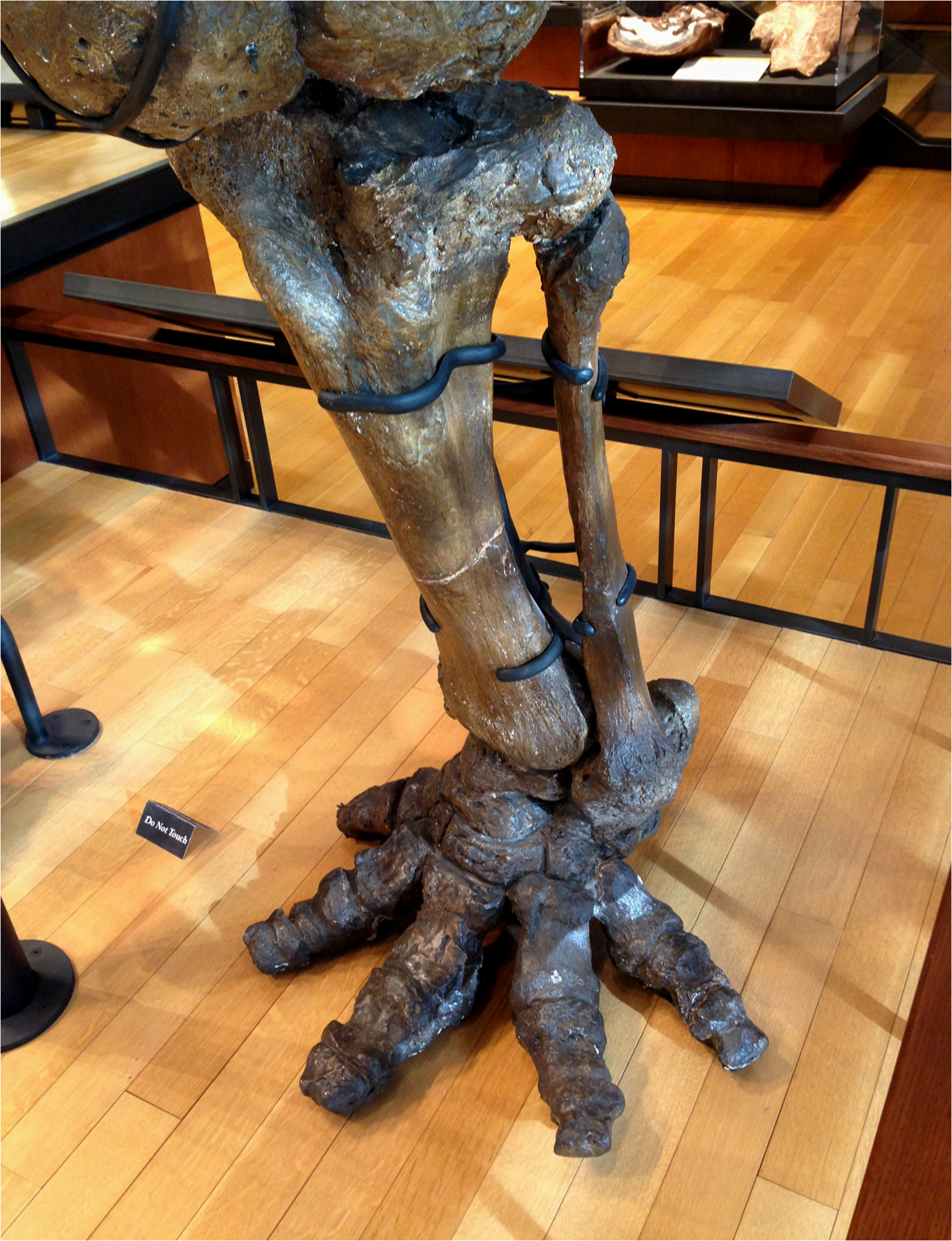
Mastodon hind leg - Photo G-Paz-y-Mino-C Beneski Museum 2015

Mastodon hind leg, Beneski Museum of Natural History – Photo GPC

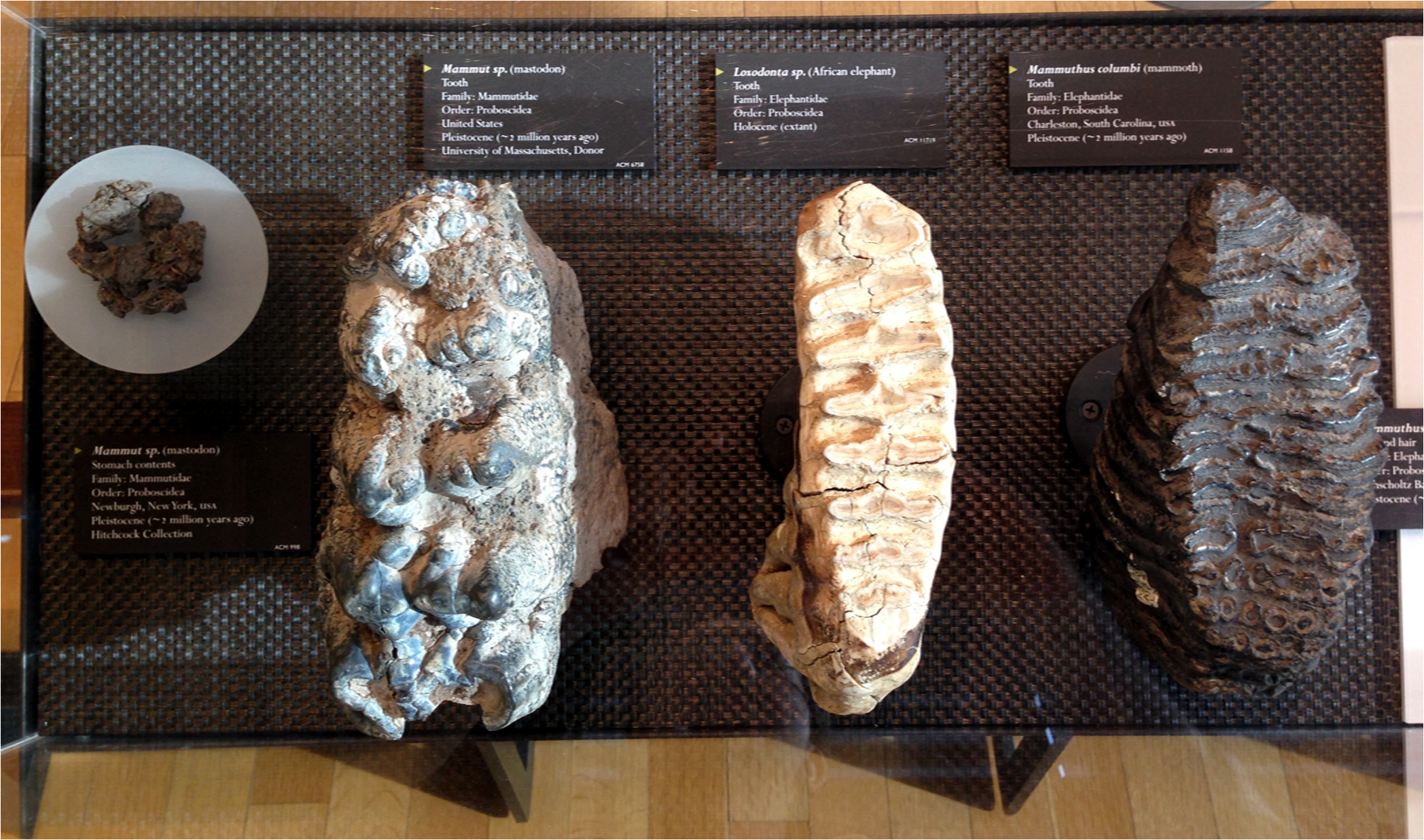
Mastodon African Elephant Mammoth Teeth - Photo G-Paz-y-Mino-C Beneski Museum 2015

Mastodon, African Elephant and Mammoth Teeth, Beneski Museum of Natural History – Photo GPC

Cave Bear - Photo G-Paz-y-Mino-C Beneski Museum 2015

Cave Bear, Beneski Museum of Natural History – Photo GPC

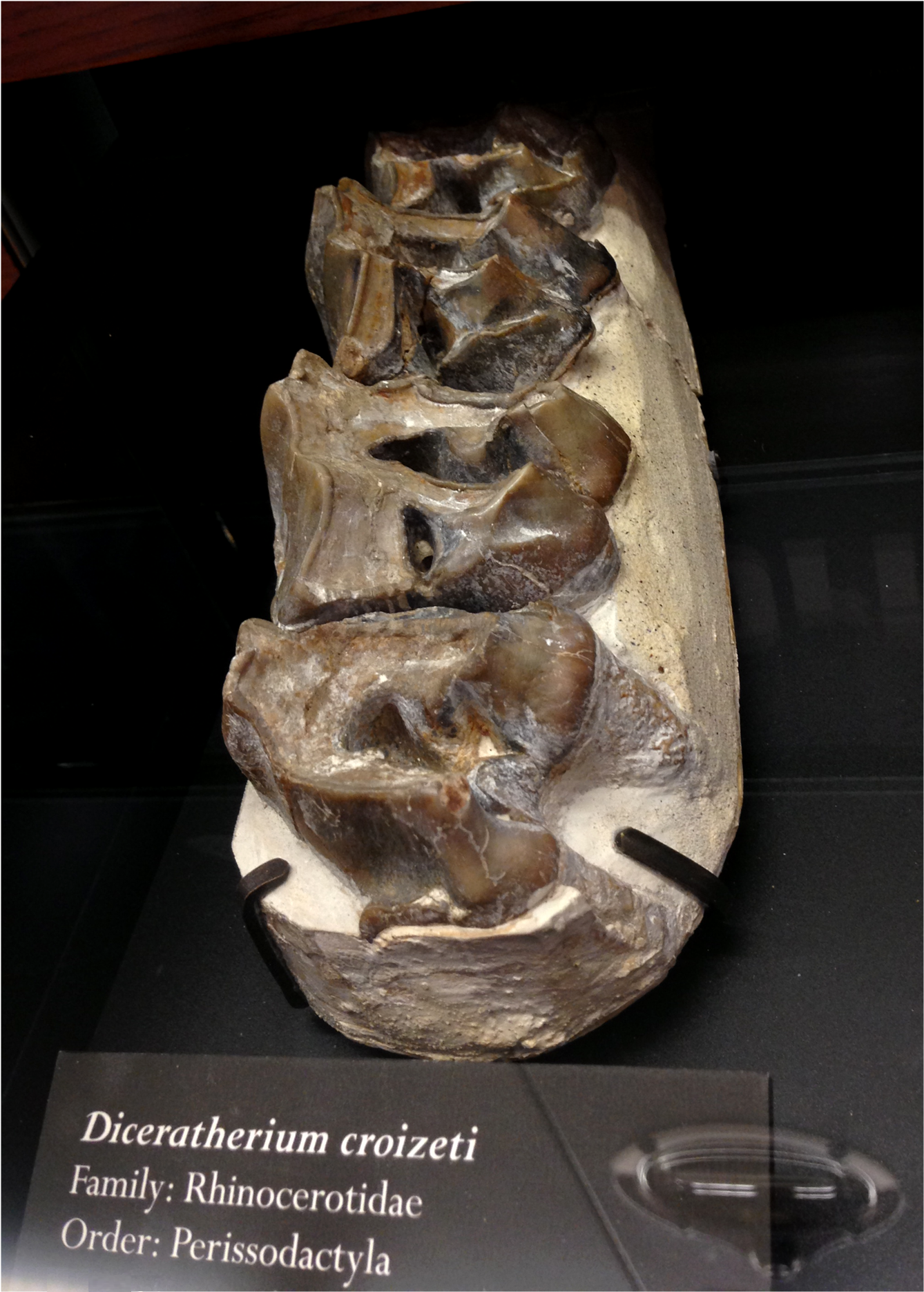
Diceratherium - Photo G-Paz-y-Mino-C Beneski Museum 2015

Diceratherium, Beneski Museum of Natural History – Photo GPC

Eryops megacephalus - Photo G-Paz-y-Mino-C Beneski Museum 2015

Eryops megacephalus, Beneski Museum of Natural History – Photo GPC

Gryposaurus - Photo G-Paz-y-Mino-C Beneski Museum 2015

Gryposaurus, Beneski Museum of Natural History – Photo GPC

Tyrannosaurus rex - Photo G-Paz-y-Mino-C Beneski Museum 2015

Tyrannosaurus rex, Beneski Museum of Natural History – Photo GPC

Tyrannosaurus rex upper jaw - Photo G-Paz-y-Mino-C Beneski Museum 2015

Tyrannosaurus rex, maxilla or upper jaw, Beneski Museum of Natural History – Photo GPC

Tyrannosaurus rex lower jaw - Photo G-Paz-y-Mino-C Beneski Museum 2015

Tyrannosaurus rex, lower jaw, Beneski Museum of Natural History – Photo GPC

Triceratops - Photo G-Paz-y-Mino-C Beneski Museum 2015

Triceratops, Beneski Museum of Natural History – Photo GPC

Diplodocus longus - limb - Photo G-Paz-y-Mino-C Beneski Museum 2015

Diplodocus longus – limb, Beneski Museum of Natural History – Photo GPC

Gastropod fossils - Photo G-Paz-y-Mino-C Beneski Museum 2015

Gastropods in the fossil invertebrate collection, Beneski Museum of Natural History – Photo GPC

Ammonites - Photo G-Paz-y-Mino-C Beneski Museum 2015

Ammonites parkinsoni, Beneski Museum of Natural History – Photo GPC

Promicroceras - Photo G-Paz-y-Mino-C Beneski Museum 2015

Promicroceras, Beneski Museum of Natural History – Photo GPC

Clypeaster - Photo G-Paz-y-Mino-C Beneski Museum 2015

Clypeaster, Beneski Museum of Natural History – Photo GPC

Phacops - trilobite - Photo G-Paz-y-Mino-C Beneski Museum 2015

Phacops – trilobite, Beneski Museum of Natural History – Photo GPC

Hominid micro exhibit lateral view - Photo G-Paz-y-Mino-C Beneski Museum 2015

Hominid micro exhibit lateral view, Beneski Museum of Natural History – Photo GPC

Hominid micro exhibit front view - Photo G-Paz-y-Mino-C Beneski Museum 2015

Hominid micro exhibit front view, Beneski Museum of Natural History – Photo GPC

Related Articles:

Hiking Among Trilobites, Ancient Whales and Dinosaurs

On Whales And A Whaling Museum

Boston’s Hayden Planetarium carries standard of scientific study

Suggested Readings: click on image for open access PDFs

Journal Book Covers Paz-y-Mino-C Espinosa Articles


EvoLiteracy News 10 26 2015

Today in EvoLiteracy News: A recent study about the authenticity of the Shroud of Turin caught my attention for two reasons. First, it was published in Scientific Reports, a science-media outlet sponsored by Nature. Second, five authors believed to have tested two “hypotheses” when, in reality, they reconfirmed –indirectly– support for an old thesis (i.e. the Medieval origin of the shroud, 800 years ago) and speculated over a historicity-based idea (i.e. that the shroud originated in Jerusalem, 2000 years ago, and it was later transported to Turin). The study is an exemplar of conceptual error, and it can be used in scientific-methodology courses to educate our students on how to avoid making similar mistakes. – Guillermo Paz-y-Miño-C

Shroud of Turin, Poor Science, and the Persistence of a Myth

I will dedicate some length to examine this study (Uncovering the Sources of DNA Found on the Turin Shroud), which falls apart by itself when attempting to combine modern DNA analysis with a silly, pseudoscience project: to find scientific evidence to justify believing in a myth. The concerning part is that five authors, Barcaccia et al., were fortunate to publish the research (October 5, 2015) in Scientific Reports, a fairly known science-communication venue.

A - Shroud of Turin 2015

Negative of the Shroud of Turin printed as positive 1898

The team examined “two” hypotheses, one scientific, the other a historicity supposition. The scientific thesis –for which Carbon dating has provided unequivocal evidence since 1988/9— is that the Shroud of Turin is a fake, a fabrication of Jesus’ body’s imprint on ordinary linen traceable to the 13th and 14th centuries, specifically to 1260-1390 (C-dating is quite accurate). The historical supposition, in contrast, suggests that the shroud must have come from the years 30 or 33, of modern times, which makes it a 2000-year-old relict. The latter has no scientific sustain. But the authors build up –in a technical report format– the argument that their molecular analyses bring support to “both” hypotheses (Medieval origin and Jesus’ timeline). This is not the case. In fact, it is impossible to merge both proposals because the shroud is 800 years old, while the Jesus-person tale –if real– is three times older. Therefore, there is an irreconcilable mismatch in time between the two views.

Readers can judge the study for themselves (at this link), but I prefer to summarize the reality of its findings –while avoiding the authors’ convoluted logic– as follows:

First, Barcaccia et al. admit that the Carbon-dating piece of evidence –a crucial element in this case– demonstrates that the Shroud of Turin originates in Medieval times (statistical confidence 95 percent). That is, we are pretty sure that the linen does not come from 2000 years ago. The shroud is one third the age it is supposed to be under the historicity hypothesis. Therefore, everything else upon which the authors speculate in the study is irrelevant. The Barcaccia et al. conjectures, no matter how the investigators spin them, are inconsistent with the Carbon-dating clock: 800 years old.

Second, the shroud is contaminated with plant material (particularly pollen, which can be detected via chloroplast DNA analysis) belonging to plant species from, almost, all over the world (see figure below). Because the shroud’s linen is 800 years old, the contamination must have occurred during recent times.

C - Shroud of Turin 2015

Plant DNA species found on the Shroud of Turin. Schematic overview of the centers of origin of plant taxa identified in samples of the shroud. Image source Barcaccia et al. 2015.

Third, the linen of the shroud is also heavily contaminated with human DNA (detected via mitochondrial DNA profiling; see figure below), which belongs to multiple individuals, from multiple ethnic backgrounds and, therefore, from multiple geographic locations (Europe, West Asia, Northeastern Africa, Arabia, Middle-East, all the way down to India –not from the Americas). Again, because the shroud is 800 years old, human contact with it must have occurred during recent times.

D - Shroud of Turin 2015

Human mtDNA haplogroups found on the Shroud of Turin. Schematic overview of the current geographical distribution of human mtDNA haplogroups and sub-haplogroups identified in samples of the shroud. Image source Barcaccia et al. 2015 (click on it to enlarge).

Fourth, and this is not a trivial finding, although the authors report it as extraneous, the shroud is also contaminated with DNA from the bird Southern Grey Shrike (Lanius meridionalis), distributed in Southwest Europe, Northern Africa, the Near East, and Southwest Asia. And also with genetic traces of a marine Nemertine worm (Cerebratulus longiceps), from the Northern Pacific Ocean (species description from Alaskan samples, 1901). Once more, as it becomes crucial to remind the readers, because the shroud is 800 years old, bird- or marine worm-DNA must have contaminated the fabric during the past eight centuries.

Fifth, despite these findings, the authors bend over backwards, put aside the age of the shroud and free fall into speculating that if we –somehow– eliminate the noise of the overwhelming DNA contamination, we can “parallel” the genetic patterns of human DNA contamination with the historical path taken by the shroud’s carriers, allegedly from Jerusalem to Turin. A sort of “spatial” retracing of the shroud’s migration. That is, an attempt to find in the genetic markers –which in reality only inform us about the diverse geographic sources of the DNA contaminants– the evidence in support for the historicity hypothesis: Hh that the linen has traveled from Jerusalem to Turin, and via human hand-to-hand (with occasional bird or marine worm intervention) along an envisioned route. And this way of reasoning –by Barcaccia et al.– is so troubling, because it is a blunt Type One Error, a conceptual violation of scientific scrutiny. It picks and chooses what type of contaminant DNA is more informative than other (when all of them are, in principle, contaminants of a cloth one-third the age it is supposed to be), in order to fit the authors’ wish to force support for the historicity hypothesis. And this is done in plain sight of an 800-year young cloth or, in fact, a fake 2000-year-old-wanna-be relic.

“…To be authentic, the Shroud of Turin must be 2000 years old. It is not. Carbon dating places it only eight centuries ago, in Europe. And there is no evidence to link the shroud to Jerusalem, and to the years 30 or 33.”

Sixth, what Barcaccia et al. seem to have found, after cleaning some of the noise in the multiple genetic contaminations (i.e. by discarding some contaminants and keeping “informative” DNA sequences) is an artifact, a byproduct effect of the spatial source of the contamination, that gives the impression of a geographic pattern of migration of the shroud (from Sacred Land to Turin). In reality, it is a pattern of the source of the contamination (not a reflection of the origin of the shroud), consistent with the history of human-worshipers’ approaches to the linen, to touch it. This actually explains the apparent absence of human DNA contaminants from the Americas in contrast to the more-likely-contaminants to be found: the people living nearby the shroud, from the years 1200-1300s onwards. And this is a more parsimonious explanation to the Barcaccia et al.‘s speculations. The authors could have just rationalized over a 2×2 table (see figure below) when designing the tests for: Medieval-origin hypothesis (spatial and temporal evidence) and historicity hypothesis (spatial and temporal evidence). In other words: Medieval-origin hypothesis (Europe and 800 years) and historicity hypothesis (Jerusalem and 2000 years). It becomes obvious that the authors cannot combine, in any manner, one hypothesis with the other because the proposals do not match in time (the time dimension). Therefore, any spatial speculation of consistency, as Barcaccia et al. propose, is senseless. More so when the spatial argument for “possible parallelisms” between hypotheses relies on the capricious use of DNA-contaminants and the exclusion of the timeframe disparity (800 vs. 2000 years). Poor science, indeed.
E - Shroud of Turin 2015 Evolution Literacy

To be authentic, the Shroud of Turin must be 2000 years old. It is not. Carbon dating places it only eight centuries ago, in Europe. And there is no evidence to link the shroud to Jerusalem, and to the years 30 or 33. A: spatial evidence for the Medieval origin hypothesis vs. the Historicity hypothesis; European art techniques used to fake the shroud have been confirmed vs. the genetic contaminants used to speculate that the shroud may come from the Sacred Land. B: Temporal vs. spatial evidence; radio Carbon-dating places the shroud 800 years ago, which is inconsistent with the hypothetical Jerusalem origin. C: Temporal vs. spatial evidence; the hypothetical 2000-year-old age of the shroud is inconsistent with the Medieval European art techniques used to fake it 800 years ago. D: Temporal vs. temporal evidence; the 2000 years of age required for the hypothetical Jerusalem origin of the shroud is inconsistent with the actual 800 years of age determined by Carbon-dating. – GPC

CONCLUSION: Barcaccia et al. study is another, among many, in-text acknowledgments that the shroud of Turin is a Medieval fake, only 800 years young (C-dating) and not a 2000-year-old relic (as demanded it to be in any test of the historicity hypothesis). Reality occurs in a space-time context, yet the authors chose to put time aside to facilitate survival of the historicity tale. The shroud is heavily contaminated with plant, human, bird and marine worm DNA, a phenomenon enhanced exclusively during the past eight centuries, during which the linen has had increasing exposure to people –and their debris, including critters’ goo– from Europe and nearby locations (not to mention the rest of the world). The genetic spatio-temporal mapping presented by Barcaccia et al. reflects a pattern of contamination by humans of multiple ethnicities, consistent with convergent traveling, from diverse locations, in the direction to the object, the shroud, possibly to worship it. If anything, this paper documents the spatial distribution of human contamination of the linen from likely-geographic locations. It fails to provide any evidence in support of the historicity hypothesis (due to the time dimension incongruity), and it actually strengthens the notion that the shroud of Turin is a Medieval fake. The study by Barcaccia et al. is exemplar of how far poor judgment can go, and how belief in supernatural causation disrupts, distorts, delays or stops (the 3Ds + S cognitive effects of illusory thinking) the acceptance of scientific evidence before the very eyes of the investigators, and with their own data. – GPC

B - Shroud of Turin 2015

Negatives (left and right images) of the Shroud of Turin. The cloth is about 14 x 4 ft.

VIDEO: Click on image below to be redirected to NatGeo video Remaking The Shroud, in which techniques for faking it are discussed, and some modern-technology tests shown, including UV light and 3-D imaging.

F - Shroud of Turin 2015 Evolution Literacy NatGeo

EvoLiteracy News 10 21 2015

Breaking News – New Species of Galapagos Tortoise is Identified

Sorry for the introductory drama. Today, my pick for EvoLiteracy News includes a study just published -hours ago- in PLoS ONE. A characterization of a distinctive lineage of Galapagos Giant Tortoises. The study is rich in data; below I summarize its major points. Enjoy! – GPC

C - New Sp Galapagos Tortoise Chelonoidis donfaustoi PLoS One 2015

The two populations of Galapagos tortoises in Santa Cruz Island apparently belong to separate species. Click on image to enlarge.

First, the discussion over the “correct genus” of the Galapagos tortoises has been vivid since 1914, with three justified proposals: Testudo (14 species: 1914), Testudo elephantopus (all subspecies, 1955), Geochelone (as genus, 1957) and Chelonoidis (as sub-genus of Geochelone, 1957). The latest proposal is that all sub-species (13 or 14), or valid biological species, should be placed within Chelonoidis (2006), as legitimate taxa (the problem with Geochelone is that it seems to be polyphyletic, a fancy word to imply “artificial” rather than a natural group, as Chelonoidis).

Second, historic classifications of tortoise varieties based on carapace shape are informative, but taxonomically unreliable (i.e. saddleback, dome, intermediate, and unknown).

Third, populations from different islands represent independent evolutionary lineages, geographically isolated, even within islands, and are distinguishable genetically (via nuclear microsatellites).

B - New Sp Galapagos Tortoise Chelonoidis donfaustoi PLoS One 2015

The skull of the holotype (i.e. the representative specimen) used for description of Chelonoidis sp. nov. from Cerro Fatal, Santa Cruz. Click on image to enlarge.

Fourth, the new species is described for Santa Cruz Island. It belongs to a separate population (Chelonoidis donfaustoi sp. nov., from “Cerro Fatal,” estimated divergence 0.43 million years ago), genetically distinctive and only 20 Km distant from Chelonoidis porteri (from “Reserva,” estimated divergence 1.74 million years ago).

Fifth, the new species C. donfaustoi is genetically identifiable (via nuclear microsatellite and mitochondrial DNA), which suggests reproductive isolation.

Sixth, the new species has only 250 surviving individuals, which makes it one of the rarest, possibly one of the most endangered lineages of extant Galapagos tortoises.

CONCLUSION: The paper by Poulakakis et al. (total 12 authors), which was published today in PLoS ONE, is interesting and well documented. Keep in mind, however, that populations naturally –and not unusually– move, drift over time, colonize environments, become isolated, and gradually diversify (i.e. the foundation of species radiation). In this respect, the study adds specificity to our previous understanding of the Galapagos tortoises’ population genetics. It gives us additional hints about island connectivity during the  geologic past of the archipelago; for example, if we look closely into the mtDNA (mitochondrial) haplotype phylogeny of the extant and extinct tortoises, including museum specimens (below), the newly described “species” (C. donfaustoi) branches as sister taxa of the San Cristobal Island tortoise C. chathamensis, today a separate island, but likely connected to Santa Cruz in the past. Hopefully, the study by Poulakakis et al. generates support to conservation efforts (funding) of these magnificent giant tortoises. – GPC

D - New Sp Galapagos Tortoise Chelonoidis donfaustoi PLoS One 2015

Tree constructed from data including mitochondrial DNA haplotypes sampled from extant and extinct species, plus museum specimens of Galapagos tortoises. Click on image to enlarge.

F - New Sp Galapagos Tortoise Chelonoidis donfaustoi PLoS One 2015